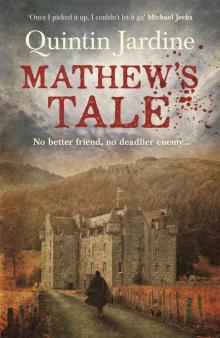
Mathews tale, p.23
Mathew's Tale,
p.23


‘I know nothing of wholesale markets, Mr Armitage. I have no idea how they work.’
‘I suppose not,’ he sighed. ‘There is worse than that. Only last Thursday, when my livestock manager drove our beef cattle and our hoggets to the slaughterhouse in Lanark, they were told there was no demand and were turned away. He made enquiries of the place in Wishaw and was told the same story. We cannot take the beasts further than that, or they would arrive in no condition to be sold. So we have them back, and not sufficient hay in our barns to feed them all over the winter. That means I will have to buy enough, yet there is little to be had, and what there is commands a premium price. So, no income from their sale, plus the added cost of keeping them until next year.’
‘But what of your poor tenants?’ Lizzie asked. ‘I see no sign here in the shop of them suffering.’
‘They sold early and received the top price; all of them, as if they had been advised to.’
‘I see.’ She looked him in the eye. ‘Mr Armitage, why are you telling me all this?’
He returned her gaze. ‘I suppose I am telling you, Mistress McGill, because it is almost as if there is a conspiracy against the Cleland Estate. Can you imagine? Yet who would do such a thing? Indeed, who could do such a thing?’
‘How would I have any idea of that?’ she countered. ‘I am only a simple village woman. But if you ask me how I would feel about such a conspiracy, if it existed, then with no animosity towards you, Mr Armitage, I say that I would welcome it with all my heart and would wish it the very best of luck.’
‘I see.’
‘I hope you do. Sir, I do not mean to be unkind, but factor or not, you are still only a servant. You served the old Laird, and very well, by every account. Now you have served both his sons, as best you could, I am sure also.’ She paused, to be sure of her words.
‘With your servant’s mind,’ she continued, ‘you are accustomed to accept, and not to question. So when Gavin Cleland and his two fine ladies said that black was white and that my David was a deranged murderer, who used my son as an excuse to excise an old grudge, you could not even consider that your master might be a liar, even though you knew my husband well.’
Armitage frowned, and was silent for a while, as if considering his response. When it came, it took her by surprise.
‘I believe you are right in what you say of me, Mistress McGill, almost all of it, but for one thing. In my mind I do not serve the baronet. I serve the Cleland Estate, and so should he, whoever he is, for his time as its custodian. The old Laird was undeniably a fine man. My experience of his sons in his place has been too short to judge, although I did think them unsavoury tykes as youngsters. However, if Sir Gavin was proved to be what you say he is, then I would be the first to wish him removed, for the sake of the estate itself.’
‘Then what do you know of the two women, whose corroboration condemned my David?’
‘I know nothing,’ he admitted. ‘However,’ he added, ‘there are some who might know a little. The Laird is absent in Edinburgh this week, as usual. I will ask the chambermaids, and see what they have to say. If it is of interest, I will tell you. Or would it be better if I told Mr Fleming?’
Chapter Thirty-Six
‘YOU SAY SO?’ MATHEW smiled, easing his chair away from the dinner table.
‘Indeed,’ Lizzie confirmed. ‘Two months ago now, he said he would question the staff who attended to the pair. It has taken him that long to get back. Indeed I had begun to think he might have made good on his jest and told you rather than me.’
‘Thon Armitage said something in jest?’ Hannah exclaimed. ‘Afore ye know it water will be flowing uphill.’
‘It surprised me also, Mother Fleming. It was a barb, but I did not rise to it. I had not seen him since but yesterday he came back into the shop, when there were no other customers, and told me the tale. It seems that Miss Smith and Miss Stout were given two fine rooms upstairs with a view out over the lawn.’
‘Miss Stout was well-housed for a lady’s maid, surely,’ Mathew observed.
‘So it seems, but even better housed than that, in fact. In the time they were in the house, four nights in all, the maids confessed that the ladies’ bedding was never disturbed.’
‘Perhaps they were considerate,’ he suggested. ‘Perhaps they made up their own beds in the morning, as I do, always.’
‘Perhaps they did,’ Lizzie agreed. ‘Perhaps they also brushed the hair off their pillows. And perhaps that hair, some fair and some auburn, was carried by the wind under two closed doors and on to the pillows of Sir Gregor and Sir Gavin, for the maids to find when they changed the bedlinen.’ She sniffed. ‘Fair and auburn hair on the pillows of both brothers, I might add.’
‘The brazen hussies,’ Hannah gasped. ‘And them no’ married!’
Mathew exploded with laughter; his mother frowned at him, mystified until the penny dropped. If the lamps had not been turned down a little, she might have seen Lizzie blush, at a memory over twenty years old.
‘Are ye sayin’ they were hoors, lassie?’ Hannah exclaimed.
She nodded. ‘Beyond a doubt. Mr Armitage also spoke to the laundress. She told him that the bedsheets had shown clear evidence of what I will only describe as “double occupancy” . . . although that might have been an understatement.’
‘They were prostitutes, Mother,’ Mathew said, his expression serious once more. ‘Frankly, I do not look down on them for that; wherever our regiment went, women like them followed us.’
‘Ye’re no sayin’ that you . . .’
‘No, Mother, I am not,’ he retorted quickly . . . and truthfully. ‘But they served a purpose. The Iron Duke tolerated them, though not in any written order; he even had the surgeons check them for obvious infection.’
‘Hmphh!’ Hannah grunted. ‘It’s as well we’re finished wir denner.’
He nodded. ‘Point taken; all I will add is that there are more ways to put a soldier out of action than blades and musket balls. Those who were found to be unclean were deemed to be agents of Napoleon, then put up against a wall and shot.’
Lizzie gasped. ‘Mathew, is that true?’
He grinned; that awkward sideways grin that signified he had been caught at something, that grin that had always melted her in their youth, and did so again even though she had not seen it since they were both in their teens.
‘No, of course not,’ he chuckled. ‘But my mother always did like a tall story, and if it has a wee bit of sauce, so much the better. Anyway,’ he continued, soberly, ‘as I was saying, I have nothing against honest prostitutes, but these women are something different. They are the lowest of the low, worse than cutpurses and pure . . .’ He had been about to say ‘gallows meat’, but stopped himself just in time.
‘Next time you see friend Armitage, tell him to keep those maids, and the laundress, in his service, and to keep them happy into the bargain. If things go as I hope, we may not need them, but if I have to, I will put them before the procurator fiscal, or even before the Lord Advocate.’
‘Oh I will,’ she murmured. ‘Worry not. He did not tell me their names, or I might look after them in the shop as well.’
‘No, it’s as well you don’t. If you show them favour, it could work against us.’ He rose to his feet. ‘Come and have a digestive in the parlour, and then I will drive you back to Carluke.’
‘Listen tae ye,’ Hannah laughed, ‘and yer fine words. “A digestive in the parlour” indeed,’ she mimicked. ‘Yer faither had a deep sense of humour, but if he could hae heard that, he’d hae laughed his boots aff. You go on, tho’, A’m for my bed. Good nicht, lassie. Ah’m pleased tae see ye well and oot the black claes.’
Lizzie had been a frequent visitor to Waterloo House, but only to visit David’s grave, and often Mathew had not been there. His dinner invitation had been a gesture, an exploration of whether she was beginning to move on. When Ewan Beattie had brought her, leaving Matt in charge of his young sister, mother and son had been pleased to see that beneath her heavy cloak she wore a long blue dress and a white blouse with a high white collar.
‘Mother Fleming is in good humour herself,’ Lizzie said, as she left them.
‘She is my rock,’ Mathew confessed. ‘She is not far short of seventy, but still looks for things to do. She was on at me yesterday about baking more than we need for here and giving you some for the shop. She said the oven here is far too big just to be serving us.’
‘Then let her. I’ll give her three-quarters of the takings.’
‘Spoken like a true shopkeeper.’
‘As now I am. Which reminds me of something I was going to tell you. Old Macgregor, the butcher from Lanark, approached me this week, with a proposition. He wants to supply me with meat, sausage, black pudding and the like, the kind of produce folk have to go to Lanark to buy for a treat. He had been thinking of opening a shop in Carluke, but since there are none available, he came to me.’
‘Could you accommodate it?’
‘With a little adjustment and perhaps a partition to separate butchery from the rest of the shop.’
‘How would you keep it fresh, though?’
‘Believe it or not, there is an old ice house behind the building, a deep cellar below the back boundary wall. The loch’s on the other side, remember. Matt cleaned it out and I’ve been using it. That would serve.’
‘Are Macgregor’s prices acceptable?’
‘They are to me.’
‘Then why not try it. I’ll pay for any alteration you need.’
‘I can do that myself,’ she replied proudly. ‘And I can start paying you rent now.’
‘Ten pounds a year,’ he said, ‘payable annually in arrears.’
‘Mathew,’ she protested, ‘that’s nowhere near enough!’
‘It is for me. Pay me that or pay me nothing.’
‘In that case, thank you. You are far too good to me.’
‘Nowhere near good enough. I’ll start being that when Gavin Cleland has been paid in full.’
‘Mmm.’ Lizzie pursed her lips. ‘What is Armitage’s game, do you think?’
‘Survival. He told you, the estate is his life; he knows that change is coming and he is worried that it will sweep him away.’
‘And will it, do you think?’
‘Well,’ he replied, after a while, ‘when a man is as loyal, and as capable, as he is, I would think twice about throwing those virtues away. The estate’s present misfortunes are beyond his control. However,’ he added, ‘Philip Armitage’s future will not be decided by me.’
Chapter Thirty-Seven
IT WAS TWO DAYS after Lizzie’s visit to Waterloo House for dinner, on a Wednesday, that Mathew was summoned by Paul Johnston.
He had spent much of that time thinking of the future; his own and hers. Less than half a year had passed since David’s death, and he was still able to think of her as his friend’s wife. But the intimacy of that dinner table, and its humour, had been a reminder of former days, and since then he had felt his resolve beginning to soften. He strengthened himself by thinking of Margaret, something he had done infrequently since the summer tragedy had exploded upon them all.
The day before he had ventured into Carluke cemetery to visit her grave. He was pleased to find it well tended, with a clematis planted on one side and a winter jasmine on the other. The same flowers grew where David lay and so he knew who the carer was, and cursed himself for his own neglect.
‘Please call on me at your earliest convenience,’ Johnston’s note read. ‘There have been developments in the matter of Sir G.’
By Thursday afternoon, he was in the Waterloo Hotel, he and Beattie in the same two rooms they had occupied in June. As soon as they were settled in, he set off for Hanover Street, taking the coachman with him. ‘You were in at the start of this journey, Ewan,’ he said. ‘Come a little further with me.’
Johnston had just returned from court when they arrived. ‘How are things in Parliament House?’ Mathew asked him.
The solicitor smiled. ‘They are interesting. Edward Cooper may be a dull man, but he is proving to be an excellent Lord Advocate, and is keeping a healthy distance between himself and the Bench. He and the new Lord Justice General seem to have reached an accommodation. Bellhouse has been banished, effectively, from the High Court and now sits only on civil cases in the Court of Session. There, at least, any damage the malevolent old swine does cannot be fatal. He will not put on the black cap again.
‘In the High Court, there will never be another rush to judgment. Cooper has introduced new rules which say that a prisoner must be indicted within three months, but must be given at least three weeks to prepare his defence. Innes tells me that some of his brethren in the Faculty are calling it the “McGill Rule”. Our unfortunate client’s case has acquired some notoriety, although his conviction is still generally accepted as just.’
‘How is Innes?’
‘He does very well. He declined the offer of advocate depute, saying that he lacked experience, but he has been gathering that apace. He is an attractive proposition now, and Baird is giving him some very choice briefs . . . from which Baird benefits himself as clerk, naturally.’
‘And the Dean of Faculty?’
‘Gone. Cooper got rid of him by the simplest method of all: he elevated him to the Bench at the first opportunity.’ He smiled. ‘But none of this High Street intrigue has anything to do with my note.’
‘Then why are we here?’
‘Because, sir, the agents I employed in Edinburgh on your instruction have earned their fees. They have found three prostitutes, all of them plying their trade in the St Bernard’s Crescent house of entertainment, who have all testified that Sir Gavin Cleland was a regular client.
‘Their affidavits go into great detail. He is an energetic man, it seems, for they say that he usually prefers the company of at least two ladies at a time. His tastes are more than a little disgusting, and I will let you read of them rather than describe them. I have sworn statements also from the agents, detailing the days and times on which they followed Sir Gavin.
‘It seems that it was his regular habit to go directly from Lord Douglas’s house to St Bernard’s Crescent . . . even after the announcement last month of his betrothal to Miss Douglas.’
He handed over a folder, and leaned back in his chair as Mathew read, watching his frowns, enjoying his gasps of astonishment at certain passages.
When he finished, he was grim-faced. ‘I hope these women were well paid,’ he said.
‘Not well enough,’ Johnston replied, ‘for they were only too keen to speak to my men, for no reward at all.’
‘Earlier,’ Mathew remarked, ‘you used the past tense. Was that accident or design?’
‘The latter. The women were able to speak to the agents because two weeks ago Sir Gavin Cleland was ejected from the premises and told never to return. A cheque that he wrote was dishonoured and he could not cover his debts at the tables. Since then he has been pursuing his carnality in much poorer surroundings in the port of Leith. He takes his life in his hands down there, sir.’
‘Then let us try and keep him safe, I do not want him to wind up on the end of a knife in some dark close.’
He brandished the folder. ‘Thank you for this, Paul. Your Edinburgh men have done a good job for me. Let me have a final account for their services, and I will deal with it immediately. How of the other agents, though?’
‘Nothing yet, but the last letter I had said they were “pursuing a line of enquiry”, as they put it. I will advise you of any further news.’ He pointed at the folder. ‘You may take that with you; I had two further copies made, all signed and witnessed by an independent notary, with his seal. What do you plan to do with it?’ he asked.
‘I intend to settle my first, lesser, score, and I will take pleasure in it. I will not involve you, for your own sake, even though you might enjoy being there. There is nobody so grand that he is beyond humility.’
Johnston grasped his meaning. ‘Be careful how you tell him, though. Douglas may have lost his political power by putting on the red jacket with the ermine trim, but there are few more formidable enemies than the Lord Justice General, whoever he might be.’
‘I will step lightly, Paul, worry not. My intention is to let him see for himself the error of his ways, rather than to ram them down his throat.’
‘Then good luck. But please do not give him my regards.’ He smiled, and then his eyebrows rose, suddenly. ‘Ah,’ he exclaimed, ‘I almost forgot. Blackwood the printer called on me on Wednesday, just after I had sent you my note; he gave me a message for you, although I did not understand it. Some friends of his, he said, are anxious to speak with you.’
Chapter Thirty-Eight
‘ARE YOU SURE YE dinna want me to come in wi’ ye, master?’ Ewan Beattie asked.
‘No,’ Mathew replied. ‘I do not believe Lord Douglas would take that too kindly. But wait outside; in his position, he must have discreet guards about him, so I am putting myself in a small hazard by going in there . . . if I am admitted, that is.’
‘And if ye dinna come out?’
He checked his watch, then handed it to his escort. ‘It is seven o’clock now; if I am not out by ten, then have Mr Johnston at the court first thing tomorrow, clutching a writ of habeas corpus.’
‘What kind o’ flower is that, sir?’
‘A rare one, but very efficacious in cases of confinement.’
Leaving Beattie utterly bewildered, he trotted up to the steps to thirty-three Heriot Row and pulled the brass handle that rang the bell within. A minute later, the heavy door opened, slowly and only halfway. A uniformed footman frowned at him. ‘Yes?’ he murmured, eyeing him up and down.
‘Is Lord Douglas at home?’ he asked.
‘That would rather depend, sir.’