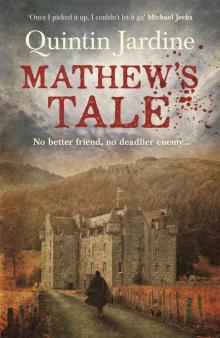
Mathews tale, p.6
Mathew's Tale,
p.6


‘As good a man as you are, you could never live comfortably here with me in this village. Nor would it be fair to Lizzie either. She will always be a good wife to you, but if I am not here it will be easier for her to forget that today ever happened.’ He paused, then added, ‘And I’m selfish enough to admit that it would not be fair to me either.’
‘No,’ McGill protested. ‘None of this was your fault. Why should you suffer?’
‘Why should anyone suffer . . . aside from Sadie Marshall. Between you and me, it’s only Lizzie that stops me from pursuing her with all the rigour of the law. The stocks?’ he scoffed. ‘Left to me, I would see her gibbeted corpse hanging in a cage and being picked at by crows, like I saw in England on my way home.’
His face formed a distorted frown. He glanced at McGill, who was shocked by his sudden candour. ‘Now you see why I must go, David. I’m not the young man who left here. I’ve seen bad men send good men to their deaths, then look on from their position of safety. I’ve seen my comrades pillage and rape, and done nothing about it.
‘I tell you, and you alone, there’s a part of me wants to cut Sadie Marshall’s throat. I hate that man but he’s been bred by war. So do not look for me in the kirk on Sunday, when she gets her verbal lashing from John Barclay, and do not look for me here again, not for a while at least.’
‘Mathew,’ McGill sighed. A hand fell on his shoulder, while the other raised the lamp to illuminate both men’s faces.
‘Look,’ Mathew continued, ‘I was all but dead after Waterloo. I suppose it was too much to expect that I’d return to a life just as it was, so I must move on, make another somewhere else. No’ too far, though; I am still a Lanarkshire man. My mother has people in Cambusnethan, near to where she was born, and that is where I will go. Her too, if she will come. I came back here with a plan for a future; it will go with me and if it works out, it will be the making of us both.
‘Never think this means that you and Lizzie are dead to me,’ he added. ‘Far from it. Life is always uncertain, even in this quiet wee place. If times change and you and she ever need my help, John Barclay will always know how to contact me.’
‘No,’ McGill said, firmly. ‘I respect your reasons for leaving, but please dinna cut yourself off from me. Write to me, let me know how things are with you. And dinna worry,’ he allowed himself a smile, ‘I will make certain that your letters reach me.’
Mathew watched him as he mounted the carriage and drove away; long after he was out of sight he stayed there, looking around at the place where he had grown to manhood, and to which he had returned, only to feel like a stranger. Finally, he shrugged his broad shoulders and went inside.
The very next day he left, to begin the life that he had been planning for almost a year, and to seek his fortune.
Chapter Nine
‘YE’ COULDNAE IMAGINE IT,’ Hannah Fleming declared, as she looked around the reception room, larger and more lavish than any she had ever seen.
‘In eleven years ye’ve come frae a Waterloo far away, tae another Waterloo here in Lanarkshire, if that’s what ye really do plan tae call it. Ah’m very proud of ye, my son.’
‘It is ironic indeed, Mother,’ Mathew agreed, ‘that two places so far apart should have the same name, with no other connection between them.’
‘And a’ this is yours?’ She touched the fabric of a large armchair.
He nodded. ‘Ours, Mother. It will be your home too.’
‘But Mathew, Ah like our wee place in Cam’nethan. We dinna need onything bigger.’
He smiled. ‘Mother, I spent six years of my life sleeping in a tent . . . if I was lucky; often enough we had to make do with the open air. I crave living space, and now that I can afford it, after eight years of hard toil, I will have it. If you want to stay in Cambusnethan, you may, but why cut off your nose to spite your face?’
‘But this house is awfu’ big, son; it’s got an upstairs, it’s got lamps built intae the wa’s, and fancy paper on them too, and five bedrooms, and rooms tae bath in. No’ tae mention places inside tae do yer business, and running water tae tak’ it away.’
‘And water heated by a boiler, Mother,’ he chuckled, ‘not a kettle, don’t forget that.’
‘But twa parlours, Mathew,’ she exclaimed. ‘Wha needs twa parlours?’
‘I do. If I choose to meet with a customer or a supplier at my home, I’ll have a private room for that purpose. The way we’ve lived until now, I can’t do that.’
‘And a’ that land,’ she persisted. ‘It’s only fine folk that hae hooses wi’ a’ that land.’
‘Wars have been fought to change that situation, Mother,’ he pointed out. ‘There is a parliament in London to change that.’
‘Aye,’ she laughed, a rarity, ‘and did ye no’ tell me that fool Captain Feather’s a member? That’s a mark o’ what that’s worth.’
‘Lieutenant Colonel Feather now; I will never forget the look on his face when I called on him on my first visit to London, and told him who I was. I told you, he remembered the letter straight away.’
She nodded. ‘And he was richtly mortified,’ she said. ‘At least he had the guid grace tae send me his apologies. What an eedjit.’
‘Victor’s a fool to you maybe, but he’s the right sort of man to have in Parliament, an ex-soldier with humanity in him, as is Wellington himself. They say that the Duke wept after the siege of Badajoz when he saw the bodies piled high. I fought with these men, and I’m glad that they’re showing interest in governing the country. And Mother, it is not a sin to have wealth. A man can be rich and righteous.’
‘Och, laddie.’ She paused, hesitated, then blurted out, ‘Are we no’ gettin’ above oor station?’
‘No, we are not,’ he insisted. ‘Mother, your days of taking in sewing are long since over, yet you do not seem to have accustomed yourself to that fact. Have I always been an obedient son?’ he asked.
‘Apart frae when you insisted on joining the army, aye,’ she conceded, ‘you have.’
‘Then obey me, for once in your life. Let me move you in here.’
She frowned. ‘If ye must. Ah’ll come and live here, as your housekeeper.’
‘No, ye’ll come and live as my mother, I have a housekeeper in mind already.’
Hannah displayed her most inscrutable smile, but said nothing. Her son hesitated, but only for a second or two.
‘We’re not above our station, as you put it, Mother. I was a common soldier not an officer, but I can tell you that those commanders who were the most respected were those that had earned their rank through hard work at the military college, rather than those who claimed it through social status. I have what I have because I’ve worked for it over the last eight years, since we left Carluke, worked just as hard as they did. I have earned it. What would you rather I did? Hide it away?’
‘Ah suppose not,’ Hannah conceded, ‘but ye must hae an awfu’ lot o’ money tae buy this.’
He shook his head. ‘No, this place did not cost as much as you think. It was built by a man called Schultz, a Prussian. He was an inventor who had come to work in Glasgow, and much of what’s in this house is of his creation. It has its own pure well and its water is pumped into the house by a steam engine, fired by a furnace in the cellar, then stored in a big tank in the loft. It also heats some of the water and stores it in a second tank up there. Whatever you want, hot or cold, it can be drawn within the house, not from a well-head outside. More than that, the heat from the furnace isn’t wasted; there is a piping system that spreads it through the rooms. Can you not you feel it?’
She pursed her lips. ‘Aye,’ she said, grudgingly, ‘it is warm in here for April.’
‘See? I tell you, the man was a genius.’
‘Then why were ye able to buy the place as cheap as ye say?’ she challenged.
‘Schultz died,’ he replied. ‘His family were all in Prussia and they instructed his lawyer in Glasgow to sell it as quick as he could. His lawyer knew my lawyer and it was offered to me, furniture and everything.’
‘How did he die?’ she asked, casually. ‘Did he bile tae death in his iron bath?’
He smiled. ‘Not exactly. He was in England supervising the building of a locomotive engine that he had designed. It exploded under pressure and he was killed.’
‘Michty! So this hoose could blow up too?’
Mathew laughed. ‘No, not a bit of it. Mother, I am not that daft. I had my own engineer check it over. It is safe, I promise you.’
‘Mmm.’ Hannah nodded. ‘A comfort. It’s no’ that clever it’ll kill us a’.’ She threw him an appraising glance. ‘It’s closer tae Carluke too,’ she observed.
‘Waterloo House is within that parish,’ he conceded.
‘So Mr Barclay’ll be oor minister again.’
‘He will be.’
‘And when we go tae his kirk we may see . . .’
‘We may. Indeed we probably will.’ He sighed. ‘Time has passed, Mother; we have all become different people. David and Lizzie are happily married . . . although,’ he paused, ‘David’s last letter had some news I wasn’t going to trouble you with. Their second child, the wee lass they christened Georgina; she died last month, of the scarlet fever.’
‘Och!’ Hannah flinched as if she had been struck. ‘Whit a thing. And after she miscarried wi’ the other one. But the boy, he’s a’ richt, aye?’
‘He’s fine, from what David tells me. They call him wee Matt, on account of John Barclay making a mistake when he put his name in the parish register and spelling it with an extra “t”. He’s a strong healthy laddie, and good at the school too, his father says.’
‘Then Ah hope they don’t make the mistake Ah did. Ah hope they send him tae Lanark Grammar. Mathew, I dinnae allow myself tae say “if only” very often, but if only I had let you go there.’
‘What would have been different?’ he asked her. ‘Father would still have died. The recruiters would still have arrived.’
‘Aye, but ye’d have been a scholar then, on your way tae bein’ a lawyer perhaps.’
‘And away to Edinburgh, like Braxfield, to be an advocate and maybe one day a hanging judge? No thank you. I put no trust in those people.’ He put his strong hands on her shoulders. ‘Mother, when I became indentured to my father, it was not only because it was what you wanted me to do. It was what I wanted to do as well. I’ve never regretted that.’
‘No?’
‘Not at all. If I was a lawyer I would still be scratching out a living. King’s Counsel at thirty-three years old? I doubt it. But thanks to my trade and my skills, I was able to design a saddle based on those I saw the French and the Spanish use, and with professional help I managed to patent it.
‘Now I have customers all over the nation, including the military. I have orders from America and from Europe, and even from France and Spain, ironically. I employ men, the most skilled men, to make them in a proper manufactory, not just one at a time in a wee workshop. I pay them good wages and I make a fortune myself. But to keep me humble, I still make my own footwear and yours . . .’
‘And Margaret Weir’s?’
His expression remained unreadable even in the face of his mother’s raised eyebrow, a gesture that was for her almost coquettish.
‘And Mistress Weir,’ he conceded. ‘She’s a friend as well as an employee.’
‘And she will be housekeeper here; am I right?’
‘That is my intention.’
‘Will she occupy the servants’ quarters?’
‘No,’ he replied, ‘one of the bigger rooms; that is my intention also.’
His mother shook her head, then lowered herself into the armchair she had admired earlier, directing her son towards the one that faced it.
‘Mathew,’ she declared, stiffly, ‘will ye please stop using such guile. The whole o’ Cam’nethan knows that ye’re sharing Mistress Weir’s bed. Well, ma cousin Elspeth does, and that’s the same thing.
‘There are some that disapprove, like that mealy-moothed auld weasel o’ a minister and his dried-out wife, who probably allows him access tae her once a year, if he’s lucky enough . . . or unfortunate enough, frae the look of her. But most folk say, “Why should they no?” when they finish their gossip.
‘Mistress Weir’s a widow woman whose late husband was a minister o’ the Kirk. You are a single gentleman of means. Indeed, ye’re seen as a catch.’
Mathew shook his head. ‘I thought Cambusnethan was big enough to allow us a bit of privacy,’ he chuckled.
‘Then ye’re a dreamer, son. There are no people more closely watched than beddable widow women, unless they be single men wi’ a bit o’ money.’
‘You’ve told me what most people say, Mother. What do you say?’
‘I say that Ah tried to bring you up tae be honourable, and Ah’m not sure ye are. If ye have feelings for this woman, ye should see that employing her and bedding her at the same time might lead the wrang sort of people tae think the wrang thing, and even to say it.’
‘Meaning?’
‘Meaning that one or two stupid, nasty people are calling her a hoor a’ready,’ she said. ‘No’ in my hearing, mind, but they are, Ah ken. If ye move her in here, what will they say? More still, if we will be goin’ back tae Carluke Parish Church, will she come wi’ us? If she does, how will that look?’
‘Should I care?’
‘Of course ye should,’ she snapped. ‘Ye could be in the next pew tae Mr McGill and his wife, with your fancy wumman. Wid that be richt? Better, much better, for you, and for Lizzie too, if she was yer wife. Mak’ her an honest woman, Mathew. She has your respect, that I dinna doubt, but she’s entitled tae the respect of a’body else.’
He sighed. ‘Very well, Mother. I’ll give it some thought.’
‘Do that, or mair folk will be saying what some are saying a’ready, that you live in hope o’ an accident or an illness befalling David McGill, so that you may slip back in where ye were before.’
Chapter Ten
MOST PEOPLE SEEING MARGARET Weir for the first time described her as handsome, rather than pretty. She had strong features and brassy red hair, a gift from an Irish grandmother, she said, and her build was solid rather than sylph-like. Those qualities underlined rather than disguised an inner strength that had drawn Mathew Fleming to her, when she had come to him seeking employment in his factory in Netherton three years before.
The interview had been brief. After she had given him her life story . . . born in Glasgow twenty-eight years earlier, to a tailor and a housemaid, educated at a parish school, married to the Reverend Samuel Weir at the age of twenty-three and widowed two years later . . . and shown him references, he had handed her a copy of Jonathan Swift’s Travels of Mr Gulliver, and asked her to read a chapter, then given her a line of numbers and asked her to add then multiply them.
Both tasks accomplished, he had employed her as a clerk, as he had known he would the moment she walked through the door. Margaret was a highly capable woman, who would be a help to his business, and more than that, he had taken an instant liking to her, as had happened occasionally in the Cameron Highlanders, when a recruit had arrived with a personality that breathed new vigour into war-tired, jaded soldiers.
Since arriving in Cambusnethan with his mother, his tools, his skills, his plans and his pony, but little else, Mathew Fleming had become a slave to constant toil. In little or no time, he had established himself as a boot and shoemaker and repairer, at prices he knew his customers could afford. At the same time he had engaged a draughtsman to produce proper copies of his plans for the new saddle that he had already begun to manufacture, and then a lawyer to secure patents for the design.
His masterstroke had been to take a gamble on the cost of a journey to London . . . by the fastest stagecoach . . . and to run to ground his former captain, Victor Feather. Not unnaturally, the officer had been astonished to see him and even more astonished to learn how his career had progressed.
Feather retained considerable influence as an aide to the Duke of Wellington, who had been as much a politician as a soldier. He arranged field trials for the sample saddle that Mathew had taken south with him, and within two months the first order had arrived, for a quantity beyond his imagination. With money borrowed from the British Linen Bank, he had equipped his factory in Netherton, close to Cambusnethan, and had watched his business grow, working on production along with his men, and ensuring that the promised quality was maintained at all times.
Soon, the Netherton Saddle, as it became known, was in demand not only by armies but by even more civilians, as word spread, by mouth but also by announcements placed in The Times of London and in the fledgling Scotsman newspaper in Edinburgh.
Mathew knew nothing but his business as it grew, and that suited him as it helped put the tragedy of his loss in Carluke out of his mind, although never out of his heart.
One of the virtues that endeared Margaret Weir to him very quickly was that she worked whatever hours he asked of her without complaint. They were close within six months, and intimate within another year, initially within the confines of a small bedroom that Mathew had equipped for himself above the factory, but later also in Margaret’s house in Gowkthrapple, a short distance from the factory.
He liked her smile. There were few lights in his life, beyond his mother, his business, and one of whom he would no longer allow himself to think.
David McGill was a faithful correspondent, as he had promised he would be, but his letters, while usually cheery, were sometimes difficult to read, as Mathew found himself searching between the lines for hidden signs that all might not be well between him and his wife.
The growth of his relationship with Margaret eased that for him. He was able to think of Lizzie, if not less frequently, in a more detached way. There had been a second significant benefit. He dreamed no longer of the last great battle and of the Voltigeur dying on his bayonet.
‘Would it offend you, Mathew,’ Margaret asked, ‘if I asked for time to think about your proposal?’