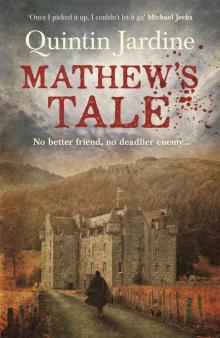
Mathews tale, p.4
Mathew's Tale,
p.4


‘Wis it a long journey home?’
‘It was, because I made it long. I left the army with only a small bounty, barely enough to get me home. And so I worked along the way. I am now a field-certified saddler and shoemaker, Mother, officially, and a man of means.’ He reached inside his shirt and pulled out his well-filled leather pouch. ‘There’s twenty-seven pounds and nine shillings in this bag, money I’ve earned in the long months o’ my journey home.’
His quick frown distorted his scar. ‘Is that man Armitage still here?’ he asked.
‘Oh aye,’ Hannah replied. ‘And so is Mr Hinshelwood, to the disappointment o’ mony that remember the quality of your faither’s work.’
‘Then I will have a conversation with the factor. He’s a practical man, as I remember. If Hinshelwood is not giving satisfaction, I’ll give him an alternative.’ He paused, and Hannah saw in his expression someone new to her; he was still her son, but more than she had ever imagined him becoming. He would never be the village laddie again, she realised, and she knew there and then that Carluke would never be big enough for him.
As if to prove it, he went on, ‘But I will never be beholden to one man for my livelihood, never again. I’ll work for Armitage, but it will be on my terms and conditions, no’ his. If he’s obdurate, I’ll go straight to Sir George. He was always a good friend to my father.’
His speech had indeed changed, as his mother had noted. He was using words that she had never heard and his accent was less country-hewn than it had been when he had left.
‘I’ve learned a lot, Mother, and most of it from the French. They use much less leather than we do, and they have less waste. Their saddle design is much better than ours, and their footwear too, but it’s the saddle that I believe can make our fortune.’
He smiled, and he was her boy again. ‘Enough of that, though. There’s someone else I must see, with no more delay. Will Lizzie be at her uncle’s shop still?’
To Hannah’s astonishment he took a pocket watch from his jacket and checked the time. ‘Aye, of course she will. Mother, I will see you at the cottage. Lead Gracie there, will you? She’s a biddable animal, and she’ll give you no bother.’ He kissed her on the forehead and turned towards the door.
‘Aye,’ she called after him, ‘but Mathew, wait on, son.’
But he was gone, seizing the astonished John Barclay’s hand in both of his, shaking it like a pump handle and bidding him, ‘Thank Jessie for the stovies,’ before rushing from the manse.
Chapter Five
THERE HAD ALWAYS BEEN a defiant streak in Elizabeth Marshall. From her earliest days, her mother had described her as a wilful girl, requiring obedience to be beaten into her, and defiance beaten out. She had gone about it wholeheartedly too, until her father had intervened.
The beatings were always inflicted in private with no witnesses, but Lizzie had gone crying to Mathew after one particularly severe thrashing, when she was six years old, and shown him the weals that her mother’s strap had left on her body. When he saw the marks on his youngest child, after being advised by Robert Fleming, Thomas Marshall had finally put his foot down, heavily, and declared that from that time on, physical punishment was a matter for him and him alone.
In the years that followed, Lizzie came to know well enough what it was to ‘wait till your faither gets home’, but when he did, whatever her transgression, the worst she ever received was a reproof. In truth those hurt as much as any beating, for she loved her father, and felt guilt whenever she incurred his displeasure.
Thomas Marshall was a self-employed carter, a solid, reliable, honest man who looked after his family well (although never quite well enough for his wife). His closest friend was Robert Fleming, not unnaturally, since he shared those qualities. Also he had great admiration for Hannah, wishing that his own wife possessed her common sense and serenity.
Thomas had never seen Sadie as a bad woman, but he had always known that she had married him for security rather than love, and that she carried within her resentment that there had been no better catch around at the time.
After all, Sadie Wright was the grocer’s daughter, and the grocer was an important man in any community. While she accepted that any sons of hers might follow their father into his occupation, she had greater ambitions for her daughter, her firstborn, and as it transpired her only surviving child. Those did not include marriage into the Fleming family. She had set her sights elsewhere, on the county town of Lanark, where there were many potential matches.
Lizzie’s friendship with Mathew Fleming dated from their fledgling years, and Sadie had never approved. As they grew, the boy was always about the house, or she was always about his, coming back with tales of helping Mrs Fleming make potato scones, oven scones, pancakes, floury dough balls and other treats that were rare in her household; everything there came from the family shop, where Sadie had a theoretical account, although when it was rendered it was for a fraction of what it might have been.
She would have banned Mathew from her premises, but Thomas would never have permitted that, since he was alehouse cronies with Robert Fleming, and so, all she could do was bite her tongue as the two children became adolescents and grew into adulthood: bite her tongue and hope.
Lizzie was aware of her mother’s pride and prejudice all along, but she would have none of it. When she went to Lanark Grammar School and Mathew did not, she sensed a wave of relief from her mother, but it amused her more than anything else. Whenever Sadie asked her if she had met any ‘nice young men’ at the school, she would play her by being coy, not answering directly, and building up false hopes with the occasional fluttering eyelash.
In fact there were no ‘nice young men’ at Lanark Grammar as far as she was concerned. They were all town mice and she was country, as they made very clear.
Not that she was bothered for a second; she and Mathew had their lives mapped out. As soon as he completed his apprenticeship, he would speak to her father, asking for her hand. There was no doubt what his answer would be, and her mother would not defy him and parade her prejudice for the whole village to see.
It all ended on the morning that Robert Fleming did not awaken from his sleep. When he went to break the news, Mathew found her in the shop. It had passed from her late grandfather to her uncle, Peter Wright, and she had gone to work there on leaving school, not as a counter servant . . . her mother would not have that . . . but as his bookkeeper, a job that needed filling, since Uncle Peter was clumsy with numbers.
She was in the small office at the back when the door opened and she saw Mathew standing there. He needed to say nothing.
‘Your mother?’ she whispered.
He shook his head. ‘No, Lizzie, ma faither. He’s gone.’
The days that followed were a blur. The funeral, Hannah’s meeting with Armitage, and the collapse of her plan to secure Mathew’s future.
‘I’ll ask my father,’ Lizzie proposed. ‘Perhaps ye could work wi’ him.’
‘No, love,’ he replied. ‘That wouldn’t do. I must look after Mother as best I can, but anything your faither could give me would be taken from somebody else. Ah maun make my own way.’
And that way of his had taken her from him. There had been tears, hers and his, when he told her about the men from the regiment. The minister had been appalled. Her father had offered, unbidden, to take him in and find work for him. But Mathew had seen no other way and she had never known him so determined.
‘Will you wait for me, Lizzie?’ he asked. ‘Seven years is a long time, Ah ken, but who knows, maybe Ah can send for you when the fighting is over.’
‘Of course I’ll wait, my love. I’ll wait until a horse trots across the top o’ Lanark Loch, if that’s what it takes.’
So he had gone. But the fighting did not end as swiftly as they had hoped; instead it went on, and on, interminably. The seat of battle moved from country to country, and there was no prospect of leave for common soldiers. Yet Mathew wrote, to her and through her to his mother.
When each letter arrived from the mail coach, she would read it alone, to make sure the news was good, then take it to Hannah . . . Mother Fleming, she called her . . . and repeat his latest story for her, even embellishing from time to time.
She read through the years and their seasons, in the cold of winter by the light of the fire and the lamp, in the dampness of spring, in the warmth of the summer . . . although there were years when there seemed to be none, only a continuous grey drizzle, until the days grew short again.
Mathew’s tales were never of fighting and war. Instead they were like a personal diary, with descriptions of his surroundings as he wrote each one, so that the two women learned of the heat and dust of Spain, of the lush green French countryside and latterly of the flatness of the Netherlands.
There was no blood in those letters. They were warm, kind and optimistic, full of hopes and dreams of a shared future that was growing closer, letter by letter . . . until without warning that future was ripped away from her.
When Mr Barclay and Mother Fleming came to see her, she refused to listen to them at first, as if not hearing the news she had read on their faces would somehow make it go away. But eventually, it came to her that her world was at an end, and she wished that she could have been a witch, so that she could curse Napoleon Bonaparte, Captain Feather, an unknown, unnamed French soldier, curse all of them to death.
She fell into mourning, and for all that had happened since, she had never stopped, and knew she never would.
Six years, almost to the day, after Mathew’s departure, she was sitting in the small office behind the shop, when the door opened.
A man stood there. He was tall, as tall as her Mathew had been, but thicker in the chest. He would have looked like Mathew too, but for a great scar that marred his fine appearance, and but for the fact that Mathew was dead. His legs were thick in his breeches and his hands were big and used to strong work; she remembered hands like those running over her body in the last hours she and her lost love had spent together, as she betrothed herself to him in the most meaningful way she could imagine.
He stood there, almost as high as the lintel of the door, looking down on her as she sat behind the desk, in her long, enveloping dark dress. And then he spoke.
‘Lizzie,’ he said, ‘my captain was a good but headstrong man, always wanting to charge too soon. He had the heart of a lion but the brains of a donkey. He never questioned a thing, and rarely got a story straight, so when he was told I was like to die, he took it as a given thing.
‘The surgeon, he was a man of certainty too, so at least he held back from burying me until he could be certain that I was quite bereft of life,’ he smiled, ‘which as you can see I never was.’
Lizzie’s world swam before her; her eyes lost all focus and she slumped forward across the desk. She was aware, but only vaguely, of him calling her name, and then of his arm around her shoulders, raising her up and pressing a cup of water to her lips.
‘There now,’ she heard him say, as she came back to full consciousness. ‘It’s all right. My face scares bairns the first time they see it, but it’s me nonetheless.’
He was crouching beside her, his one eye engaging both of hers.
‘Oh Mathew,’ she sighed, and then began to cry, great heaving sobs, of pure anguish that tore at his heart.
He pressed her against his shoulder. ‘There now, my love,’ he murmured in her ear. ‘I’m not a ghost, but flesh and blood. It took me a while to live with my scar, and with another that cannot be seen. I hope that you will too, in time, and forgive my appearance.’
‘Forgive?’ she mumbled, into the cloth of his coat. ‘Man, it’s you that must do the forgivin’.’
She eased herself away from him and stood up from her high-backed chair, so that he could see her properly as she was, her left hand with the gold ring on its third finger, and her belly, heavy with child.
Chapter Six
TO THE IMMENSE RELIEF of Peter Wright, a quiet, timid man who hated any sort of fuss or upset, Mathew and Lizzie left the shop. Together, they walked the short distance to Hannah Fleming’s cottage, in silence all the way until they came upon the pony, tethered to the gate.
‘She’s yours?’ Lizzie ventured, tentatively.
‘Yes. This is Gracie. She’s brought me all the way from France. I got her in payment for two pairs of boots for a man and his wife. She’d probably have been their family’s dinner by now if I hadn’t. They eat horses over there. In truth, they eat all sorts.’ He shuddered. ‘Even snails.’
He wondered why his mother had left her outside the garden until he saw that what was once a small green area had been dug up and planted, with turnips on one side and potatoes on the other.
Mathew had dreamed many times of the moment when he would step across Hannah’s threshold once again but never had he imagined such circumstances. Gravel chips crunched under his heels as he walked up the short path that divided what had become the vegetable patch. As he reached the door he raised his hand to knock, automatically, then corrected himself and opened it instead.
Unlike the manse, the front of the cottage faced north. Impending rain had darkened the sky and the small living room was gloomy, so Hannah had lit a lamp and placed it beside the empty fireplace. She was absent as Mathew ushered Lizzie inside, but at the sound of their entry she appeared, from the kitchen.
‘The kettle’s on the range,’ she said, as if they were ordinary visitors, ‘and there’s broth in the pot. You’ll hae things tae talk about so Ah’ll go and mak’ whatever ye’d like.’
‘Tea would be fine, Mother Fleming,’ Lizzie replied. Mathew simply nodded.
‘Sit down, Lizzie, please,’ he murmured, as his mother left them alone.
She shook her head. ‘I’ll stand for now. Mathew,’ she blurted out, heat in her voice, ‘why in the name of God did ye no’ write?’
‘I did,’ he replied. ‘As He’s my witness I did, as soon as I had recovered enough. I wrote, and after that, as often as I could, for the mail service was less frequent as we were moved around after the war had ended. Less frequent,’ he added, ‘but no less reliable, we were told.’
‘How did you come by your wound?’ she asked, her earlier flash of anger dissipated.
‘I was struck in the liver, in the last battle, by a French foot soldier, just as I . . .’ He stopped short, not ready to confess to killing another man, even in battle.
‘The surgeon told me he had never seen a man survive a thrust like that. He decided that it was either a miracle, or that the liver must be able to heal itself in some way. Being not much of a Christian he decided on the latter; I believe that I am the anonymous subject of a paper that he published in a learned journal of his profession . . . or so he told me anyway.
‘It was a close-run thing, but now I’m as strong as I ever was, apart from having no taste for liquor of any kind. Even beer makes me sick.’
‘Your liver?’ Lizzie repeated. ‘Not your eye?’
Mathew laughed, bitterly. ‘That? No, that was a scratch, by comparison. France was in turmoil after Napoleon finally fell, and we were not the most popular citizens out there. Some disaffected fools attacked us, and in the process,’ he reached up and touched his scar, ‘I was branded. The same surgeon that mended me before sewed me up a second time, then declared me hors de combat, and my colonel discharged me from my service. The last letter I wrote you was to tell you that I was about to make my way home.’
‘How long did you travel?’
‘The best part of a year,’ he told her, ‘but I worked along the way, to make as much money as I could, for Mother, and for you . . . for you and me. There was a bounty, but not much. Six years at war had left me with nothing, other than the tools of my trade, and a head full of ideas.’
Finally Lizzie sat, in what had been Robert Fleming’s chair, beside the cold hearth. ‘A year,’ she whispered. ‘Then even if ye’d come straight back, by the fastest coach, it would have been too late.’ She looked up at him.
‘It was, what,’ she frowned, ‘a year and a half after the letter that told us you were dead, that a gentleman came calling, at my mother’s invitation.’
‘Who?’ Mathew asked, impassively.
‘His name is David McGill. He’s a clerk on the Cleland estate.’
‘Davie McGill? I know him. He settled my father’s bills whenever he presented them to the factor. He must be ten years older than you and me, but I remember him as a good man, courteous. My father often wished aloud that he was the factor rather than yon man Armitage.’
‘David’s those things right enough. He’s good, he’s courteous, he’s kind, and when he asked me if I would marry him I settled for those qualities, thinking I would never know love again, thinking that you were gone.’ Her brow knitted into hard ridges. ‘Damn your mail service, Mathew!’ she snapped. ‘Damn your war!’
‘And damn me for going in the first place?’
‘Aye if ye’ like, damn you too, for leaving me!’
His eye focused on the hearth.
‘And damn me for being alive, and coming back to you?’
‘No!’ she retorted instantly. ‘Not that! I’ve prayed every night for God to be keepin’ you safe in his arms. You were my love, you are my love, but now I’m married to another man, and havin’ his child. If only one damned letter had found me in time.’
‘Maybe that was God’s doing too.’ He paused, and as she looked at him she saw a frown gather on his face, made oddly asymmetrical by his scar. ‘But as John Barclay said to me an hour or two back, that which we might think divine is usually down to human intervention.’
‘What do you mean?’ she asked.
‘Lizzie,’ he replied, ‘I have written many letters now, all to you, but I’ve never received one. How does the mail arrive in Carluke? How does it get to those for whom it’s meant?’