Mathews tale, p.16
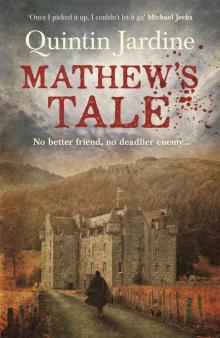
Mathew's Tale,
p.16


‘Yes, but I have no idea where that will be. I would not go back to the estate cottage even if Gavin Cleland begged us on his knees, although there is no chance of that. There is nothing within my family. When my mother died, Uncle Peter moved my cousin Daphne and her family into her house, for he owns it. He has no other property, though, other than the shop.’
‘Peter cannot continue there for much longer, surely,’ Mathew observed. ‘He is an old man now, well past seventy, and from what I hear, getting no help from your cousin, whose dog of a husband, Cleland’s gamekeeper, keeps her rushed off her feet.’
Her eyes blazed, suddenly. Across the table, young Matt seemed to stiffen in his chair. ‘Gerald Grose?’ Lizzie retorted. ‘Please do not speak of him to me. After the Sheriff’s men had taken David away, he was one of the men who threw our furniture into the street and smashed it with hammers. A kinsman of mine and yet he did that on his master’s orders. Gamekeeper indeed! A brute and a bully, that is what he is.’
‘Mmm,’ Mathew murmured. ‘I was not aware of that. Next time I see Mr Grose at the kirk, he and I will have words that he will not enjoy.’ He stared into his water glass for a few seconds, as if he was anticipating that meeting.
‘But back to your uncle,’ he continued, suddenly. ‘He has no children, apart from Daphne, who can barely run her own household, as you say. There is nobody to whom he can hand on his business, and he does not have wealth enough to be able to afford to close it and retire, although John Barclay tells me he would dearly love to do so. He has a problem, it seems.’
‘But not one that worries me too much,’ she said.
‘Why not, Mother?’ young Matt asked. ‘He is your uncle, after all; should you not be sad that he is in such a predicament.’
‘And he is your great-uncle, but does he ever treat you as such when you go into his shop?’
‘No, but why should he when you ignore him? Only my father and I go in there, you never do. As for the man Grose, when I am a bit more grown, he will pay with his teeth for what he did to us, as will everyone else who acted against my father, but your uncle had nothing to do with it, for all that you are so against him; or my grandmother either. She died when I was eight, yet I never met her. Why?’
‘Stop right there,’ Mathew told him; his voice was raised, an almost unique occurrence. ‘Your mother’s feelings towards them,’ he continued, more gently, ‘they are part of an old story, one that is none of your concern; take it from me that I understand her completely, and do not fault her for them.
‘As for your plans for Grose, you are speaking as he would himself. Out of respect for your parents, and for me, for that matter, you should be above his level. If I wanted, I could hire my own men, ex-soldiers who work for me in Netherton and Coatbridge, and have them beat the living shit . . . excuse me, ladies . . . out of the coward and those who were with him last Sunday.
‘But that would be wrong, legally and morally; moreover, it would not be sufficient. I have my own plans for those people, and what I do to them will not be something that will wear off in a week, as would the effects of a thrashing. It will be something that will be with them for the rest of their lives. So let me hear no more of such talk from you.’
He clenched his right hand into a fist. ‘You do not fight people with this,’ he paused and tapped the side of his head, just above the temple, with one finger, ‘when you can do much more damage with this. All it takes is a little patience, and that is what you must learn.’
‘And where did you learn that, ma son?’ Hannah asked.
‘From you, Mother. Where else?’ He turned back to Lizzie. ‘I have a solution to your uncle’s problem, and to yours, if you are agreeable. I believe in investing my wealth prudently, but for the good of others when I can. I know what a fair price would be for Peter Wright’s shop, as a business, and for the property. I am sure he would sell. If I bought it, would you run it for me? You helped your uncle before Matt was born, so you know how the business works. The profits would be yours, and from them you would pay me rent; your brain would be occupied and you, David, Matt and Jean would have that roof over your head.’
She stared at him. ‘Are you so wealthy you could do that?’
‘Of course,’ he laughed. ‘You have no notion of how wealthy I am.’
‘Mathew, I don’t know . . .’
‘No, you don’t, I agree. This is not a decision I expect you to make on your own, but with David, when he is released. However,’ he smiled, ‘I have a fair idea of his response.’
The idea of buying Wright’s shop had come to Mathew out of the blue, but he retired to bed that night resolved to instruct his lawyer to take the first steps towards that end.
In the morning he rose and dressed in his best black. ‘You will come to the service too, Ewan,’ he instructed Beattie. ‘After all, you did work for the Cleland family, and so it would be respectful. There is also the point that another pair of eyes in the kirk would do me no harm.’
They arrived at the church at one minute after noon, for a service that was scheduled to begin at half past the hour, but they did not go inside; instead they stood in the kirkyard in a prominent spot. Mathew wanted to be early so that he could observe the demeanour of those who attended, and also so that he could be observed himself.
Not that there were many people to be seen. All of the subsequent arrivals appeared to be estate employees, or workers on tenant farms. But one in particular attracted his attention: Gerald Grose, who arrived with his wife, Lizzie’s cousin Daphne. He remembered her from their youth; she was two years younger than him, but had not aged well. Her face was lined and there were dark, saggy bags under her eyes.
He knew the gamekeeper also; they had been classmates at the parish school. As he approached, he beckoned to him. Grose looked surprised, but he came across. ‘Mr Fleming,’ he said. ‘What can I do for you?’
‘For me, nothing,’ he replied, quietly. ‘For yourself . . . you might be well advised to seek alternative employment very far away from here.’
The man stuck out his chin, in a truculent gesture. ‘And why should Ah do that?’
‘If you do not know, then you have become an even bigger idiot than you showed yourself to be in the classroom.’
Grose flushed; he frowned. ‘I did what Ah was telt tae do by my master. Your friend McGill had just kilt his brither. His family belang in the street, and that’s where we pit them.’
‘And broke their belongings with hammers? Did your master tell you to do that also, or was that your own idea?’
‘Ah told you; we did as we were telt. Sir Gavin was righteously angry.’
‘So you obeyed his order to persecute your own wife’s kin.’
‘Lizzie McGill doesna acknowledge her folk.’
‘And you know why that is. I can see you, man, for what you are. You took pleasure in what you did last Sunday. You are a bully, Grose, a weak man and a rogue. Even so, until I heard what you did, you were nothing to me. Now you are my enemy; see how well that suits you, then take my advice. Go away from here, never come back, and never let a day go by without reflecting on the harm you did to an innocent woman and her children. You might tell your fellow cowards to do the same, for I will find out who they are and come after them.’
‘And how would ye dae that?’
‘With the full force of the law. As soon as David McGill has been cleared of this false accusation, I will have you and your cronies before the Sheriff. Are you so stupid that you think it legal to evict a family without a warrant or to destroy their property? It will probably be classed as robbery with violence, an offence that my friend the Sheriff hates. Whatever else your sentence might be, you can all expect to be baring your arses for the birch.’
Mathew’s smile was mocking. Ewan Beattie thought that he might be trying to provoke Grose into striking him, but the gamekeeper was not so foolish, or so brave, as to try. Instead he slunk back towards his wife, a voice calling after him, ‘Far away, remember. It will not stop me coming after you, but it is your best chance of keeping your hide intact.’
‘Would the Sheriff do that, sir?’ the coachman asked, quietly.
‘Be sure of it. When I saw him last Monday, it was his proposal that we swear a complaint against the men who forced Lizzie from her home.’
‘Cleland too?’
‘No. He would only plead that his rabble were over-zealous. He may also have had the right to order the eviction. I admit that I did fantasise to an extent, to gain Master Grose’s full attention.’
‘Ye succeeded, sir. Yon’s a frightened man now.’
As he spoke the hearse came into sight, an ornate affair drawn by four black-plumed horses. The two men entered the church, which was little more than half full; this was to Mathew’s pleasure. The people he recognised all had estate connections, but he saw no one who was a friend of David McGill. Peter Wright was there, though, beside his daughter and Grose, who refused to meet his gaze.
Leaving Beattie at the back of the kirk, he took his place in the elders’ pew, at the front. The organist was playing as they waited; the instrument was in good condition, since Mathew had paid for its refurbishment the year before. After a minute or so, John Barclay entered from the vestry door and stood facing the congregation. He looked strangely ill at ease, as if he wished his task done with, and quickly.
‘All rise,’ he said, motioning with his hands, and as he did so there came the sound of shuffling feet as the pall-bearers turned into the aisle.
Sir Gregor Cleland’s coffin was an ornate affair, of dark mahogany, with polished brass screws and handles and draped with red cords. The six men who carried it were all strangers to the village; Mathew wondered whether they were simply the undertaker’s assistants or whether the new Laird had thought it prudent to hire bodyguards, against any popular reaction to David McGill’s arrest and trial.
Gavin Cleland walked behind the coffin, pausing, and giving a respectful nod as it was laid on trestles before the altar, then slipping into the family pew, the front row to the right, beneath the pulpit; in it, he was alone. The factor Armitage and his wife were in the row behind, but no others sat close to him.
The service was formal; it began with a hymn, followed by prayers and after them the Twenty-third Psalm. Then John Barclay climbed slowly and laboriously into the pulpit. He had gained considerable weight since Jessie’s death, through a stodgy diet and probably, Mathew guessed, because there was no longer any restriction upon his consumption of Madeira wine.
‘Dearly beloved,’ he began. ‘We are gathered here on this most sad occasion to pay our respects to our young Laird, Sir Gregor Cleland, and to commend his blameless soul to God.’
Mathew’s one eye narrowed.
‘The Cleland family have been stalwarts of Carluke Parish for many generations,’ the minister continued. ‘They have blessed us with their munificence, they have been easy landlords and they have been generous employers. It is a very short time in the affairs of man since we gathered here to bury the good Sir George, yet here we are again, come together in grief to say farewell to his older son, and to extend our deepest condolences to his brother, who sits with us today as Sir Gavin Cleland, master of Cleland House and its estate. May God grant him comfort in his hour of despair over his great loss, and may He show him the way forward to guide his community.’
A spluttering cough came from the back of the kirk; Mathew thought he recognised Ewan Beattie’s familiar manner of clearing his throat when it was tickled by dust from the road.
With only the briefest of frowns Barclay went on. ‘It is not for me to comment on the manner of Sir Gregor’s death. The matter is in the hands of the highest court in the land and we can only wait for it to dispense justice, in all its majesty, and if it is so determined with all its final severity. Make no mistake, God demands that the guilty be punished, even if that should strike at the very heart of this congregation.’
The old cleric bowed his head. ‘There is no comfort for Carluke today. A terrible sin has been committed in our village, and we all sit in its shadow; it will only be expiated when the sinner himself rests in the ground to which we are about to commit his victim. In the name of the Father, Son and Holy Ghost, amen.’
He moved on to the final hymn, and then a benediction, before instructing the congregation to remain standing while the coffin was raised once more on to the shoulders of its bearers, to be carried outside, to the Cleland plot, for burial.
Mathew was obliged, as an elder, to attend the committal, and he was at the head of the group that followed the bearers, with the three other members of the Kirk Session. As they reached the graveside, Gavin Cleland turned and approached him. ‘Fleming,’ he said, his voice clear enough to carry to all those present, ‘there are eight cords on the coffin, but only seven of us. You will oblige me, sir, by taking the eighth.’
‘If you wish,’ he replied. He could have refused, he knew, but that would have been a public display of antipathy that he felt it would be better not to make at that time.
‘Thank you,’ the baronet murmured. ‘I will be at the head; you will please take the cord at the feet.’
The eight men took their positions, John Barclay intoned the words of committal and steadily, slowly, they lowered the coffin into the ground. As they did so, Mathew could read the inscription on the polished brass plate; ‘Sir Gregor Cleland, Bt., foully murdered, by David McGill.’
As their burden reached the ground and the cords lost their tension, he looked up and along, into Gavin’s eyes. They shone, with what could only have been triumph.
He tossed the end of his cord into the grave and stood, then walked round past three of the pall-bearers, to the new Laird. ‘Your ladies are not here, I note,’ he murmured.
‘No. My brother’s fiancée . . .’
‘Fiancée? I had heard of no betrothal.’
‘It was to be announced this very day. Poor Charlotte is distraught, too grief-stricken to attend. It was a terrible experience for us all, Fleming. I was taken completely by surprise by the suddenness of McGill’s attack and by its ferocity, I had no time to defend myself before my pistol was seized and the fatal shot fired.’
‘Aye, sure,’ Mathew replied. ‘And who is the beneficiary of this mindless violence, Sir Gavin? Not David, only you. We will see what view the court makes of it . . . if it gets that far.’
‘I am confident that it will, Fleming, and I do not fear its verdict. Within the next week, I expect to see your friend swinging, and off on his way to the anatomist’s table. Perhaps when they look at his brain they will find whatever it was that made him act so madly.’ He smiled. ‘Good day, sir. I look forward to our next meeting, under the kindly auspices of Lord Bellhouse.’ He turned on his heel and strode off towards his waiting carriage.
For his part, Mathew strode towards the minister. ‘Your eulogy, John,’ he exclaimed. ‘What the hell was that about? You know David is innocent, yet you damned him!’
‘No, Mathew, I did not,’ Barclay countered. ‘My words were very carefully chosen. The matter is with the court, and like you I have to trust that it will reach the correct verdict. As for what I know . . . well, what I know is what David told me, and that is what you know too, for you were not there yourself. You were not a witness to what happened. The only thing that you and I have seen for ourselves is that young Matt was whipped, for his face bears that out. For the rest, I have a man dead by violence, and my first duty, God’s first duty, is to him. Can you not see the truth of that?’
Mathew took a pace back, and looked him up and down. ‘All that I can see, old friend,’ he murmured, ‘is the uncomfortable fidgeting of a man who is sitting on the fence.’
Chapter Twenty-Five
‘I AM DISAPPOINTED IN our minister, Mother.’
Mathew had said nothing to Lizzie or Matt about the service, or about his encounter with Gerald Grose, but Hannah had recognised the worm that was gnawing at him and had asked him what was wrong as soon as they were alone in the garden summer house.
‘Mak’ allowances for him, son,’ she responded. ‘Ah never took him for a strong man. He’s spent most o’ his life in a quiet village wi’ nobody tae bother him but God, and wi’ old Jessie tae bolster him when he needed it and keep him off the fortified wine when he didna’ need any more o’ that. Now something terrible’s happened, almost in his front parlour, and he finds himself wi’ a duty tae both the dead and the livin’, wi’ a conflict between them. From what ye say he did indeed choose his words carefully in the pulpit, but that may have been more out of fear than what you see as disloyalty.’
He sighed. ‘You may be right. All the same, I am glad that we will not need him to stand as a character witness before the court, with the defence we propose. The last thing we will need there is any show of ambivalence.’
‘Ach,’ she laughed, ‘you and yer big words. Ah suppose it’s tae be expected, given the folk ye mix with. Deputy Lord Lieutenant Fleming, indeed; it would never do for ye tae be speaking Scots tae the King, would it?’
‘I doubt if I will ever get the chance to speak any language to him. There are many deputy lieutenants across the land, and remember, our function is to represent him in his absence.’
‘Then let’s hope there’s nae more o’ that Jacobite nonsense. Ma granny used to tell us about the forty-five rebellion. There were heids on spikes after that, she said.’
Mathew smiled. ‘I think mine is secure,’ he said. ‘Bonnie Prince Charlie died a drunk in Rome, and any new pretenders are likely to speak Italian, hardly the language in which to rally the clans.’
‘That’s better,’ Hannah chuckled, ‘mair like your usual humour. So,’ she continued, ‘ye feel the next few days will go well for David?’