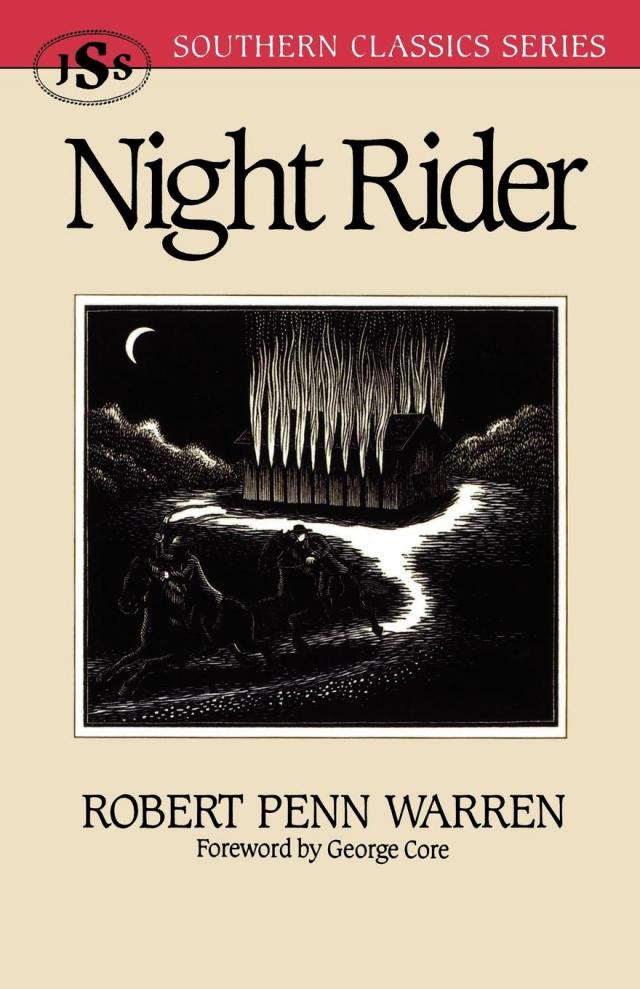
Night rider, p.11
Night Rider,
p.11


May went up the wide stairs beside the older woman, appearing smaller than ever beside her bony height. At the turn in the stairs, May looked backward fleetingly over her shoulder and gave a quick, almost shy smile, which Mr. Munn took for a good-bye. Then with the Senator he walked across the hall and the length of a long room, where a fire was burning but no one was present. ‘I thought we’d have the meeting in the library,’ the Senator was saying. ‘All the men are here now but Captain Todd. He ought to come driving up any minute. He’s going to bring his boy over. You know his boy, he’s off at college in Virginia. I think it’s Virginia.’
When they entered the library, the men there were standing around the wide fireplace, in which a log was blazing and sputtering. Mr. Munn shook hands with each of them. Then he took out his pipe and began to pack it.
‘I reckon the Captain’ll be here any minute,’ Senator Tolliver said, and walked over to look from one of the windows that gave on the long slope at the front. It was definitely snowing now, not heavily but steadily. A few flakes clung to the base of the window-panes. ‘He’s not in sight yet,’ the Senator added, and then returned to the group of men at the hearth. He stood there among them, smiling easily, his hands thrust into the pockets of his coat and his head thrown back a little. Over across the room Mr. Sills and Mr. Burden stood, cut off from the rest of the group. Mr. Burden leaned his heavy, dark, unkempt head down toward Mr. Sills, who was talking earnestly and tapping a pencil on a pad of paper which he held in his left hand. Mr. Munn packed his pipe and lit it, and then looked at the shelves of books around the room — lawbooks mostly, he guessed, and history, for the Senator had the name of an inveterate reader of history and could quote pages of Macaulay and Gibbon when he wanted to — and at the big table and the desk, and the great engravings on the wall. Then, idly, he looked at the faces of the men around him. Good men, he thought, even old Sills; good men. He rocked a little on his heels, feeling the comfortable glow of the fire on his back. He took long, deep pulls on his pipe. It was a sweet pipe.
No one had noticed Captain Todd driving up the long lane, and no one had heard the bell. A negro man opened the library door, and there Captain Todd stood, nodding his head slightly and wearing his grave smile. ‘I’m sorry I’m late,’ he said, ‘but I ain’t been on time since General Buell beat me and General Bragg to Louisville and saved our glorious Commonwealth of Kentucky for Mr. Lincoln.’ The Senator, with outstretched hand, moved quickly toward him, saying: ‘Why, that’s all right, plenty of time. Come up to the fire and warm up.’
‘Thank you,’ and Captain Todd moved around the group, shaking hands with each man. Then he stood on the hearth and spread his long, brown fingers to the vigorous blaze. ‘Right sharp outside,’ he said.
‘Where’s your boy?’ the Senator asked.
‘I put him in the other room,’ Captain Todd replied. ‘He’s reading a book he found out there, or’ — and he paused, smiling — ‘I reckon he’s reading. He claims he knows how.’
‘I’ll go speak to him,’ the Senator said. He turned at the door. ‘I’ll be back in a minute; then we can start.’
Mr. Munn looked at Captain Todd, who was still leaning toward the blaze with his fine, strong-looking hands spread out for the warmth. The brown skin was splotched a little, he noticed, and the veins across the back looked too big. He wondered if Captain Todd’s boy would be like the Captain. He did favor the Captain, he remembered, or rather he had favored him three or four years before. He hadn’t seen the boy now for some time, not since he went off to college. In Virginia, the Senator had said. That was right, he remembered, the boy had gone to Virginia to college, to Washington and Lee. Before he left, the boy had favored the Captain, tallish and cleanly put together, with blue-green eyes, like the Captain’s and a good nose. That was nice of the Senator to take the trouble to go out and speak to the boy. He was a good man, the Senator, but Captain Todd was a better. The best of the lot. But the Senator was a good man.
Before four o’clock everybody who was not going to spend the night had left. They had driven off down the hill in the steadily falling snow, the flakes settling on their shoulders and on the lap-robes and the backs of the horses. The snow had begun to obliterate the tracks of the wheels and the hoofprints of the horses, and the gray light began to fade from the sky. As they parted in the hallway of the house, the men had been full of good temper and laughter, all except Mr. Sills, who rarely if ever took more than one drink of anything. The cold and snow and the early twilight had seemed like nothing to them then.
Lounging in the library, where the fire leaped and flickered up at the deep, black throat of the chimney and the bottles sat solidly on the big silver tray on the table, they had drunk glass after glass. They had thrust their legs out before them and held their glasses in their hands and comfortably digested the turkey and ham and pudding, their conversation grave and slow at first, and then, with the warmth of the liquor, more brisk, and punctuated by bursts of deep laughter. But behind the pleasure of the hour there had been a more substantial cause for satisfaction. The secretary had reported that the Alta Company was prepared to open negotiations at the rate of nine-fifty for prime leaf, and that a private buyer was offering ten for Australian, grade A, and seven for snuff leaf, fine. The board had voted against consideration of the offers. ‘By God!’ Mr. Christian had exclaimed, slapping the top of the table with the weight of his red hand, ‘we’ve got the bastards by the short hairs! Make ’em say papa, make ’em wish they never heard about tobacco. Make ’em wish they was in the ribbon business. They’re up that old creek and ain’t got no paddle. By God’ — and he had paused to take a deep breath, like a thirsty man who has been drinking deep — ‘nine-fifty, they say! After we’ve published our price schedule, Australian, grade A, sixteen dollars; Italian, grade A, fifteen-twenty-five; spinners, fine, twelve’ — and he paused again, his breath sucking through his teeth — ‘they ain’t a thing on the schedule I don’t know in my sleep. I read it every night like old maids read the Bible, to keep their feet warm. Nine-fifty, they say! Pretty Jesus, they can’t read. But we got ’em, and we gonna give ’em hell, and you, Mr. Secretary, you write the bastards and tell ’em I said so!’
‘We’re not trying to break the tobacco companies,’ the Senator had said; and then quickly added: ‘Not that I’m trying to talk you gentlemen into accepting this offer. But we aren’t trying to break them. What we want is a fair price. Just a fair price. When they offer us that I’m in favor of doing business with them. We just want to be fair, we don’t want to gouge them ——’
‘The hell I don’t!’ Mr. Christian shouted. ‘Who says I don’t? I’d like to gouge their God-damned eyes out and feed ’em to ’em for oysters. By God, I would, and I’d pay money to do it. I’d like to cut their guts out and tie ’em in bow knots around their necks and hang the bastards on Christmas trees, for orphan children in hell’ — he had slapped the table again — ‘and if anybody here still has a hog’s eyebrow of doubt in his mind as to how I’m gonna vote on this proposition, I’ll break down and tell him. I won’t let him languish for information. I’m gonna vote no.’
‘I suppose,’ Mr. Sills had said, ‘it won’t be necessary to enter these remarks in full in the minutes.’
‘You can frame ’em, for all of me, and hang ’em over your bed,’ Mr. Christian had replied. ‘You can teach ’em to nursing mothers and small children.’
Even the knowledge that some eight hundred thousand pounds of tobacco outside the Association had moved within the past ten days did not do much to impair the confidence and pleasure of the day; nor the clipping from the paper which Mr. Sills had brought. He bought a paper when he came through the settlement above Monclair Crossing, he had said. He had carefully removed the clipping from his long slick leather wallet, which he always kept bound with three big rubber bands, and had read the item to the board. The item was to the effect that Mr. Ben Sullins, a respected tobacco farmer of the Allen Settlement section and a strong anti-Association man, had found a bundle of switches and an anonymous letter in his mailbox the morning after Christmas. ‘Attached to a bundle of willow switches,’ the clipping said, ‘was a note in childish or illiterate penmanship which read as follows: “This is whut Santy Claws brings bad littul boys whut aint got sense to keep frum running off at the mouth and holes there terbacco but dont join the Assoc.” Mr. Sullins has stated that he attaches no importance to the message and is not one to be intimidated, and the Edgerton Messenger must strongly endorse and applaud the attitude of Mr. Sullins and condemn the cowardice of those who send unsigned communications. However, Mr. Sullins has also stated that he believes the incident to be some childish prank committed by boys who have heard their parents comment on his attitude toward the Association of Growers of Dark Fired Tobacco. The Edgerton Messenger hopes that this is the true case.’
‘A childish prank,’ Mr. Burden had said meditatively, lifting his dark, untidy-looking head.
‘Now it looks to me,’ Mr. Christian had observed, ‘folks in the Allen Settlement section have got some right forward and thriving children. Bet they was born feet-first and grinding their teeth.’
‘No,’ Mr. Burden had said in his slow voice, ‘no, it wasn’t children did it. Some poor farmer had a bad Christmas. The Association is seeing folks through the best it can, but the best ain’t a whoop and a holler better’n sowbelly for most. Not for some poor man with a few thousand pounds with us. What kind of an advance can he get? Not Christmas fixings.’
‘He must think of the future,’ Mr. Sills had answered.
‘But he has a bad Christmas and there ain’t much for the kids and he catches his wife off in the kitchen crying a little and one of his kids tells him what the Sullins children got for Christmas — how the Sullins boy came down the road with a new rifle, maybe — and he figures Sullins has been selling off some tobacco to run on, and at the price made because the Association was holding out. Then he stomps off down to the barn and gets to figuring about Sullins. He gets madder and madder, and then being a complete damn fool he goes to the house and gets him some paper outer one of the children’s writing tablets and a pencil and fixes up the letter. Then he gets him a piece of binder twine outer the barn and goes down by the creek and cuts him some willow switches and after it gets dark he walks down the road toward the Sullins place and sticks ’em in the mailbox. Then,’ Mr. Burden had lamely finished, ‘he goes on back home.’
There had been a moment of silence in which the men seemed to be turning Mr. Burden’s words over and over in their minds. Then Captain Todd had broken the silence. ‘Mr. Chairman,’ he had said quietly, ‘it seems to me it don’t exactly matter who wrote the letter or why, really. It seems to me, being the board, we’ll just have to take it as done with malice aforethought and act accordingly. Mr. Chairman’ — and he had hesitated while the other men all looked at him — ‘I move that the board of directors of the Association of Growers of Dark Fired Tobacco make a statement condemning the author of the anonymous communication received by Mr. Ben Sullins and that the statement be given to all the papers of this section for publication.’
‘I second the motion,’ Mr. Munn had said.
The motion had been unanimously carried.
‘And that’s a good thing, gentlemen, in my opinion,’ the Senator had observed while the secretary was writing out the statement. ‘What the Association wants is justice, but we must have it in an orderly fashion. We do not want to see the passions inflamed.’
‘I just hate to think how easy it is to inflame my passions,’ Mr. Christian had said to no one in particular, showing his big yellow teeth in an amiable grin.
Within fifteen minutes the whole matter had been forgotten, apparently, and no one referred to it again after the reading of the board’s statement by Mr. Sills. It did not recur to Mr. Munn’s mind until late that evening when Mr. Christian, after the ladies had gone to bed, began to tell what he knew about Ben Sullins. For after Mr. Sills and Mr. Burden and the rest had left, there was no further talk of business. The Senator’s sister, Lucille Christian, and May came down, and they all sat around the fire in the long room which opened to the library. The Senator told jokes, jokes that kept everyone laughing, and yet he seemed to be doing it naturally and effortlessly, without attempting to dominate the party. But, Mr. Munn noticed, his sister never laughed, never even smiled.
She sat very upright in a small wing chair, somewhat withdrawn on one side of the fireplace. While the light died at the windows and the voices went on around her, her gaze would wander to the center of the flames. Her hands were laid palms-down on her knees, the size and boniness of the knees being somehow apparent under the folds of the black silk. She did not seem discourteous, or cold in her remoteness, her lack of attention. Rather, Mr. Munn thought, she was like a grown person who sits in the midst of children while they play. Once when May, who sat near her, spoke to her, she leaned toward her, apparently not catching the words, and said, ‘Yes, child?’ May seemed to get along with her.
But when they sat at the table that night, and the light fell more directly on her face, the hardness and the bitterness there were more obvious. Her brows were square, the cheekbones high, the mouth large-lipped but drawn into a fixed pattern of will, and the chin bony and prominent. The nose had a kind of rough aquilinity. The eyes were deep-set and slaty-blue. Her whole face was like a sculpture in some grayish stone left unfinished. He noticed her earth-colored, bony hands holding the silver or picking up a glass, and remembered how her hand had felt in his own that morning.
After the meal was over they sat again in the long room. A negro man came to put more wood on the fire. The men held glasses of whisky in their hands and took slow, careful sips. Lucille Christian, drinking a glass of port, was amiably shaking her head at her father, who had just said he couldn’t figure out why she didn’t like to be called Sukie.
‘I don’t mind the name,’ she said, ‘if you’d just save it for me.’
‘Now you see, Senator, the girl is downright selfish,’ and Mr. Christian nodded his head toward Senator Tolliver.
The girl took a sip of the wine, and explained: ‘No, it’s just that you call half the animals on the place Sukie, then you call me Sukie too. Bird dogs, cows, mares. After all, I’m your daughter, you know.’
‘It’s a good name. When you come right down to it, now, I can’t say as I know a better, not for a she-critter. And I always wanted my daughter to have the best. Yes, sir, I took one look at her when she was born and I said to my wife: “You name her Lucille if you want, but she’s a likely-looking passel and she’ll be Sukie to me. If she keeps on improving.” ’
‘Along with fifty bird dogs at one time and another,’ the girl said, ‘and the Lord knows how many hounds.’
‘Selfish,’ Mr. Christian observed, and shook his head despondently. ‘Selfish and self-centered.’
The son of Captain Todd was sitting beside Mr. Munn on a sofa. Leaning forward with his elbows on his knees, he watched Lucille Christian, whose profile was toward him, or now and then turned to glance at Mr. Munn as though he were about to say something. Mr. Munn decided that he was a good boy. He did look like Captain Todd, still did. Probably would look more like as time passed. But he didn’t have any hint of the Captain’s quality of control, of certainty. But what boy could?
‘You finish this year, don’t you?’ Mr. Munn asked the boy.
The boy straightened up suddenly, and turned to Mr. Munn, a hint of pleasure and of anxiety to please showing in his face. ‘Yes, sir, next June. Barring accidents.’ He seemed about to say more, then stopped, flushing a little.
‘Going to practice in this section?’
‘Well, you see, not until lately I didn’t think so. You see’ — the boy hesitated — ‘I was thinking about going into a man’s office in Cincinnati. A Mr. Lightfoot; he used to know Father a long time ago. He’s got a lot of railroad business and some big companies in Ohio get him to do work for them, him and his partners.’
‘Lightfoot,’ Mr. Munn said ruminatively, ‘Lightfoot.’
‘Yes, sir, Lightfoot; and the firm’s name is Hayden, Hughes, and Lightfoot. Father used to know him in Tennessee.’
‘In Tennessee?’
‘Yes, sir, in the war, I believe it was. He went up North after the war. He came down to see Father once a long time ago when I was a kid. I just barely remember him there. They still write letters off and on, or used to. Then I met him again. His boy went to Washington and Lee, too, but he didn’t take law. He’s working on a newspaper in Baltimore. I met his father again when he came down to school one time to see Mose. Mose didn’t want to be a lawyer.’
‘Getting in a firm like that, that’s got a big practice, and working up,’ Mr. Munn said, nodding, ‘that’s a good way to get a start in the law. I reckon it’s the best way, these days. But I reckon I was homesick, being away from home so long going to school and all, and then my mother died and left me the place, so I just hung my shingle out in Bardsville. Made a mistake, maybe.’
‘No, no, I didn’t mean that,’ the boy asserted vehemently, and then hesitated in obvious embarrassment. ‘That isn’t what I meant. I’m changing my mind, I guess. I don’t believe I’m going to Cincinnati like I thought. Being back this Christmas and all ——’ The sentence hung unfinished in the air.
‘You might be passing something up,’ Mr. Munn pointed out, sucking his pipe. ‘That’s where they tell me the money is. Up yonder across the river. God knows there’s not much around here.’
‘That’s not the point. Exactly ——’
‘It’s a pretty big point, a right smart of the time.’
The boy looked across the room, and Mr. Munn followed his glance. Mr. Christian was telling some tale, leaning forward with his hands on his spread knees and his arms bowed out like a bulldog’s legs. His glass was on the floor beside him. Lucille Christian was regarding her father with an air of affectionate amusement, which made Mr. Munn, for the first time, become aware of a real liking for her. The boy, he noticed, was looking at her too. Then he turned back to Mr. Munn. ‘Lucille told me — Miss Christian, that is — she told me about the first big rally when they organized the Association. I wish I’d been here last summer and heard your speech. She told me about your speech. It was wonderful, she said. She said everybody thought it was wonderful. Her father and Senator Tolliver. Everybody.’