Night rider, p.29
Night Rider,
p.29
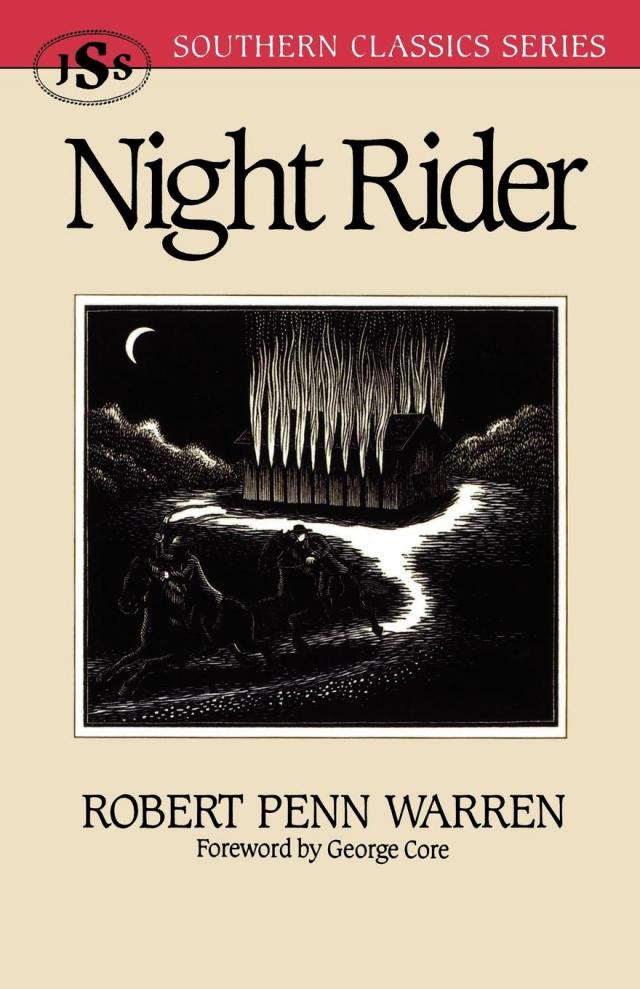


They all passed, and the lane was empty. The sound of their crunching tread died away. There was silence except for the stamping of a horse beyond the elder thicket.
Doctor MacDonald looked at his watch. ‘Mr. Burrus,’ he said, ‘it’s time for you all to be getting on to the telephone office. You’ll make it about right if you start now.’
‘Sure,’ a voice responded drawlingly. The man walked off down the lane. In a minute there was a crackling of brush down the lane, and then the sound of hoofs.
Mr. Munn wondered, idly, why Doctor MacDonald did not start. He wondered what time it must be by now. It could not be long, now. In a minute, in two minutes, they would mount, and move in. The cold had climbed past his knees, but somehow he was not really uncomfortable, and did not feel disposed to stamp his feet and swing his arms, as some of the other men had done. He felt very calm, now, very detached.
Doctor MacDonald was speaking. ‘Get the telegraph wires at exactly twelve-twenty-five,’ he said. ‘And you, Mr. Murray, you and your boys get the telephone wires on the pike at the same time. Then come in by Jefferson to Fifth. Pick up anybody loose on upper Jefferson.’
The two men moved off.
‘We’re ready,’ Doctor MacDonald announced, and turned back into the elder thicket. Mr. Munn and the three other men remaining followed him. They led their horses out into the lane, and mounted. Twenty yards or so down the lane toward the pike, they stopped, and two of the men rode into the grove, which was more open here.
‘Well, we might as well put on our fancy-dress,’ Doctor MacDonald said. He drew from his pocket a strip of white cloth and adjusted it over the lower part of his face. He pinned a white band around his left arm. Mr. Munn and the other man put on their masks.
Horsemen began to file out of the grove and proceed at a walk toward the pike. Doctor MacDonald, accompanied by Mr. Munn and the other man, trotted to the head of the uneven line. At the junction of the lane and the pike they stopped, then moved out into the pike. ‘Form them here,’ Doctor MacDonald ordered, and Mr. Munn and the other man moved back along the line, passing the word.
Four abreast the long column moved forward at a trot. The pike stretched out straight before them, its paleness distinguishable in the darkness. Down the slight slope ahead, the few lights of the town were visible. They are lights in the streets, Mr. Munn thought, and in houses; and in other houses, the houses that are dark, people are sleeping. Behind him the metal of horseshoes chinked and rang on the gravel of the pike with a steady sound.
The head of the column reached the end of the slope. There the first houses were, jumbled shacks set back in treeless yards, their gray masses undefined in the darkness. This was nigger town. In one shack a lamp was burning. Mr. Munn saw it as he rode past, and could catch a glimpse of the board table on which it sat and of the bare interior of the room, and he remembered how the wavering lamps had lighted those other cabins that night when he had hunted the knife.
‘Twelve-thirty,’ Doctor MacDonald said. ‘Burrus ought to be in the telephone office by now.’
‘Yes,’ Mr. Munn replied.
‘And the wires down,’ Doctor MacDonald added.
The column swept into a regular street. The houses, beyond the bare trees, were darkened. The street lights were out. They passed a fork in the street, where another street joined at an angle, and Mr. Munn, turning in his saddle, could dimly see that the last section of the column was diverging into the other street. It would cover, he knew, that entrance to the town.
Far away, almost lost in the sound of hoofs, there was the report of a gun. Then, immediately, a volley, followed by a few spattering explosions, all innocent and unimpressive from distance. For an instant, Mr. Munn scarcely grasped the meaning of the sound; then he knew that it was Mr. Murdock’s men. They had hit the Cherry Creek bridge and were over.
‘West,’ the man on the other side of Doctor MacDonald said, and cocked his head. ‘It’s west, and it’s Murdock.’
‘Here goes,’ Doctor MacDonald announced in a conversational tone, but as though he had not heard the other man. Mr. Munn saw that he held in his right hand a revolver. He raised the revolver slowly, muzzle upward, and Mr. Munn, with the inheld breath, waited for the explosion. It came, sudden and blasting, just by his head. A long moment, and there was the roar of the volley behind him. His own revolver leaped in his hand at the recoil, but the individual explosion was swallowed up and lost.
Lights appeared in a few houses along the street. Somewhere farther down the street, a woman screamed, one scream painful and sustained, then two short, gasping cries that concluded on a complaining note. The lights in the houses began to go out. After the head of the column had passed, the woman began to scream again.
‘They ought to slap her and put her in a cold bath,’ Doctor MacDonald pronounced dispassionately. ‘That brings ’em out of it.’
At a trot the column climbed the rise toward the corner of Jefferson and Main. It had reached the business section, now, and moved between the stores where the cold-looking, shadowy glass of the display windows gave blankly on the street. Just before they reached the corner, Doctor MacDonald commanded: ‘Hold your boys along here, Perse, at the corner, you can see four ways there. They’ll come up the hill here, and go out Jefferson when they go.’
‘Yes,’ Mr. Munn said. He pulled his mare over toward the curb. The column moved past him, and he watched it, the uneven lines, the white, anonymous masks under the flopping hat-brims. A good many of the mounts, he could tell even in such a light, were jaded and work-worn. They thrust their long necks out, and their bony, hammer-shaped heads jerked mechanically with the motion of their bodies. Some of them had been ridden pretty far already; and it would be farther before morning.
His own band, and the band that would act with his, were at the end of the column. Just before they came up even with him, he lifted his hand, and raggedly they drew to a halt. ‘Mr. Allen, Mr. Todd,’ he ordered, ‘you all go down Main, west, to the next corner so you can keep an eye out up and down that cross-street. Anything stirring, and one of you come back up here.’
‘All right,’ the man named Allen said. Benton Todd, sitting his horse very straight, said nothing. The two men detached themselves from the main body, turned the corner, and trotted off down the hill to the west.
‘The rest of you just form four abreast,’ Mr. Munn directed, ‘at the corner there’ — and he pointed to the corner — ‘and wait till it’s over.’ Then he added, ‘We’ll be the last out, on this side of town anyway.’
The men moved into position at the corner, juggling their mounts into a crude order.
‘God-a-mighty, hit’s a-gonna be cold here,’ one man said, ‘wind outer the north rising now like hit is and come-en down Jefferson. Us standing here, and ain’t nuthen to break hit.’
‘It won’t be long,’ Mr. Munn said. ‘Besides, we’re supposed to stay here.’
‘I ain’t complainen,’ the man replied.
The rest of the column of mounted men was far down Main Street, to the east, now. Down there, along the tracks, were the warehouses, all of them strung out along Front Street. Mr. Munn wondered if they were putting the dynamite to them yet. He guessed that the men on foot had already passed down at the foot of the slope. He pulled off his right glove and held his hand to the wind. It was coming from the north, all right, as far as he could tell with the buildings and all, and it was freshening. He hoped it wouldn’t get much stiffer. A high wind, and there’d be a good chance of burning up the town when the warehouses went. But an east wind would be the most dangerous. An east wind would bring the fire right up the rise, this way, through the middle of town.
The lights were on in the lobby of the hotel, a few doors down the street. But the lights that had at first come on in the rooms upstairs were out now, all but one, one on the top floor. It made a streak of yellow light under a lowered window-shade. Down Jefferson, southward, there was a single shot, and Mr. Munn turned toward it. Two blocks away a body of horsemen were wheeling off of Jefferson into a cross-street. Then, as they wheeled, they fired a volley into the air. Mr. Sills, Mr. Munn thought, and his men. Mr. Sills, he thought. He tried to imagine Mr. Sills, his small, thin, gray face set and expressionless beneath the white cloth, riding along the dark streets, prefacing his dry-voiced orders to his men with a cough, lifting a revolver as he rode, and firing, suddenly, into the darkness. It was absurd. But Mr. Sills was down there, with a hundred men, and they would go back down the next street, to the edge of town, and wheel, and fire a volley, and again come back up Jefferson, and fire. And the people would stay indoors, lying in their beds, propped upon one elbow with their ears straining and their hearts knocking, and their wives would clutch them by the arm until the nails cut the flesh, or the bolder men would peer secretively out of darkened windows at the horsemen, Mr. Sills and his men, as they rode past. They were all afraid of Mr. Sills, tonight.
‘Look,’ one of the men said, and Mr. Munn followed his pointing finger. ‘Look, there’s a fellow coming out the hotel.’
A man came unsteadily from the hotel doorway, and stood for a moment motionless on the pavement.
‘I believe ——’ one of the men began. Then another cried: ‘Watch out! he’s got a gun.’ But before the words were out of his mouth, the man had fired.
‘The bastard,’ the first man uttered, and fumbled for his own revolver.
The man on the pavement fired again, but the report of his shot almost merged with the boom of the heavy-caliber revolver of the horseman. The big pane of glass in the main hotel window collapsed with a shattering sound just behind the man on the pavement. The man on the pavement wavered, and fell forward.
‘By God,’ somebody said, ‘you got him!’
‘The fool!’ Mr. Munn exclaimed, ‘the poor God-damned fool.’ Then: ‘See about him.’ And he rode toward the spot. Two men, the one who had fired the shot and another, slipped out of their saddles, and ran to the fallen man.
Mr. Munn, from his saddle, looked down at them as they turned the body over, and fumbled at the buttons of the coat.
‘He’s alive,’ one of the men said excitedly. ‘His heart, I can feel it!’
‘Where’s he hit?’ Mr. Munn demanded.
‘Hit!’ The other man, the man who had fired the shot, stood up. ‘Hit! the bastard’s drunk.’ He looked down at him disgustedly. ‘He’s puked all over hisself.’
‘You might-er killed him,’ the other man said.
‘He might-er killed me.’
‘Listen,’ Mr. Munn said, ‘you’re supposed to fire when you’re ordered. You understand?’
‘Ain’t no bastard gonna shoot at me,’ the man retorted.
Mr. Munn looked down at him for a moment. ‘Fire,’ he repeated, ‘when you’re ordered, I said. Do you understand?’
‘All right,’ the man said grudgingly.
‘Now drop that fellow in the lobby of the hotel,’ Mr. Munn ordered, ‘and get back in line.’
He watched them drag the fallen man toward the doorway, kicking aside the shattered glass on the pavement as they did so; then he returned to his position at the intersection of the streets. All the men there were staring down the slope of Main Street, eastward. There at the foot of the slope, under the distant arc-light, he could see the column of men on foot passing toward the warehouses. Mr. Munn took out his watch. ‘It won’t be very long now,’ he remarked.
‘Wonder what took ’em so long,’ one of the men said.
‘I don’t know,’ Mr. Munn answered, ‘unless we just miscalculated. I’ve heard it said it takes a lot of men marching together a lot longer to get somewhere than it does one man. I don’t know, but that’s what I’ve heard said.’
The last men passed at the foot of the slope. There was nothing but the empty street, on which the store windows looked, and the thin string of arc-lights reaching one block beyond Front Street, down there. He heard the sound of a volley somewhere to the south — Mr. Sills again, he decided — and an answering volley behind him to the west, much nearer. That would be Mr. Murdock coming up.
‘I bet a lotta folks does sumthen tonight they ain’t done in a long time,’ one of the men said, and snickered.
‘What’s that?’ another voice demanded.
‘Pee in the bed.’
There was laughter.
Then another voice: ‘Them puny little old six-guns ain’t nuthen. Just wait till they hear them warehouses go, and then what!’
There was more laughter.
Then there was silence, the silence, all at once, of a sleeping town. One of the horses pawed at the pavement, then stopped. The arc-lamp above made a small, humming, empty sound. The shadows of the horses and riders spread out blackly around them on the pavement. The men were silent, as though straining to listen.
A group of riders, a buggy, and several men on foot came down Jefferson Street, from the north, and approached the corner where Mr. Munn was. It was Mr. Murray’s band, which had waited to cut the wires, and the men they had picked up as they came in. When Mr. Munn questioned the men who had been picked up, they all, except the old man in the buggy, seemed frightened, and protested that they had been out so late just because they had to and that it had nothing to do with what was going on, and they gave their names in uncertain voices. But the old man was different. He was furious and fearless. He was Doctor Potter, he shouted, and he had already been up half the night with a patient, and he’d be damned if any gang of blackguards was going to keep him from getting to bed.
Mr. Munn ordered two men to go with him and see him home.
‘I don’t want them!’ he shouted. ‘I don’t need protection. Not from a gang of cowardly ruffians. You’ll all be in the penitentiary. You ought to be. You haven’t any right, you blackguards!’
‘It’s not for you to say, Doctor Potter,’ Mr. Munn finally said, and motioned to the men to move on.
Doctor Potter shouted back something unintelligible as he drove away, slowly, down Jefferson.
The other men, three of them, who had been picked up were ordered to stand back in a deep doorway of the store at the corner. Two of the men from Mr. Murray’s band dismounted, and stood in the street, just in front of the doorway. ‘You won’t be hurt,’ Mr. Munn told them, ‘if you stay right there till it’s over.’
One of the men began snuffling. His wife was sick, he said, and she would be worried; he had to get home to her.
‘You’re lying,’ Mr. Munn said. ‘You just thought of that. Now get back in there and shut up.’ He had scarcely listened to what the man said; he was straining his ears, waiting. There were two more volleys; then, again, the silence.
The arc-lamp over his head hummed. He fixed his eyes eastward, down Main Street. A cat came out of an alley there, some thirty-odd feet away, and began to pick its way, fastidiously, across the street. It stopped to nose something in the gutter, then proceeded. A piece of newspaper slid over the pavement before the wind. It made a rustling, rasping sound.
The cat was halfway across the street.
The sound, when it came, was at the first split instant more like an undefined bodily impact, a pressure on the head, than like a sound. The sound filled the air, and would not go away. It filled the air to bursting. It hung like a great grape, swollen and clustered in its reverberations. Then it was gone. The cat was frozen there in the middle of the empty street. The sound had passed. In the painful, empty silence that ensued, Mr. Munn heard the tinkling, brittle sound of glass striking the pavement. A piece of glass that had still clung to the shattered window of the hotel lobby had been dislodged.
Under the pressure of the bit, his mare ceased her plunging.
Down the hill, there was a volley, then a burst of shouting. The second explosion struck, less powerful than the first. Before its reverberations had fulfilled themselves, there was the third, still farther off. There’ll be one more, Mr. Munn thought, the Alta warehouse, the last one. He clamped his knees and his knuckles tightened on the rein. A single tongue of flame, curved like a whiplash in the fresh wind, towered beyond the roofs at the foot of the slope.
The last blast came, and its echoes died off.
‘A million dollars,’ a man remarked, loud but prayerfully — ‘a million dollars, and gone just like that.’
Now the sky was reddening with the flames.
‘Gone,’ another voice rejoined flatly, ‘like them salts through the widder-woman.’
Down Jefferson, Mr. Sills’ men swung the corner again. Again there was their volley. Then there was silence; and then, from an indeterminate direction, a sound like the sound of a horn, low-pitched, pervasive, penetrating. It came three times.
‘They’re blowing now,’ somebody said.
‘They’re gitten ready to go, blowen on that shotgun barr’l.’
‘They’ll be coming soon,’ Mr. Munn said. ‘Right up by this corner.’
‘There they come now,’ a man called, ‘some of ’em.’
A group of men were turning into Main Street, two blocks down. Just around the corner they stopped, and clustered together on the pavement. Mr. Munn strained his eyes toward them. He could not tell what they were doing. No more men came from around the corner. The group was still clustered there, milling about. Then two figures detached themselves from it. One figure seemed to stagger toward the middle of the street, then it fell. The other disappeared around the corner.
Some of the men in the group down there were, apparently, entering a building. No one paid any attention to the figure that lay in the street.
‘Mr. Simmons,’ Mr. Munn directed, ‘you ride down there and see what’s going on.’ He pointed down the slope of Main Street.