Night rider, p.27
Night Rider,
p.27
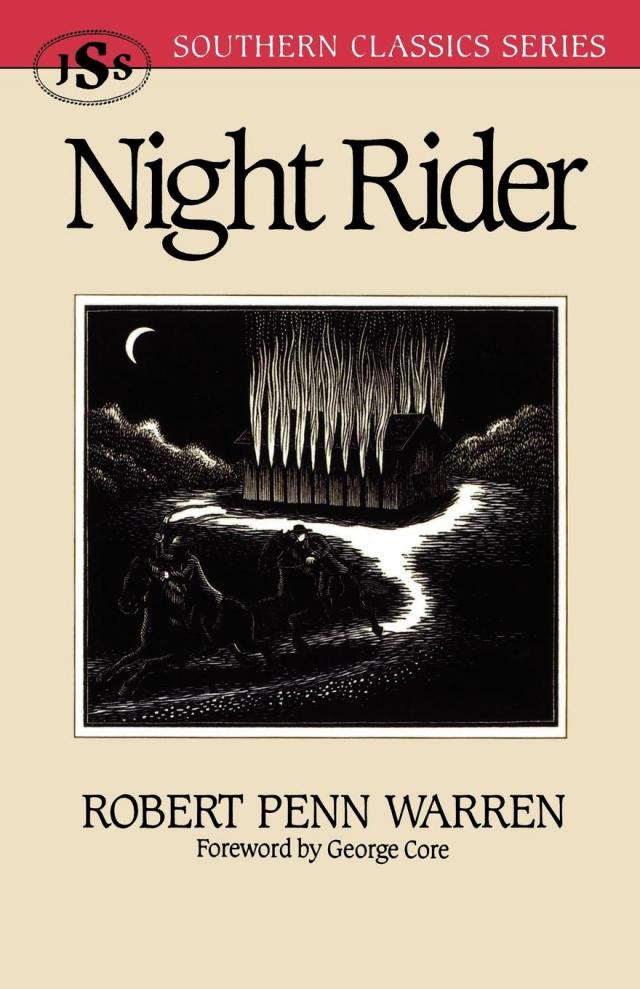


He had told her he did not know what the patch of flame on the horizon was; but he did know. He knew that it was a burning tobacco barn. It was a barn belonging to some man who, after receiving warnings, had not listed his crop with the Association. He knew that a band of men from some other locality, Band Number Six, he remembered, Mr. Burden’s band from over in Hunter County, had picked up its guide, a mounted man waiting in the shadows by the roadside at an appointed place, and had been led to that spot where the flames now made that little center of rosy light against the black sky. And he knew that some other night, soon, he himself would stand and watch men apply the match and then would mount and ride away, the hoofs of the horses drumming the frosty earth and the flames climbing the sky behind him. He knew, because that was the way it had already been.
There were burnings all fall. As soon as the tobacco in the barns began to cure, the fires began. At first there were only a few, then there were the letters. Then there were many fires. Some men who received letters listed their crops immediately with the Association. Others sat up night after night, alone or with their sons or hands or tenants, guns ready. They waited, lying behind piles of brush or in the protection of a fencerow or behind a stone fence, while the cold stiffened their fingers on the metal of a rifle or shotgun, and their eyes blurred with sleep, and high in the empty, black, metallic sky the steady stars seemed to be withdrawing into a more and more incalculable distance. Sooner or later for some of those who guarded their barns, there came the night when out of confidence or weariness they relaxed their vigilance and stayed in their beds. And once or twice the night riders came just at dusk when men were at supper and expected no danger.
Some of the larger growers sold their crops, half cured and hanging in the barns, to the companies, and the companies undertook to guard the barns. One gang of hired guards was surprised, half drunk at its post, and the men were whipped, dragged through a creek, and left lying, bound and gagged, by the roadside. The barns which they had been supposed to guard were burned. The night riders exchanged shots with another gang, and two men, under cover of the firing that drove the guards back to the protection of a cedar fencerow, galloped by the barn and flung two charges of dynamite against the wall. Galloping past the barn, they had lighted the fuses from cigars which they held clamped in their teeth. The charges blew in one wall of the barn, and the curing fires in the barn ignited the tobacco.
It was reported that one man, a Mr. Sanderson of the New Bethany community, had been burned to death in his barn, or had been shot and flung into the flames. He had, his wife said, left the house with his shotgun to guard his barn, as he had been accustomed to do for some time. But after the burning of the barn he had not appeared. His wife had run to the spot where the flames still rose, calling his name, and then, when there was no answer, she had run frantically and stumblingly across the fields to the nearest house, where there was a telephone. Men had come back with her to stand aimlessly before the glowing mass where the barn had been or to wander about the fields calling the man’s name. The next day, when the ashes had cooled enough, they began the process of sifting to find what might remain of the body. They found nothing but the twisted metal which had apparently been the barrel of the shotgun. The body, it was assumed, had been completely destroyed.
But Mr. Sanderson was not dead. He was found two weeks later, seventy-five miles away, over toward the central part of the state. Some boys out possum-hunting found him cowering in a thicket. His clothes were in tatters and he was almost barefoot. His beard was matted with mud and small fragments of dry leaf. He was nearly starving. He remembered nothing. When the boys questioned him, he put the knuckle of his right forefinger into his mouth, like a confused and frightened child, and peered from face to face. When they built a bonfire and tried to warm him, he was so terrified that they had to hold him. After a little while he became quiet in their grasp, but he kept shaking his head like a sick man who is too weak to protest otherwise against an injustice, and the tears flowed silently and resignedly out of his red-rimmed eyes.
Later, he was identified and sent to his home. His health gradually improved, and by spring he was able to go about his ordinary occupations. But he could never remember what had happened that night when his barn was burned, nor in the two weeks when he wandered over the countryside hiding in the woods and ditches.
Toward the end of the curing period the numbers of burnings over the section increased. Just before the elections violent encounters were frequent between peaceful and respectable men. Prayers were offered from the pulpits that order might be restored, and sometimes that the injustice that had caused the disorder and the lifting of the hand of brother against brother might be corrected. ‘Hit’s a curse,’ Mr. Grimes said to Mr. Munn, ‘laid onto the land, hit looks lak.’
Mr. Munn stood in front of the stable door and tightened the girth on his mare. Mr. Grimes had climbed the fence to the lot, getting stiffly and awkwardly over the whitewashed boards, and had slowly approached Mr. Munn.
‘Howdy-do,’ he had greeted him, and then, after Mr. Munn’s reply, had stood and studied the light that faintly tinted the edges of the slate-colored clouds on the western horizon. The sun was already out of sight. Then, at last, he said, ‘I’m a-leave-en.’ He did not take his gaze off the western sky. ‘Come January,’ he added. ‘I thought I’d be a-tellen you.’
‘I’m sorry,’ Mr. Munn replied. He raised his head from his task and looked at the man.
‘I’m sorry to be a-tellen you,’ the man said. In the fading light Mr. Munn tried to read the man’s face, but it showed nothing.
‘I wanted to be a-tellen you early,’ the man continued, ‘so you could be looken round and make a trade.’ He hesitated, then resumed in an apologetic tone: ‘Not you’d have no trouble, not with a good place and give-en good furnishen and all. You got a name fer hit.’
‘You made a good crop this season,’ Mr. Munn said, ‘drouth and all. You’ll get some money out of it.’
‘Hit’s a good crop.’
‘Aren’t you satisfied here? You’ve been here before. You came back.’
‘I’m satisfied,’ Mr. Grimes admitted, ‘but that ain’t all.’
‘What is it?’
Mr. Grimes returned his gaze to the west. The color was fading now from the edges of the low clouds, and as their own slate color darkened they seemed to gain in weight and solidity. ‘This carryen on round the country,’ he said. ‘Men carries on and revels round the country at night. Burnen and sich. I ain’t a-sayen who’s right and who’s wrong. Hit ain’t fer me to say. The Book says, jedge not. Hit’s fer God A-mighty to say. But I ain’t easy in my mind. And I’m a-leave-en.’
‘You mean you’re leaving this section?’ Mr. Munn asked.
‘I’m gitten old,’ Mr. Grimes answered, ‘and I reckin I don’t know nuthen but terbacker, come right down to hit. But I alluz say, a man kin put his hand to hit when the time comes. I’m a-leave-en.’
The mare stirred restively, and Mr. Munn patted her on the neck, murmuring to her. Then he said: ‘If you don’t want your crop in the Association next year, you can hold it out. If that’s it. I prefer for you to have it in, but I wouldn’t want you to go on that account. There’s plenty men who raise on shares have held their crops out.’
‘I ain’t easy in my mind,’ he declared. ‘They’s some as won’t tech terbacker, snuff, smoke, ner chew, ner lay a hand to hit fer a liven. They say hit’s a God’s curse.’
‘A man living round here hasn’t much choice,’ Mr. Munn remarked.
‘Hit’s come to my mind hit’s a curse,’ Mr. Grimes said, ‘like they says, and hit a curse all these years and me too blind to see.’
Mr. Munn leaned over and tightened the girth on his mare. ‘I don’t reckon it’s that bad,’ he returned.
‘Hit’s a curse,’ Mr. Grimes insisted, ‘laid onto the land, hit looks lak.’
Mr. Munn swung up to the saddle. From his height he looked out over Mr. Grimes’ head and over the fields, where darkness was gathering. It seemed to gather and rise from the fields, rising to extinguish whatever little light yet showed in the upper air. ‘Well,’ he concluded, ‘I’m sorry you’re going.’
‘Hit ain’t yore doen,’ Mr. Grimes said.
Chapter eleven
WHEN Mr. Munn rode out of the shadowed lane toward the white picket fence, that was dimly visible, a figure rose from beside the carriage block at the gate and waited for him. Closer, he saw that it was a negro man. Then he saw a few horses hitched to the palings of the fence, for the hitching-rack would not accommodate them all. The negro said, ‘Howdy-do, boss, kin I hitch yore hoss?’ and reached for the bridle.
Mr. Munn swung out of the saddle and dropped the rein. ‘Thanks,’ he replied.
‘Is you one of the gemmun gonna spend the night?’ the negro asked.
‘Yes,’ Mr. Munn said. He fumbled in the saddlebags and pulled out a small packet, tied up in newspaper.
‘I jes’ wanted to know, boss, so I’d know to put her in the stable. All the hosses fer the gemmun whut spends the night I puts in the stable.’ Then, when Mr. Munn seemed to hesitate, the negro added, ‘Misser Ball, he say jes’ come right on in, jes’ go over to the ’cademy house, over yander, and jes’ push, he say jes’ open the big dohr, and dar ’tis.’
‘Thanks,’ Mr. Munn said, and entered the white gate, which sagged under his touch and with its motion set up a loud clanking of plowshares that hung on a wire for weights. A dog growled suddenly, a deep-throated, powerful growl near at hand, and another dog, a little farther off, barked.
‘Ain’t nuthen to worry ’bout,’ the negro man assured him, ‘ain’t nuthen. Dey’s all tied up tonight. Ain’t tied up, dey eat a man, ha’r and hide, liver and lights. Yassuh. Pow’ful mean. Yassuh ——’ As he moved away, he heard the negro still talking, saying, ‘Yassuh.’
The dogs continued to bark while Mr. Munn walked over the brittle leaves toward the dark, formless bulk that was the building. He could see cracks of light where the windows were. Up the hill he could see, vaguely, the mass of another building, and a little light. That, he decided, must be the dwelling-house. He reached the academy building and fumbled for the door. His hand came into contact with the rough surface of a log, and then chinking. He found the latch, lifted it, and entered.
When he entered the long room, he was aware, even as his eyes adjusted themselves to the sudden light, of a tenseness, a hush. The backs of all the men were toward him. He quietly closed the door, took off his gloves and coat, and moved toward the nearer of the two big fireplaces that heated the room.
‘That’s the size of it,’ a man at the other end of the room was saying. Then there was silence again, except for the nervous shuffling of some man’s boots on the board floor. The men were scattered in several groups about the room, sitting on top of desks or lounging against the walls. Doctor MacDonald stood in front of the other hearth, his head bent over a piece of paper. He raised his head, straightened to his height, and passed his gaze deliberately over the men assembled. Then he said, ‘For the benefit of Mr. Munn, who has just come in, I’ll read this communication again.’
‘I’m sorry to have inconvenienced the meeting,’ Mr. Munn apologized. ‘I miscalculated the distance, I reckon.’
‘This is a letter received by Mr. Murdock, here,’ and Doctor MacDonald inclined his long head toward a heavy-featured, dark man who lounged against the wall, near one of the lamp brackets. Then he added, ‘Unsigned.’ Having pronounced the word, he smiled confidentially at the men, with the air of one who feels it unnecessary to point the humor of a situation, and then began to read.
Dear Mr. Murdock,
If you knows what is good fer you, you will git rid of them niggers on yore place and git you some white croppers like a white man ought. When January gits here you better hunt you up some good hard-workin white men and make you a trade and git rid of them black bastards.
He folded the piece of paper. ‘I needn’t tell you what Mr. Murdock’s reactions are,’ he said.
‘They ain’t no secret,’ Mr. Murdock remarked glumly. He walked across to the fireplace before which Doctor MacDonald stood, spat upon the burning logs, and addressed himself to the company. ‘Ain’t no man gonna tell me who’s gonna crop on my place. That is, till the bank takes it over.’ He spat again, and walked back to resume his place against the wall. He added, ‘Which ain’t gonna be long, I’m free to tell you, unless something happens.’
‘A lot of folks been saying ain’t no man gonna tell ’em when they could sell their tobacco,’ Mr. Burden said. ‘It’s all whose shoes it is pinches.’
Doctor MacDonald grinned. ‘That’s a way of putting it,’ he admitted, ‘but there’s a difference. Now ——’
‘Durn it,’ Mr. Christian said. Mr. Munn had not seen him before. He was sitting humped over in one of the desks, concealed by a group of men. ‘Durn it,’ he said, ‘say it’s whose shoes pinches. Say it, and I say, well, by God, I’ve just decided it ain’t gonna be mine, it’s gonna be somebody else’s for a pissing-spell.’
‘I don’t mean to say I’m backing down,’ Mr. Burden explained, shaking his mass of dark, unkempt hair so that the forelock fell over his brow. ‘It ain’t a secret I’ve done things of late I never thought I’d set my hand to, but I reckon there’s been many a man could say that before he turned his eyes to the wall. But I ain’t backing down. I was just remarking. All I said it was, was whose shoe it is pinches.’
‘There’s a difference, now, you’ll grant,’ Doctor MacDonald said. He smiled and wagged his pipe at Mr. Burden. ‘The fellow who wrote this note to Mr. Murdock is some poor Godforsaken, belly-dragging blackguard that blames his bad luck on a nigger. Any white man that’s honest and got jaybird sense and wants to crop can get a place round here. The niggers aren’t crowding him any. It’s a little different down in Louisiana, where I come from, maybe, but not here. You’ll grant now, Mr. Burden’ — he addressed Mr. Burden pleasantly and patiently, as though explaining something, the course of a disease, perhaps, or the meaning of a symptom, as though making an effort for the simple and non-technical description — ‘you’ll grant there’s a difference between this sort of thing’ — and he tapped the paper, which he held in one hand, with the stem of his pipe — ‘and the meaning of our’ — he paused slightly, grinning again — ‘endeavors. There’s ——’
Professor Ball, who had been standing by the wall, a little aloof, leaned his tall, emaciated body forward, and thrust out a bandaged forefinger. ‘A difference,’ he said croakingly — ‘the difference between justice and injustice, darkness and the holy light.’
‘That’s telling ’em, Professor,’ Mr. Christian exclaimed. ‘I just had it on the tip of my tongue.’
Doctor MacDonald was waiting for them to finish. He was standing very straight, but casually, for his erectness always had about it a certain impression of repose, and confidence, as well. His long arms hung loosely, the wrists showing out of the too-short sleeves. He looked from Professor Ball to Mr. Christian and back again, with a bearing of courtesy and tolerance, and waited to be sure that they had finished speaking. Mr. Christian again sank back upon himself, paying no attention, apparently, to what was going on around him. Then Doctor MacDonald said, speaking very deliberately: ‘You all know I said when you elected me that I’d try not to get you into any more trouble than necessary. Well, we’ve been in plenty of trouble. Over half a year now. We all got into it together, and we don’t know how much good it’s done.’ His voice moved along casually and conversationally, but it was distinct even at the other end of the room. He paused. Then he continued, his voice gaining a certain sharpness: ‘But it hasn’t done enough good. I know that. You know it. This fall the companies have managed to buy tobacco. They’ve paid high for it, but they’ve managed to get it. Enough to tide them over. That tobacco is in their warehouses. In Bardsville, in Millville, in Alltown, in Morganstown.’
He paused again. He let his gaze wander from the group before him, as though for the moment he had forgotten them, and seemed to find his interest at the far end of the raftered ceiling. Then he fixed his eyes upon them, and leaned toward them, confidentially, thrusting out his long, bony face. ‘It’s in their warehouses,’ he repeated. ‘Millions of pounds. It’s lying there, in those warehouses. In Bardsville, in Millville, in Alltown, in Morganstown. Just lying there. Well’ — he grinned at them, amusedly, almost apologetically, confidentially, drawing his lips back so that the long dog-teeth were exposed, and leaned closer — ‘I’m proposing a little trouble, boys.’
There was silence in the room for a moment, except for the comfortable, domestic drone and hiss of the logs being consumed in the big fireplace behind him. Then, in a flat, uncommunicative tone, some man said, ‘Well, I’m durned.’
‘Well?’ Doctor MacDonald asked, leaning.
Nobody said anything.
‘Well?’ Doctor MacDonald asked again, with a suggestion of mockery in the word.
Then a dozen voices broke out at once. Boot heels scraped on the boards as men moved restlessly about. Doctor MacDonald, grinning, lifted his hands for silence, and held them up while the noise subsided. ‘It’s the last card,’ he said.
‘The truth,’ some man agreed.
‘The last,’ Doctor MacDonald repeated. ‘There won’t be any more.’
The voices broke out again, and subsided beneath his lifted hands.
‘The last card,’ Mr. Munn said, very loud. Some of the men turned to look at him, then others. ‘The last card,’ Mr. Munn reiterated. ‘It’s take it or leave it. And I say, take it ——’
‘Take it!’ a voice called.
‘Take it,’ Mr. Munn said again, ‘for it’s the last chance. But there’s another reason. Mr. Burden, yonder’ — he pointed at the man, who from under his dark, shaggy forelock stared stolidly at him, shaking his head — ‘he said tonight he’s done things this year he never thought he’d set his hand to. So’ve you. So’ve I, and, by God, I say so. And so’ve you. There’s no use to name them. You know. Everybody ——’