Night rider, p.37
Night Rider,
p.37
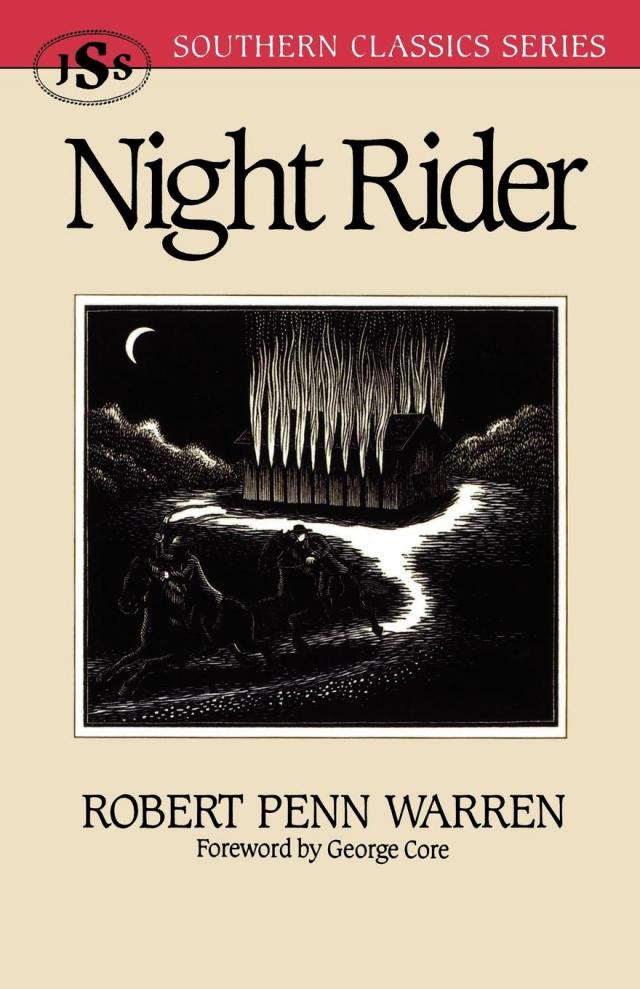


Mr. Munn had walked down the street and across the courthouse square to the jail. They had let him into the cell. He had not known how, exactly, to say it to Doctor MacDonald.
‘Durn it,’ Doctor MacDonald exclaimed, ‘just like I said, sitting round so much makes me bilious. It’s not natural to a man to be sitting round. And this time of year your blood needs thinning like as not, anyway. I’m sure glad they’ll be starting the trial in a few days.’
Mr. Munn said nothing.
‘Of course,’ Doctor MacDonald added, almost cheerfully, ‘they might decide to keep me indoors for quite a spell afterward. Bilious or not.’
‘You ought never given yourself up,’ Mr. Munn said bitterly, not looking at him. ‘You ought never come down that night. It wasn’t necessary. They would have gone away. After what happened.’
‘Hell, Perse, you keep saying that. How did I know what was happening downstairs, hearing that shooting and all? Anything might have been going on, and me in the attic, not knowing.’
‘You ought never come down,’ Mr. Munn repeated.
‘Well, I did,’ Doctor MacDonald said, ‘and here I am. Only hope I don’t stay here too long.’
‘Listen,’ Mr. Munn commanded, leaning toward him, looking at him now, ‘I don’t know what evidence they got, but I bet they don’t nail you. Wilkins is a good man, a damned good lawyer; he’s no fool; he’ll see to it that jury’s not all one way ——’
‘Sure, Wilkins is all right, I’m not denying that,’ Doctor MacDonald said. ‘But I still wish you’d taken the case. Like I asked.’
‘And have your lawyer get arrested in the middle of it? They may get me any day. Any day they think they’ve got evidence that’ll stick. Wilkins, he’ll manage.’
‘Maybe,’ Doctor MacDonald agreed, in a tone of friendly concession.
‘Listen,’ Mr. Munn reiterated, leaning, ‘let them nail you, and there’s men will take this place apart. Plenty of them. Soldiers or no soldiers. No’ — and he shook his head — ‘they won’t nail you. They’ll be afraid.’
‘Maybe,’ Doctor MacDonald repeated cheerfully. He moved the length of the cell, three paces, short paces for him, and lifted his arms, slowly, almost luxuriously, above his head.
Mr. Munn sat down on the edge of the cot. He felt done in. He felt like a man who, new to a high altitude, runs up an easy slope and finds, suddenly, his knees water and his head giddy with the empty air.
‘Bilious,’ Doctor MacDonald declared; ‘that’s what it does to me. My teeth feel green. Like moss on a rotten shingle. Damned if they don’t.’
Mr. Munn did not answer, looking down at the stained concrete of the floor. He had the impulse to lie back on the cot, to let himself go. If they got him, arrested him and brought him here, he could just lie back and shut his eyes. Then there wouldn’t be any reason not to. He could do it.
‘Well?’ Doctor MacDonald was saying inquiringly. He was standing in the middle of the cell, staring down at him.
Doctor MacDonald stood there, in his shirt-sleeves and with his vest unbuttoned, tall even in his carpet slippers, the light from the window falling directly on his unkempt, strong-boned head. He stood with his weight off his heels, like a boxer, or a man ready to go somewhere. The cuffs of the shirt he wore were fresh and stiff. Mr. Munn looked at them. Cordelia brought him a clean shirt every morning, he knew. She wrapped the shirt up in a piece of paper, every morning, and left the hotel, and walked down the street, not looking at anybody, and crossed the square and came here. She would stand in the cell and hold one of Doctor MacDonald’s hands with both of hers.
‘Well,’ Doctor MacDonald demanded, ‘what’s the matter with you?’
Mr. Munn leaned back until his shoulders came into contact with the stone of the wall. ‘The board,’ he said; ‘they sold.’
‘Our figure?’ Doctor MacDonald asked, almost casually, after the pause of scarcely an instant.
‘No,’ Mr. Munn answered. He did not look at Doctor MacDonald.
‘Licked,’ Doctor MacDonald said.
Mr. Munn slowly raised his gaze. But Doctor MacDonald was looking away. He was looking out the window, and his face betrayed nothing. ‘That’s right,’ Mr. Munn said. ‘Licked.’
Doctor MacDonald continued to look out the little window. Mr. Munn followed his gaze. Outside the window, there was a bough with the leaves putting out, golden-tinged and pubescent.
‘I reckon they just didn’t have it in them,’ Doctor MacDonald remarked.
‘I did what I could,’ Mr. Munn told him. Then added, ‘And Sills did.’
‘It just wasn’t in them,’ Doctor MacDonald said. ‘One way or another, that’s what a man does. What’s in him. A man goes along, and the time comes, even if he’s looking the other way not noticing, and the thing in him comes out. It wasn’t something happening to him made him do something, the thing was in him all the time. He just didn’t know. Till the time came.’
‘No,’ Mr. Munn answered, sitting up on the cot, feeling an alarm stir obscurely in him. ‘No,’ and hesitated; then, less emphatically, repeated, ‘No.’
Almost amusedly, Doctor MacDonald looked down at him. ‘Don’t kid yourself,’ he said. ‘Take the Professor, now. Him doing nothing but teaching his boys and reading his books, all that old history and stuff. You’d never guessed it, but look what came outer him.’
Mr. Munn stood up.
‘Did you ever notice,’ Doctor MacDonald asked, ‘how what happens to people seems sort of made to order for them? When you think about it.’
‘Why don’t matter!’ Mr. Munn exclaimed, and jerked his arm forward in a violent, sweeping gesture of dismissal. ‘We’re licked. The reason for things is gone. For what we did. Like flood water going down and leaving trash and stuff up in a tree.’ He jabbed his forefinger at the other man’s breast. ‘That’s you,’ he asserted, ‘left high and dry. Stuck up in a tree.’ Then, more quietly, he added: ‘And me. Both of us.’
Doctor MacDonald laid a hand on his shoulder, and said, ‘Take it easy.’
Mr. Munn sat down again. They talked of the trial, which would begin in two more days.
As he started out, behind Mr. Dickey, who had come to let him out of Doctor MacDonald’s cell, his glance fell upon the door of the cell where Trevelyan had been. An old man was in there now, lying on the cot, his thin body lax and huddled like a pile of old clothes. He was in for murder. He had gone out to milk one morning, and had brought the milk in and strained it and put it away; then, with an ice-pick, he had killed his wife as she leaned over the stove preparing breakfast, then his pregnant daughter, who was lying in bed, then the young child at her side. He had killed the son-in-law with a rifle when he came back to the house from feeding the stock. He had called the sheriff. Then he had gone to bed and wrapped himself up in the bedclothes. He had been asleep when the sheriff came for him. Now, in his cell, he lay on his cot, only stirring to reply to questions. He answered questions with a dazed and innocent patience, like a man scarcely aroused from sleep.
Mr. Munn could not recall his name.
‘Nuts,’ Mr. Dickey said, and nodded toward the cell where the man lay on the cot.
Outside, when he stood in the courthouse yard, he saw the sunshine falling over the roofs of the buildings and on the stones and the young grass. People were moving up and down the street. People he knew. He walked soberly across the square toward his office.
He had gone to the jail afraid to tell Doctor MacDonald what the board had done. He had been afraid of the way Doctor MacDonald might take it. He should have known, he thought now, the way it would be: Doctor MacDonald standing there in the middle of the cell floor, his weight forward off his heels, his face showing nothing. It was Doctor MacDonald who had laid a hand on his shoulder, and had said, ‘Take it easy.’ It had gone past Doctor MacDonald and had never shaken him.
But the next day when he saw Doctor MacDonald he was not so sure. Watching him stand at the cell door, ready to call Mr. Dickey, Doctor MacDonald said suddenly, ‘Don’t it smell in here to you?’
Mr. Munn turned to look at him.
‘Don’t it stink?’ Doctor MacDonald demanded.
‘Yes,’ Mr. Munn admitted, aware, anew, of the fetid, almost sweet odor, as of rottenness, ‘I reckon it does, a little.’
‘It stunk mightily to me, at first,’ Doctor MacDonald said, ‘but it don’t seem like it stinks now. A man gets used to a thing. It gets natural to him.’ He stopped moving about, as he had been doing, his carpet slippers making a dry, sliding noise on the concrete. ‘That’s what I don’t like,’ he added, ‘it getting so natural. It looks like a stink oughter stay a stink to a man.’
Mr. Munn grinned, thinking it a joke. Then he noticed that Doctor MacDonald was not grinning. Mr. Munn let the muscles of his face relax.
Doctor MacDonald lay down on the cot, staring up at the ceiling.
Mr. Munn called for Mr. Dickey.
While Mr. Dickey was coming, Doctor MacDonald said, ‘If I get out, I’m figuring on leaving this country.’
‘Leaving?’ Mr. Munn echoed, surprise in his tone.
Doctor MacDonald nodded. ‘Yeah,’ he replied, adding, ‘but not so quick anybody’d think he was running me out.’
Mr. Munn did not answer for an instant. ‘Where you going?’ he then asked. He was aware of the unevenness in his own voice. That unevenness, which he noticed, detachedly as in the voice of another person, defined for him the sense of confusion, betrayal, that at Doctor MacDonald’s words had moved smally, almost innocently, in him, like the first tremor of a landslip.
‘Out West somewhere, I reckon,’ Doctor MacDonald was saying matter-of-factly. ‘Arizona, New Mexico, I don’t know. Somewhere where people haven’t caught up with themselves yet.’
Mr. Dickey was coming, his keys jangling as he searched for the right one.
‘I’m not staying round here,’ Doctor MacDonald added. ‘I might get used to the way this country stinks.’
By seven o’clock in the morning on the first day of the trial of Doctor MacDonald on charges of conspiracy and arson, the courthouse square was crowded. The troops kept the courthouse yard clear. When the doors were opened, the troops permitted only five or six men at a time to approach the building, and at the door each man was searched for arms. By half-past eight word came out that the courtroom was full. Although the crowd thinned somewhat, it did not disperse. The people were restless, but unusually silent. When Mr. Munn and Professor Ball and his daughters walked from the hotel to the courthouse, people made way for them, gazing curiously at the faces of the women, and after they had passed talking in low tones, identifying them. Now and then a man would speak to Professor Ball, who would raise the bandaged right hand in a kind of grave salute. Cordelia walked beside him, leaning on his left arm. She was very pale.
A voice from the crowd called out to her, ‘Don’t you worry, Miz MacDonald, we’ll take keer of him.’
She gave no sign of having heard. Professor Ball raised his bandaged hand in decorous salute.
A scuffling began at the point in the crowd where the voice had called. Another voice cried, ‘Hit him again!’ The soldiers tried to force a way into the crowd toward the spot; but they could not. Then the disturbance was over.
At the courthouse door the soldiers stopped them. While the women waited just inside, one of the soldiers patted the men’s pockets and waistbands. Professor Ball, looking straight ahead, seemed unaware of the searching hands on him.
‘They ain’t got nothing,’ the soldier said, stepping back.
‘You can go in now,’ the lieutenant told them.
It was that way every day for three days, in the morning and in the afternoon when the court resumed, the crowd thinner each time but still there, the soldiers around the courthouse yard, where the grass showed an incongruous fresh green as of some pasture corner, and the soldiers at the door. And with Professor Ball, it was the same every day, and with Cordelia. Professor Ball sat in the courtroom, very erect, with his eyes fixed before him as though he were paying no attention to what was going on, and his bandaged hands lying on his bony knees, as passive as stones. Cordelia walked beside him, leaning on his left arm, or sat beside him in the courtroom, still holding his arm; but her glance rarely wavered from her husband’s face. As for Doctor MacDonald, he leaned back in his chair, at ease but alert to what was going on, with his brown hands lying on the table-top before him. Or he inclined his head to hear some remark which his lawyer made in an undertone to him. Once, when almost everybody was watching a witness, Doctor MacDonald — Mr. Munn was almost sure — winked, with an air of sly humor, at Cordelia. Mr. Munn turned, as quickly as he dared, to look at Cordelia. While she watched her husband, her face was pale, but composed. But something else, certainly, some other expression, a smile, perhaps, had been there on her face; and had fled even as he turned to surprise it.
For three days the case moved without taking on definition. Only on the first day, when the jury was being impaneled, had issues taken on any form. But Wilkins, Mr. Munn thought, seemed satisfied enough about the jury. He had not used his last challenge. He acted as if he had put one over. Mr. Munn studied the men in the jury box. He knew some of them. Some of them, he was sure, would like to see Doctor MacDonald catch it, guilty or not as a matter of fact, just because he was in the Association. But Wilkins seemed satisfied. There must be a couple on the jury who, Wilkins thought, could hold out against anything short of an absolute identification. And maybe against that. Mr. Munn tried to figure out who they were, but gave it up. Wilkins was not telling all he knew.
But after the jury was impaneled, things slacked off. Witness followed witness, each one adding some little detail to the picture of the raid on Bardsville. Officials of the Alta Company, and of the other companies, stood in the box, and recited, to the last penny, the costs of the warehouses that had been destroyed, and the quantity and value of the tobacco that those warehouses had contained. That was what it had been, to them, not a picture of men moving in the darkness, and of the flames standing over the roofs, but the sums which each in turn, standing in the box, read from a paper in his hand. A constable told how he had been sitting in the office and how masked men, with drawn pistols, had come in and tied him to a chair. They had brought in two other men, watchmen, and tied them up too. The masked men had stood around, the constable said, making jokes and chewing tobacco. ‘They said they just tied us up for our own good,’ the constable said, somewhat sullenly, ‘so we wouldn’t git in no trouble.’ The masked men, he added, had had some trouble with their masks when they tried to spit. And the first explosion, because the police office was so near Front Street, nearly threw him out of his chair. ‘They must-er used enough that shot to blow up the town,’ he said.
Miss Lucy Mayhew, chief operator for the telephone company, lowered her bony, sallow-skinned right hand after taking the oath, and smoothed the black, lusterless silk of her dress. The prosecutor asked her questions, and she answered them in a low but distinct voice, impersonal as though it were coming over a wire; she did not lift her head when she spoke, and her hands, now and then, patted and smoothed the silk. She fixed the very minute when she had first heard a trampling on the stairs up to the telephone office, for she had just looked at her clock. It was twelve-thirty o’clock, she said. Four men came in, bursting in all at once, and they had white cloths on their faces and pistols in their hands. One of the girls screamed, she said, but she herself, she stood right up to them as good as she could. She wanted to know what their business was.
‘And what did they say?’ the prosecutor demanded.
‘They said, ladies, we hate to bother you, but we just got a little private business in town, and we don’t want anybody to be making it public.’ She smoothed the silk, and her brow wrinkled in thought. ‘At least, that’s as good as I can remember what they said. So we got back from the switchboard.’
‘Did they offer you any violence?’
‘They waved those pistols some,’ she said, ‘but they didn’t point them at us. One of them — he looked like the captain or something, because he had a white bandage on his coat sleeve — he just said for us to come downstairs, and he took me by the arm. And two of the other men, each one took one of the girls by the arm, and one of the girls started pulling back, and he said, lady, you better come on down or you’ll miss something bigger’n Christmas. They took us downstairs, and the man with me held my arm going down like any gentleman would a lady’s.’
One of the men had stayed upstairs, she said, and he was the one who had cut all the wires up there. Or at least she reckoned so, for all the wires were cut up and pretty bad. He was the meanest-looking one, anyway, she said. Then the men made them stand back in the doorway of Gordon’s store, which had a deep doorway. At first there wasn’t anything, then a few men riding down the street, men with white masks on. Then some more men on horseback stopped up at the corner of Main and Jefferson, under the street light, and stayed there the whole time. Then there were the explosions, then the fire over the roofs, and one of the girls began to cry. It looked like the whole town was going to burn up, she said. But it didn’t, and after a while men with guns began marching past.
‘In military formation?’ the prosecutor asked.
‘I reckon you might call it that,’ she answered. ‘It was four abreast, but not in step exactly. And they were singing and shouting some. One man got on the sidewalk and shot off his pistol at the street light and yelled’ — she hesitated, smoothing her skirt. ‘Well, it was improper language,’ she said, ‘and then he yelled out, Boys, they said we couldn’t, but we done it! Then he shot off his pistol, and he hit the street light. But one of the men with us, the one that was captain, he said to one of the others, you go tell that man to move on, he’s using strong language like that, and there’s ladies here. And he went and told him, and he stopped.’
After the others had all left, all except the men on horseback under the street light at the corner, she said, she and the other operators were permitted to go back upstairs. The men had started to go up with them, and the captain was holding her by the arm, but she had said no, thanks, she didn’t want any more assistance from people like that who violated the law. Then the captain laughed, and went away.