Night rider, p.30
Night Rider,
p.30
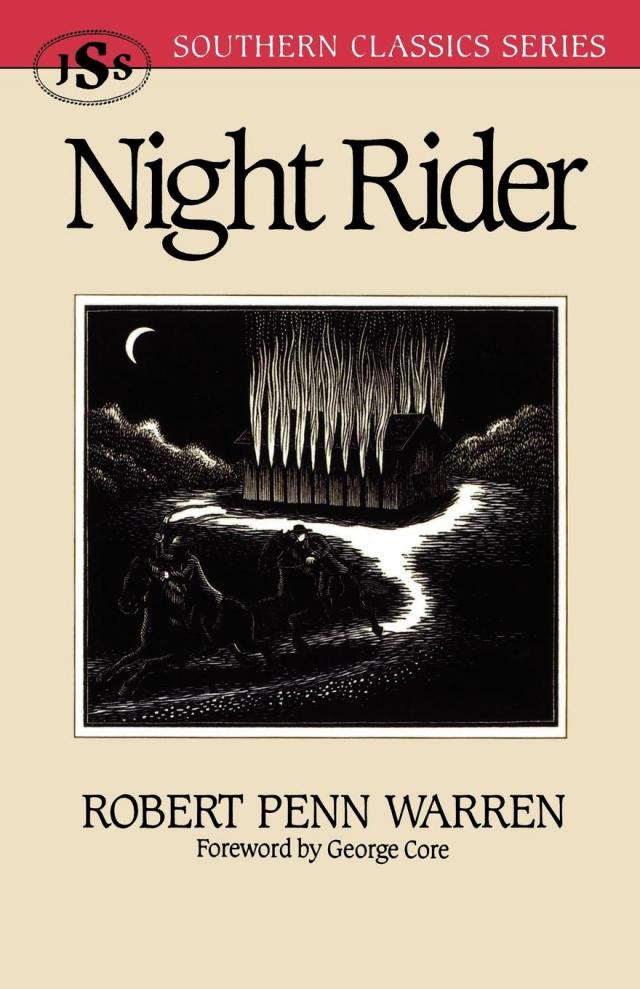


‘Yes, sir,’ the man said, but before he had touched heel to his horse, more men were running into Main Street from around the corner, below. They ran directly toward the first group, struck it, and merged with it. Then more men appeared. They picked up the figure which lay in the middle of the street. A single horseman, down there in the middle of the street, gesticulated toward the crowd. The man named Simmons was now approaching that other horseman.
More men, a solid column of men, swung into Main Street, and moved up the slope toward the intersection of Main and Jefferson. The man named Simmons passed them as he galloped back. Beyond the approaching column, over the roofs, the sky was marked with a line of flames.
Simmons drew up beside Mr. Munn. ‘Cassidy’s saloon,’ he said, breathing heavily, ‘some of ’em tried to bust into it. Their captain and another fellow, they tried to stop it, and they knocked out the captain. That was him laying in the street. The others, they come then and stopped ’em. My God, the doc, he’s down there raising hell, he’s ——’
‘Doctor MacDonald?’ Mr. Munn demanded.
‘Yeah, Doctor MacDonald, that’s him on the horse, and, by God, what he’s telling ’em! He’s calling ’em names I didn’t know.’
Mr. Munn looked off down the slope. The head of the marching column was very near now, the men swinging along irregularly four abreast, laughing and shouting. Just then, a few random shots were fired from the column.
‘Did Doctor MacDonald send any word?’ he demanded.
‘Yeah, yeah,’ the man said, his eyes fixed on the approaching column. ‘He said if you caught anybody trying to bust in a saloon or anything, just pick ’em up, no matter even if they’re our fellows or not. He said beat hell outer ’em if you had to. He said shoot ’em in the leg.’
‘He said that?’ Mr. Munn asked.
‘That’s what he said,’ the man answered, ‘and he’s sending word off to Mr. Sills and Mr. Murdock, too.’
‘Thanks,’ Mr. Munn said. And then: ‘Just drop back into line, will you please, Mr. Simmons?’
‘Excuse me,’ Mr. Simmons replied, and pulled his mount back into the formation.
The column was rounding the corner, the nearest men little more than an arm’s length from the head of Mr. Munn’s mare. The men were laughing and shouting. Somebody fired a double-barreled shotgun into the air, the two barrels in such quick succession that the reports almost blended.
Mr. Munn studied the flames above the roofs.
‘By God!’ a voice shouted from the column — ‘By God, we done it!’
Another shot was fired, close at hand. The glass clattered from the show window of a store beyond the column.
Another shout: ‘We done it!’
The men kept swinging past, shouting and laughing. The cloths had slipped down, carelessly, on their faces, or had been removed now. Mr. Munn looked at his watch. Another half-hour, he thought — no, three quarters.
Three horsemen were riding alongside the column, approaching. One of them, Mr. Munn could see even before they reached the corner, was Doctor MacDonald. He wore no mask, now. He rode up, smiling, his lips drawn back and his pipe stuck between his teeth. ‘Hello,’ he said, almost casually. He had not removed the pipe.
When he drew up, Mr. Munn said in a low voice, ‘I hear you had some trouble down the hill?’
‘Yes,’ Doctor MacDonald answered, ‘but I gave somebody some trouble, too.’ Then he looked sharply at Mr. Munn’s face. ‘Listen,’ he said, ‘don’t let it prey on your mind. If a man’s in a fight, he don’t look to see whether or not his gun’s got a pearl handle and a monogram.’
‘It’s too bad,’ Mr. Munn remarked soberly.
‘Son, the good Lord never got any thousand or so men together for any purpose without a liberal assortment of sons-of-bitches thrown in.’ He grinned and looked at Mr. Munn sidewise. ‘Not even for the purpose of burning tobacco warehouses, which is a thing to make the heavenly choir tune up. But’ — he hesitated, his eyes following the marching men appraisingly — ‘the next fellow up and does a trick like that, busting in that saloon, and it’s gonna be me or him. Next Wednesday when we hit Morganstown, it’ll be different, or I’ll know why.’
‘Well,’ Mr. Munn rejoined, ‘otherwise I guess we’ve had plenty of luck. So far.’
‘Boy, we had plenty,’ Doctor MacDonald declared. ‘Not a word getting out, nothing.’
Mr. Munn watched the flames. They rose straight upward now. ‘One piece,’ he said, ‘was the wind dying down. We didn’t burn up the town.’
‘For a minute there,’ Doctor MacDonald said, ‘it looked like we might have to untie the boys down at the fire department. Just after we’d got ’em all nice and quiet and resigned to their condition.’ He looked at his watch. The last column was approaching. Then, with a different voice, he commanded: ‘Give ’em half an hour, or better. In fifteen minutes my boys will start out; we’re going out and hit Jefferson on the edge of town. The same time you start out north on Jefferson, Sills will be going out south.’
‘I don’t reckon on any trouble,’ Mr. Munn said.
‘No, it looks now like all that home guard stuff was hot air.’ Doctor MacDonald lifted his reins. ‘So long,’ he said, nodded to the two masked men who accompanied him, and touched his mount’s flank. He and the two men moved briskly off, southward down Jefferson. Mr. Munn decided that he must be going to give Sills his last directions.
The head of the column was well up Jefferson Street now, to the north. The men were singing. They sang, ‘The old gray mare . . .’ and the reports of guns punctuated their voices. Some of the men straggling at the end of the column were firing at the glass of show windows of the stores.
‘The God-damn fools,’ Mr. Munn exclaimed.
‘What’s that?’ the next man demanded.
‘Those fools,’ Mr. Munn said somberly. ‘Shooting that glass out’ll hurt us. It’ll hurt us bad.’
The sound of the singing came back down the street:
‘. . . came trotten through the wilderness,
Trotten through the wilderness.’
‘Yeah,’ the man rejoined, ‘but did you ever feed a dog you’d kept chained up and hungry and not hear him growl when he got his teeth in the meat?’
Mr. Munn made no reply.
‘That’s all it is; they don’t mean no harm,’ the man continued. ‘They’re just showing they got their teeth in.’
To the east the flames were lower now, but still strong. There was no more sound of gunfire. The last sporadic shots, faint to the north and south, had ceased. The arc-lamp hummed. Down the street a small group of men came out of a doorway. With surprise Mr. Munn saw the three women with them. The men held the women by the arm, whether to assist them or to keep them from running away he could not tell.
‘It’s Burrus,’ a man said. ‘He’s taking the ladies back to the telephone office.’
The women had entered a building down the street, the building with the telephone office in it, Mr. Munn figured. That means it’s about time, he thought, for us to be pulling out. The men who had escorted the women disappeared into an alley. Mr. Munn looked at his watch. It would be about another five minutes, he decided.
Burrus and his men came out of the alley, on horseback now, and moved toward the corner. Mr. Burrus lifted his hand in salute as he passed. ‘We’re pulling out,’ he announced.
‘Good night,’ Mr. Munn said.
Mr. Burrus and his men cantered off up the street. The sound of the hoofs died away, and they were lost to view.
Mr. Munn turned in his saddle. The men regarded him, their faces with the white cloths shadowed by their hat-brims. ‘All right,’ he said. He lifted his revolver and fired into the air, once.
Benton Todd and the man named Allen were coming toward the corner.
Mr. Munn motioned to the two men guarding the prisoners in the doorway. They approached, and mounted their horses. The three men whom they had been guarding remained, half-hidden in the shadow. Mr. Munn walked his horse to the spot, and looked down at them. The man who had snuffled and had said that his wife was sick stood behind the other two. ‘Come on out,’ Mr. Munn ordered. ‘You all can go now.’ They came out, the last man somewhat hesitantly. ‘You can get on home now to that sick wife you haven’t got,’ Mr. Munn said.
The man raised his face, mottled and empty in the uncertain light, and ran his tongue over his lips. Suddenly, looking at him, Mr. Munn hated him. He felt the blind impulse to cause him pain, to show his hatred, to torture him. Leaning from his saddle, he exclaimed, ‘Get away from here! Go on! Quick!’
The man backed away a couple of steps, his face still raised emptily, then turned and fled. The other two men were already gone.
Mr. Munn lifted his arm. ‘Let’s go,’ he said loudly, and lifted his mare to a gallop. The men swung in behind him.
As they went out of town, all of the houses were dark. But inside of them, he knew, there were the people. They lay in their beds, listening, staring up into the dark. Or they peered from the darkened windows.
At the top of the slope outside of town, he looked back. The glow of the fires still lingered. But the flames were down.
It was some fifteen minutes later, a couple of hundred yards beyond the place where four of the men had turned off into a side lane to go home, that he first thought he heard the sound of hoofs behind him. But he dismissed the matter from his mind for the moment. Then, not much later, he was sure, or almost sure. He could hear, he thought, the hollow tattoo on a wooden bridge which they had crossed just a little earlier.
‘Do you hear anything?’ he demanded.
‘I don’t reckon I do,’ Mr. Simmons replied; ‘nothing special.’
Cantering along, Mr. Munn strained his ears. He tried to sort out the sounds. There was the sound of the horses in his own band, and that other sound, if there was another sound. He was sure, then he was not sure. It was not reasonable, he thought. He knew that he was the last out of town. Then he said loudly, ‘Stop!’
The horsemen grouped compactly in the middle of the pike.
‘Can you hear anything?’ he asked. ‘Anything coming?’
For a moment, no one answered, then a man said, ‘Maybe. I ain’t sure.’ He slipped from his saddle, and, crouching at the edge of the pike, put his ear to the earth. The other men peered down at him. He rose quickly, and said, ‘Yeah, yeah, somebody’s coming.’
‘Yes?’ Mr. Munn demanded.
‘Horses,’ the man declared, ‘and a lot of ’em.’
Mr. Munn scanned the sky. It was a little lighter now. It was not dawn, but the clouds were thinning.
‘Some of our boys going home,’ a man suggested.
‘No,’ Mr. Munn said, ‘we’re the last out. Out this way, anyhow.’
‘We could bushwhack ’em,’ a man proposed, ‘get behind that fence and let ’em ride past and bushwhack ’em.’
‘No,’ Mr. Munn decided. ‘A fight won’t do us any good. Come on!’ He leaned forward and the mare responded beneath him. Beside him and behind him the hoofs pounded the hard pike. The wind flapped his hat-brim. The fields and woods were black on each side, but between them, ahead, lay the paleness of the pike. If they could make it to the New Bethany crossroads with a decent lead, they could, Mr. Munn was sure, throw off the pursuers. They’d have a chance, a good chance in that tangle of lanes there in that locality and in the woods. If they had a decent lead. But they had to have a lead, because there, toward the crossroads, the pike ran straight and the patch of country was open, and now, momently it seemed to Mr. Munn as he raised his face in the wind and looked fleetingly at the sky, the dim light that seeped through the breaking clouds was increasing. But it was not yet dawn. There ought to be more than two hours till dawn, he figured.
Out of the tail of his eye he noticed that Mr. Simmons, who rode beside him, was looking back. He looked back over his shoulder. His men were no longer compactly together. They were stringing out down the pike behind as the horses failed the pace. ‘God damn it!’ Mr. Munn said aloud, ‘some of those plugs won’t last to Bethany.’ No better than plow horses, he thought disgustedly, irritably.
‘This keeps up,’ Mr. Simmons was shouting at him, ‘and they’ll be taking some of the boys.’
Mr. Munn shook his head. ‘No,’ he denied, ‘not that.’
‘Better bushwhack ’em while we got a chance,’ the other called. ‘We still got some cover here.’
Mr. Munn glanced to one side of the pike. It was winding here. Through brush and the black cedar thickets. That paleness against the darkness of the thicket would be stone wall. Limestone. Here was cover. Good cover, if they were going to bushwhack. He shook his head. ‘No,’ he repeated, not looking toward Mr. Simmons, but forward strainingly toward the next turn in the pike as though his own intensity might draw all the mass behind him, and himself, more swiftly toward the security of that next bend, and the bend beyond.
Beyond the turn, he again looked back. The men were stringing out behind. Worse than before, he thought. And in his mind he cursed the fools who were pursuing, fools who had no part, no real interest, no concern, with the whole business, idle, swaggering smart alecks, or fellows with some miserable little job with the companies, hangers-on at the depot, at the hotel, fools who stood on the street corners and felt big. ‘The bastards, the bastards,’ he whispered over and over, cursing them, feeling trapped and betrayed. And they were gaining, he knew they were gaining. They would have fresher horses. Better horses.
‘The last chance,’ Mr. Simmons shouted, against the wind of their passage, ‘if we’re gonna bushwhack ’em.’
Mr. Munn shook his head. He did not look back. He did not dare, thinking how the last men would be leaning forward, with their eyes glued on the vague figures fleeing ahead, how they would be flogging their horses, desperately, while the pursuers clawed at their backs.
He took the last bend. There was the straight stretch to New Bethany Church. Beyond the church the roads divided, the lanes dropped off into the creek bottom, and into the woods. If they could make it there, they could go back along those lanes, into the woods, in the darkness where on the padded earth a hoof would make no sound, and they could separate, and the pursuers would waver and hesitate and would not know what to do, for no man among them would want to be apart from the others. But before that, there was the straight stretch. It seemed more open than he had remembered, and longer. And a luminousness seemed to come from the ground there, to make everything plain there, the pike, the bare fields, the rail fences. The rail fences. Like the tumbled rail fence, he thought in a flash, in that open spot at Murray Mill that night, that open spot that had seemed, as he hesitated before advancing across it, so innocently, dangerously empty and so light.
He did not hear the first shot. Mr. Simmons shouted at him, ‘They’re shooting now!’
‘I didn’t hear them.’
‘Durn, I didn’t neither,’ Mr. Simmons answered; ‘I heard the bullet go past me.’
Then Mr. Munn did hear a report. One of the men was firing in answer.
‘No good,’ Mr. Simmons called, ‘them durn little six-guns; they got rifles.’
Mr. Munn thought that he heard a bullet pass his head. But he wasn’t sure. He heard the reports of the revolvers.
‘Oughter bushwhacked ’em!’ Mr. Simmons was yelling.
It looked so far to the church. You could scarcely see it ahead. And all the pike and the fields and the fences were so plain in that light that seemed to come upward out of the earth.
Mr. Simmons was shouting, ‘Them bastards kill me, Munn, and ’fore God, I’ll hant you!’
The church, a blur of whiteness against dark trees, crawled toward them. It crawled, painfully. Behind, the revolvers popped irrelevantly, flatly. The hoofs drummed the hard pike. Then, as though with surprise, he observed that they were even with the church. There were the crossroads, the forked lanes toward the fords at the creek, the woods and the dense darkness.
They were past the church. He swung down the nearest lanes, blindly, hoping that the mare would manage her footing. They plunged across the shallow waters of the ford, and the splashing from the horse next to him drenched him to the thigh.
But he felt nothing. Ten yards beyond the ford he pulled into the protection of the trees. ‘Hurry!’ he called sharply, ‘hurry!’ and was not sure that his own voice was speaking, for it seemed calm, not the voice that should belong to him at the moment. ‘Hurry! Get off! You Simmons, Allen, Snyder, get the horses back a little way. If they come across that ford, cut down on them.’ He stared toward the ford. The water glinted dimly there. He felt the heaving of the mare’s breath between his knees. ‘But they won’t,’ he said. ‘They’re afraid. They won’t come down there, and come across.’
He slid from the saddle, staggering almost when his feet touched the earth.
They did not come to the ford. He kept his eyes fixed on the spot. Twice there was an uneven volley from the direction of the pike. He could hear some of the bullets, very high, whipping through the twigs and the cedar fronds. ‘Don’t shoot,’ he told the men. ‘Don’t shoot unless they try the ford.’
Then, after a little while, after he was sure that the men at the pike had gone, he heard a voice say, soberly, ‘I got hit.’
‘What?’ Mr. Munn demanded. ‘Where are you?’ He had not recognized the voice; a dull, flat, aimless voice, it had been, saying, ‘I got hit.’
‘Here,’ the voice answered. ‘Here I am.’
Mr. Munn moved gropingly in the darkness of the cedars.
‘Strike a match, somebody,’ another voice said.
A match flared, then another. A man holding a match was kneeling beside a shape on the ground. Mr. Munn saw that. The match flickered quickly out. He moved toward the spot where it had been. They struck more matches, the other men, and leaned over the shape on the ground. Then they managed to make a torch.
The man on the ground, Mr. Munn saw, was Benton Todd.
‘Where’s he hit?’ Mr. Munn demanded.
‘Up in the leg,’ a man said, ‘just in the leg.’ He held a clasp knife and was trying to slit the trousers off Benton Todd’s leg. The trousers were sodden with blood. Another man was fumbling at the boot, and muttering irritably, ‘God damn it, God damn it, can’t you get that light closer?’ But the man with the torch did not hear, apparently, for he was leaning forward with his gaze fixed on Benton Todd’s face.