Night rider, p.8
Night Rider,
p.8


He stood outside the door of the jail until the deputies came back. ‘Hello,’ he said to them, and nodded.
‘You want to see your boy, Mr. Munn?’ one of them asked.
‘Is anybody back there to let me in?’
‘Old man Dickey,’ the first deputy answered. Then he spat a stream of tobacco juice into the dust by the curbstone, and with a mild wonderment shook his head. ‘Yore boy, now,’ he uttered, ‘he ain’t turned a hair. Just don’t look like he gives a damn. Don’t look like nothing’ll faze him.’
‘I reckon a piece of rope’ll faze him,’ the second deputy said, grinning.
Mr. Munn looked into the face of the second deputy, seeing, as for the first time, the face of this man whom he had met around the town for years: the small, bloodshot eyes set deep in the puckered, pouched, bluish flesh, the heavy, pocked nose, the lips grinning with a malicious and insinuating brotherliness back over the yellow teeth through which the stinking breath secretly hissed. He continued to look, thinking, No, I never really saw this face before.
The man stopped grinning, the grin fading under Mr. Munn’s scrutiny.
Mr. Munn slowly turned to the first deputy.
‘I didn’t mean nothing,’ the second deputy was saying.
Mr. Munn ignored him, saying to the other, ‘So long.’ Abruptly he stepped into the hall of the jail, where it was shadowy and cool. He stood there for a moment, before pushing open the little door that led back into the corridor and calling for Mr. Dickey.
Bunk Trevelyan was lolling on his cot as on that first day, detachedly, but with an appearance of swiftness and great competence despite the indolent posture. Standing in the little space by the cot, Mr. Munn looked down at him, and said, ‘Trevelyan, you lied to me.’
‘Ain’t nobody ever said that to me,’ Trevelyan remarked impersonally, then adding, as by way of careful explanation, ‘I ain’t never let no man.’
‘I’m saying it,’ Mr. Munn retorted.
‘What I told you was the truth.’
‘You didn’t tell me about that knife.’
‘Naw, I reckon I did’n, come to think about it,’ Trevelyan said meditatively, ‘but what I did tell you was true, all right.’
Mr. Munn took a step closer to the cot and stood directly over the bulk of the man sprawled there. ‘Trevelyan, I took this case because I thought you didn’t kill Duffy. That’s the only reason I took it. Now you sit up here and tell me the truth about that knife. Every damned word of it.’
Trevelyan squinted up at the face of the man above him, as though he were squinting against too much light. Then he rolled over to his side and heaved himself up to lean against the stone wall behind the cot.
‘Now, tell me,’ Mr. Munn ordered.
‘Shore,’ Trevelyan said, ‘shore, I bought that-air knife. Lak he said. But that don’t prove I killed Duffy, the bastud.’
‘What became of it?’
‘I taken hit on home and put hit on the kitchen table.’
‘Is it out to your place now?’
‘Naw, I can’t say as hit is. Hit was stole.’
‘Stolen?’
‘That’s right,’ Trevelyan replied. ‘Hit was stole off’n the kitchen table. That afternoon when I come home.’
‘My God, man!’ — and Mr. Munn stepped back from the cot — ‘you mean I’ve got to stand up there and tell that jury somebody stole that knife that very afternoon?’
‘Hit’s the God’s truth,’ Trevelyan asserted, and shrugged his shoulders. ‘I can’t make hit no diff’rent.’
‘All right,’ Mr. Munn said. ‘Go on.’
‘I come home from town and I put that-air knife and a hunk of cheese I bought in town on the kitchen table. Lak I said. Then I seen my wife wasn’t round the house and I knowed she was out to the field hilling up some hills fer some late squash. So I taken me my hoe and went out thar, too. When we come back to the house that cheese and that-air knife was gone.’
‘Is that all?’ Mr. Munn demanded.
Squinting at him, cocking his head a little to one side, Trevelyan said: ‘Naw, hit ain’t all. But hit’s nigh all.’ He was studying Mr. Munn’s face, squinting. ‘I recollect I seen one of them niggers up thar prowlen nigh the road. One of them niggers lives over on Mr. May’s place, or round thar. I seen him round, but I don’t rightly know his name. I seen that cheese and that-air knife gone, and I was so mad I figgered I’d go and beat on me some nigger-meat. But my wife, she said, “Naw, Harris, naw, hit ain’t nuthen.” And I said, “God-a-mighty, nuthen, and money tight lak hit is.” But I didn’t go. I oughter gone,’ he said meditatively. He spat, a tiny, hissing stream that flicked brightly on the stone. ‘I oughter broke his black neck,’ he declared.
‘All right,’ Mr. Munn said, ‘but why didn’t you tell me at first?’
Trevelyan spread his great red hands on his knees and appeared to be studying them. Then he looked up at Mr. Munn and answered: ‘I ain’t one to be crossen no crick a-fore I come to hit.’
‘You should’ve told me at first,’ Mr. Munn said, remembering the wife. ‘You should’ve trusted me.’
‘Mebbe,’ Trevelyan replied.
When Mr. Munn asked what time he got home that afternoon, Trevelyan said he didn’t know exactly, but it was the middle of the afternoon. Duffy’s body was found just before dark, lying in the buckberry bushes. He had been dead some little time, but there had been plenty of time, Mr. Munn decided, for somebody to steal the knife off the table and meet Duffy on the road and kill him and rob him.
‘You should have told me sooner,’ Mr. Munn said, ‘and I might have had a chance to do something, find the knife or something. Now I got till nine o’clock in the morning.’ He stopped reflectively. ‘You sure you don’t know that nigger’s name? The one you saw,’ he demanded.
‘Naw,’ Trevelyan answered. ‘But he’s one of them lives on Mr. May’s place. Or round thar. Them niggers over thar’s all mixed up, kin and all.’
Mr. Munn turned to the door and called for Mr. Dickey to come and let him out. While Mr. Dickey fumbled with his keys, Mr. Munn stepped to the spot directly in front of Trevelyan, and said, ‘I’ll do what I can.’ He put out his hand; and with a slightly bewildered expression, Trevelyan took it. ‘So long,’ Mr. Munn added, and went out.
He walked directly across the square, which was almost empty now, to the courthouse, and through the side door to the sheriff’s office. The lanky, middle-aged man propped up against the desk there said, ‘Hello, Perse. What can I do for you?’ and gestured toward a chair.
‘I want you to do me a favor, Mr. Sam.’
‘Tell me about it,’ the sheriff replied, and added, ‘Why don’t you take a chair? You make me tired looking at you.’
‘No, thanks, I’ll stand.’
‘You’ll wear yourself out, boy, before your span, standing up all your life.’ The sheriff tilted his own chair farther back and began to finger his gray mustache. His silver-rimmed glasses, set loosely on his long nose, gave him an air of great benevolence.
‘I want to borrow a couple of your deputies, Mr. Sam.’
‘They ain’t worth a God-damn,’ the sheriff declared, ‘but you can have ’em. You don’t even have to bring ’em back.’
‘I just want a couple. To help me at a little job.’
‘What little job, Perse?’
‘To be perfectly fair with you, Mr. Sam, I want them to go out and help me break the law. I’m a lawyer, and I know. I want them to help me shake down about twenty-five nigger cabins. I’m hunting something.’
‘You can have Monroe and Carson,’ the sheriff said.
‘I don’t want Carson,’ Mr. Munn answered.
‘What’s the matter with Carson?’
‘Nothing’s the matter with Carson,’ Mr. Munn replied. ‘I met him a few minutes ago when he came out of the jail. He just makes me want to puke.’
The sheriff put his long yellow forefinger to the silver nose-bar of his spectacles and pushed them into place. ‘Carson’s all right,’ he said deprecatorily. ‘He does the best he can according to his lights.’
‘He’s a son-of-a-bitch,’ Mr. Munn announced simply.
‘All right, all right, Perse. I’ll call up Burke, if I can get him. It’s a moonlight night tonight and somebody might see you out with Carson. I don’t blame you a mite. I never go out with the son-of-a-bitch myself in the light of the moon. Somebody might see me.’ He cocked his chair back farther, reached up and twisted the crank on the telephone box, put the receiver to his ear, and called for a number. Waiting for a response, he looked up at Mr. Munn and said conversationally, ‘Burke, now he’s a son-of-a-bitch, too.’
‘He’s not Carson, anyway,’ Mr. Munn replied.
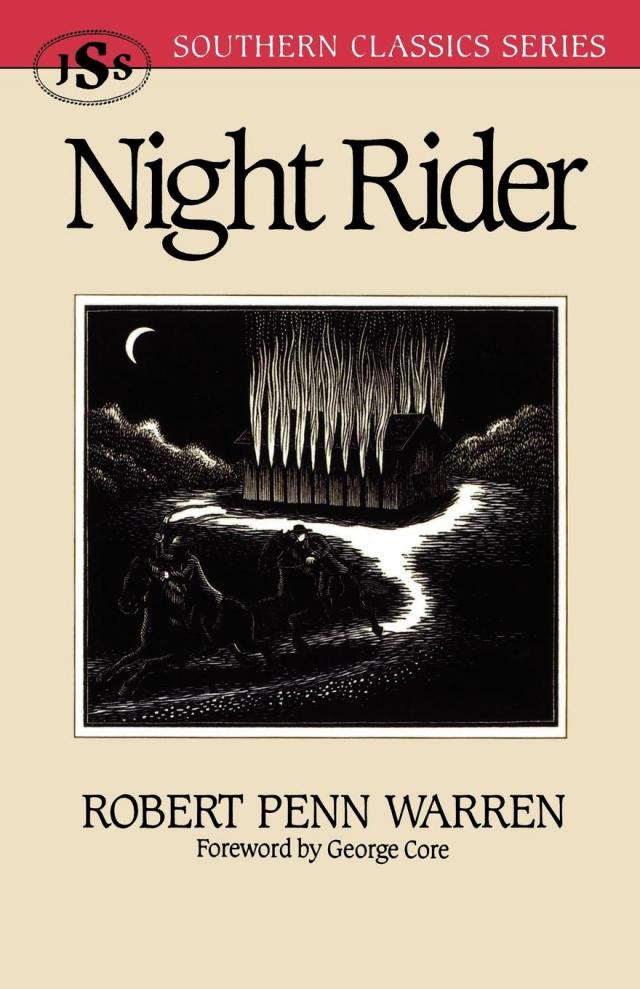
Under the uneven light of the moon the three horsemen moved at a brisk trot down the road, the hoofs making a soft, muffled sound on the earth. Just beyond a little wooden bridge, at a bend on the road where the shadows of a clump of cedars made a dark patch on the pale-colored moonlit road, one of the horsemen drew rein and pointed into the underbrush beside the road. ‘They found him along here,’ he said.
‘I know,’ Mr. Munn answered.
‘He was layen in them buckberry bushes. I come out here when they got him.’
‘Do you know this section out here?’ Mr. Munn demanded.
‘Pretty good,’ the man replied. ‘I been all over it hunting birds. They’s a passel of niggers lives round through here. They lives up and down a little road runs in this-here road ’bout a mile on out. Mr. Sutter, now, he’s got ’bout six cabins on his place. And Mr. May, he’s ——’
‘We’ll start working down the road,’ Mr. Munn said, and lifted his rein. He rode a little ahead of the other men, looking straight down the road, and not speaking again until they came to the place where the little side road joined the main one. ‘Is this it?’ Mr. Munn asked, and pointed down the little road, scarcely more than a lane, that was shortly lost from sight in the woods there.
‘That’s right,’ the first deputy told him. ‘They’s a cabin in the far side of these-here woods. Old, yaller, wall-eyed nigger man lives there, used to live on the Burdett place. You remember, Burke’ — and he turned to the other deputy — ‘that old, yaller, wall-eyed nigger’s name?’
‘It doesn’t matter,’ Mr. Munn said.
‘Naw,’ the first deputy agreed, ‘it don’t matter what he calls hisself. This ain’t exactly what you might call a social visit.’
The almost bare boughs of the trees made a web-like pattern of shadow on the road. Overhead, the highest twigs seemed touched with a delicate, pale tinsel. The main trunks against the moonlight were of an inky and unreal blackness. ‘I come out here once at night coon-hunting,’ the deputy called Burke said. ‘I wasn’t much more’n a boy, I reckon, and I come out here with some fellers.’
The other men seemed to be paying him no attention, looking down the road.
‘They was Ike Summer, I recollect, and George Hicks. I can’t name the other fellers right off. I reckon some of ’em ain’t round here no more.’
Distantly, off to the right, an owl hooted in the woods. Mr. Munn looked in that direction, and then gave his attention again to the road.
‘It was a long time back,’ the deputy called Burke added, and fell silent.
The other deputy sniggered. ‘You say you was coon-hunting?’ he inquired.
‘Yes,’ Burke said. ‘We come coon-hunting. We got two coons, I recollect.’
‘Well’ — and the other sniggered again — ‘you might say as you’re coon-hunting tonight, too.’
For a moment Burke, as though irritated or truculent, did not respond. Then he exclaimed, ‘Huh, coon-hunting, that’s good, huh!’ And laughed. ‘Well,’ he added, his laughter over, ‘I been doing this kind of coon-hunting all over hell for a long time now.’
Mr. Munn stretched out his arm toward a clearing by the road some sixty or seventy yards ahead. ‘Is that the place?’ he asked.
The first deputy said it was the place.
‘You better hitch your horse, Mr. Monroe,’ Mr. Munn directed, ‘and go around to the back through the woods, in case anybody comes out that way. We’ll go in the front.’
The deputy named Monroe swung off his horse and hitched it to a sapling by the road. The other men sat their horses quietly. Monroe moved off through the woods over the carpet of dry leaves, getting over the ground with a long, cautious stride that scarcely made a rustle.
‘He sure doesn’t make any noise,’ Mr. Munn said.
The other man shook his head. ‘Naw,’ he rejoined, ‘he’s right light on his feet for a big man.’
They watched the man in the woods out of sight, and then could see him again when he crossed patches of open moonlight.
‘We better get on,’ Mr. Munn said, aware, as he spoke, of breaking a compulsion that would draw his gaze up into the woods after that man who was treading so softly the dead leaves in the moonlit spaces and in the shadows.
He and the man named Burke stopped at the corner of the clearing and hitched their horses. They approached the cabin. In the bright light that flooded the little clearing, the separate logs of which the cabin was built, and even the individual, small roughnesses of the chinking, seemed, somehow, more clear and emphatic than in the full day. In that light the limestone chimney was licked bone-white.
The deputy knocked on the door.
A noise of stirring preceded the question, muffled by sleep and the walls, that came from someone within the cabin: ‘Who’s dare?’
‘Open up,’ the deputy said.
There was no answer. There was more stirring and a sound like low voices.
‘We just want to ask you a question,’ Mr. Munn called out.
The voice from within said, ‘I’se come-en, boss.’ Then the door swung open grudgingly and with a rasp of the hinges that seemed, suddenly, loud. A man stuck his head out, a negro man, Mr. Munn remembered with surprise, seeing how palish that face looked in the moonlight.
The deputy put his hand firmly against the door, and leaned forward with his shoulder against it, but almost casually. ‘Open up,’ he commanded, ‘and, Uncle, maybe you better light a lamp.’
Mr. Munn followed the deputy through the door into the interior of the cabin, where the dark seemed, on the instant, close and inimical and suffocating, like a depth.
The match flared in the hand of the man and touched the wick of the lamp to a smoky flame. The man turned his gaze on Mr. Munn. His face, Mr. Munn now observed, was yellowish, and the eyeballs were yellow, too, and too large.
‘Whut you want, boss?’ he asked Mr. Munn.
‘Well ——’ and Mr. Munn hesitated, and looked toward the deputy’s impassive face. He felt like a coward, a sneak, when the rest of the sentence wouldn’t come out and he looked toward the deputy; and he was sure the deputy, noticing his hesitation and his appealing glance, had put him down as a coward, too, or a fool.
‘Well, Uncle,’ the deputy said matter-of-factly, ‘where do you do you all’s cooking? You got a kitchen?’
Even as the deputy spoke, Mr. Munn was aware of the woman who lay huddled under the quilt in the bed just outside the direct rays of the lamp. He was aware of her because of her eyes, which in the shadow were glinting and dark and steady and not quite human, like the eyes of a nesting bird staring at the intruder from the interior shadow of a tree, or the eyes of a rabbit in its form.
‘We cooks in the other room,’ the negro man was saying; and the deputy stepped to the closed door and pushed it back with a familiar gesture. ‘Bring the light,’ he directed. Mr. Munn followed the negro man, who carried the lamp, into the other room, aware all the while of those eyes fixed on him.
‘Where do you keep your knives and forks and such?’ the deputy demanded.
‘In that-air drawer in the safe,’ the negro said, and pointed toward the dark, leaning cabinet, which was propped up on bricks.
The deputy opened the drawers and rattled the implements about with a forefinger. He looked up at the man, asking, ‘This all you got?’ The man nodded and said, ‘Yassuh.’ The deputy turned to Mr. Munn, inquiring with an inflection of patience, ‘Reckon we better shake it down?’
Mr. Munn nodded.
‘You better call Monroe in, then,’ the deputy said.
Mr. Munn went to the back door of the room, opened it, and spoke the man’s name loudly. He watched the tall figure detach itself from the ring of shadow under the trees and approach across the clearing, its own dark shadow swimming before it in the pure light.
When Monroe entered, Burke looked up from a box of nails and scrap-iron and wire and twine which he was examining, and said, ‘Just start in anywhere.’ Monroe went to a trunk that stood in the corner across from the stove and lifted the lid. In it, Mr. Munn could see, was nothing but a small heap of clothes on the bottom. Monroe seized them with both hands and shook them. There was nothing else in the trunk.
‘It ain’t in here,’ Burke announced shortly; ‘we better go in the other room.’ He turned to the negro. ‘Bring the lamp.’ They all followed Burke into the other room, where the woman gazed at them from the bed without a sound.
‘It’s gonna be a long night of it at this rate,’ Burke said, as they moved off down the road.
‘We might git in luck at the next one,’ Monroe ventured.
But they did not. As before, Monroe went to the rear of the cabin and the other two approached the front door. Here a dog rushed at them, barking, and circled beyond their reach. They searched the cabin systematically, while the negro man, holding a lamp, stood in the middle of the floor, with an expression of strain and puzzlement conquering the sleep on his features, and the woman and the children stared at them with a fixed and uncommunicating gaze. And at each cabin the scene was the same: the spurt of a match and then the wavering and inadequate lamplight scarcely defining the objects of the room, the deputies leaning over to rummage in boxes or to pull open drawers that would rasp with sudden sharpness in the night stillness, and always, just beyond the direct ring of the lamp’s rays, it seemed, the fixed and intent eyes watching from the tumbled bed or pallet. In two cabins babies began to cry as soon as the lamp was lighted, falling quickly into rhythmical, gasping sobs that gave no promise of stopping. At the second, when the child began crying, Mr. Munn turned to the woman and exclaimed, ‘My God, can’t you stop it!’ Without taking her gaze from his face, the woman in a blind, groping motion gathered the baby to her and thrust the nipple of her breast into its mouth.