Delphi collected works o.., p.274
Delphi Collected Works of E. T. A. Hoffmann (Illustrated),
p.274



It was a lucky thing for the anxious and unfortunate Drosselmeier that the king had found his dinner very good that day, and so was in a disposition to listen to any reasonable suggestions, which the magnanimous queen, who deplored Drosselmeier’s fate, did not fail to bring forward. Drosselmeier took courage to plead that, as he had found out the remedy and the means whereby the princess might be cured, he was entitled to his life. The king said this was all stupid nonsense; but, after he had drunk a glass of cherry-brandy, concluded that both the watchmaker and the astronomer should immediately set off on their journey, and never return, except with the nut Krakatuk in their pocket. The man who was to crack the same was, at the queen’s suggestion, to be advertised for in all the newspapers, in the country and out of it.
Drosselmeier and the court astronomer had been fifteen years on their journey without finding any traces of the nut Krakatuk. The countries in which they were, and the wonderful sights they saw, would take me a month at least to tell of. This, however, I shall not do: all I shall say is, that at last the miserable Drosselmeier felt an irresistible longing to see his native town Nuremberg. This longing came upon him most particularly as he and his friend were sitting together smoking a pipe in the middle of a wood; in Asia. “O Nuremberg, delightful city! Who’s not seen thee, him I pity! All that beautiful is, in London, Petersburg, or Paris are nothing when compared to thee! Nuremberg, my own city!” As Drosselmeier deplored his fate in this melancholy manner, the astronomer, struck with pity for his friend, began to howl so loudly that it was heard all over Asia. But at last he stopped crying, wiped his eyes, and said, “Why do we sit here and howl, my worthy colleague? Why don’t we set off at once for Nuremberg? Is it not perfectly the same where and how we seek this horrid nut Krakatuk?” “You are right,” said Drosselmeier; so they both got up emptied their pipes, and walked from the wood in the middle of Asia to Nuremberg at a stretch.
As soon as they had arrived in Nuremberg, Drosselmeier hastened to the house of a cousin of his, called Christopher Zachariah Drosselmeier, who was a carver and gilder, and whom he had not seen for a long, long time. To him the watchmaker related the whole history of Princess Perlipat of Mrs. Mouserinks, and the nut Krakatuk; so that Christopher Zachariah clapped his hands for wonder, and said “O, cousin, cousin, what extraordinary stories are these!” Drosselmeier then told his cousin of the adventures which befell him on his travels: how he had visited the grand duke of Almonds, and the king of Walnuts; how he had inquired of the Horticultural Society of Acornshausen; in short, how he had sought everywhere, but in vain, to find some traces of the nut Krakatuk. During this recital Christopher Zachariah had been snapping his fingers, and opening his eyes, calling out, hum! and ha! and oh! and ah! At last, he threw his cap and wig up to the ceiling, embraced his cousin, and said, “Cousin, I’m very much mistaken, very much mistaken, I say, if I don’t myself possess this nut Krakatuk!” He then fetched a little box, out of which he took a gilded nut, of a middling size. “Now,” said he, as he showed his cousin the nut, “the history of this nut is this: Several years ago, a man came here on Christmas Eve with a sackful of nuts, which he offered to sell cheap. He put the sack just before my booth, to guard it against the nut-sellers of the town, who could not bear that a foreigner should sell nuts in their native city. At that moment a heavy wagon passed over his sack, and cracked every nut in it except one, which the man, laughing in an extraordinary way, offered to sell me for a silver half-crown of the year 1720. This seemed odd to me. I found just such a half-crown in my pocket, bought the nut, and gilded it, not knowing myself why I bought it so dear and valued it so much.” Every doubt with respect to its being the nut which they sought was removed by the astronomer, who, after removing the gilding, found written on the shell, in Chinese characters, the word Krakatuk.
The joy of the travellers was excessive, and Drosselmeier’s cousin, the gilder, the happiest man under the sun, on being promised a handsome pension and the gilding of all the gold in the treasury into the bargain. The two gentlemen, the watchmaker and the astronomer, had put on their night caps and were going to bed, when the latter (that is, the astronomer) said, “My worthy friend and colleague, you know one piece of luck follows another, and I believe that we have not only found the nut Krakatuk, but also the young man who shall crack it, and present the kernel of beauty to the princess; this person I conceive to be the son of your cousin!” “Yes,” continued he, “I am determined not to sleep until I have cast the youth’s horoscope.” With these words he took his night cap from his head, and instantly commenced his observations. In fact, the gilder’s son was a handsome well-grown lad, who had never shaved, and never worn boots.
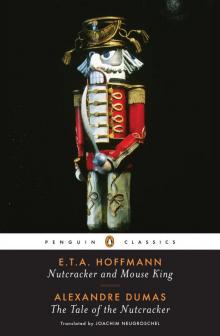
At Christmas he used to wear an elegant red coat embroidered with gold; a sword, and a hat under his arm, besides having his hair beautifully powdered and curled. In this way he used to stand before his father’s booth, and with a gallantry which was born with him, crack the nuts for the young ladies, who, from this peculiar quality of his had already called him “Nutcrackerkin.”
Next morning the astronomer fell delighted on the neck of the watchmaker, and cried, “We have him, — he is found! but there are two things, of which, my dear friend and colleague, we must take particular care: first, we must strengthen the under-jaw of your excellent nephew with a tough piece of wood, and then, on returning home, we must carefully conceal having brought with us the young man who IS to bite the nut; for I read by the horoscope that the king, after several people have broken their teeth in vainly attempting to crack the nut, will promise to him who shall crack it, and restore the princess to her former beauty, — will promise, I say, to this man the princess for a wife, and his kingdom after his death.” Of course the gilder was delighted with the idea of his son marrying the Princess Perlipat and becoming a prince and king; and delivered him over to the two deputies. The wooden jaw which Drosselmeier had fixed in his young and hopeful nephew answered to admiration, so that in cracking the hardest peach-stones he came off with distinguished success.
As soon as Drosselmeier and his comrade had made known the discovery of the nut, the requisite advertisements were immediately issued; and as the travellers had returned with the means of restoring the princess’s beauty, many hundred young men, among whom several princes might be found, trusting to the soundness of their teeth attempted to remove the enchantment of the princess. The ambassadors were not a little frightened when they saw the princess again. The little body with the wee hands and feet could scarcely support the immense deformed head! The hideousness of the countenance was increased by a woolly beard, which spread over mouth and chin. Everything happened as the astronomer had foretold. One dandy in shoes after another broke teeth and jaws upon the nut Krakatuk, without in the slightest degree helping the princess, and as they were carried away half-dead to the dentist (who was always ready), groaned out — that was a hard nut!
When now the king in the anguish of his heart had promised his daughter and kingdom to the man who would break the enchantment, the gentle Drosselmeier made himself known, and begged to be allowed the trial. No one had pleased the princess so much as this young man; she laid her little hand on her heart, and sighed inwardly, Ah! if he were the person destined to crack Krakatuk, and be my husband! Young Drosselmeier, approaching the queen, the king, and the princess Perlipat in the most elegant manner, received from the hands of the chief master of ceremonies the nut Krakatuk, which he immediately put into his mouth, — and crack! crack! — broke the shell in a dozen pieces; he neatly removed the bits of shell which yet remained on the kernel, and then with a most profound bow presented it to the princess, shut his eyes, and proceeded to step backwards. The princess swallowed the kernel; and oh! wonderful wonder! her ugliness disappeared, and, instead, was seen a form of angel beauty, with a countenance like lilies and roses mixed, the eyes of glancing azure, and the full locks curling like threads of gold. Drums and trumpets mingled with the rejoicings of the people. The king and the whole court danced upon one leg, as before, at Perlipat’s birth, and the queen was obliged to be sprinkled all over with eau de Cologne, since she had fainted with excessive joy. This great tumult did not a little disturb young Drosselmeier, who had yet his seven steps to accomplish: however, he recollected himself, and had just put his right foot back for the seventh step, when Mrs. Mouserinks, squeaking in a most hideous manner, raised herself from the floor, so that Drosselmeier, as he put his foot backwards, trod on her, and stumbled, — nay, almost fell down. What a misfortune! The young man became at that moment just as ugly as ever was the princess Perlipat. The body was squeezed together, and could scarcely support the thick deformed head, with the great goggling eyes and wide gaping mouth. Instead of the wooden roof for his mouth, a little wooden mantel hung out from behind his back. The watchmaker and astronomer were beside themselves with horror and astonishment, but they saw how Mrs. Mouserinks was creeping along the floor all bloody. Her wickedness, however, was not unavenged, for Drosselmeier had struck her so hard on the neck with the sharp heel of his shoe, that she was at the point of death; but just as she was in her last agonies, she squeaked out in the most piteous manner, “O Krakatuk, from thee I die! but Nutcracker dies as well as I; and thou, my son, with the seven crowns, revenge thy mother’s horrid wounds! Kill the man who did attack her, that naughty, ugly wicked Nutcracker!” Quick with this cry died Mrs. Mouserinks, and was carried off by the royal housemaid. Nobody had taken the least notice of young Drosselmeier. The princess, however, reminded the king of his promise, and he immediately ordered the young hero to be brought before him. But when that unhappy young man appeared in his deformed state, the princess put her hands before her and cried out, “Away with that nasty Nutcracker!” So the court marshal took him by his little shoulder and pushed him out of the door.
The king was in a terrible fury that anybody should ever think of making a nutcracker his son-in-law: he laid all the blame on the watchmaker and astronomer, and banished them both from his court and kingdom. This had not been seen by the astronomer in casting his horoscope; however, he found, on reading the stars a second time, that young Drosselmeier would so well behave himself in his new station that, in spite of his ugliness, he would become prince and king. In the meantime, but with the fervent hope of soon seeing the end of these things, Drosselmeier remains as ugly as ever; so much so, that the nutcrackers in Nuremberg have always been made after the exact model of his countenance and figure.
THE GOLDEN POT
Translated by Thomas Carlyle
CONTENTS
FIRST VIGIL
SECOND VIGIL
THIRD VIGIL
FOURTH VIGIL
FIFTH VIGIL
SIXTH VIGIL
SEVENTH VIGIL
EIGHTH VIGIL
NINTH VIGIL
TENTH VIGIL
ELEVENTH VIGIL
TWELFTH VIGIL
FIRST VIGIL
The Mishaps of the Student Anselmus. Conrector Paulmann’s Tobacco-box, and the Gold-green Snakes
ON ASCENSION-DAY, about three o’clock in the afternoon, there came a young man running through the Schwarzthor, or Black Gate, out of Dresden, and right into a basket of apples and cakes, which an old and very ugly woman was there exposing to sale. The crash was prodigious; all that escaped being squelched to pieces was scattered away, and the street-urchins joyfully divided the booty which this quick gentleman had thrown them. At the murder-shriek which the crone set up, her gossips, leaving their cake and brandy tables, encircled the young man, and with plebeian violence stormfully scolded him: so that, for shame and vexation, he uttered no word, but merely held out his small, and by no means particularly well-filled purse, which the crone eagerly clutched, and stuck into her pocket. The firm ring now opened; but as the young man started off, the crone called after him: “Ay, run, run thy ways, thou Devil’s bird! To the Crystal run! to the Crystal!” The squealing, creaking voice of the woman had something unearthly in it: so that the promenaders paused in amazement, and the laugh, which at first had been universal, instantly died away. The Student Anselmus, for the young man was no other, felt himself, though he did not in the least understand these singular phrases, nevertheless seized with a certain involuntary horror; and he quickened his steps still more, to escape the curious looks of the multitude, which were all turned towards him. As he worked his way through the crowd of well-dressed people, he heard them murmuring on all sides: “Poor young fellow! Ha! what a cursed beldam it is!” The mysterious words of the crone had oddly enough given this ludicrous adventure a sort of tragic turn; and the youth, before unobserved, was now looked after with a certain sympathy. The ladies, for his fine shape and handsome face, which the glow of inward anger was rendering still more expressive, forgave him this awkward step, as well as the dress he wore, though it was utterly at variance with all mode. His pike-grey frock was shaped as if the tailor had known the modern form only by hearsay; and his well-kept black satin lower habiliments gave the whole a certain pedagogic air, to which the gait and gesture of the wearer did not at all correspond.
The Student had almost reached the end of the alley which leads out to the Linke Bath; but his breath could stand such a rate no longer. From running, he took to walking; but scarcely did he yet dare to lift an eye from the ground; for he still saw apples and cakes dancing round him; and every kind look from this or that fair damsel was to him but the reflex of the mocking laughter at the Schwarzthor. In this mood, he had got to the entrance of the Bath: one group of holiday people after the other were moving in. Music of wind-instruments resounded from the place, and the din of merry guests was growing louder and louder. The poor Student Anselmus was almost on the point of weeping; for he too had expected, Ascension-day having always been a family-festival with him, to participate in the felicities of the Linkean paradise; nay, he had purposed even to go the length of a half portion of coffee with rum, and a whole bottle of double beer; and that he might carouse at his ease, had put more money in his purse than was entirely convenient or advisable. And now, by this fatal step into the apple-basket, all that he had about him had been swept away. Of coffee, of double or single beer, of music, of looking at the bright damsels; in a word, of all his fancied enjoyments, there was now nothing more to be said. He glided slowly past; and at last turned down the Elbe road, which at that time happened to be quite solitary.
Beneath an elder-tree, which had grown out through the wall, he found a kind green resting-place: here he sat down, and filled a pipe from the Sanitätsknaster, or Health-tobacco-box, of which his friend the Conrector Paulmann had lately made him a present. Close before him, rolled and chafed the gold-dyed waves of the fair Elbe-stream: behind this rose lordly Dresden, stretching, bold and proud, its light towers into the airy sky; which again, farther off, bent itself down towards flowery meads and fresh springing woods; and in the dim distance, a range of azure peaks gave notice of remote Bohemia. But, heedless of this, the Student Anselmus, looking gloomily before him, blew forth his smoky clouds into the air. His chagrin at length became audible, and he said: “Of a truth, I am born to losses and crosses for my life long! That in boyhood, at Odds or Evens, I could never once guess the right way; that my bread and butter always fell on the buttered side; of all these sorrows I will not speak: but is it not a frightful destiny, that now, when, in spite of Satan, I have become a student, I must still be a jolthead as before? Do I ever put a new coat on, without the first day smearing it with tallow, or on some ill-fastened nail or other, tearing a cursed hole in it? Do I ever bow to any Councillor or any lady, without pitching the hat out of my hands, or even sliding away on the smooth pavement, and shamefully oversetting? Had I not, every market-day, while in Halle, a regular sum of from three to four groschen to pay for broken pottery, the Devil putting it into my head to walk straight forward, like a leming-rat? Have I ever once got to my college, or any place I was appointed to, at the right time? What availed it that I set out half an hour before, and planted myself at the door, with the knocker in my hand? Just as the clock is going to strike, souse! some Devil pours a wash-basin down on me, or I bolt against some fellow coming out, and get myself engaged in endless quarrels till the time is clean gone.
“Ah! well-a-day! whither are ye fled, ye blissful dreams of coming fortune, when I proudly thought that here I might even reach the height of Privy Secretary? And has not my evil star estranged from me my best patrons? I learn, for instance, that the Councillor, to whom I have a letter, cannot suffer cropt hair; with immensity of trouble, the barber fastens me a little cue to my hindhead; but at the first bow, his unblessed knot gives way, and a little shock, running snuffing about me, frisks off to the Privy Councillor with the cue in its mouth. I spring after it in terror; and stumble against the table, where he has been working while at breakfast; and cups, plates, ink-glass, sand-box, rush jingling to the floor, and a flood of chocolate and ink overflows the Relation he has just been writing. ‘Is the Devil in the man?’ bellows the furious Privy Councillor, and shoves me out of the room.


_preview.jpg)
_preview.jpg)