Delphi collected works o.., p.90
Delphi Collected Works of E. T. A. Hoffmann (Illustrated),
p.90



“That monstrous chasm had a terrible appearance by day; but now, when night had fallen, and the moon was just peeping down into it, the desolate crags looked like a numberless horde of horrible monsters, the direful brood of hell, rolling and writhing, in wildest confusion, all about its reeking sides and clefts, and flashing up fiery eyes, and shooting forth glowing claws to clutch the race of mortals.
“Torbern, Torbern,’ Elis cried, in a terrible voice, which made the rocks re-echo. ‘Torbern, I am here; you were not wrong I was a wretched fool to fix my hopes on any earthly love, up on the surface here. My treasure, and my life, my all-in-all, are down below. Torbern! take me down with you! Show me the richest veins, the lodes of ore, the glowing metal! I will dig and bore, and toil and labour. Never, never more will I come back to see the light of day. Torbern! Torbern! take me down to you!’
“He took his flint and steel from his pocket, lighted his candle, and went quickly down the shaft, into the deep cutting where he had been on the previous day, without seeing anything of the old man. But what was his amazement when, at the deepest point, he saw the vein of metal with the utmost clearness and distinctness, so that he could trace every one of its ramifications, and its risings and fallings. But as he kept his gaze fixed more and more firmly on this wonderful vein, a dazzling light seemed to come shining through the shaft, and the walls of rock grew transparent as crystal. That mysterious dream which he had had in Goethaborg came back upon him. He was looking upon those Elysian Fields of glorious metallic trees and plants, on which, by way of fruits, buds, and blossoms, hung jewels streaming with fire. He saw the maidens, and he looked upon the face of the mighty queen. She put out her arms, drew him to her, and pressed him to her breast, Then a burning ray darted through his heart, and all his consciousness was merged in a feeling of floating in waves of some blue, transparent, glittering mist.
“‘Elis Froebom! Elis Froebom!’ a powerful voice from above cried out, and the reflection of torches began shining in the shaft. It was Pehrson Dahlsjoe come down with the Captain to search for the lad, who had been seen running in the direction of the main-shaft like a mad creature.
“They found him standing as if turned to stone, with his face pressed against the cold, hard rock.
“‘What are you doing down here in the night-time, you foolish fellow?’ cried Pehrson. ‘Pull yourself together, and come up with us. Who knows what good news you may hear.’
“Elis went up in profound silence after Dahlsjoe, who did not cease to rate him soundly for exposing himself to such danger. It was broad daylight in the morning when they got to the house.
“Ulla threw herself into Elis’s arms with a great cry, and called him by the fondest names, and Pehrson said to him:
“‘You foolish fellow! How could I help seeing, long ago, that you were in love with Ulla, and that it was on her account, in all probability, that you were working so hard in the mine? Neither could I help seeing that she was just as fond of you. Could I wish for a better son-in-law than a fine, hearty, hard-working, honest miner — than just yourself, Elis? What vexed me was that you never would speak.’
“‘We scarcely knew ourselves,’ said Ulla, ‘how fond we were of each other.’
“‘However that may be,’ said Pehrson, ‘I was annoyed that Elis didn’t tell me openly and candidly of his love for you, and that was why I made up the story about Eric Olavsen, which was so nearly being the death of you, you silly fellow. Not but what I wished to try you, Ulla, into the bargain. Eric Olavsen has been married for many a day, and I give my daughter to you, Elis Froebom, for, I say it again, I couldn’t wish for a better son-in-law.’
“Tears of joy and happiness ran down Elis’s cheeks. The highest bliss which his imagination had pictured had come to pass so suddenly and unexpectedly that he could scarce believe it was anything but another blissful dream. The workpeople came to dinner, by Dahlsjoe’s invitation, in honour of the event. Ulla had dressed in her prettiest attire, and looked more charming than ever, so that they all cried, over and over again, ‘Ey! what a sweet and charming creature Elis has got for a betrothed! May God bless them and make them happy!’
“Yet the terror of the past night still lay upon Elis’s pale face, and he often stared about him as if he were far away from all that was going on round him. ‘Elis, darling, what is the matter?’ Ulla asked anxiously. He pressed her to his heart and said, ‘Yes, yes, you are my own, and all is well.’ But in the midst of all his happiness he often felt as though an icy hand clutched at his heart, and a dismal voice asked him,
“Is it your highest ideal, then, to be betrothed to Ulla? Wretched fool! Have you not looked upon the face of the queen?’
“He felt himself overpowered by an indescribable, anxious alarm. He was haunted and tortured by the thought that one of the workmen would suddenly assume gigantic proportions, and to his horror he would recognize in him Torbern, come to remind him, in a terrible manner, of the subterranean realm of gems and metals to which he had devoted himself.
“And yet he could see no reason why the spectral old man should be hostile to him, or what connection there was between his mining work and his love.
“Pehrson, seeing Elis’s disordered condition, attributed it to the trouble he had gone through, and his nocturnal visit to the mine. Not so, Ulla, who, seized by a secret presentiment, implored her lover to tell her what terrible thing had happened to him to tear him away from her so entirely. This almost broke his heart. It was in vain that he tried to tell her of the wonderful face which had revealed itself to him in the depths of the mine. Some unknown power seemed to seal his lips forcibly; he felt as though the terrible face of the queen were looking out from his heart, so that if he mentioned her everything about him would turn to stone, to dark, black rock, as at the sight of the Medusa’s frightful head. All the glory and magnificence which had filled him with rapture in the abyss appeared to him now as a pandemonium of immitigable torture, deceptively decked out to allure him to his ruin.
“Dahlsjoe told him he must stay at home for a few days, so as to shake off the sickness which he seemed to have fallen into. And during this time Ulla’s affection, which now streamed bright and clear from her candid, child-like heart, drove away the memory of his fateful adventure in the mine-depths. Joy and happiness brought him back to life, and to belief in his good fortune, and in the impossibility of its being ever interfered with by any evil power.
“When he went down the pit again, everything appeared quite different to what it used to be. The most glorious veins lay clear and distinct before his eyes. He worked twice as zealously as before; he forgot everything else. When he got to the surface again, it cost him an effort of thought to remember about Pehrson Dahlsjoe, about his Ulla, even. He felt as if divided into two halves, as if his better self, his real personality, went down to the central point of the earth, and there rested in bliss in the queen’s arms, whilst he went to his darksome dwelling in Falun. When Ulla spoke of their love, and the happiness of their future life together, he would begin to talk of the splendours of the depths, and the inestimably precious treasures that lay hidden there, and in so doing would get entangled in such wonderful, incomprehensible sayings, that alarm and terrible anxiety took possession of the poor child, who could not divine why Elis should be so completely altered from his former self. He kept telling the Captain, and Dahlsjoe himself, with the greatest delight, that he had discovered the richest veins and the most magnificent trap-runs, and when these turned out to be nothing but unproductive rock, he would laugh contemptuously and say that none but he understood the secret signs, the significant writing, fraught with hidden meaning, which the queen’s own hand had inscribed on the rocks, and that it was sufficient to understand those signs without bringing to light what they indicated.
“The old Captain looked sorrowfully at Elis, who spoke, with wild gleaming eyes, of the glorious paradise which glowed down in the depths of the earth. ‘That terrible old Torbern has been at him,’ he whispered in Dahlsjoe’s ear.
“‘Pshaw! don’t believe these miners’ yarns,’ cried Dahlsjoe. ‘He’s a deep-thinking serious fellow, and love has turned his head, that’s all. Wait till the marriage is over, then we’ll hear no more of the trap-runs, the treasures, and the subterranean paradise.’
“The wedding-day, fixed by Dahlsjoe, came at last. For a few days previously Elis had been more tranquil, more serious, more sunk in deep reflection than ever. But, on the other hand, never had he shown such affection for Ulla as at this time. He could not leave her for a moment, and never went down the mine at all. He seemed to have forgotten his restless excitement about mining work, and never a word of the subterranean kingdom crossed his lips. Ulla was all rapture. Her fear lest the dangerous powers of the subterranean world, of which she had heard old miners speak, had been luring him to his destruction, had left her; and Dahlsjoe, too, said, laughing to the Captain, ‘You see, Elis was only a little light-headed for love of my Ulla.’
“Early on the morning of the wedding-day, which was St. John’s Day as it chanced, Elis knocked at the door of Ulla’s room. She opened it, and started back terrified at the sight of Elis, dressed in his wedding clothes already, deadly pale, with dark gloomy fire sparkling in his eyes.
“‘I only want to tell you, my beloved Ulla,’ he said, in a faint, trembling voice, ‘that we are just arrived at the summit of the highest good fortune which it is possible for mortals to attain. Everything has been revealed to me in the night which is just over. Down in the depths below, hidden in chlorite and mica, lies the cherry-coloured sparkling almandine, on which the tablet of our lives is graven. I have to give it to you as a wedding present. It is more splendid than the most glorious blood-red carbuncle, and when, united in truest affection, we look into its streaming splendour together, we shall see and understand the peculiar manner in which our hearts and souls have grown together into the wonderful branch which shoots from the queen’s heart, at the central point of the globe. All that is necessary is that I go and bring this stone to the surface, and that I will do now, as fast as I can. Take care of yourself meanwhile, beloved darling. I will be back to you directly.’
“Ulla implored him, with bitter tears, to give up all idea of such a dream-like undertaking, for she felt a strong presentiment of disaster; but Elis declared that without this stone he should never know a moment’s peace or happiness, and that there was not the slightest danger of any kind. He pressed her fondly to his heart, and was gone.
“The guests were all assembled to accompany the bridal pair to the church of Copparberg, where they were to be married, and a crowd of girls, who were to be the bridesmaids and walk in procession before the bride (as is the custom of the place), were laughing and playing round Ulla. The musicians were tuning their instruments to begin a wedding march. It was almost noon, but Elis had not made his appearance. Suddenly some miners came running up, horror in their pale faces, with the news that there had been a terrible catastrophe, a subsidence of the earth, which had destroyed the whole of Pehrson Dahlsjoe’s part of the mine.
“‘Elis! oh, Elis! you are gone!’ screamed Ulla, wildly, and fell as if dead. Then only, for the first time, Dahlsjoe learned from the Captain that Elis had gone down the main-shaft in the morning. Nobody else had been in the mine, the rest of the men having been invited to the wedding. Dahlsjoe and all the others hurried off to search, at the imminent danger of their own lives. In vain! Elis Froebom was not to be found. There could be no question that the earth-fall had buried him in the rock. And thus came desolation and mourning upon the house of brave Pehrson Dahlsjoe, at the moment when he thought he was assured of peace and happiness for the remainder of his days.
“Long had stout Pehrson Dahlsjoe been dead, his daughter Ulla long lost sight of and forgotten. Nobody in Falun remembered them. More than fifty years had gone by since Froebom’s luckless wedding-day, when it chanced that some miners who were making a connection-passage between two shafts, found, at a depth of three hundred yards, buried in vitriolated water, the body of a young miner, which seemed, when they brought it to the daylight, to be turned to stone.
“The young man looked as if he were lying in a deep sleep, so perfectly preserved were the features of his lace, so wholly without trace of decay his new suit of miner’s clothes, and even the flowers in his breast. The people of the neighbourhood all collected round the young man, but no one recognized him or could say who he had been, and none of the workmen missed any comrade.
“The body was going to be taken to Falun, when out of the distance an old, old woman came creeping slowly and painfully up on crutches.
“Here’s the old St. John’s Day grandmother!’ the miners said. They had given her this name because they had noticed that she came always every year on St. John’s Day up to the main shaft, and looked down into its depths, weeping, lamenting, and wringing her hands as she crept round it, then going away again.
“The moment she saw the body she threw away her crutches, lifted her arms to Heaven, and cried, in the most heartrending accents of the deepest lamentation:
“‘Oh! Elis Froebom! Oh, my sweet, sweet bridegroom!’
“And she cowered down beside the body, took the stony hands and pressed them to her heart, chilled with age, but throbbing still with the fondest love, like some naphtha flame under the surface ice.
“‘Ah!’ she said, looking round at the spectators, ‘nobody, nobody among you all, remembers poor Ulla Dahlsjoe, this poor boy’s happy bride fifty long years ago. When I went away, in my terrible sorrow and despair, to Ornaes, old Torbern comforted me, and told me I should see my poor Elis, who was buried in the rock upon our wedding-day, yet once more here upon earth. And I have come every year and looked for him, all longing and faithful love. And now this blessed meeting has been granted me this day. Oh, Elis! Elis! my beloved husband!’
“She wound her arms about him as if she would never part from him more, and the people all stood round in the deepest emotion.
“Fainter and fainter grew her sobs and sighs, till they ceased to be audible.
“The miners closed round. They would have raised poor Ulla, but she had breathed out her life upon her bridegroom’s body. The spectators noticed now that it was beginning to crumble into dust. The appearance of petrifaction had been deceptive.
“In the church of Copparberg, where they were to have been married fifty years before, they laid in the earth the ashes of Elis Froebom, and with them the body of her who had been thus ‘Faithful unto death.’”
“I see,” said Theodore, when he had finished, and the friends sat looking straight before them in silence, “that you don’t much like this story of mine. Perhaps, in your present mood of mind, it strikes you as too painful.”
“It does produce a terribly melancholy effect upon one,” said Ottmar, “and, to speak my candid opinion, I cannot say that I care about all the Swedish ‘Fraelse’ holders, the national festivities, the spectral miners, visions, and so forth. The simple account in Schubert’s ‘Night Side of Natural Science,’ of the finding of a body in the Falun Mine, which an old woman recognized as her betrothed of fifty years before, affected me much more deeply.”
“I must betake myself for aid to our patron, Serapion,” said Theodore; “for the story of the miner really came to my fancy exactly as I have told it.”
“Everybody has his own way of looking at things,” said Lothair, “but perhaps it is as well that it was to us that you read this tale, inasmuch as we have all some knowledge of mining matters, of Falun, and of Swedish manners and customs. Other people might say you had sometimes been a little unintelligible from the use of too much mining phraseology; and it isn’t everybody who would know that the ‘Aehl’ which you mention so often is simply a fine, strong sort of beer.”
“Theodore’s story has not displeased me so much as it has you, Ottmar,” said Cyprian. “Writers very often show us people who perish in some disastrous way as having been at issue with themselves all through their lives, as if under the control of unknown powers of darkness. This is what Theodore has done; and I must say I approve of it, because I think it is exceedingly true to nature. I have known people who have suddenly seemed to alter and change completely — who have appeared to be suddenly petrified (so to speak) within themselves, or driven hither and thither by hostile powers, in constant unrest, till some fearful catastrophe has withdrawn them from life.”
“Stop, stop!” cried Lothair. “If we give this spirit-seer Cyprian a chance, we shall be drawn into a regular labyrinth of dreams, presentiments, and all the rest of it. Allow me to dispel the gloomy tone which has come upon us at one stroke, by reading you — as a finale to our present sitting — a children’s story which I wrote a short time ago, as I believe, under the direct inspiration of the tricksy spirit Puck, himself.”
“A children’s story by you, Lothair!” they all cried.
“Even so,” said Lothair. “It may seem to you a piece of insanity that I should write a children’s story; but let me read it to you, and then give your verdicts.”
Lothair took a carefully written MS. from his pocket, and read: —
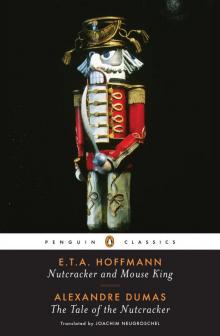
NUTCRACKER AND THE KING OF MICE.
CONTENTS
CHRISTMAS EVE.
THE CHRISTMAS PRESENTS.
MARIE’S PET AND PROTÉGEÉ.
WONDERFUL EVENTS.
THE BATTLE.
THE INVALID.
THE STORY OF THE HARD NUT.
UNCLE AND NEPHEW.
VICTORY.
TOYLAND.
THE METROPOLIS.
CONCLUSION.
CHRISTMAS EVE.
“ON THE 24TH of December Dr. Stahlbaum’s children were not allowed, on any pretext whatever, at any time of all that day, to go into the small drawing-room, much less into the best drawing-room into which it opened. Fritz and Marie were sitting cowered together in a corner of the back parlour when the evening twilight fell, and they began to feel terribly eery. Seeing that no candles were brought, as was generally the case on Christmas Eve, Fritz, whispering in a mysterious fashion, confided to his young sister (who was just seven) that he had heard rattlings and rustlings going on all day, since early morning, inside the forbidden rooms, as well as distant hammerings. Further, that a short time ago a little dark-looking man had gone slipping and creeping across the floor with a big box under his arm, though he was well aware that this little man was no other than Godpapa Drosselmeier. At this news Marie clapped her little hands for gladness, and cried:


_preview.jpg)
_preview.jpg)