Delphi collected works o.., p.67
Delphi Collected Works of E. T. A. Hoffmann (Illustrated),
p.67



The text is structured over eight evenings (sections), wherein six friends, Theodor, Lothar, Cyprian, Vinzenz, and Sylvester, orally present a total of 28 stories (only 19 have titles) and discuss in detail their quality and whether or not they adhere to a certain “Serapion Principle” that becomes clear to the reader as the narrative progresses.
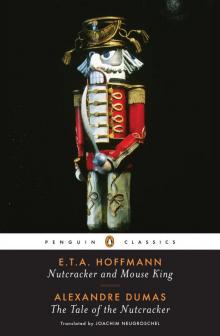
The collection is famous for containing The Nutcracker and the Mouse King (Nussknacker und Mausekönig), a story written in 1816, in which young Marie Stahlbaum’s favorite Christmas toy, the Nutcracker, comes alive and, after defeating the evil Mouse King in battle, whisks her away to a magical kingdom populated by dolls. The Russian Romantic composer Pyotr Ilyich Tchaikovsky famously adapted the tale for his celebrated 1892 ballet The Nutcracker, which remains a popular and enduring entertainment throughout the Christmas period in the Western world.
Another important tale is Mademoiselle de Scudéri. A Tale from the Times of Louis XIV, which was first published in 1819 in Yearbook for 1820. Dedicated to Love and Friendship, the story was an immediate commercial and critical success and led to Hoffmann’s becoming a popular and well-paid author. The tale is still widely regarded as one of Hoffmann’s best, not only because of its suspenseful plot and interesting descriptions of life, places and people in late seventeenth-century Paris, but also due to the many different levels of interpretation that it allows. Mademoiselle de Scudéri is sometimes cited as the first detective story and went on to have a direct influence on Edgar Allan Poe's The Murders in the Rue Morgue.
The first edition’s title page
CONTENTS
VOLUME I.
SECTION I.
AN INTERRUPTED CADENCE.
THE POET AND THE COMPOSER.
SECTION II.
A FRAGMENT OF THE LIVES OF THREE FRIENDS.
THE ARTUS HOF.
THE MINES OF FALUN.
NUTCRACKER AND THE KING OF MICE.
SECTION THIRD.
THE SINGERS’ CONTEST.
AUTOMATONS.
THE DOGE AND THE DOGARESSA.
SECTION FOURTH.
MASTER MARTIN, THE COOPER, AND HIS MEN.
THE STRANGER CHILD.
ENDNOTES.
VOLUME II.
SECTION V.
THE LIFE OF A WELL-KNOWN CHARACTER.
ALBERTINE’S WOOERS.
THE UNCANNY GUEST.
SECTION SIXTH.
MADEMOISELLE SCUDERI:
GAMBLERS’ FORTUNE.
SECTION VII.
SIGNOR FORMICA.
PHENOMENA.
SECTION EIGHT.
THE MUTUAL INTERDEPENDENCE OF THINGS.
THE KING’S BETROTHED.
ENDNOTES.
Adelbert von Chamisso (1781-1838), a German poet and botanist, was the author of ‘Peter Schlemihl’, a famous story about a man who sold his shadow.
VOLUME I.
PREFACE.
NOTWITHSTANDING THE POPULARITY which several of Hoffmann’s tales have obtained in many different countries, we are not aware of any complete or accurate translation of his works. In England they have become known in a very partial form, chiefly by the appearance of a few isolated tales in association with those of other writers, as in the ‘Specimens of German Romance,’ or in Gillies’ ‘German Stories,’ which were published about 1830. Others are familiar only through the medium of a translation from a previous French version, as is the case with the well-known ‘Nutcracker,’ — and in this process of double dilution the Author’s name has sometimes disappeared altogether.
The most important attempt to present this writer to English readers is the recent publication of two volumes entitled ‘Hoffmann’s Weird Stories,’ which contain eleven tales seven being from the Serapions-Brüder, two from the Nachtstücke, and two from other parts of his works. These stories are all separated from the setting in which, as in the present volume, they for the most part appeared, and the translator has not aimed at any completeness or method in their selection. The first attempt to give English readers a satisfactory idea of Hoffmann’s work in its completeness is inaugurated by the present volume, which will be followed by the remaining portion of the Serapion Brethren, and in due course it is hoped by other portions of his works.
Musicians will be interested by the fulness with which the Author’s views on musical subjects so much in advance of his age, and so just and accurate are developed in many places, such as the dialogue called “The Poet and the Composer,” and the conversation which precedes the tale “Master Martin.” It would be of much interest could any of Hoffmann’s numerous musical compositions be brought to light at the present day; they appear to have been considerably in advance of their period, although Weber’s critique on one of Hoffmann’s operas is full of high praise.
A. E.
Taunton, September, 1886.
SECTION I.
“LOOK AT THE question how one will, the bitter conviction is not to be got rid of by persuasion, or by force, that what has been never, never can be again. It is useless to contend with the irresistible power of Time, which goes on continually creating by a process of constant destruction. Nothing survives save the shadowy reflected images left by that part of our lives which has set, and gone far below our horizon; and they often haunt and mock us like evil, ghostly dreams. But we are fools, and expect that matters which, in reality, were nothing but our ideas, parts and portions of our own individualities, are to be found actually existent in the world outside us, and blooming in perpetual youth! The woman we have loved and parted from, the friend to whom we have said good-bye, are both lost to us for ever. The people whom, perhaps years afterwards, we meet as being them, are not the same whom we left, neither are we ever the same to them.”
So saying, Lothair got up from his seat, and folding his arms on the mantel-piece, gazed, with gloomy sadness, into the fire which was blazing and crackling merrily.
“One thing is certain enough,” said Theodore, “that, at all events, you, dear Lothair, are so far actually the same Lothair whom I bade good-bye to twelve years ago, that whenever any little thing vexes or disappoints you at all, you immediately sink down to the lowest depths of gloom and despair. It is quite true — and Cyprian, Ottmar and I feel it as much as you that this first meeting of ours after our twelve years’ separation comes short of being quite all that we had pictured it to be. Put the blame on me, who raced through one of those endless streets of ours after another, leaving no stone unturned to get you all assembled here to-night by my fireside. Perhaps I had better have left it to chance. But I could not bear the idea that we — who had spent so many years together in such close friendship, joined by the bonds of our common pursuits in art and knowledge, and only driven asunder by the hurricane which raged during that fateful time — that we, I say, should come to cast anchor in the same harbour, for so much as a single day, and yet not look upon each other with the eyes of the body, as we had with the eyes of the spirit in the interval. And now, we have been sitting here together for some hours, wearying ourselves to death over the enthusiastic quality of our revived friendship, yet not one of us has said anything worth listening to: we have talked tedious, tiresome stuff, to a perfectly astonishing extent. And why is this, but because we are a set of very childish children, thinking we were going to take up the old tune which we sang twelve years ago, at the point where we broke off with it, and go on singing it as we were doing then. Lothair, we will say, should have read Tieck’s ‘Zerbino’ aloud to us for the first time, to our astonished delight; or Cyprian should have brought some fanciful poem, or perhaps the text of a whole operatic extravaganza, to which I should then have composed the music on the spot, and thundered it out on the old weak-loined piano of twelve years back; or Ottmar should have told us about some wonderful curiosity he had come across — some remarkable wine, some extraordinary nincompoop, etc., and set us all on fire with projects and ideas how to make the most of our enjoyment of either, or both; and because none of all this has happened, we sit secretly sulking at each other, each thinking (of the other) ‘Ay! what a change in the dear old fellow. Well! I never should have believed he could have altered so!’ Of course we none of us are the same. I say nothing of the circumstance that we are twelve years older; that, no doubt, every year lays more earth upon us, which weighs us down from aerial regions, till we go under the earth at last. But whom of us, all this time, has not the wild whirlpool carried surging on from event to event, and from action to action? The terror, the trouble, the anxiety of that stormy time,1 could not pass over us without leaving bleeding scars graven on our hearts. The pictures of our early days are pale compared with that, and we cannot revive their colours. No doubt, too, there is much in life and in ourselves which looked very bright and glorious, and has lost its dazzling glitter for our eyes, grown accustomed to a brighter light; but the modes of thinking and feeling which gave rise to our friendship remain pretty much the same. I mean that we all consider each other something rather above the common, in suitability to each other at all events, so as to be worthy of a thorough friendship. So let us leave the old days out of sight, with all the promise and anticipations belonging to them, and, starting from the conviction which I have expressed, see how we can best establish a new bond of union.”
“Heaven be thanked,” said Ottmar, “that Lothair could no longer endure the forced, unnatural condition in which we were, and that you, Theodore, have at once exorcised the malignant little fiend which was vexing and teasing us. This constrained feeling of ‘You are bound to be enjoying yourself, whether you really are or not,’ was beginning to stifle me, and I was just getting fearfully out of temper, when Lothair broke out as he did. But now that Theodore has pointed out so clearly what it was that was amiss, I seem to be brought much nearer to you all, and things appear as if the old kindly unconstrained comfort, with which we used to meet, were getting the upper hand. Theodore is right; though Time has altered a good many things, our belief in each other remains untouched. And with this, I solemnly declare the preliminaries of our new League established; and it is laid down as a rule that we come together once every week on a certain day — otherwise we shall lose sight of each other in this big town, and be further asunder than ever.”
“A great idea,” cried Lothair, “only you should add a few regular rules as to our weekly meetings; for instance, that we are, or are not, to talk upon certain subjects; or that each of us is bound to be three times as witty as usual; or that we must always eat sardine-salad. In this fashion, the fullest blown form of Philistinism that flourishes in any club will burst in upon us. Don’t you think, Ottmar, that anything in the shape of a formal stipulation connected with our meetings would at once introduce an element of constraint, destructive, at all events, of my enjoyment in them? Let me remind you of the extreme repugnance which we used to feel towards everything in the shape of a ‘club,’ or whatever name might be given to absurd institutions of the kind, where all sorts of tedium and wearisomeness are carried forward on system. And now you propose to force and constrain, artificially, this four-bladed clover-plant of ours — which can only flourish and thrive naturally without any gardener’s training — into an evil form of this sort.”
“Our friend Lothair,” said Theodore, “does not get out of his moods so very quickly, that we all know; as also that when he is in them he sees spectres, and fights with them sturdily until he is dead-beat, and obliged to acknowledge that they were nothing but spectres, the creations of his own brain. How is it possible, Lothair, that Ottmar’s harmless and very innocent suggestion should at once set you thinking of clubs, and the Philistinism inherent in them? All the same, you have brought to my memory a very amusing remembrance of our former days. I dare say you remember the time when we first left the Residency and went to the little town of P —— ? The customs of society made it incumbent on us to join the club which the so-called ‘Upper ten’ of the place belonged to. We received due notification, in a solemn document, worded in the most formal juridical style, that, after the due formalities, we had been admitted as members; and this notification was accompanied by a great book, of some fifteen to twenty sheets of paper, handsomely bound, containing the Club Rules. They had been drawn up by an old legal luminary, exactly in the style of the Prussian Municipal Code, all divided into titles and paragraphs, and were the most entertaining reading it is possible to conceive. For instance, one title was superscribed, ‘Concerning Women and Children, and their Rights, and Privileges,’ in which nothing more or less was sanctioned than that the wives and daughters of the members had the privilege of coming to tea within the precincts of the club every Thursday and Sunday evening, and might even dance there some five or six times during the winter. Concerning children the law was still more accurately and critically enunciated, the jurist having handled this subject with even more than his usual care, jealously distinguishing between children under age, children of age, and children under parental tutelage. Those under age were further sub-divided, according to their moral qualities, into well-behaved, and ill-behaved, and the latter were unconditionally debarred from admission, ‘good behaviour’ being a fundamental principle of the club constitution. The next title was the noteworthy one, ‘Concerning Dogs, Cats, and other irrational creatures,’ and laid down that nobody might bring into the club any dangerous wild beast. So that, had any member taken to himself (for example) a lion, a tiger, or a panther by way of lapdog, it would have been impossible for him to take it into the club. Even had its mane and claws been cut, a schismatic of this description would have been excluded unconditionally by the committee. Even the cleverest poodles, and the most highly-trained pugs were declared ineligible, and might only, (on exceptional occasions in summer, when dinner was in the open air,) be introduced, on presentation of a card of permission by the committee. We — Lothair and I — invented a number of addenda and declarations supplementary to this deeply-considered codex, which we proposed, with the most solemn gravity, at the next meeting, and, to our great entertainment, carried the thing so far that the most preposterous nonsense was discussed and debated on with the gravest deliberation. But at last one or two saw through our joke, so that all confidence in us was at an end — although our expectations were not realised, for we had thought it a certainty that we should be solemnly expelled from the club.”
“I remember it quite well,” said Lothair, “and I’m not a little annoyed to feel that nowadays I could not carry out a similar mystification. I have grown much too dull and sluggish, and inclined to be annoyed with matters which used to make me laugh.”
“Nothing shall induce me to believe that,” said Ottmar; “rather I feel convinced, Lothair, that the echoes of something painful are louder in you to-day than common. But a new life will shortly breathe through you like a breeze of spring; those jarring discords will die away, and you will be the same Lothair that you were twelve years since. Your club at P —— reminds me of another, whose founders must have been witty fellows. It was on the plan of a regular kingdom, with a King, Ministers, a Parliament, &c. Its sole raison d’être was good eating, and better drinking, and its meetings were held in the principal hotel, where the wines and cuisine were of the best. At those meetings, the Minister for Foreign Affairs would give notice of the arrival of some remarkably superior Rhine wine at some merchant’s in the town. An embassy would then be despatched, furnished with minute instructions, and provided with necessary credits to be drawn against a special reserve-fund in the hands of the Chancellor of the Exchequer. On occasions when a ragout turned out badly, everything was at sixes and sevens. Pourparlers and diplomatic notes were exchanged relating to the threatening aspect of the affairs of the realm. Then Parliament would meet to decide as to the particular wine to be used on a given day in compounding the cold punch. The decision had to be solemnly laid before His Majesty in Council, and, after due deliberation, the King would bow, in assent; the ordinance concerning the cold punch, duly passed, would be remitted for execution to the Minister of the Interior. Art and Science, also, were represented in these ceremonies; the poet who wrote a new drinking song, and the musician who composed and performed it, receiving a decoration from His Majesty’s hands in the shape of a red hen’s feather, coupled with the permission to drink an extra bottle of wine — at their own expense. On State occasions the King had a crown, orb, and sceptre of gilt pasteboard, and the dignitaries of the realm wore quaint head-dresses. The symbol of the fraternity was a silver box with a hen sitting on eggs on the lid. At the time when I forgathered with this pleasant company, there was a large proportion of talented people in its ranks, so that it was entertaining enough, as far a it went.”
“I have no doubt it was,” said Lothair, “but I can’t comprehend how a thing of the kind could be kept up for any length of time. The best of jokes loses its point if it is kept going so long as it seems to have been in this ‘Lodge of the Clucking Hen,’ if I may so style it. You have both, Theodore and Ottmar, told us of clubs on a grand scale, with their rules, regulations, and mystifications. Let me direct your attention to what was probably the very minutest club that ever, I should think, existed on this earth. In a certain little town on the Polish frontier, occupied, at the time, by Prussia, the only German officials were an old captain — retired on account of bad health — who was postmaster, and the exciseman. Every evening as the clock struck five, these two repaired to the only inn which there was in the place, to a little room where nobody else was admitted. Generally, the exciseman arrived there before the captain, who would find him smoking his pipe over his jug of beer. The captain, on coming in, would greet him with, ‘Fine evening! Any news?’ sit down opposite to him at the table; light his pipe — filled beforehand; take the paper out of his pocket, and hand each sheet, as he finished it, across to the exciseman, who would read it with equal care and avidity. They would go on puffing their clouds of smoke into each other’s eyes in profound silence, till the clock struck eight, when the exciseman would get up, knock the ashes out of his pipe, and with a ‘Not much news, to speak of,’ be off to his bed. This they styled, in all seriousness, ‘Our Club.’


_preview.jpg)
_preview.jpg)