

The case of the shoplift.., p.1
The Case of the Shoplifter's Shoe,
p.1
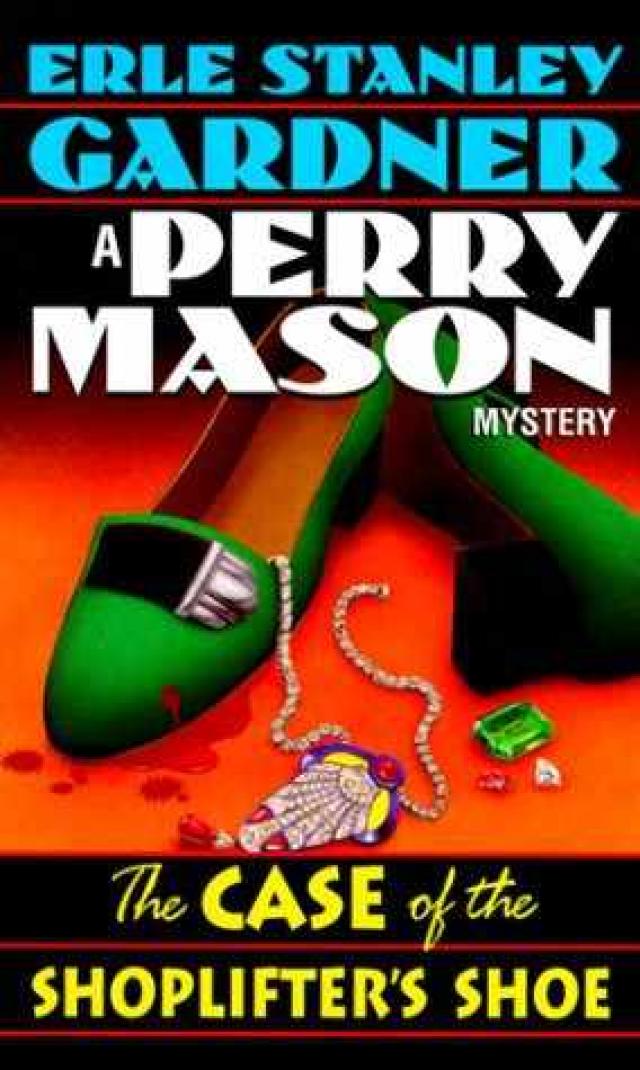


The Case of the
Shoplifter’s Shoe
by
Erle Stanley Gardner
Copyright © 1938 by Erle Stanley Gardner. Renewed 1965.
Electronic Book: Copyright © 2012 by The Erle Stanley Gardner Literary Trust.
All rights reserved.
Contents
Copyright
Cast of Characters
Chapter 1
Chapter 2
Chapter 3
Chapter 4
Chapter 5
Chapter 6
Chapter 7
Chapter 8
Chapter 9
Chapter 10
Chapter 11
Chapter 12
Chapter 13
Chapter 14
Chapter 15
Chapter 16
Chapter 17
Chapter 18
Chapter 19
Chapter 20
About the Author
Cast of Characters
PERRY MASON, a lawyer who digs up his own evidence
DELLA STREET, Mason’s secretary and “Girl Friday”
SARAH BREEL, whose emotions were very well controlled and whose shoplifting instinct was not
HAWKINS, a department-store detective
VIRGINIA TRENT, a young woman largely controlled by her emotions
GEORGE TRENT, Sarah Breel’s brother, whose periodic binges finally came home to roost
MRS. IONE BEDFORD, an attractive young matron with an interest in jewels
AUSTIN CULLENS, who collected gems, and who knew lots of interesting people
SERGEANT TREMONT, police officer
HARRY DIGGERS, a witness who wished to be fair
PAUL DRAKE, a private detective, whose most exciting, if not his best, client was Perry Mason
SERGEANT HOLCOMB, of the homicide squad, who viewed all defense lawyres as natural enemies
BILL GOLDING, a gambler with a desire for anonymity
EVA TANNIS, Golding’s partner and associate, more deadly than the male
DR. CHARLES GIFFORD, a physician, whose friendship for Perry Mason often tempted him into extracurricular activities
PETE CHENNERY, a wise guy who knew all the answers
LARRY SAMPSON, a deputy district attorney
MR. MARQUAD, a banker, whose indiscretion caught up with him
LIEUTENANT OGILBY, Virginia Trent’s boy friend, whose hobby was firearms
JUDGE BARNES, presiding
DR. CARL FRANKEL, autopsy surgeon
CARL ERNEST HOGAN, ballistics expert for the police force
Chapter 1
As the first big drops of rain splashed to the sidewalk, Perry Mason cupped his hand under Della Street’s elbow and said, “We can make it to the department store—if we run.” She nodded, held up her skirt with her left hand, and ran lightly, her weight forward on the balls of her feet, her stride long and easy, with lots of knee action. Perry Mason, long-legged as he was, did not have to hold back on her account.
The first forerunners of the shower had caught them on a side street where there were no protecting awnings. By the time they reached the corner, the eaves were sluicing rain. The portico of the department store was twenty yards from the corner. They sprinted for it, while raindrops, pelting like liquid bullets, hit the sidewalk so hard they seemed to rebound before exploding into mushrooms of water. Mason guided Della Street straight through the revolving door. “Come on,” he said, “this rain’s good for half an hour, and there’s a restaurant on the top floor where we can tea and talk.”
Her laughing eyes regarded him from under long lashes in sidelong appraisal. “I didn’t think I’d ever get you into a department store tea room, Chief.”
Mason regarded the drops of water on the brim of his straw hat. “It’s Fate, Della,” he laughed. “And remember, I’m not going to squire you around while you shop. We get in the elevator and go to the top floor. I pay no attention when the attendant says, ‘Second Floor … Women’s fur coats and lingerie, third floor, diamonds, pearl necklaces and gold earrings, fourth floor, wrist watches, pendants, and …’”
“How about the fifth floor?” she interrupted. “Flowers, candies and books. You might stop there. Can’t you give a working girl a break?”
“Not a chance,” he told her. “Straight up to the sixth floor—tea, biscuits, baked ham and pie.”
They crowded into the elevator. The cage moved slowly upward, stopping at each floor while the girl called out the various departments in a tired monotone. “We forgot children’s toys on the fifth,” Della Street pointed out.
Mason’s eyes were wistful. “Some day, Della,” he said, “when I’ve won a big case, I’m going to get a railroad track with stations, tunnels, block signals and side tracks. I’ll lay out an elaborate electric railway through my private office, out into the law library, and …” He broke off as she tittered. “Matter?”
“I was just thinking of Jackson in the law library,” she said, “looking up some legal point in beetle-browed concentration, and your electric railroad train rattling and swaying through the door, heading for the library table.”
He chuckled, guided her to a table in the tea room, looked out at the sheeted rain which lashed against the windows. “Jackson,” he said, “would hardly appreciate the humor of the situation. I doubt if he ever had any boyhood.”
“Perhaps,” she ventured, “he was a child in another incarnation.” She picked up the menu. “Well, Mr. Mason, since you’re buying the lunch, I’m going to make it my heavy meal.”
“I thought you were going on a diet,” he said, with mock concern.
“I am,” she admitted, “I’m a hundred and twelve. I want to get back to a hundred and nine.”
“Dry whole wheat toast,” he suggested, “and tea without sugar, would …”
“That’ll be fine for tonight,” she retorted, “but as a working girl, I know when I’m getting the breaks. I’ll have cream of tomato soup, avocado and grapefruit salad, a filet mignon, artichokes, shoestring potatoes, and plum pudding with brandy sauce.”
Mason threw up his hands. “There go my profits on the last murder case. I’ll have one slice of melba toast, cut very thin, and a small glass of water.” But, when he glanced up to see the waitress hovering at his elbow, he said firmly, “Two cream of tomato soups, two avocado and grapefruit salads, two filet mignons, medium rare, two hot artichokes, two shoestring potatoes, and two plum puddings with brandy sauce.”
“Chief!” Della Street exclaimed. “I was only kidding!”
“You should never kid at mealtime,” he told her sternly.
“But I can’t eat all that.”
“This,” he said, “is poetic justice for lying to your employer.” Then, to the waitress, “Go ahead and start bringing it on. Don’t listen to any protests.”
The waitress smiled and departed. Della Street said, “Now I suppose I’ll have to live on bread and water for a week to keep from putting on weight…. Don’t you like to watch people in a place like this, Chief?”
He nodded, his steady, tolerant eyes moving from table to table, appraising the occupants in swift scrutiny.
“Tell me, Chief,” she said, “you’ve seen human nature in the raw. You’ve seen people torn and twisted by emotions which have ripped aside all of the hypocrisy and pretense of everyday life…. Doesn’t it make you frightfully cynical?”
“Quite the contrary,” he said. “People have their strong points and their weak points. The true philosopher sees them as they are, and is never disappointed, because he doesn’t expect too much. The cynic is one who starts out with a false pattern and becomes disappointed because people don’t conform to that pattern. Most of the little chiseling practices come from trying to cope with our economic conventions. When it comes right down to fundamentals, people are fairly dependable. The neighbor who would cheat you out of a pound of sugar, would risk her life to save you from drowning.”
Della Street thought that over, then said, “There’s a lot of difference in people. Look at that aggressive woman over there at the left, bullying the poor waitress … and contrast her with that white-haired woman who’s standing over there by the window—the one who has such a benign, motherly look. She’s so placid, so homey, so …”
Mason said, “As it happens, Della, the woman’s a shoplifter.”
“What!” she exclaimed.
“And,” Mason went on, “the man who’s standing over by the cashier’s desk, apparently trying to cash a check, is a store detective who’s followed her in here.”
“How do you know she’s a shoplifter, Chief?”
“Notice the way she keeps her left arm rigidly at her side. She’s holding something under that long tweed coat. I happen to know the store detective. I was in court once when he was testifying on a case…. Notice the way the woman’s turned her head. I believe she knows she’s being followed.”
“Will she sit down and start eating?” Della asked, her eyes wide with interest.
“Probably not. She must have quite a bit of stuff concealed under her coat. It would be difficult to eat without … There she goes into the restroom.”
“Now what?” Della Street asked.
“If she’s wise she’s being followed,” Mason said, “she’ll probably ditch the stuff in the restroom…. There’s the store detective going over to talk with the colored maid. They’ll try to handle the thing very quietly.”
&nbs
p; “I can’t imagine her being a shoplifter,” Della Street protested. “That white hair, the high forehead, the calm, steady eyes, and the sensitive mouth … it just isn’t possible.”
Mason said thoughtfully, “My experience has taught me that when a person with an honest face has stolen goods in his possession, the face is usually a mask, carefully cultivated as a stock in trade.”
Their waitress brought them steaming, fragrant soup. The maid appeared in the door of the restroom and nodded briefly to the store detective. A moment later, the white-haired woman emerged and walked directly to an adjoining table, which had been set for two, with bread, butter, water glasses, knives and forks in place. She calmly seated herself.
Mason heard an exclamation at his elbow. “Oh, there you are, Aunt Sarah. I lost you.” The lawyer looked up, to see a tallish young woman who moved with quick decision. As he glimpsed her moist gray eyes, his courtroom experience told him there was fear in her voice. The white-haired woman’s voice, on the other hand, showed no fear, only calm poise. “I lost you somewhere in the crowd, Ginny, so I decided I’d come up and have a cup of tea. At my age, I’ve found it never pays to worry. I knew you were perfectly capable of taking care of yourself, calling a cab and going home.”
“But I didn’t know about you,” the girl said, seating herself with a nervous laugh, high-pitched with apprehension. “I wasn’t certain you were all right, Aunt Sarah.”
“I’m always all right, Ginny. Never worry abpout me. Always remember that no matter what happens, I’ll take care of myself, and …”
The store detective interposed his bulk between Mason’s eyes and the face of the white-haired woman. “I’m very sorry, Madam,” he said, “but I’m going to have to ask you to step into the office.”
Mason heard a quick gasp of consternation from the girl, but the woman’s voice remained calmly placid. “I have no intention of stepping into the office, young man. I’m about to eat lunch. If anyone in the office wishes to see me, he can come here.”
“I’m trying,” the detective said with dignity, “to avoid making a scene.”
Mason pushed back his soup, to watch with frank interest, as the detective stepped behind the woman’s chair. She calmly broke off a piece of bread, buttered it, unhurriedly glanced up over her shoulder and said, “Don’t try to avoid making a scene on my account, young man. Go right ahead.”
“You’re making it difficult for me,” he said.
“Indeed!” she muttered.
“Aunt Sarah,” the girl pleaded, “don’t you think …”
“I don’t think I’m going to budge until I’ve had my lunch,” Aunt Sarah interrupted. “They say the cream of tomato soup here is very nice. I believe I’ll try some and …”
“I’m sorry,” the detective interposed, “but unless you accompany me, Madam, it will be necessary for me to make a public arrest.”
“Arrest?” she inquired, pausing with the buttered fragment of bread half way to her lips. “What are you talking about?”
“I’m placing you under arrest for shoplifting,” the man said.
The woman conveyed the bread to her mouth, chewed it calmly, nodding to herself as though mentally digesting the possibilities of the situation. “How very amusing,” she said, picking up her water glass.
The irritation in the detective’s voice made it distinctly audible to persons sitting within a radius of three tables. “I’ve been following you,” he charged, “watching you put things under your coat.” And, as the woman made as though to open her coat, he added quickly, “Of course I know you haven’t them now. You left them in the restroom.” He turned and nodded to the maid, who vanished through the curtained doorway.
“I don’t think,” the woman said reminiscently, as though trying to recall an eventful past, “that I’ve ever been arrested for shoplifting…. No, I’m quite certain I haven’t.”
“Aunty!” the girl exclaimed. “The man’s not joking, he’s serious….He’s …” The maid emerged from the restroom carrying an armful of clothing. There were stilk stockings draped over her arm, bits of silk lingerie, a silk blouse, a scarf and a pair of lounging pajamas.
The girl opened her purse, pulled out a checkbook. “My aunt,” she explained rapidly, “is rather eccentric. She does her shopping at times in an unusual manner. I’m afraid perhaps she’s a little absent-minded. If you’ll kindly tell me the exact amount and will be so good as to have the purchases wrapped, I’ll …”
“I’ll do nothing of the sort,” the detective interrupted. “You can’t get away with that stuff, and you know it. That’s an old gag, pulled by every shoplifter in the country. When you get caught red-handed with the goods, you’re ‘shopping.’ We have another name for it. We call it stealing!”
Other diners, attracted by the scene, were staring. The girl’s face flushed with mortification. But the white-haired woman seemed concerned only with the menu. “I think,” she said, “I’ll have some of the chicken croquettes.”
“Madam” the detective exclaimed, placing a hand on her shoulder, “you’re under arrest!”
“Indeed!” she said, looking at him over the top of her glasses. “You’re an employee of this store, young man?”
“I am. I’m a detective. I’m a duly authorized deputy …”
“Then, if you’re an employee,” she said, “I’m going to ask you to kindly get me a waitress. After all, I want lunch, not dinner.”
His hand tightened on her shoulder. “You’re under arrest!” he repeated. “Are you going to come down to the office quietly, or will I have to carry you?”
“Aunty! Please go,” the girl pleaded. “We can straighten this up somehow. We …”
“I haven’t the slightest intention of going.”
The detective braced himself. Mason’s chair scraped back, as the lawyer got to his feet, to tower above the chunky detective. His hand clapped down on the man’s shoulder with explosive force. “Just … a … minute,” he said. The detective whirled, his face dark with rage.
“You may be a detective,” Mason told him, “but you know very little about law. In the first place, that’s not the proper way to make an arrest. In the second place, you evidently haven’t a warrant, nor has any crime been committed in your presence. In the third place, if you knew any law, you’d realize that you can’t make a charge of shoplifting stick until a person attempts to remove the goods from the premises. Anyone can pick up goods in a department store and carry ’em all over the place, and you can’t do a thing about it until that person walks out to the sidewalk.”
“Who the hell are you?” the detective asked. “An accomplice?”
“I’m a lawyer. The name’s Perry Mason,” the lawyer told him, “in case that means anything to you.”
It was instantly apparent from the expression on the man’s face that it meant a great deal to him. “What’s more,” Mason went on, “you’re laying your store wide open to a damage suit. Try using force on this woman and you’ll be a very much sadder and perhaps a wiser individual.”
The young woman again indicated her checkbook. “I’m quite willing to pay for anything Aunt Sarah has taken,” she said.
The detective was undecided. His eyes showed surly rage. “I’ve a notion to drag you both down to the office,” he said.
Mason’s voice was quiet. “Put a hand on that woman, and I’ll advise her to sue the store for twenty thousand dollars’ damages. Put a hand on me, my burly friend, and I’ll break your damn neck.”
An excited assistant manager, who had evidently been summoned by the telephone, bustled into the room. “What’s happening here, Hawkins?” he asked.
The detective indicated the woman. “I caught this moll red-handed,” he said, “shoplifting. I’ve been following her around for half an hour. Look at the pile of stuff she had under her clothes. She must have had a hunch I was on the job, because she ditched the take in the restroom.”
“Evidently,” Mason said, “your detective is somewhat green at the game.”
“And who the devil are you?” the manager demanded.
Mason presented his card. The manager glanced at the card, then his head jerked back and up, as though pulled with a string. “Come down to the office, Hawkins,” he said, “I’m afraid you’ve made a mistake.”
“I tell you there hasn’t been any mistake,” Hawkins said. “I’ve been following her …”















