

The naked and the deadly, p.1
The Naked and the Deadly,
p.1


A New Texture book
Copyright © 2023 Subtropic Productions LLC
Stories and Introduction © 1958, 1961, 1962, 1963, 1967, 1968, 1974, 2023 Lawrence Block. All rights reserved.
Archival materials supplied by The Robert Deis Archive
All Rights Reserved.
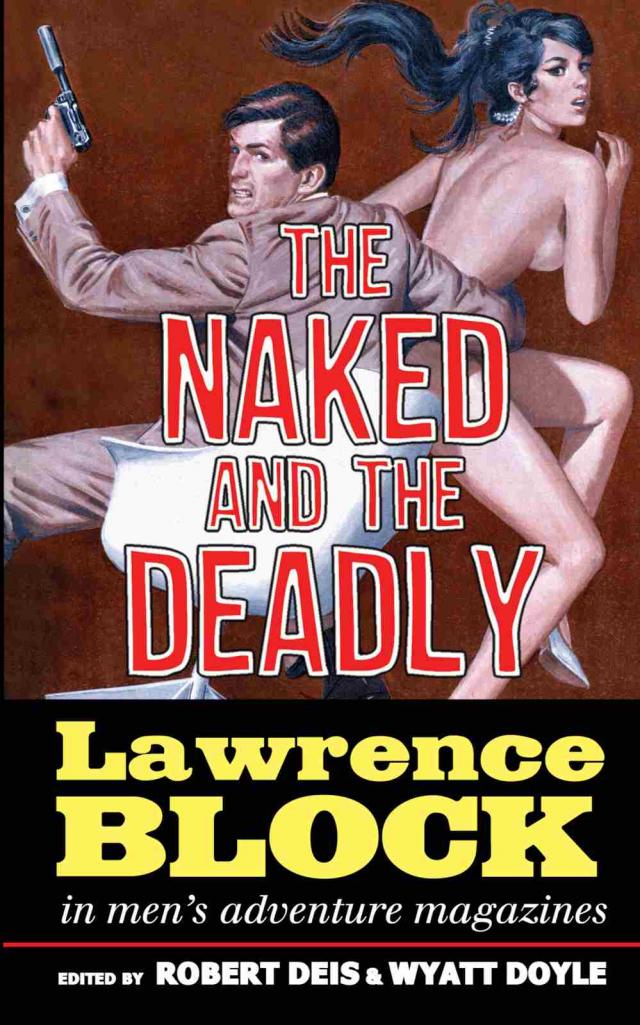
Cover: Detail from “Bring on the Girls” by Bruce Minney
Designed by Wyatt Doyle
NewTexture.com
Twitter: @NewTexture Instagram: @ThisIsNewTexture
MensAdventureLibrary.com MensPulpMags.com
Booksellers: The Naked and the Deadly and other
New Texture books are available through Ingram Book Co.
ISBN 978-1-943444-65-6
First ebook edition: May 2023
This book is also available as a deluxe, expanded hardcover with additional material
Men’s Adventure Magazines [MAMs]
A bona fide publishing phenomenon that emerged in the 1950s and thrived through the 1970s, the tropes and aesthetic estblished by men’s adventure magazines (MAMs) have proven so durable and have been absorbed so totally into the American consciousness that even decades after their demise, MAMs remain an incontestable—if invisible—hand behind key events and directions in entertainment and popular culture.
Incorporating the colorful, eye-catching cover paintings and pulse-pounding action/adventure fiction of pre-World War II pulp fiction magazines, MAMs added non-fiction adventures to the mix, and blurred the line between the two by frequently claiming the outrageous, high-octane fiction was also true, even when such claims were implausible, preposterous, or demonstrably false. This blend quickly became standard for the genre, and pulp “fact” ran side by side with pulp fiction.
The MAM formula cannily incorporated aspects of other popular magazines that appealed to the working-class readership they targeted, including racy “bachelor” and pin-up mags, outdoor and travel periodicals, true crime and detective magazines, and celebrity scandal rags.
The format was adopted by multiple publishers, who produced magazines of varying quality. All told, more than 160 different periodicals fit the classification. Some lasted decades, others, only a few issues—or just one. While the more lurid varieties (sometimes called “sweats” or “sweat mags”) often draw the most attention (and criticism), the range and quality of MAM content is more varied than is generally understood.
Though dismissed in their time as downmarket, lowbrow entertainment, the magazines were an enduring success, enjoyed by millions of readers over three decades. MAMs published popular writers of the day, and artwork by many of the era’s top illustration artists. The terse, hard-boiled intensity of the writing and the dynamic, explosive, and racy illustration art—on their covers and in their pages—are essential to their appeal, then and now. The potency of these words and images remains undiminished; their excesses still spark gobsmacked wonder, and their artistry inspires fascination on its own terms.
Contents
Tricks of the Trade
by Wyatt Doyle and Robert Deis
A Naked and Deadly Introduction
by Lawrence Block
“Queen of the Clipper Ships”
attributed to Sheldon Lord
From REAL MEN April 1958
“The Greatest Ship Disaster in American History”
written as Sheldon Lord
From REAL MEN April 1958
“She Doesn’t Want You!”
written as Sheldon Lord
From REAL MEN June 1958
“Pleasure Cruise for 137 Corpses”
written as Sheldon Lord
From REAL MEN November 1958
They Called Him ‘King of Pain’”
written as Sheldon Lord
From ALL MAN May 1961
“Killers All Around Me”
written as CC Jones
From ALL MAN September 1961
“The Naked and the Deadly”
From MAN’S MAGAZINE October 1962
“Just Window Shopping”
written as Sheldon Lord
From MAN’S MAGAZINE December 1962
“Stag Party Girl”
From MAN’S MAGAZINE February 1963
“Twin Call Girls”
From MAN’S MAGAZINE August 1963
“Great Istanbul Gold Grab”
From FOR MEN ONLY March 1967
“Bring On the Girls”
From STAG July 1968
“Tricks of the Trade”
by Wyatt Doyle and Robert Deis
Hellish disasters at sea. Human monsters in swastika and jackboots. The unvarnished realities of prostitution. Life in an asylum’s violent ward. International intrigue and white-knuckle adventure. Party girls who turn up dead. Randy stewardesses and sex at 12,000 feet.
The focus and subject matter of mid-century men’s adventure magazines (MAMs) were wide-ranging, and versatile storytellers able to confidently navigate varied genres, approaches, and authorial voices found regular, lucrative work in their pages. Among those talented writers was a notable newcomer named Lawrence Block—though his initial pieces would see print under pseudonyms.
Not the Lawrence Block you know, who is among the most widely read, respected, and celebrated writers of crime and mystery fiction in the world. Internationally read and internationally honored, upon whom the Mystery Writers of America bestowed the title of Grand Master. A storyteller with over 65 years of professional experience in damn near every mode of written expression, whose essays, magazine columns, and non-fiction books focused on the art, craft, and business of writing have endured to inform generations. Not that Lawrence Block.
Not yet.
MAMS could be a good fit for a young writer. Block’s initial pieces appeared in magazines published by Stanley Morse, whose company Stanley Publications, Inc. gained notoriety for putting out some of the extreme horror comic books that sparked the anti-comics hysteria that led to Congressional hearings and the 1954 Comics Code, which prohibited bloody violence and sex in comic books.
Morse responded by toning down his comics and amping up the blood-and-guts quotient of his magazines for adult men. He transformed the Stanley comic Battle Cry into a MAM of the same name and launched a number of other pioneering titles, including All Man, Champion for Men, Man’s Adventure, Man’s Best, Man’s Look, Man’s Prime, Men in Combat, Men in Conflict, Real Men, Real War, Rugged, Rugged Men, Spur, True Battles of World War II, True Men Stories, and War Criminals.
Morse would become the second-largest publisher of MAMs after Martin Goodman, who started out publishing pulp magazines and comics (including Marvel). Beginning in the early 1950s, Goodman’s Magazine Management Company published a long list of popular MAMs, such as Action for Men, Battlefield, Complete Man, For Men Only, Hunting Adventures, Ken for Men, Male, Man’s World, Men, Men in Action, Stag, and True Action.
MAMs published by Morse and Goodman weathered a changing marketplace across three decades, holding on until the MAM format faded away in the late 1970s.
AT THE core of all MAMs was a dedication to covering any subject thought to be of interest to American men at the time—a strategy to appeal to the largest possible readership by including a little of everything. They cast wide nets for content, offering fiction and non-fiction that played to popular and established interests and curiosities, along with pin-up photos, gag cartoons, and more. The magazines’ content is best remembered today for tough, pulpy fiction, war stories, survival sagas, and “Weasels Ripped My Flesh”-style animal attack yarns, but MAM non-fiction was an essential and popular aspect of the magazines, and came in as many varieties as MAM fiction: celebrity gossip, biographical profiles, travel pieces, advances in technology and medicine, cryptozoological sightings and UFO-related developments…even mad-as-hell consumer advocacy had a place. As long as an idea could be reasonably tied into the broad category of male interest, there was room for it.
Men like sex, so MAMs included plenty of it, packing as much into the magazines as could safely pass muster with the laws, social mores, and postal regulations of the era. In a time when frank exploration of the subject could be difficult to come by, part of MAMs’ appeal was as a venue where relatively adult discussions of sex and sexuality could be found—often presented salaciously, but safely within the accepted standards of the era. Publishers knew where lawmakers (and postal censors) drew the line, and even seedier MAMs with lower standards knew to toe that line or face serious legal consequences.
MAMs focused heavily on escapist entertainment and male-oriented fantasy. They offered a portal to other lives and imaginary places where excitement was everywhere and casual sex with desirable partners was easy and frequent. Directly and indirectly, they catered to male erotic fantasies from conventional to kink, making up for what they couldn’t baldly say or show by emphasizing sex in every kind of content in their pages, sexualizing most situations involving women. Even an otherwise straightforward adventure like “Queen of the Clipper Ships” has a prominent component of sexual threat that is the source of much of the story’s tension.
THE LINE between MAM fiction and non-fiction pieces could accurately be described as fluid. MAM fiction was frequently presented as factual accounts, and MAM non-fiction was prone to heavy exaggeration, even outright invention.
Though MAMs were not cynical, editorial voices were presented as informed and experienced, at times judgmental. A barracks-room familiarity was typical, with readers encouraged to trust the maga
zines for the straight dope on everything from sex to insurance scams to international tensions, with consumer reports and fraud warnings regularly found among the hard-boiled fiction, illustration art, and pin-up photos. Exposés and accounts of historical tragedies and disasters were popular, and when the guilty party was a specific person or company (as opposed to enemy forces or fate), a bit of good old fashioned finger pointing lent a fresh edge to dusty historical accounts.
Whether the blame could be laid at the feet of moneyed fat cats looking to save a buck or workers simply failing to do their jobs, righteous indignation proved as consistently alluring to MAM readers as accounts of wartime action or animal attack fiction. [See “The Greatest Ship Disaster in American History” and “Pleasure Cruise for 137 Corpses”.]
Like most of these early pieces, Block’s “She Doesn’t Want You!” was written as Sheldon Lord. It is part of another notable MAM lineage: Exposés and firsthand tell-alls about taboo and forbidden subjects; in this instance, prostitution.
Since many mid-century American males were World War II veterans, Nazis were a staple of both the magazines’ fictional and fact-based features. Non-fiction profiles of notable figures both heroic and notorious appeared regularly in MAMs, and Block’s brief but potent look at the life and crimes of Reinhard Heydrich, Hitler’s “Blond Beast”, appears to be his only foray into biographical sketches for the magazines.
Considering MAMs’ emphasis on all things tough and manly, extreme and dangerous jobs cropped up frequently in the pages of MAMs, both as dramatic settings in short fiction and in fact-based articles. Block dipped a toe in with 1961’s “Killers All Around Me”, written from the perspective of a mental institution employee and chronicling physical threats encountered on the job. Published as “CC Jones,” Block submitted the story with the byline “CO Jones,” but an editor with at least a passing familiarity with Spanish seemed to catch the author’s risque wordplay en español (“CO Jones” = cojones) and sanitized the pseudonym for print.
“Just Window Shopping” is a brief and unsettling account told from the perspective of a peeping tom, a most unreliable narrator. Despite its first-person trappings, the story is unexpectedly presented as a work of fiction and credited to Sheldon Lord, a name that until then Block had only applied to non-fiction.
IN CLASSIC pulp magazines, novels were sometimes serialized over the course of several issues before they were published in book form. By the 1950s, pulps had waned and the men’s adventure magazine genre was taking shape. MAMs continued some pulp traditions, most notably, eyeball-grabbing painted covers and lots of action/adventure fiction stories. But MAMs didn’t serialize novels.
Instead, MAMs published Book Bonus versions of novels and some non-fiction books of interest to their male readers. Typically, these were drawn from books that had already been published. Sometimes they were promoted as versions of soon-to-be-published novels, or books soon to be made into movies. Other times, they were condensed versions of existing movie tie-in novels for films that were recent hits.
Most Book Bonus stories were published by MAMs with circulations in the hundreds of thousands and budgets that allowed them to pay for reprint rights to novels and other books. Those included the top-tier MAMs like Argosy, Bluebook, Cavalier, and True, and mid-tier MAMs such as Pyramid’s flagship MAM Man’s Magazine, and Martin Goodman’s popular Magazine Management MAMs. Most of the bottom tier of MAMs, with circulations of 50,000 to 100,000 or so, had budgets too slim to pay for Book Bonus reprints.
MAMs that did feature Book Bonus stories usually trumpeted them in their cover headlines, especially when they were by writers who were famous or at least well known to fans of crime and action/adventure novels. Even a short list of some of the best-selling authors who had Book Bonus stories in MAMs would include Nelson Algren, Louis L’Amour, Michael Avallone, Lawrence Block, Carter Brown, Erskine Caldwell, Brett Halliday (David Dresser), Ian Fleming, Joseph Heller, Frank Kane, Day Keene, Philip Ketchum, Alistair Maclean, Norman Mailer, Richard Matheson, Richard S. Prather, Ellery Queen, Quentin Reynolds, Robert Ruark, Mickey Spillane, and Donald Westlake.
Goodman MAMs would add a new wrinkle to the concept: Book Bonuses for imaginary books. Touted as novels soon to be published (or soon to be adapted for upcoming movies), it’s doubtful that readers ever noticed these novels never were published—much as most didn’t notice (or didn’t care) that many MAM stories presented as true (and accompanied by editor’s notes and photos to support that illusion) were entirely fictional. What mattered to readers was whether the story delivered.
For the authors of books that actually existed, Book Bonuses offered the dual advantage of an extra fee and some additional publicity. Typically, the publication of these shortened versions was arranged by the author’s agent. Sometimes the agent provided the shortened version, sometimes the edited version of the text was created by the editors of the magazines.
One special aspect of MAM Book Bonus stories is that they were frequently accompanied by specially commissioned artwork by top MAM illustration artists, rather than the actual books’ cover art. MAM editors usually made up their own title for the Book Bonus version to fit the high-octane, often sexually tantalizing style of the genre. Thus, the Book Bonus version of Lawrence Block’s first Evan Tanner novel, published in 1966 as The Spy Who Couldn’t Sleep, became “Great Istanbul Gold Grab” in the March 1967 For Men Only. The Book Bonus version of “The Scoreless Thai” from the 1968 Tanner novel Two for Tanner was titled “Bring on the Girls” in Stag, July 1968.
UNLIKE the pulps that preceded them, MAMs usually did not have recurring characters in stories unless they were Book Bonus versions of novels constructed around characters like Mickey Spillane’s Mike Hammer, Richard S. Prather’s Shell Scott, Donald Westlake’s Parker, and Block’s Evan Tanner. The Ed London stories by Block are an exception. They are unusual because they were first published in MAMs, but didn’t appear in book form until many years later.
Lawrence Block has another unusual credit in the realm of stories that connect MAMs and books. Early in their careers, Block and fellow scribe Robert Silverberg (later a Science Fiction Grand Master) both jumped on the ever-popular “sexology studies” bandwagon sparked by sex researcher Alfred Kinsey’s books Sexual Behavior in the Human Male (1948) and Sexual Behavior in the Human Female (1953), generally called The Kinsey Reports.
Block would write a series of fascinating faux—but seemingly well-researched and very cogent—books of sexual studies under the pseudonym Dr. Benjamin Morse. They included The Lesbian (1961), The Homosexual (1962), The Sexually Promiscuous Female (1963), The Sexually Promiscuous Male (1963), Sexual Behavior of the American College Girl (1963), and Adolescent Sexual Behavior (1964).
Silverberg also wrote sexology and sex advice books under the name L.T. Woodward, whose books include 1001 Answers to Vital Sex Questions (1962), Sex and the Armed Forces (1963), Sex and the Divorced Woman (Non-fiction, 1964), and I Am a Nymphomaniac (1965).
Excerpts from the sexology books penned by Block and Silverberg showed up as articles in MAMs, sometimes identified as Book Bonus stories, sometimes not.
Capitalizing on the sexual revolution then underway, between 1968 and 1973 Block wrote another series of sex-related books, this time under the name John Warren Wells. Wells’ books include Eros and Capricorn (1968), The New Sexual Underground (1968), Sex and the Stewardess (1969), Comparative Sex Techniques (1971), and Come Fly with Us (1972), the sequel to Sex and the Stewardess. Portions of the Wells books were also published as articles in MAMs, sometimes with the book source identified, sometimes not. Many of those books include introductions or quotes by—who else?—the esteemed sex studies expert, Dr. Benjamin Morse.
“A Naked and Deadly Introduction”
by Lawrence Block
For five bucks a week, I chose Scott Meredith over Henry Luce.
Well, in a manner of speaking. It was the summer of 1957. After spending the month of July on Cape Cod, where I wrote a batch of short stories before hunger prompted me to take a horrible job in a restaurant, I quit and headed back to my parents’ house in Buffalo. I’d bought my first car, a 1953 Buick, in order to drive to the Cape, and I cracked it up en route to Buffalo, where I sold it and got on a train to New York. I found a furnished room on East 19th Street and set about looking for a job.


