

Once our lives, p.18
Once Our Lives,
p.18


Among the galleries of dead and murdered dreams, there were also posters of the most wanted bandits, armed robbers and killers. Most of them had been labeled “Dangerous!” and “Do not approach.”
The message was clear: Escape or you could be the next one on the wall. Passengers glanced at the pictures, tightly grasped their possessions, and strained to hear any faint sounds of a coming train. They were ready to take flight.
For the next five days and nights, Yan, An Chu, and their newborn child were trapped in a tangle of sweaty limbs and luggage. The air in the train compartment was saturated with cigarette smoke and stale breath. The hard wood benches grew more and more unbearable, especially for Yan as the hours turned into days. Every time the train hit a rough join in the rails, it was like being hit on the backside with a hammer. Gradually, she began to predict and prepare for approaching bumps. As soon as she felt the upswing of the train, she clenched her teeth and tightened her muscles to absorb the coming shock. She never closed her eyes. The little baby cradled in her arms was always crying and it was stiflingly hot. A sickening feeling haunted her that the baby Ping was not getting enough air and would not survive the trip. Her sweat-soaked sleeves provided little comfort to the baby. Yan’s arms were numb. Her body was numb. Only her mind felt alive and it was filled with worry.
It would be five days before Yan and An Chu reached Shanghai, and for five days they sat thinking what would happen once they got to the city to which neither of them ever expected to return. They had nothing waiting for them: no money, no jobs, no place to stay. They had no false hopes. Their families were not aware they were coming, and even if they were, had little to help them. The only comfort for An Chu and Yan was that the little bundle they held would be spared from bandits, beggars, and streets filled with the nameless dead.
“Ahhmm,” Ping whimpered, her little fists stirring aimlessly against her tiny head. Yan tried to calm her as she held the baby up against her own sweaty chest. “Shh, my precious Bao Bei,” she whispered into Ping’s ear as she gently patted her back, no bigger than her own palm. “Mama’s right here. Mama’ll take care of you. Go back to sleep. When you wake up, we’ll be home. Everything will be much, much better.” Thinking about the future, she felt a moment of hope. But in reality, the train was only helping take them from one uncertain station in their lives to another.
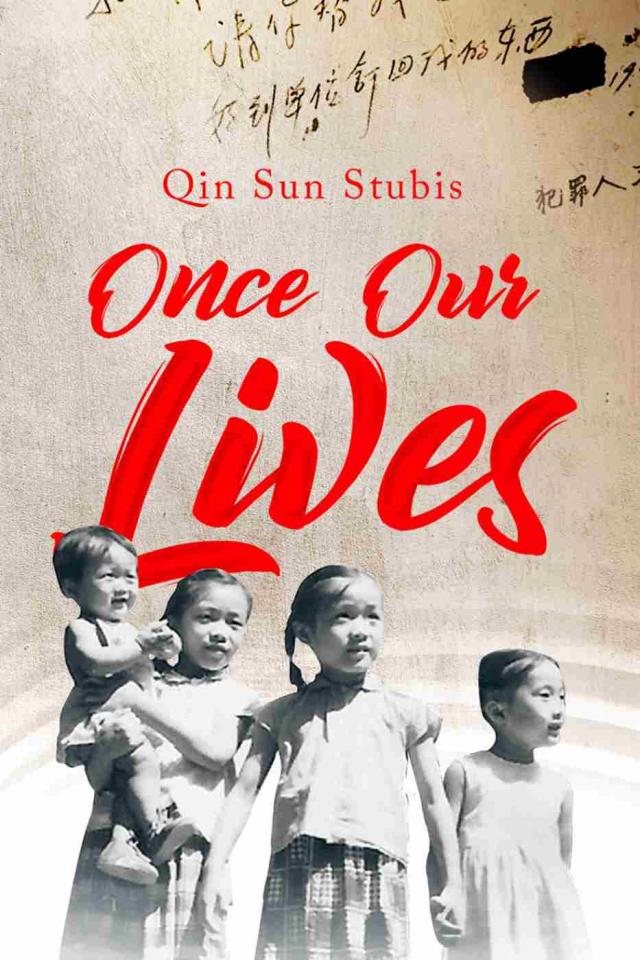
The Sun sisters (L to R: Wen, Ping, Qin & Min) Jubilee Court Lane, Shanghai, 1967.
Ping (back row left), Min (front row left), and Qin (front row right) with two sons of a family friend. Shanghai Honglei Studio, 1964.
Yan Gu (middle row, second from left) holding Wen with Min, Qin & Ping (front row from left to right), and An Chu standing (back row fourth from the right). This family photo was taken on Yan’s birthmother’s birthday in 1968.
Yan & An Chu’s engagement photo taken in 1957.
Ping in the shantytown, Shanghai, 1959.
Ho De with Chon Gao in the mid 1950s.
Yan’s work ID issued in August 1960, less than two weeks after Qin’s birth.
An old censored postcard dated 12/24/1969 from An Chu to Pin from jail, including his criminal ID # 198. The Mao quotation at left, "Confess and receive leniency, resist and receive punishment. A path to death for those fight to the end" was added in a different handwriting.
An old postcard from An Chu to Ping: "Ping Sun: Please send me a belt. Best to go to my company and retrieve all my belongings. Your dad, An Chu Sun (198)." "Your dad" was blacked out, and replaced with the words: "Criminal."
A birthday card from Qin to An Chu dated 5/10/1984, addressed to the Shanghai Prison with An Chu's criminal ID# 2942.
An Chu's service ID issued by the Property and Land Headquarters, Shanghai Municipal Workers' Revolution Rebel Command Center, 1969.
Yan (left) with a neighbor friend in her late teens. Exact date unknown.
Yan at the age of 19.
The staff of the Housewares Department, Zhang Ye Department Store, 1957. Yan is in the front row, second from right.
Yan (right) with a friend.
Yan
Young An Chu.
An Chu in his teens.
An Chu in 1957.
Qin with An Chu at Shanghai's Hong Chiao Airport.
The author in 1964.
Qin as a freshman at the front gate of the Shanghai Institute of Foreign Languages in 1978.
Qin's college graduation class photo in 1982, Shanghai. Qin, third from left, back row.
In 1991, Qin graduated with a Master’s Degree in Communications from the University of Arizona.
Qin with her husband, Mark Stubis, in Bethesda, Maryland.
Part III
The Return of the
Low-down Prodigals
(Shanghai, 1958-1964)
Chapter I
A Daughter Is a
Daughter for All That
The train made a sudden violent shudder, rocking sideways like a drunken sailor, shaking off its coat of dust accumulated during the slow and tedious journey. Startled by the unusual disturbance, the crowd awoke from its week-long stupor. Heads tilted and half-open weary eyes instinctively looked outside. Through the greasy semi-opaque windows, the Shanghai North Train Station came blurrily into sight. A minute later, the locomotive made one more maneuver, applied its air brakes and gave out one last, long cracked groan of relief with a huge burst of hot steam. Then, without warning, it stopped. The train lay like a giant caterpillar, depleted and motionless. Its weary passengers, enervated by the July heat and humidity, had yet to come to the realization that they had arrived at their final destination.
They were back in the city they had left only a year ago, yet few showed any enthusiasm about resuming their lives. They would have been better off staying in Shanghai with their old jobs, which they gave up in exchange for nothing but horror and humiliation. They were not looking forward to going back home and sitting down with their families for they didn’t have any heroic deeds, glorious accomplishments, or found fortunes to report. Nothing except stories of hunger, death, and persecution by bosses and bandits.
An Chu waited until their car was half emptied and then let himself inhale the salty, familiar air floating his way from the open doors.
The adventure was over. No more running away. No more starvation. No more political battles. No more robbers, corpses, or ambitions of glory. A feeling of relaxation washed over him as little Ping dozed on Yan’s arm like a rag doll. He let a few more minutes go by, just listening to the sounds of stumbling passengers getting off the train one at a time. They had nothing but time and nowhere to go. There was no one on the platform to greet them. They hadn’t even decided on where to go once they got off the train.
An Chu looked at Yan. Yan looked back at him. Their looks said nothing and everything.
When they finally got off, Yan holding the baby and An Chu holding their suitcases, they made the only choice they could: They spent the last few yuan in their pocket on one of the many pedicabs waiting outside the station. Once aboard, they directed the driver to Yan’s home just a couple of miles away.
It was a strategic decision, for between Yan and An Chu, they only had enough money to ride for a couple of miles, and they needed to go somewhere they could find help. At first, Yan was vehemently against the idea. She didn’t want to return in such an awkward position, down and out, homeless, and helpless. She was horrified by the prospect that her father would see her in the sweat-soaked rags she had worn for a week, with a new husband and baby and nowhere else to go.
As they approached the familiar street where she lived, Yan felt her heart beating in her throat. Her hands began shaking and she could barely hold onto baby Ping. Life had played a cruel joke on her, taking her back to the exact spot she had left only a year earlier with such strong determination never to return. Yan was so ashamed she felt her real self disappearing, leaving only a ghost to face her father.
It was a midsummer day, hot and humid. All the trees along the neighborhood streets stood still, paralyzed among entrapped sunbeams and haze. Moisture hung heavy in the air, threatening to suffocate anyone who dared to move.
All the houses had their bamboo shades down. The grownups were taking refuge inside. Only children, mostly boys and tomboys, were still outside. They shed their sweat-drenched rags and ran around in colorful, homemade shorts. Their bare skins glistened with their own free-flowing sweat. Imitating fighting roosters, they stood on one leg, hopping and bumping into one another amidst a lot of yelling and cheering. The ones who fell backwards conceded defeat and joined the audience, while the winners kept fighting until the last rooster stood alone, crowing triumphantly.
“Go, go!” the crowd on one side cheered.
“Come on, fight! Fight!” the other side yelled.
Chon Gao hit the ground with a bang just as Yan and her family arrived in their pedicab. He was so stunned to see her that for a moment he could not get up.
For a boy of fourteen, a year was a long time to live without a mother. After Jin Lai died, he clung tightly onto Yan as a second mother. But she’d betrayed him. She went to a far, faraway place all by herself without ever thinking what could happen to him. Since then, Chon Gao had learned to get by with an elderly father four times his age, a father who had never dirtied his hands doing any domestic chores, even cooking and cleaning. They had yet to wash their quilts and sheets since Yan left over a year ago. The wooden floor had long ago lost its shine and was now coated with grease, dust, dirt, and anything that had fallen down and was now in the process of decaying. Dirty dishes were piled up high on the table, patiently waiting to be reused when someone eventually, or ever, scrubbed them and put them back into the cupboard.
Chon Gao’s world was now mostly on the streets with his teenage friends, boys and girls from average working-class families trying hard to earn enough to feed themselves. Blue-collar workers often had to leave their children on their own with a chain of house keys around their necks. Chon Gao felt comfortable with these street urchins who were, in a way, as parentless as he was. They wore rags no better than those on his back. Like him, they were forced to go to school and get their twelve years of free education from the government. Except for that one chore, they had nothing but time, empty, idle time during which they were glad to see each other and found ways to entertain themselves. Street life gradually became their life.
It took Chon Gao a minute or two and a few blinks before he realized that Yan was really back.
Then, he sprang to his feet and raced to see her.
While Yan and her family were getting their things out of the pedicab, Ho De appeared in front of them. There he stood, shaking, filled with emotion, tears brimming behind his glasses. He nervously wiped his soy sauce-and-vinegar-stained hands on his apron, while his eyes shifted from Yan to the baby in her arms to the man who stood next to his daughter and then back to his beloved little girl who was little no more.
“I guess … I am a grandpa already,” he murmured and nodded his head as a confirmation to himself.
Yan stood frozen as An Chu smiled, waiting to be introduced.
Ho De finally broke the silence. He extended his hands to An Chu. “And … this must be my son-in-law?”
“An Chu, Dad. His name is An Chu. And this is your granddaughter, Ping.”
Yan could not distinguish one word from the next as she introduced her new family. The heat of the July sun and her embarrassment melted her composure.
“Welcome to my humble home. Pardon its appearance. I have had little time to attend to the apartment since Yan went away.” Ho De tried to maintain his dignity, even though he was overwhelmed by the sudden appearance of his daughter and her new family.
For Yan, the reunion felt bittersweet. Her heart ached seeing how much her father had aged since she left. In just a year, he had changed from a strongly built, middle-aged man to an old man with hair white as snow. His hands were shaking. His tall frame was bent forward, and his shoulders were drooping, as if he had lost all confidence and hope in life so that he could no longer hold his head high and his shoulders could not carry any more weight. Ho De looked no better than a scarecrow after a storm. If it weren’t because of Ho De’s distinguished thick eyebrows (now all white), high-bridged nose, and exceptionally tall body, Yan would never have recognized him.
Seeing her father’s threadbare life, a life too humble for a man with a dignified past like his, Yan wanted to cry. She wanted to embrace Ho De and weep until the whole world heard her. But her upbringing taught her to swallow her tears before they had a chance to well up in her eyes. She had to be positive in front of her father. She had to smile and tell him that everything would be fine, that she had made her way back, and come to see him first as soon as she entered the city. How would she have the heart to tell him that neither An Chu nor she had any job prospects, savings, or anywhere to settle down?
The once strong, confident, resourceful general manager she knew as her father was no more. He now barely made a living handling a convenience store and a teenage boy. Ho De’s apartment was too cramped to add another family of three. Yan could not bear the thought of putting another burden on her father’s sagging shoulders. And most important of all, she understood that Ho De was a conservative man. The same mindset that barred her from public education and stage life would also dissuade her from living with her family. Old Chinese tradition dictated that a married woman should live under the roof of her husband’s family. A married daughter was like a bucket of water already emptied outside a house. Just as you cannot get the water back into the bucket, going back home was out of the question. It was shameful to have a married daughter at home. Yan was now officially a married woman with a child.
I must be out of my mind, Yan thought. She looked down at her sweat-soaked clothes and her pathetic little family and regretted ever coming home. Daddy could never bear the shame of taking in a married daughter.
She wanted to leave as soon as possible.
“Father, we just came to see you and pay our respects,” Yan said suddenly. “We are on our way to my husband’s family and will see you as we are settled. Goodbye.” Her husband looked at her curiously but said nothing. Although they did not have a single fen, they hailed another pedicab and instructed the driver to take them to An Chu’s family residence.
Before Yan got into the taxi, Ho De called her aside and pressed a roll of bills into her palm with such strength that she knew it would upset her father if she did not take the money.
“It’s a small present for meeting my first granddaughter,” he said. “Take it. I would have given you more if I could.”
“Thank you, Dad.”
“Come back to see me as often as you can.” Ho De’s voice was firm. “I would like that. An Chu seems to be a very solid and honest man. I think he’ll be a good son-in-law.”
At that, the pedicab heaved forward.
As Yan expected, Ho De did not extend an invitation for them to stay there, nor did he ask where they were going. She belonged to her husband’s family now.
Silence accompanied Yan and An Chu as they headed to their next destination. Yan was lost in her own thoughts, shaken by the physical deterioration of her father and the ramshackle condition of his apartment. The warm old home, once so neat and pleasant, was now nothing but a squalid bachelor’s refuge. Every little pleasant touch she had carefully left throughout the years had been wiped out. She almost wondered if she had ever been there at all. Only memory served as a ghostly link to her sentimental past where she now felt like a stranger.
Let the past go, Yan said to herself. I need to concentrate on what I do now.
What would she do now? Yan felt helpless, as if her hands and feet had been bound together. She was married and now belonged to her husband’s family, whom she had yet to meet. She had a week-old baby depending upon her and a husband without any prospects. Everything considered, her future was dim. She sighed. Her eyes closed. She allowed the breeze in the pedicab to brush gently against her cheeks and dance in her hair. She needed a rest to pull herself together and be strong enough to confront whatever was to come.
An Chu and Yan had escaped from one disaster only to land in Shanghai during a famine and economic crisis caused by natural calamities and politics in the late 1950s. Grain production dwindled to a trickle as the population exploded. Millions starved.
China had few allies to help it, especially among the major financial and economic powers. China’s self-isolation became even more obvious when its friendship with its big brother and one-and-only companion, the Soviet Union, withered away. The Chinese leadership would have sought international relief if not for its isolation, its belief in the ultimate correctness of its cause, and the fact that another superpower, the United States of America, was a close ally of Taiwan—the enemy of the People’s Republic of China. For that, China loathed America, calling it an “imperial paper tiger” and an “enemy to socialism.” What remained was a handful of socialist countries and sympathizers, which China called its “brothers.” But these little brothers—Albania, Bulgaria, Cuba, North Korea, Pakistan, Hungary, Congo, Iraq and Egypt—were in no position to help giant China.
The fact of the matter was that no country could provide help, for China was too proud to ask for it. After all, the pillars of Communism were supposed to be cast from steel, strong enough to hold up the sky. China could not be in crisis. Her pride and confidence would not allow it. She was on her way to great success, establishing a brand-new social system, combining Marxism, Leninism, and Maoist Thought. She was to become the foremost and most glorious country of its kind in the history of the world.


