

Once our lives, p.2
Once Our Lives,
p.2
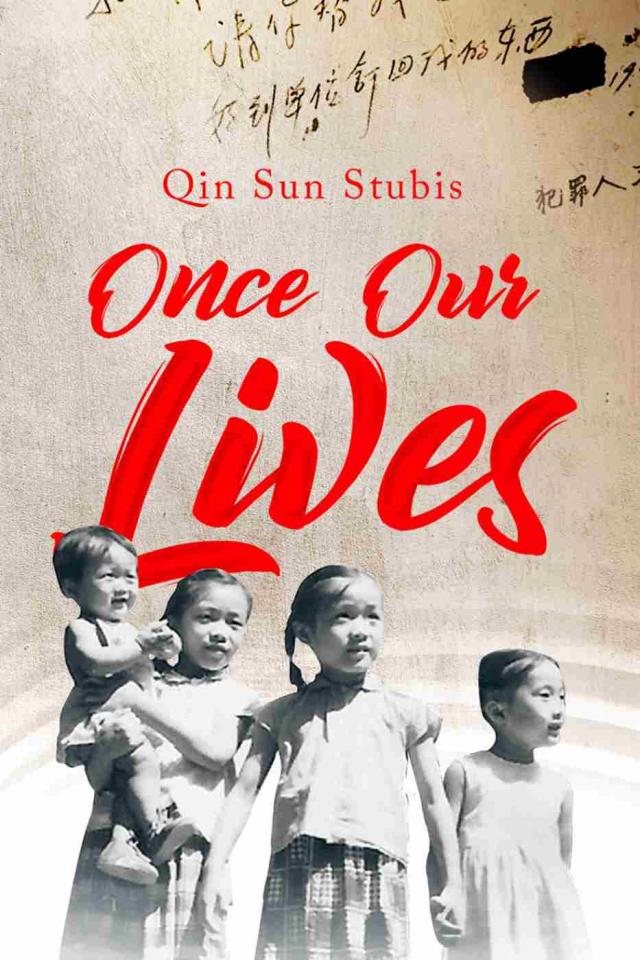


“The baby will be … will be … will be a boy, a boy! I can feel it. It’s a boy!” Her face was radiant. “Oh, he is lovely! He is sensitive, caring, and hardworking. He is a Dog, you know, a lucky Dog, a boy with a lot of luck. As a matter of fact, I’ve never seen a baby with so much luck. That’s why he will end up in your family. Watch out, though! His luck doesn’t have depth. A lucky soul is always looking for opportunities. A dog can be jumpy, curious, and led away easily, so his luck can change.”
The fortune teller didn’t take away Ya Zhen’s worries. She only added more, but the in-laws seemed to be pleased by her prophecy: A boy, a grandson, a first-born grandson!
Ya Zhen felt her baby’s strong kicks inside her and worried about her own fate as she took the empty bowl back from the beggar. He wiped his greasy face on his torn sleeves and gave out a loud, satisfied burp. She stared at him. He smiled at her. His smile reminded her of a little boy’s—bright, innocent, satisfied, and grateful. She felt surprised by her maternal instincts, brought out by this total stranger, a vulnerable beggar whose very life now depended on her. She started to say something to him but stopped. His smile had disappeared, leaving him with a strange, blank face. Her eyes met his, and she was startled by what she saw: For a moment, the beggar’s eyes seemed like a pair of deep, dark tunnels, taking her to an unknown world. He put his hand on her belly and muttered, “He is coming. He is coming,” before turning and walking away.
Ya Zhen stood watching him until he shrank to a dot in the distance. When tomorrow comes, I hope I will be here to feed him, she thought.
That night she gave birth, an easy birth, to a healthy baby boy whom the family named An Chu Sun. My father.
The day after she had the baby, Ya Zhen broke a cultural taboo: Instead of staying in bed for a whole month, as required by tradition, she got up, for she was eager to feed her beggar. As usual, she prepared him a special feast and waited. She went to the door several times at the slightest noise. But he was not there. He never came back. Not the next day. Not the day after. Not ever.
Sometimes, as she nursed her baby, she pondered her seven encounters with the beggar. One day, as she examined her own child, she was startled to see a familiar twinkle in her baby’s eyes. She suddenly realized that she knew all along that the beggar was a wandering spirit—a youhuen—searching for a home. And now, that beggar’s spirit was in her son!
An Chu was a first son, and first grandson, born into a prosperous family, so his birth brought joy, glory, admiration, praise, gifts, and feasts. But, even at the celebration banquet, held under a silver moon with hundreds of colorful paper lanterns, tables filled with roast ducks and suckling pigs, sea cucumbers as dark as the earth, bowls of fresh peanuts, flying firecrackers and thick stacks of lucky paper money in red envelopes, red-faced uncles shouting loudly over drinking games, and fat-faced aunts gabbling and predicting glorious things for the newest heir to the Sun name, Ya Zhen worried about her son’s life path, for a beggar’s existence was destined to be a struggle against poverty, hardship, and all sorts of unpredictable dark forces …
Later in life, when the Japanese burned her family’s factory, civil war destroyed the Sun fortune, and she and her son were plunged into poverty, Ya Zhen silently saw all these events as signs confirming the treacherous path of the beggar’s life An Chu had yet to walk. She prayed that, one day, all the good luck the fortune teller had predicted for her boy would shield him and break the beggar’s spell.
Part I
A Tale of Two Families
(Shanghai, 1940s to the 1950s)
Chapter I
Charcoal Slaves
The winter of 1942 was cold. Eight-year-old An Chu shivered as he watched the city’s usually fashionable ladies hurrying down the streets, buried under bulky fur coats, hats, and scarves to protect themselves against the Siberian wind. Old men shielded their reddened faces, little icicles clinging to their mustaches. Coolies pulled down the yellow oil-cloth curtains of their rickshaw cabins to protect their passengers. Most children were hiding inside their warm homes. But not An Chu. With only rags on his back and bare feet, he dashed through the streets of Shanghai behind a rickety wooden wheelbarrow, delivering charcoal. “Excuse me, Madam! Sorry, Mister!” he shouted as he steered his cart through crowds of pedestrians. Most people were kind enough to move out of his way. Some yelled at him after being brushed against. Some spat in his face or kicked his bony behind with their patent leather shoes. Policemen in black uniforms often drove him away with their whips.
“Get lost! Stop blocking traffic!”
“Get out of my way, you little black devil!”
“Be careful, you filthy bastard! You couldn’t afford to buy me a new coat, even if you sold your mother!”
It was a time before gas stoves became popular in Shanghai. Charcoal and rice occupied equal importance in everyone’s daily life, and you could find more charcoal delivery boys than milkmen out on the streets. They were poor and dirty, and people called them xiao hei guei (“little black devils”).
An Chu learned never to argue with anyone on the street. He needed to make as many deliveries as possible and get home before his mother started to worry. He knew his mother didn’t want him to become a delivery boy at such a young age, but she had no choice. His uncle—his father’s only brother—owned a charcoal store and decided everything for them.
For as long as he could remember, his father worked as a charcoal presser and his mother toiled as a housecleaner so they could live for free in the attic above the store. Instead of playing with toys, An Chu packed rows and rows of charcoal cakes onto racks and bagged charcoal nuggets. Once in a while, when work was slow, he sat atop a stack of coal crates, wiped his runny nose on his blackened sleeves and closed his eyes, letting a few gauzy, half-remembered images drift in front of him like dust motes in the afternoon light. He could hear the distant song of a golden canary and felt himself dancing in the arms of a beautiful lady. As she spun, her black, shoulder-length hair flew in the air and cascaded all around him. He shook the small, golden bells tied around his wrist and heard the tinkle of his mother’s laughter. The memories were so faint and impossibly idyllic, it was as if they had all occurred in his dreams. Now, he was just a very poor boy and had to earn his keep.
“Your kids eat a lot of my rice,” his uncle often said. “Of course they should work in my shop!”
Ya Zhen shook her head and swallowed her pride, for she had nowhere to take her family. Her husband, once a pampered, soft-spoken young man, had never learned to deal with the ruder, more practical aspects of life. Five years before, as the new mistress of a prosperous household, she would never have imagined him toiling in front of anything, let alone a charcoal machine. Now, that was all he did.
“I’m home!”
Ya Zhen heard An Chu’s little feet beating against the wooden steps. Her poor baby was home. She could stop worrying about him now, stop making up stories in her head that he was hurt somewhere out there on the dark, wicked city streets. She had reason to worry about An Chu, for she often found bruises and gashes on him. “I fell down,” he often said lightly as he avoided her inquisitive eyes. “It was an accident.” But she always knew there was more to it.
The attic was cold with plenty of holes for the winter wind to squeeze through and spend the night with them. Other times of the year were no better. In the summer, the place was like a dumpling steamer. It was always too hot or too cold, but at least they had a home.
She scooped a ladle of porridge into a bowl just as An Chu appeared, black as a charcoal ball. He brought with him a gust of wind that almost put out the weak glow of the candle on the tabletop.
“Why didn’t you wash downstairs?”
“I want to show you my new shoes, Mom,” An Chu said gleefully. “A nice lady gave them to me. She said nobody should have bare feet in this weather.”
“Did you thank her?”
“Yes, I did. Oh, it feels good to have shoes!” He couldn’t stop looking at his feet, moving happily and freely in the worn-out loafers that were a few sizes too large.
“Come and look at my new shoes,” An Chu called to his brother and sisters, but they showed little interest.
“I’m cold, Mommy. I want to go to bed,” one of the girls complained and pulled Ya Zhen’s apron, while her younger son sat on the floor, sneezing, and coughing as he made paper toys out of an old newspaper. Her youngest baby kept herself warm by crying.
Ya Zhen waited until An Chu slurped down his porridge and wiped his mouth with his sleeves. Then, she rounded up all her children, sent them to bed, and blew out the candle.
All the whining, crying, talking, sneezing, and coughing gradually came to a stop. The dark room gave quiet audience to the wind as it sang through the leaky window and a hundred knotholes. Under one large, old quilt, the children snuggled against each other, sheltered, for the time being, from the winter’s cruelty. Ya Zhen took one more look into the dark room before she went downstairs to help her husband wrap up the day.
Life in the Sun household could have gone on like this forever, but, one day, An Chu got up with a bad stomachache.
“Why don’t you eat your breakfast?” his mother asked as he pushed away his untouched bowl of porridge. “You should have something hot before you go out into the cold.”
“I’m not hungry, Mom,” he said. “My stomach doesn’t want me to eat.”
Ya Zhen shook her head as she took away the bowl.
His younger brother stared at the bowl with hopeful eyes. “Can I have An Chu’s porridge, Mother?” he begged. “I’m still very hungry.”
“Of course, you can,” she said, passing along the bowl. “Hurry up, though. Your uncle wants you to pack fifty bags of charcoal balls by noon for a special order.”
“I want more porridge, too, Mommy.”
“Me, me, me …” her two other little ones cried out, both holding out their empty bowls.
Ya Zhen scraped her pot hard, added a bit of hot water, and divided the burnt mush evenly between her eager, hungry children.
An Chu stumbled out onto the street, pushing his loaded cart. After a couple of deliveries, his stomach started to churn. His arms began to shake, and he had a hard time maneuvering the cart. What happened to my cart? An Chu wondered. It felt heavier than ever before. I need to finish my morning rounds, I have to, have to … He squeezed those words out between his chattering teeth as he pushed forward one step at a time. Halfway through his route, his body gave in, and he stopped to lean on the remains of an abandoned wooden wagon. What should I do? he wondered, but An Chu couldn’t think of anything. His head was hot, and his heart was beating like a drum. He stood on a street corner for a couple of minutes, feeling cold and miserable, and decided to turn around and head home before a policeman could approach him with his whip.
Of course, his uncle was upset. Now, he had to pay some local boy to finish the deliveries. He went up the attic, kicked the door open, and dragged An Chu out of bed by the ear.
“Lazy bastard!” he screamed. “Son of a bitch! You want to be a prince and stay in bed all day?!”
“I didn’t feel good. I … I threw up.”
“Threw up? You ate too much! It serves you right. I’ll teach you not to be so greedy next time.”
Too weak to resist, An Chu let the blows fall on him until his uncle got tired of hitting him.
“If you don’t want to work, don’t stay here,” his uncle warned, pointing his long, bony finger at him as he dashed out. “Remember, I’m the one who gave you a home.”
Two streams of tears ran down An Chu’s face as he struggled to his feet and went back out into the cold to finish his deliveries.
An Chu staggered along an alley, his teeth chattering and his breath hot in the frosty air. He felt a familiar twinge in his stomach as the nausea came back. He tried to hold it in but could not. So, he dragged himself to a corner where he could lean against a building. As he bent down, he spotted something red and glittering, half-hidden under a piece of crumpled paper. Was he dreaming? It was a desolate street filled with nothing but garbage. He wiped his eyes and opened them wide. Just as he was about to poke the paper, a gust of wind lifted it up into the air and blew it away. There, on the ground in front of him, was a gold ring with a sparkling red stone. An Chu knew it must be precious, for it looked just like the one on the fat finger of his uncle’s wife.
“Red stones are called rubies.” He remembered what his mother had once told him. “Only the rich can afford them.”
He looked left and right to make sure that no one was around before he picked up the ring, wrapped his small hand around it, and stumbled on.
That night, as Ya Zhen shepherded her kids to bed and was about to douse the candle, An Chu called her over.
“Mom, don’t blow it out.”
“What, baby? You should be asleep.”
“Mom, I want you to look at something.”
An Chu struggled out of his bed and opened his fist under the candlelight.
“A ring!” Ya Zhen half-shouted in panic before she clapped her hand over her mouth. She turned around and checked to make sure that no one was at the stairs who could hear their voices.
She looked at An Chu questioningly with great seriousness, as if he had done something terribly wrong. “Did you steal it?” she asked in a low voice.
An Chu shook his head. “Mom, you always told me that we may be poor, but we have our dignity. We would rather be poor than be thieves,” he said, reciting her teaching. Ya Zhen continued to stare at him, not sure what to think. “Where did you find the ring?” she asked, her voice shaking.
“On the street corner, when I was sick.”
“You didn’t take it from anyone?”
An Chu shook his head and looked back at his mother.
For a while, Ya Zhen tossed the ring from one hand to another as if it burnt her hands. She gazed hard at the ring as she tried to make some sense of the situation. Then, her face brightened.
“Buddha sent us a ring! Buddha knows our sufferings, after all!” she exulted. When she finally realized that she now owned this ring, she was happy beyond belief. “You are a blessed child, just as the fortune teller had said. You still have your luck with you! We can trade it in for a place of our own, and maybe something else as well, and soon we will leave this dirty charcoal store for good.”
With the ring in her hand, her eyes closed, and a smile on her face, Ya Zhen had already planned out her family’s future.
“Oh, my special boy!” Her eyes shone under the candlelight and glistened with tears as she wrapped her arms around him. Only then did she realize how hot her son’s thin body felt.
“First,” she said firmly in a low voice, “we need to take care of you and make you well again. Then, we will get out of here.” She helped him back to bed and blew out the candle.
As her eyes adjusted to the darkness, Ya Zhen searched for the precious package of dark brown sugar she had saved for special occasions. She found it safely tucked away inside a hole in the family’s worn mattress, warmed by her sleeping children. By the light of the room’s one-and-only half-sized window, she opened the packet, poured a generous amount of sugar into a mug and then added hot water. The cold wind howled through the window and blew in her face as she plunged her stiff index finger into the mug, swirled it around, and popped it into her mouth. She tasted its sweetness and felt the blood racing through her finger, pain mixed with pleasure at the same time.
She brought the mug to An Chu. “Drink it. Drink it all and you’ll feel better tomorrow,” she said as she supported his burning back and weak neck.
He drank it down. Ya Zhen was relieved to see him drift off as she sat with him, stroking his hair.
Such a good boy.
Thanks to him, she now held the passport to her family’s freedom from slavery. She got up and found her sewing basket. Standing next to the window, she quietly sewed the ring into her underwear, wiped back tears of joy, regained her composure, and went downstairs. She decided to keep everything a secret—even from her husband—until An Chu felt better.
Chapter II
Life in a Shantytown
It was the spring of 1956, and An Chu Sun was twenty-two years old. Although of average height, he was muscular and strong. His shoulders were broad, and he was as powerful as a crane. He could lift five hundred pounds with his bare hands. With only three years of elementary school, strength was what he used to make a living and help his parents to raise six younger siblings. An Chu worked odd jobs as a laborer. Years of life on the street had taught him to be smart, sensible, and reliable. By his early twenties, he had already built a network of jobs for himself.
His home sat among clusters of broken-down shacks in a shantytown, off the hustle and bustle of a big commercial street in the old French quarter of Shanghai, which was established in 1849 after the First Opium War. The huts were built of used wood, nailed, glued, or sometimes tied together, their perilously tipping walls inset with crooked doors. Some sported windows of odd and varying sizes, scavenged from condemned houses. The doors were useful enough, but the windows seemed almost pointless. Nobody could see through the decades of dirt, cooking grease, and dust encrusting their ancient panes. However, they did provide some light and could be opened for ventilation.
All the roofs were made of thin, recycled metal sheets, easily found at construction sites, where they were used for fencing. The shantytown residents readily took advantage of this convenience, although it had consequences. Whenever it rained, it was like sitting through a percussion concert: the harder the rain, the louder the music, punctuated by the crash of thunder. Under those roofs, little boys and girls learned to have fun by hiding themselves dramatically under quilts for protection. With their fingers in their ears and their eyes half open, they waited in anticipation of each lightning flash and thunderclap until, gradually, their excitement was exhausted and they were overpowered by sleep, surrendering to the rhythm of a steady rain.


