

Once our lives, p.33
Once Our Lives,
p.33
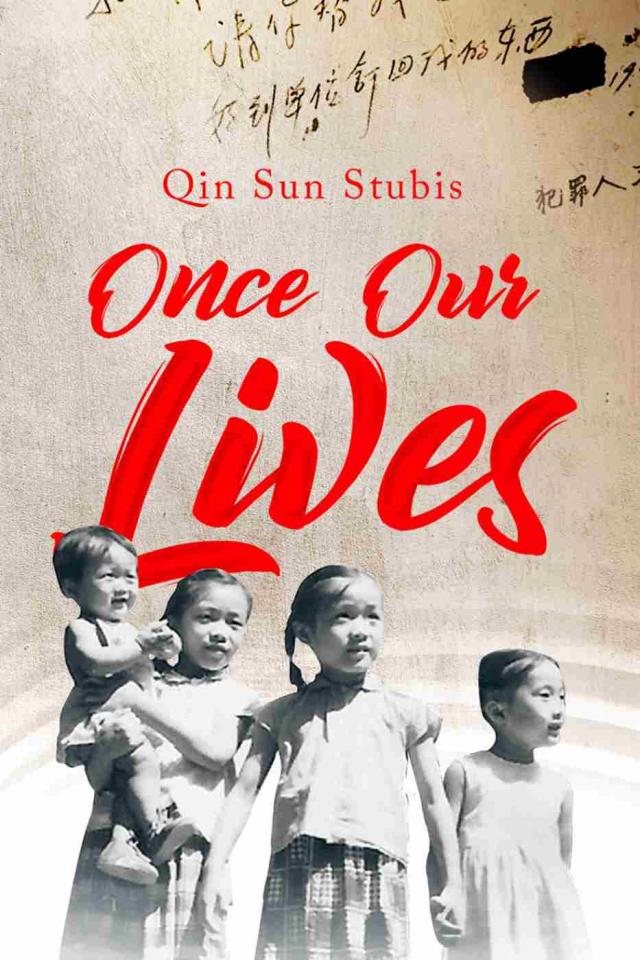


Others might say that she was confused and crazy, but Ya Zhen knew that her mind was very clear and sane. She was right all along. How else could she have explained the transformation of her son, his resemblance now to the beggar whom he had never met, and the continuous disasters that had taken place in his life: the loss of the Sun family fortune, the endless poverty and hardship, the revolution, the prison sentence and the four granddaughters he had given her to end their family name and put shame on her face? Worse still, there was not a thing that she could have done to avert his fate and had to watch powerlessly until her son and the beggar finally fused into one.
Ya Zhen often wished that An Chu had not been so innocent and hardheaded, like she was when she was young. She wished that he just would have listened to what she had to say and learned to protect himself and his future. Sadly, the revolution had brainwashed him, making him believe all her words were only superstitious nonsense. Her poor boy. He had never lived a decent day in his life and as a mother, she knew that, ultimately, she was responsible for everything that had happened to him. She was now old and helpless. Ironically, they had swapped roles. She was the one who now depended on her old beggar-son to come and feed every day. He brought her food and called her “Mother,” which made her uneasy. And yet she was looking forward to his visits and waited eagerly.
It was getting late. Ya Zhen didn’t want to leave and seek shelter inside, even though she was no match for the Siberian air. The colder she felt, the harder she stamped her feet. Her hopeful, searching eyes grew dimmer and dimmer. Finally, she couldn’t feel her arms and legs anymore. Even her lips were numb. Still, he didn’t come. It was time for her to give up. Reluctantly, she turned around and walked back into her apartment. A great weariness came over her as she stumbled into her bed. She lay there in long, utter silence. Her disappointment gradually gave way to a memory that had played and replayed in her head so many times throughout her life. It took her back to the days right before An Chu was born when a beggar came day after day to be fed until one day, he failed to appear. Just like today. And then, he never came back. Her heart constricted, and she panicked at her own premonition: The end of this endless spell had finally arrived. Her son and the beggar were never coming back. The dark spirit had finally taken her son.
Four of Ya Zhen’s five daughters gathered around her. The room was dark, and the air was heavy. Their mother had been bedridden for a week now. She wasn’t eating or drinking anymore but lay motionless with her eyes closed. Only the gentle rise and fall of her chest showed that she was still there. They waited in silence for their eldest sister to arrive and bring them some news about An Chu.
At some point, they heard muffled footsteps in the hallway and soon after, a key being inserted into the lock of the front door. She had finally arrived. She walked straight toward them, her head hanging low, very low.
“How is Mother?”
“Still the same. We don’t think she is conscious anymore.”
“How is An Chu?”
“He took his last breath an hour ago,” she said mournfully to the startled gasps of her sisters. “You must get to the hospital quickly if you still want to see him.”
“Shh!” They motioned to keep her voice down.
“Why?” she asked. “Mother can’t hear anything anymore.” Still, she slightly lowered her voice. “Poor An Chu, his blood sugar was zero by the time he got to the hospital.”
As the five of them huddled in the dark and quietly wept, two lines of tears silently streamed down from the corners of Ya Zhen’s closed eyes.
An Chu, my son! Where is the beggar taking you? I cannot let him harm you and torment you anymore. I must free you from him so your next life will be a better one …
She saw herself walking on a gray, murky path. Her pace was brisk, and her mind determined. Suddenly, she made out two, dark familiar figures ahead. Ya Zhen began to run. She had to catch them before it was too late …
On her bed, shrouded under a darkening evening veil, Ya Zhen quietly released her last breath. No one heard it. No one saw that her final moment had arrived and was gone. All five sisters, blinded by grief, were consumed by the death of their brother. The darkness eased their pain and they stayed surrounded and enveloped by it until they couldn’t see each other’s faces anymore. One of them finally got up and turned on the small light on Ya Zhen’s night table. They all looked toward their mother. The only visible sign of their mother’s life was no longer there. Her chest was still, and her heart had stopped.
Ya Zhen had gone to chase after the beggar and her first-born son.
Afterthoughts
The changes after the Cultural Revolution made it possible for me to attend Shanghai Institute of Foreign Languages and earn a bachelor’s degree in English and English literature. I was honored to be the first college graduate from the Sun family. My success boosted my parents’ confidence in life, but it did not change my father’s beggar’s fate.
After being released from detention, he was accused of more crimes that he had never committed—this time, supposedly, on behalf of the Cultural Revolution—by the same political chameleons who first prosecuted him for being a counter-revolutionary. He was convicted in a secret trial without the presence of his own lawyer, family members, or even a jury. His sentence was long and severe: Seven years in Shanghai Prison, where hard-core criminals who committed unspeakable crimes were sent.
It was double jeopardy for Father and our entire family. We did not see it coming and it hit us hard. Now that the revolution was finally over and we could see some light at the end of a very long tunnel, we thought we could finally live in peace. With my younger sister Min and me in college and bound to get good jobs, we would not be poor for much longer. Then, Father had to go to prison for another seven years. How could a person be punished for being for and against the same thing? It defied logic and troubled us.
We went through the next seven long years, not knowing whether my father, with his untreated heart condition, high blood pressure, diabetes, chronic hepatitis, rheumatism, and deflating spirit would ever make it out of prison alive.
Father served the full seven years of his prison term, drawing on all his strength to survive his unjust punishment and reach the end of his life’s journey as a free but broken man. In an intriguing twist to his beggar’s fate, he and Ya Zhen passed away within hours of each other. While he was a political prisoner, he missed two daughters’ weddings, three daughters’ university graduation ceremonies, and the birth of his first grandson. He never recovered from his political persecution but remained hopeful up to the very end of his life that his convictions could be overturned.
I love you, Father.
Mother learned to live in the dreams, hopes, and futures of her four daughters. Her religion, which had given her the strength to go on with her life, helped yet again in the absence of her husband. She had learned to accept whatever life unmercifully threw at her, be it political persecution, poverty, or pirates. In her dark, troubled world, there was little hope of a happy ending. She coped by letting the days slip away one at a time until an ordeal, a famine, a seven-year sentence, or a death sentence, was over.
At the age of fifty, Mother was already dwelling on her past. Without Father, she could not live in the present tense. On those endless hot summer days and nights, sitting side by side on a pair of bamboo chairs as we worked on a sewing or knitting project, Mother often retraced her life’s journey with me. She invited me into every part of her personal story, which we visited, revisited, examined, and reexamined.
She often wondered what would have happened to her if her mother had never given her away and she had grown up with her real brothers, and sisters, or if her birth father had never perished in the Pacific Ocean, if her life path had never crossed Father’s, or if she had never gotten married.
It was through her stories that I learned all about Mother, learned to respect and admire her, learned to share her cherished, yet unfulfilled, young dreams, and her many grievances when life let her down. Most of all, I came to realize that my mother was my heroine and my friend. I could share my hopes and dreams with her, hold her hands, and show her a brighter path where life can be a success story. Indeed, we became, by the truest definition, best friends.
I love you, Mother.
Acknowledgements
When I was little, I envied my classmates who didn’t go to school wearing patched clothes and worn-out shoes, and never had to worry about their next meal or whether their father was still alive. I often wondered why I had to be born into my family and given such a hard life. When I grew older, I realized that my life was special because it was molded by challenges, hardships, bitterness, and love, all of which made me strong. Now, I would never want to trade it for anyone else’s in the world. I’m eternally grateful to my family, especially my mother, Yan, my father, An Chu, and my sisters, Ping, Min, and Wen. You all have made my life’s journey a special one.
My deepest thanks to Guernica Editions and its tremendously talented staff and partners for bringing Once Our Lives into the world, especially editor-in-chief Michael Mirolla, publisher Connie McParland, and graphic designer Allen Jomoc Jr. for creating my book cover. You are a true artist! I am extraordinarily grateful to my editor, Sonia Di Placido, who worked on my manuscript and provided so many perceptive, sound, and sensitive suggestions to make the book the best it could be. Thank you all.
I am forever indebted to Senator John McCain, who helped secure my visa to the United States, to Uncle Jack Ho and Aunt Wai Kwan Wang, who welcomed me to America and supported my ambitions, and to Barbara and Carl Brown, who generously opened their home and their hearts to me during my years at the University of Arizona.
I want to thank Diane Margolin, the publisher of the Santa Monica Star, who for the past fifteen years has provided me a public writing platform in her paper and gave me a place to share my stories and refine my craft. I am grateful to Lisa Hagan and Carolyn Doyle Winter for having given me confidence in Once Our Lives. Thank you to Alexandros Plasatis, the editor of the other side of hope magazine for believing in my writing and publishing my first short story, “The Proposal.” And loving thanks go to Dr. Michael Pisani, as well as Edna and Dr. Lewis Lipsitt, for lending me an ear and supporting my quest to see this work from the heart published. Michael and Lew, I wish you could be here to witness the birth of my book.
To Frank McCourt, Amy Tan, Maxine Hong Kingston, Lisa See, Gish Jen, and Helen Zia: You are my inspirations and my idols! To Zhu Fang Zhen and Jia Ray Liao, my honorary grandparents, I am eternally grateful for the life-changing free English lessons you gave to me when I was sixteen. To Margaret Wang, my professor at the Shanghai Institute of Foreign Languages, you opened my eyes to Shakespeare and the beauty of the written word.
I want to thank the many special people who encouraged and cheered me on over the years from New York, Washington, D.C., California, Maryland, Pennsylvania, China, Hong Kong, Morocco, India and Latvia, my beloved family members Keaton Stubis, Halley Stubis, Yi Dai, Angela Bamfield, Jeanne Fuchs, Ligita Stubis, and Dong Nan Dai, and my dear friends Anthony Taibi, Constance Kovar, Ye Faye, Jim Feldman, Pamela Levinson, Robin Ganzert and everyone at American Humane, Leah Yaw, Heather Heath, Gerry and Lindsey Biel, Kui Hui Wu, Meeta Charturvedi, Margaret Tsang, Christine Crosby, Christine Biddle, Xin Zhang, Rabbi Bruce Lustig, Sinaly Roy, Mary Seibel, and Vivian Wu, to name just a few.
To my readers, thank you all for walking down this very special memory lane with me. I hope you enjoyed the journey.
Last, but not least, thank you to my husband and my love, Mark Stubis, the most literate and literary man I know. I will never forget the many late-night, candle-lit hours we spent together, talking about and shaping this book to reflect the lives we once lived.
About the Author
Qin Sun Stubis was born in the squalor of a Shanghai shantytown during the Great Chinese Famine. Growing up during the Cultural Revolution, she quickly learned that words could thrill—and even kill. She saw her defiantly honest father imprisoned and tortured for using the wrong words. Shunned as political pariahs, Qin and her family sustained themselves with books and stories of adventure and past glory. With the help of a borrowed radio, an eccentric British teacher, and a fortuitous assignment as a library assistant, Qin discovered and fell in love with Western literature, committing to memory the strange but beautiful sounds of Keats, Wordsworth, and Lincoln.
But it was in bed late each night, after scouring local parks for enough firewood to cook the family’s meal of rice, that Qin and her three small sisters heard the dramatic stories that make up this book. The four girls listened to their mother, an aspiring actress in the early days of Asian cinema, recount colorful tales of pirates, prophesies, fortunes won and lost, babies sold in opium dens, glorious lives and gruesome deaths. Based on actual experiences and family lore from Imperial to Post-Revolutionary times, these stories represent a wealth of colorful but little-known Chinese history.
Eventually, through sheer grit and perseverance, Qin won admission to the famed Shanghai Institute of Foreign Languages and graduated with a bachelor’s degree in English and English Literature. With the help of family, friends, and U.S. Senator John McCain, Qin was granted a visa for study abroad. She arrived in America with two suitcases and not much more. After winning several scholarships, she graduated with a master’s degree and a profound love for her new adoptive country.
For the past 15 years, Qin has been a newspaper columnist and writes poems, essays, short stories, and original Chinese tall tales inspired by traditional Asian themes. Her writing is inflected with both Eastern and Western flavors in ways that transcend geography to touch hearts and reveal universal truths.
The only Chinese she knows who never learned to ride a bicycle, Qin now lives in the Washington, D.C. area with her husband, Mark, a classical pianist and media executive, and their children, Keaton and Halley. To learn more about Qin and her work, visit www.QinSunStubis.com.
Qin Sun Stubis, Once Our Lives


