

Once our lives, p.24
Once Our Lives,
p.24
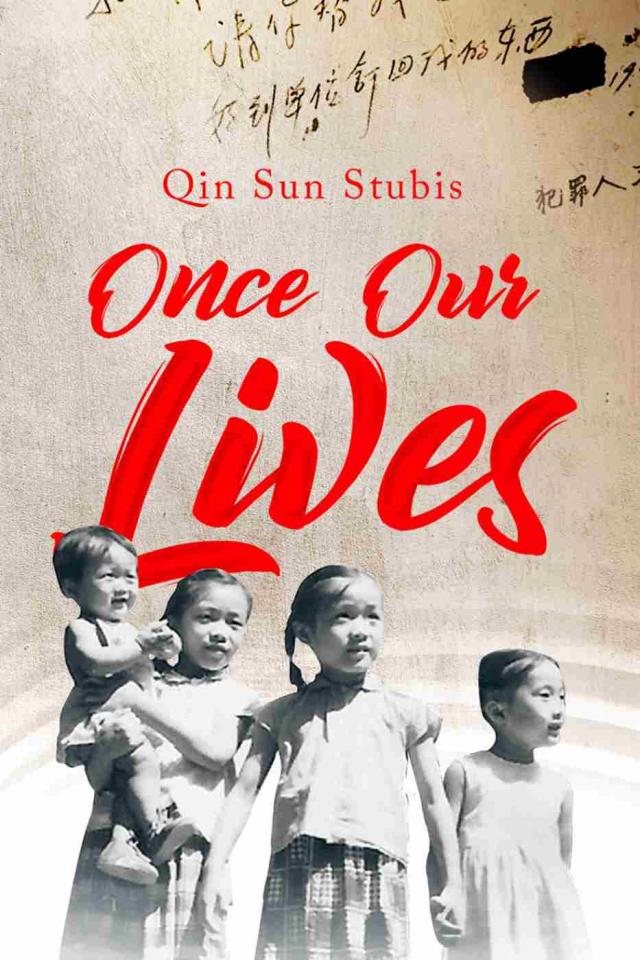


For now, I lay contentedly on my stomach and looked through a knot hole, watching our neighbors running with household objects. I saw dust swirling and babies screaming. I saw a curious rooster that was wondering what was going on stride right into the middle of the crowd, where someone stepped on it. The bird squawked, its face scarlet red, and its combs shaking with nervousness. Abandoning its ill-advised curiosity, the injured bird flapped its wings, and flew off to hide from careless human feet. In all the hubbub, no one even noticed the rooster. Maybe Mother was smart after all. Maybe she did not want me to suffer the same fate.
We did not stay in the shantytown long enough to see its last dying days. As an employee of the House and Land Management Agency, my father was offered new living space in the city. Eager to get out of the chaos, my parents jumped at the chance.
I remember leaving our home on a fine spring day. A pleasant sea breeze, just slightly cool, sweetened the usual pungent smells of the neighborhood, and I inhaled it all deeply to help me remember the only place I had ever lived. I said goodbye to the upside-down wooden box in which I had grown up, and then we all held hands and walked out of the slum into a new, completely different world.
Tall, beautiful buildings were lined up along the avenues and side streets, so many that they disappeared into the horizon in both directions. After the low shacks and open sky of the shantytown, I was dazed by the size and depth of the city, wondering if it would suck me in and turn me into a small dot like all the other people. Where we came from almost nothing grew, but here I saw rows upon rows of giant trees along the streets. Their new, tender leaves made my heart sing. The world was more beautiful than I had ever remembered, and its air was sweet and friendly.
We must have been a sight. We neared our new home pushing a bicycle piled ten feet high with junk, dragging packages, a broom, cooking pots, and a funny-looking device someone told us we would need in the big city: a toilet-plunger. Holding a precious slip of paper with the address of our new home, my mother was nervous, rushing us through the streets and herding us along like ragged little ducklings. She paid no attention to anything except for the street signs, and her concentration paid off. Before we knew it, we were standing in front of a massive pair of iron gates.
At the time, gated neighborhoods were practically nonexistent. The communist ideal was the equality of all people, abolishment of class differences, and the distribution of wealth. The stiff formality of the wrought-iron entrance awed Ping and me into instant silence and froze our childish enthusiasm. We hid behind Mother as a middle-aged man slowly waddled out of his sentry box, examining us up and down.
“You can’t pass through here. This is for residents and visitors only,” he announced in an official voice. He waved his hands from side to side, as if to block us from entering.
He obviously thought we were strangers who didn’t belong there, judging from our modest clothes.
“We don’t want to pass through.” Mother replied. “We are moving in.”
The man looked confused. “You? Moving in?”
After a few inquiries, Mother showed him the address and the key, and he let us enter.
“I’m not sure if the place is fit to live in,” he warned us before waving us on.
We looked at each other. We didn’t quite get what he meant.
Little did I know that my family and I had just moved into the most elite neighborhood in Shanghai. Like Park Avenue in New York City, or the Champs-Elysees in Paris, it was a place for the rich and powerful—retired members of the Chinese politburo, an ex-mayor, high-ranking army officers, and a few cast-off mistresses left stranded by the city’s great industrialists when they vanished following the founding of the People’s Republic of China. These great and faded ladies were the last reminders of the past glories of the pre-communist era, the elite of Shanghai’s fabled high society, where women wore silk and diamonds, commanded small armies of maids and servants, and whose delicate, expensively shod feet never touched the ground. They were tolerated, perhaps because they had lost so much, or perhaps as curiosities—like some harmless fossils in a local museum.
By some strange luck, not only were we moving into the prestigious French Quarter, but into one of its most elegant streets. Old-timers in the area still called it “Jubilee Court,” although after the revolution the new leaders quickly renamed it with the more proletarian-sounding “New Healthy Gardens.” Maybe they thought that by changing its decadent name, they could change its decadent character and transform it into a perfect breeding ground for good, strong, young communist citizens. Unfortunately, the opulent, private lane remained defiantly haughty and imperial—at least outwardly—with luxurious, fairytale-like Spanish colonial villas on each side. They were designed to look like castles, and their roofs were made of beautiful orange-red tiles whose colors reminded me of ripe persimmons.
Only two families lived in each house, occupying one of the two, huge main floors and having separate entrances. At that time, most people were lucky to have a 15 x 15 room to live in, and they usually shared a bathroom and kitchen with five, or ten, other families. Of course, that would still be a step up for the Suns, who had never had a bathroom or kitchen, and managed with a chamber pot under their beds and a wood stove for cooking and warmth.
Here, in front of every villa, was a spacious garden enclosed by a seven-foot-high black bamboo fence. Spilling teasingly over the tops, tall plants and ornamental trees danced and competed to be the most beautiful and graceful. French pines, magnolias, loquats, figs, wild roses, and trumpet vines rested comfortably along with their owners in a paradise lost by the French in 1949 and discovered by the new Chinese ruling class. At the end of the lane, four Western-style six-story apartment buildings stood, forming a circle. These buildings towered over the villas, competing to be the center of attention.
Some things had changed since the French left, although the new residents didn’t realize it. A giant boiler room, the size of a two-car garage, used to supply heat to all the residents in the lane, but had been abandoned long ago. Nestled between the last villa and the first apartment building, it looked functional, but a closer look through the dust-covered glass windows at the top of the door revealed the gigantic skeleton of what appeared to be a very ancient coal-eating mechanism sleeping under a blanket of dust. The new residents never seemed to miss the heating in the wintertime, or wonder why the apartments were equipped with stone-cold radiators under every window. Having heat in an apartment was an unheard-of luxury in the early Communist years. In fact, in the late 1960s, almost no one had heat in the winter—not in private homes, not in offices, not in schools, not even in hospitals. People learned to live with the cold or keep it at a respectable distance with quilted door protectors, hot-water bottles, and thick winter clothes both indoors and out. Frostbitten fingers and toes were everyday affairs and considered common winter annoyances, comparable to mosquito bites in the summer. With lots and lots of hot tea, steaming soup, rubbing of hands, and stamping of feet, people managed to make it without help through the winter to the warmth of spring.
On the other side of the lane from the obsolete boiler room, crammed into a narrow gap between the garden of one villa and the side of an apartment building, sat a miniature castle, the size of a large dollhouse. It had the same stucco exterior and tile roof as those of the grander villas and looked very sturdy. A giant sycamore tree snuggled against the tiny house, reminding me of a very small person with a comically oversized umbrella. This was our new home.
Seeing it for the first time, we were both awed and excited. Mother inserted a shiny new key into the lock of a wooden door leading to a modest inner courtyard that matched the size of the house. While she was doing this, Ping and I struggled up on our tiptoes to get a peek through the black bamboo fence.
“Let me see.”
“No, let me see.”
“Mom, Ping won’t let me look,” I screamed.
“Qin is blocking me, Mother,” Ping protested back.
We had so much fun pushing each other and preventing the other from getting the first glance that neither of us could gain an advantage.
Finally, Mother pushed open the door and we leapt into the yard.
We were utterly disappointed by what we saw: There was absolutely nothing in the tiny yard except a concrete patio, which lay uninvitingly in front of a very small house. What really caught my attention was the sheer wall of the apartment building next door, which towered above us like a dark force. I looked upward through the iron slats of the fire escapes until my neck ached. The height of this six-story building boggled my imagination.
“When I grow up, Mother,” I declared, my right index finger pointing upward, “I will live up there.”
At that moment, I meant it. I had such a longing to be standing all the way up there, the highest point I had ever seen in my life. But it made my mother panic. We were neither rich nor famous. My declaration would make my family a laughingstock if anyone heard it. Mother muffled my mouth with her hand before I could cause any trouble and pushed me into the little house.
“Little children shouldn’t talk nonsense,” she scolded.
Our home used to be the bath house for the maids and chauffeurs of the four apartment buildings. Under a thick layer of dust, we could see that the now one-room house had a floor half made of concrete and the other half made of mosaic tile. The concrete section was the men’s shower room and the daintier, more decorative mosaic section had served the women. Severed pipelines along the rust-stained walls told of previous shower locations and vanished drains, although I only learned what they were years later, for I had never seen a shower before.
Alone on the floor sat a porcelain fixture. I could not tell from its odd shape and size what it was or why it was not taken away like the rest of the objects in that room. But I immediately saw that Mother was delighted by the sight of it.
“A toilet!” she gasped. “Our own! What a luxury!”
We could not understand her excitement, but Ping and I grew curious.
“What is it?”
“What did you call it, Mother?”
She patiently explained its workings to us as she excavated it from under dust and spider webs, scrubbed it inside and out, then depressed its little handle. I saw water gush down into the big bowl, swirl around, and then magically disappear along with the dirt and dust, all the while making a pleasant gurgling noise. I felt I was witnessing a magic trick. I kept on wondering where the dirty water went and how the fresh water appeared. I did learn from Mother that this magic bathroom device was a western invention, and that we did not need a chamber pot anymore. Our new toilet would always be clean and fresh, unlike our smelly, old wooden chamber pot, which we only emptied out once a day.
The marvelous toilet occupied our attention for the rest of the day. We flushed it again and again, watching the water swirl down and disappear while Mother dusted, swept, and scrubbed the floor on her knees. Between this gleaming porcelain fixture and the luxury of so much clean, solid space, our hearts were sold on the new house. I forgot all about the tall buildings next to us. This was a palace compared to the wooden box and dirt floor we left behind. It was more than my parents had dared to hope for. It would be the place I called home for the next twenty-five years.
Chapter II
Days of Innocence
The new house was a welcome change in our lives, especially Mother’s. With our own water tap, toilet, and yard, and no one to share any of these luxuries, she finally got the privacy for which she dreamed so long. For us, however, privacy was a shock. All of a sudden, the hundreds of friends who stopped by, played with us, and sometimes fought with us, disappeared. Instead of the clamor and din of the slum, we discovered a new sound: silence.
Once the fascination with all the many novelties wore off, boredom set in. Since our lane was private, no one ever unexpectedly appeared at our door. In fact, we rarely even saw anyone walking in the lane. Mother granted us permission to stroll there but warned us not to go beyond the sentry gates. We took advantage of Mother’s offer and wandered around, exploring outside the big villas’ expansive gardens, gathering flowers that stuck their heads out from underneath fences, picking strange berries and seeds, or simply skipping back and forth down the street until we were exhausted.
Soon we discovered that we were not the only working-class family in the neighborhood. The original garages had been transformed into apartments, and in each garage, an entire household was temporarily parked. They were less fortunate than us, with no private bathroom fixtures, one public water tap, and a well to serve some twenty apartments. Nevertheless, they at least gave the feeling of one big community, which reminded me of the shantytown where everyone was part of everyone else’s lives. We watched from a distance as they shared food, played cards, and wandered in and out of each other’s homes. Ping and I wanted to make friends with the children there, but to our disappointment, when we peered into their enclave and our eyes met theirs, they just pulled each other’s sleeves, turned, and walked away. We came to the realization that they did not want to make any outside friends.
At the end of the lane, past the sentry box, was a spacious, fenced-in public garden. This little park offered a view of Huai Hai Road, the famous shopping street known in the French colonial days as “Avenue Joffre.” Ping and I would often take Min to the garden and play together under a giant magnolia tree. When the blossoms peaked, we industriously gathered stacks of colossal pink petals from the ground, placed assorted seeds and wild flowers in them, and played “family dinner party.” We played hide-and-seek in the bushes, exploring the limits of our world, but our eyes wandered even further. We wanted to know what lay beyond the fence where we admired the endless flow of people strolling by and holding bags, boxes, and packages. Tickled by the sights and our own curiosity, we started to toy with naughty ideas like leaving the park and walking out among strangers.
One day, we did it. I remember my heart pounding in my throat as we slipped out of the gate. Ping held baby Min while I looped my arm through hers. I did not enjoy freedom as much as I had thought I would. Worry steered my mechanical steps.
Does Ping know where we’re going? I wondered, afraid to know the actual truth.
We walked for a few minutes before a strange woman approached us. She was about Mother’s age, perhaps a little bit older.
“Hi, little girls,” she said, sizing us up. “Don’t you all remember me? I’m a friend of your parents.”
Her eyes were filled with smiles and her mouth with teeth.
I turned back to see if she was addressing someone else behind us, but there was no one there.
“Your mother has sent me here to find you,” she said as she patted me on the head. “She is waiting for you at the North Train Station.”
What?
Now I was really puzzled. Mother was doing laundry at home. We had sneaked out. She did not even know we were out wandering on our own. So how could she have sent someone here to take us to the train station? Mother said trains were for families with money traveling to faraway places. Was this woman lying? Why? Why did she want to take us to faraway places?
But she looked like a good person, well-dressed, and with a kind, gentle face. Maybe she really knows our parents …
I was so confused that I thought aloud: “Mother is home doing laundry, Ping. She doesn’t even know where we are.”
Ping and I looked at each other, and we suddenly came to a revelation: It was a trap.
We turned around and ran as fast as we could. We did not stop and never looked behind us until we slipped back inside the gate.
Mother was kneading dough and steaming buns when we returned. She wiped her floury hands on her apron and listened patiently as we breathlessly poured out the story of our narrow escape.
“That is why I don’t want you to go out on your own. The time will come when I’ll let you do so. First, you have to grow up a bit more,” she commented matter-of-factly without any criticism, handing us each a steamed bun.
That summer soon slipped by and it was time for Ping to go to school. To prepare Ping for the first grade, Mother had been home schooling us an hour a day. She made me her pupil, as well, much against my will. Two years younger than Ping, I was not an eager student and dreaded that endless hour each day. I was glad when summer was finally over and Ping went off to school.
Ping was a good student. She always got perfect scores in math and spelling, which pleased mother very much.
“I will be a good student, too, when I go to school,” I vowed. “But I’m just not ready yet.”
Mother laughed.
I did not like that summer for another reason, as well. A very bad flu hit the city. To combat the chance of our getting it, Mother turned to an old Chinese trick to ward off the disease: Day and night she boiled a mixture of herbs and vinegar, filling our small home with sour steam that hurt our lungs and made tears run down our faces. If I’d had a choice, I would gladly have risked getting sick rather than be suffocated by acid. To make matters worse, every night at the dinner table, Mother dispensed to each of us, as a precautionary measure, two cloves of raw pickled garlic. I had always run to be the first at the table when supper was ready, but now I stopped. Instead, I used every excuse to be the last. The very smell of garlic and vinegar made me sick. I even started to have second thoughts about the sweet and sour foods I used to love. There were nights I sat frozen at the table and refused to eat anything until mother suspended her rule, and let me eat my dinner without those cursed garlic cloves. Only then would I wipe away my tears with the backs of my hands and enjoy my dinner with victorious glee.


