

Once our lives, p.30
Once Our Lives,
p.30
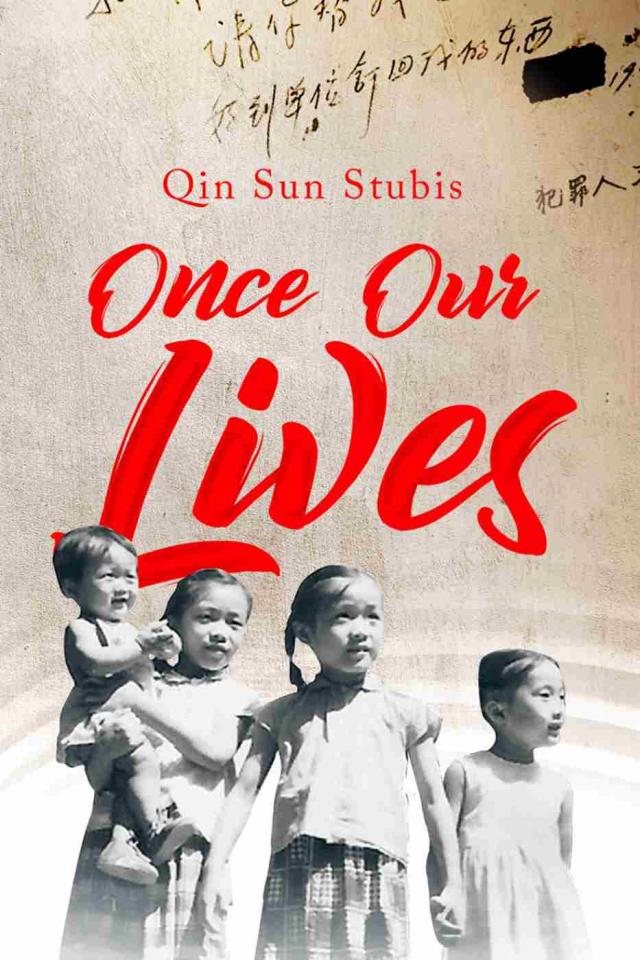


Ironically, Father started getting paid again during his “sick leave” from detention, so we did not have to scavenge for coal nuggets anymore. Instead, we often spent our time picking grass so our chickens would have enough food.
To gather grass in the city took energy, luck, and vigilance. We watched for any green, young blade curious or foolish enough to stick its head from under the fence of a neighboring yard. We also made visits to the municipal park at the end of the lane but had to do so secretly since it had become a political arena and the public was no longer permitted inside. Ping, Min, and I worked together to get inside. We decided to divide up our roles. One of us stayed outside the entrance, pretending to be playing while watching out for any grownups coming in our direction. The second planted herself inside the garden within earshot of the entrance in order to relay any warnings to the third who was picking the grass. When our covert operation was accomplished, we casually slipped out of the area, carrying a basketful of green treasure secretly hidden under a dirty dish towel.
Little by little, Father started to get better. He got out of bed for short periods of time. His movements were slow, labored, and confined to our one-room house and its small yard. Any desire he might have to go further was quickly killed by the knowledge that right outside our door waited a two-man surveillance team.
For the first time, though, Father seemed happy just to be home not doing anything. He enjoyed watching us tending the chickens, cleaning up after them with a broom, or cuddling with them in the sun.
It was very comforting to have Father around the house. It made up a little for the months he was gone. I enjoyed him so much that I wanted to stay home all day so he wouldn’t disappear again before I returned from school. Father saw the fear in my eyes. That was when he held me on his lap and gave me a lecture on life.
“Going to school is the only source of pride for a poor family,” he said. “Education gives you the same knowledge and promise of a good life a privileged child has. If, someday, you have a choice of going to a college at the cost of disowning me as your father, I would push you to go. Knowledge stays with you for the rest of your life but I cannot. My love tells me to choose what’s best for you and your future. As for me, I will always be part of you. You will always be my daughter in my heart. I will always be your father. You cannot lose me, no matter what happens.”
Struck by his gaze and words, I slowly chewed on his words. Father knew I loved school, but I loved him even more. He was worried that I would give up everything because of him. But if he told me to stay in school and learn, he knew I would. Every morning, when I picked up my army-green school bag and headed out, I thought of my father and my silent promise to do well. And I did just that, but not without a struggle.
Of the forty students in my class, I was the shortest one, always at the beginning of the line and always with the shabbiest clothes. My trousers were often patched at both knees and in the back. My jacket was discolored, bleached by the sun. And I always wore homemade cotton shoes. My modest outer appearance and my silent nature doomed me to be unpopular—someone everyone picked on.
Even during the Cultural Revolution, you could easily tell a child’s family background by his or her clothes. There were plenty of other kids dressed like me. But in my neighborhood, kids were mostly dressed in starched shirts, ironed pants, and shining, black patent leather shoes. Though plain, in politically acceptable colors such as navy blue and army green, their clothes were crisp, tailored, and new. Most kids came from families with political connections and lived in the apartments high above my shabby little bathhouse. They had live-in nannies and servants they called arh yi—“aunts,” who cooked for them, cleaned their apartments, and washed and pressed their clothes. Their parents were attended by si ji tong zi—“comrade drivers” in white gloves—who drove their government-issued cars. Even my teachers were afraid of them.
“Hey, The One from the Bathhouse,” they often called me in school. “How do you live there? Taking baths while you sleep?”
They had too good a time making fun of me to stop.
“Anyone want to meet a beggar living in a bathhouse? Just see where my finger is pointing!”
“Look at the patches on her pants and elbows and her shoes … she looks like a walking quilt!”
“Can anyone tell the difference between her and a scarecrow? No, because there isn’t any!”
I could hear kids laughing behind me, but I wouldn’t look back or respond. I pretended that they were talking to someone else. I knew that if I answered, I would make a fool of myself, and they wouldn’t be punished anyway. I’d learned that much.
Once during our political science class, I was sitting straight with my hands behind my back, the way we were taught, while the teacher copied Chairman Mao’s newest quotation onto the blackboard. A boy sitting behind me suddenly leaned forward, grabbed my pencil-box, and threw it on the floor.
Crash!
The teacher turned around, just in time to see me dropping down and crawling on all fours to retrieve my precious pencils and crayons, which were rolling everywhere, before they disappeared under everyone else’s desks.
“Qin Sun! Did I give you permission to get up and do a monkey dance? Get back in your seat! You are disrespectful to our great leader’s teachings. If I ever catch you crawling on the floor while I’m writing his quotations, I’ll make you stand in the corner for a week!”
I sat on the floor, frozen, my hands still holding onto the few crayons I had salvaged. I bit my lips and held in my tears until I got home. The moment I arrived home and saw Mother, I cried so hard for so long that I could feel my head buzzing.
“I’ll take you back to school right now,” Mother said. “I want you to tell your teacher everything just the way you told me.” She was outraged when she heard my story and saw my empty pencil-box.
My teacher listened impatiently because it was her lunch hour.
“Well,” she finally said to Mother, “when I turned around, I saw that boy sitting with his hands behind his back, like the rest of the class. Although I don’t believe her story, I’ll ask the boy if he threw down your daughter’s pencil-box. He is a very good boy and will tell the truth.”
She looked at me severely. “Are you sure it was him? You know his father is a very high-ranking official at the city hall and he is very strict with his children.” I nodded timidly.
Of course, the boy denied everything and my teacher believed him.
The next day, the teacher told Mother that I must have pushed down my own pencil-box, and that I lied to protect myself. She almost made me believe that I was the guilty one, except that between classes, the boy behind me pushed me down and pressed mud balls into my pigtails for telling on him. He warned me that he would paste mud balls all over my skull if I dared tell on him again.
Mother shook her head, took out two pencils and a few crayons from Ping’s pencil-box, and put them in mine.
Over the years, I gradually earned a good reputation because of my grades. Classmates fought to sit near me in case of a test. They visited me at home with their homework and I helped them. Knowing that I could do something well was satisfying. But knowing that no one could take away my thoughts and ideas was better.
Chapter X
Someone Wanted Us Dead
Just as Father started to get better, nourished back to health by the many precious eggs from our chicken friends, our worst fear came true: he was sent back to detention. Since he was in ill health, we were at least allowed to visit him every few days and bring him things, including food.
Since his return, Father had been the focus of our lives. Now, everything felt meaningless. To save rice, Mother even got rid of our chickens.
It was a hot, hot summer with little to do. I sat on my little bamboo chair in our front yard and tried to amuse myself by waiting for clouds to pass across the patch of sky between the apartment buildings and our sycamore tree. Too often, though, it seemed that the sky reflected my life. Nothing was moving. Nothing was happening. One day, I went out to skygaze but the summer sun was blinding. I shifted my eyes to our tiny house. To my surprise, its stucco walls were alive with activity. The normally plain, sandy surfaces were glistening like fields of jewels, every grain of sand a tiny diamond. I harvested them one by one with my eyes, and discovered a new game using the magic of the sun. When I squinted or tilted my head, the stucco wall began creating an endless variety of pictures. Glittering patches of its uneven surface turned into flying horses, cats, dogs, and all sorts of fanciful shapes to make me forget my missing clouds. This helped me pass the time until the late afternoon when I could go and visit Father.
Since it was close to home, Mother sometimes allowed Ping and me to go by ourselves. We often took along newspapers, little treats Mother specially prepared for Father, and packs of cigarettes. Father’s cell was not a normal room. It was a tiny living space—a cage, really—formed by wooden boards, not tall enough to stand up in and not long enough for the prisoner to actually lie down, although he was given a pile of hay to sleep on. A battered desk and chair were the only amenities and were crammed in next to the “bed.” On the desk were a writing pad, a pen, and a Chairman Mao quotation book. Father was instructed to sit there all day, reading the Chairman’s wisdom and writing out his anti-revolutionary confession.
But Father was as hard-headed as ever. He stood firm on his innocence and insisted that he did not drive a thumbtack into Mao’s portrait, didn’t kill any cats to threaten our great leader, and was never the high-ranking Nationalist Party officer he was accused of being—he had just reached his teens when the Nationalists retreated to Taiwan. He also denied staying in Shanghai to spy on Communist Party members or making any of the anti-revolutionary remarks, of which he had been accused.
“No one knows me better than myself,” he said. “Don’t tell me that I joined the National Army, handled guns, and gave orders to soldiers in my diapers. If I know I didn’t do it, I didn’t do it. No one can force me into a confession.”
He left his accusers feeling annoyed and angry.
Detained in his little room, he had more free time than he could possibly fill, so he copied out Chairman Mao’s quotations on a white pad time and again. But no matter what, he refused to write down any confessions or falsely accuse any of his co-workers of wrongdoing, as his captors suggested he do in return for his release.
I often asked when he would come home again, to which he always replied, “Soon, very soon.”
Only after I grew up did I come to the realization that Father must have been exceptionally strong to maintain his sanity under such cruel conditions.
Father did not come home, and the summer dragged on. The days were too long and too hot. The heat just would not break, and our little house felt like a rice steamer.
Mother had already stripped our beds down to the bare wooden boards and covered them with straw mats, which were supposed to make them cooler. Instead, the heat turned the mats annoyingly sticky and left our sweaty bodies with their woven imprints. I flapped my palm-leaf fan left and right all night long, even when I was asleep. The heat turned the pleasure of resting into torture. I tossed and turned.
The heat wasn’t the only thing that kept me from sleeping. The nights were long and creepy. Stories of murder and mutilation kept me up at night listening for any unusual noises. It was the height of the Cultural Revolution when factional violence intensified among political groups, when conflicts gave birth to murderous attacks, and executions were conveniently carried out with a kitchen knife under cover of night with haunting stories of tragic, sudden deaths that made people shut their doors and windows even in the summer heat. I heard grownups whispering about the head of one political group who came home late and found his entire family dead. He went mad and never recovered. His group was taken over by his rival. I imagined a wild man with shoulder-length hair, filthy face, bloodshot eyes bigger than bottle caps, and claw-shaped hands tearing at the air, stamping around in a pool of blood. I shivered.
In spite of all the horror stories, I never imagined political violence could reach my own doorstep, but it did.
It started out as an ordinary summer night. Min got an invitation to spend the night at a neighbor’s apartment. As a treat, Mother assigned the two family beds to Ping and me while she made herself a temporary cot with two wooden boards in the kitchen. Baby Wen was placed in the old bamboo crib in the middle of the room. We left our bedroom and kitchen doors open to let in any slight breeze, although that night there wasn’t any.
It was hopelessly hot. I dozed off under the monotonous flapping sound of my own fan.
Sleeping in such awful heat often caused nightmares: I dreamt I was in a yard littered with dead chickens. A vicious black dog chased me, and I couldn’t run. The sky was raining rocks on me. I often woke up in the dead of night in a hallucinatory state, disoriented, and not knowing what was real and what was a dream. That night I awoke in pitch darkness to roaring waves of sound. Sitting up on my stiff bed in my sweat-soaked clothes, I listened as the noise faded away. By then, I was more awake and realized that it was not a dream. I heard Mother get up and walk toward the front door. I saw her anxiously peering through the mail slot. There was nothing out there but the silent night and the usual yellow light flooding in from the street.
Mother could not make sense out of what had just happened. She was a light sleeper and was woken up by unfamiliar sounds, as if someone was hitting something every few seconds at our front door. Before she could figure out what was going on she heard the loud burst of a motorcycle engine racing away. Alarmed by the unusual noises, she kept the lights off and told us all to be quiet. To be safe, Mother moved her bed back into the room with us and locked up all the doors for the rest of the night. We were so tense that we did not feel the heat anymore and nervously waited for daybreak to arrive.
We did not find out until the next morning how close we came to disaster.
The elderly neighbor who kept Min for the night lived in an apartment right above us. In the middle of the night, she happened to go to the bathroom and heard a slight noise in the darkness below. She approached the window and looked down. Two shadows rolled a motorcycle slowly toward our house. After turning it around and parking it in a position for a fast getaway, they started to hit our front door with a six-foot iron rod.
They could have easily knocked open our decaying, wooden front door with just one blow, except that it was pitch black and they could not see. Instead of hitting the door or the fence—easy targets—they were hitting the sturdy wooden doorframe, wrapped by my unconventional father with old rubber tires. Still, they could have been through the door in a few more blows if it were not for the sudden illumination of the streetlamp outside our house, which unexpectedly bathed both men, their weapon, and the motorcycle under a flood of light. They jumped onto their bike and within seconds disappeared into the night.
Early the next morning, Mother examined a dozen deep dents and gashes on our front door as she listened to the neighbor recalling what she had seen and heard.
“Don’t stay here anymore,” she advised Mother. “Someone wanted your lives, and they will come back again.”
That day, we went into exile.
Mother scattered the family, sending us into hiding for the next few months. I was sent to live with my father’s parents and had a very unhappy time there. I soon forgot about the danger, and ached to be back home with Mother.
When our family was finally reunited that fall, Mother took me to see an old man at the end of the lane. She was still seeking answers to what had happened the night of the motorcycle incident.
The stooped, wrinkled bachelor poked his head out of his basement apartment and squinted at us. He was in charge of turning on and off a dozen or so streetlights in our lane and Mother wanted to know when he flipped the switches, and why a light would be turned on at midnight. He seemed to be confused why Mother asked such questions, although he admitted that he sometimes forgot to turn the lights on or off when he fell asleep. I guess it was just dumb luck that we survived that night. The old man happened to wake up and flip the switch of life at the very moment two mysterious men hit our home.
Chapter XI
The Americans Are Coming!
For several more years, Father went in and out of detention. It became our way of life. Life settled into a three-part routine: from home to school to Dong Hu Road #20. We were happy that we could go and visit him, get patted on the head, and share the treats that Mother had bought him, even under the watchful eyes of a guard or two.
Just when we thought that the Cultural Revolution was going to last forever and Father would never come home for good, a sign of change arrived with the warming spring air of 1972. For the first time since the founding of the People’s Republic of China, the Communist Party opened the country’s doors to a delegation of American diplomats led by U.S. President Richard Nixon.
Newspaper headlines, radios, and cars with roof speakers all blared the news:
Top officials from imperialist America have landed in China!
They are shaking hands with Chairman Mao and Premier Zhou Enlai!
They are heading to Shanghai!
China and America have signed the “Shanghai Communiqué!”
The minute Mother heard this news, and every morning thereafter, she put a couple of fen in my palm and I ran to the post office to get her a newspaper. She wanted to know exactly what was going on and what it meant for the country. And for us. The crowd at the post office told me that the entire city of Shanghai shared her thoughts.


