

Once our lives, p.5
Once Our Lives,
p.5
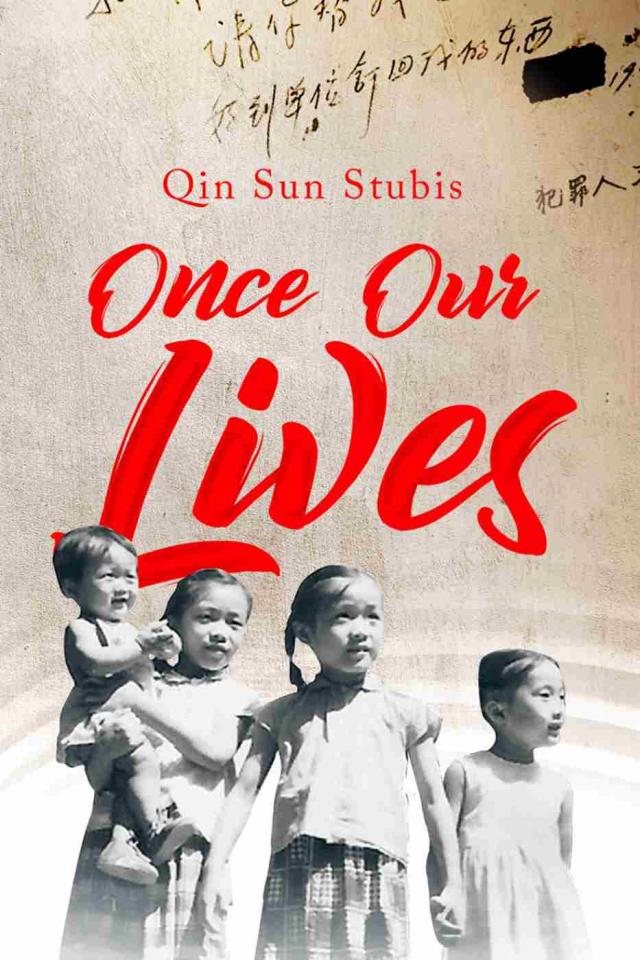


Yan lived for the days when Papa came off the ship with his worn leather suitcase and an armful of presents, yes, always presents for her, and her brothers and sisters. And, of course, the biggest package was for her mother. His eyes glistened in the sunlight and his loud voice echoed through the harbor, along with the ship’s horn: “I’m home, precious ones! I’m home!” Everyone ran to embrace him. Small Yan raced to be the first one to get to him, feel his scrubby face, and hang happily around his neck. She inhaled deeply and smelt the ocean and faraway lands.
“Papa! Papa! Papa’s home!”
Papa always returned in triumph with children hanging on his neck, his back, his arms, and legs as he walked toward home.
One day, he returned on Yan’s birthday and handed her a package right on the dock. Yan looked up at her mother for approval since she knew her rules about getting and opening presents only at home. But her mother didn’t say anything.
“Come on, sweetie, open it here. It’s okay,” Papa said in his gentle, lilting voice.
Surrounded by envious brothers and sisters craning their necks, Yan opened it and soon held in her palm a pair of miniature water pails hanging on their own shoulder-pole. They looked just like the ones the village women used to fetch water from their wells.
“I bought them from a village far away, a village just like ours,” he explained. “Happy birthday, my little pearl. Happy birthday.”
That day, Yan skipped dreamily home next to Papa, her little hands guarding the precious water pails. Afterwards, they had a lunch of longevity noodles, steamed fresh fish in ginger and scallion sauce, and hard-boiled birthday eggs dyed in happy red. Everything was so special when Papa was home.
That was her best birthday. No more birthdays would ever be like it again.
Early one morning, Yan sat still as her little maid braided her hair. She enjoyed watching a pair of swallows building a nest under the edge of the red-tile roof of her home. They flew out again and again, carrying back all sorts of fine objects for their little house under the big one. Yan started to sing her favorite song:
Little swallow
I adore you
Every spring you return
When I ask you where you’re from
You tell me that the spring is the most beautiful here
Little swallow
I want to tell you—
“Ai Zhu!? Ai Zhu!?” Yan heard her mother calling. “Where is Ai Zhu?”
“I’m here, Mother!” she answered, but her mother didn’t hear her. She sent the maid to find out what was going on. The maid came back with her mother, followed by a stranger with a familiar face.
“Do you remember my cousin, Aunt Jin Lai?”
Yan got up and bowed. “Aunt Jin Lai.”
“I have good news for you. You don’t need to call her Aunt Jin Lai anymore. Starting today, she is your mother. I have decided to give you to her.”
The words made no sense. Yan felt a cold numbness creep into her stomach.
What does it mean Jin Lai is my mother? I have a mother already. Can people change their mothers? Yan was very confused. “I want Papa!” she cried out in desperation. “Papa, Papa, where are you?”
“You know your Papa is at sea. Even when he’s home, I’m still the one in charge.”
“Mother, please don’t give me away,” Yan begged. “I want to stay home with you. I want to wait for Papa to come.”
But her mother didn’t pay her any mind. She was too busy talking to Jin Lai.
“Get Ai Zhu’s things all packed and ready. She’ll leave at noon,” she ordered the maid before she left the room.
Yan’s new family resided in an impressive apartment in the British quarter of Shanghai. Few Chinese could afford to live in the foreign districts of the city, where rents were payable only in gold. Their home was directly over the world-famous Three Oceans Emporium, and the prestige of living on Nanking Road, which ran right into the Bund—the famous waterfront of this “Paris of the East”—was enormous. But Yan didn’t know that. She mostly spent her time inside the family apartment, watching the sea of strange shoppers as it flowed freely under her living-room window. She didn’t have brothers or sisters to play with her anymore. Her only friend now was a busy yellow canary in its brand-new bamboo cage. Yan didn’t like it. She missed her swallow friends under the red-tiled roof back in Da Chi Tou and wondered how many baby birds would hatch this year. And, of course, she missed her Papa. She wanted to know if he had come home yet and what he said when he found out she had been given away.
Does he even know what happened to me?
Yan stood in front of a pair of tall windows and scrutinized every man’s face as he passed by. Papa could be here searching for me. I have to make sure he doesn’t miss me! Days went by. Months went by. But Papa didn’t come looking for Yan. After a while, she still stood by the windows, but instead of searching men’s faces, she looked at the families with children going by, children about her size.
These children have their real parents. Hear them laugh!
Even the bird in a cage is happy.
Yan looked up at the canary with its flapping wings and dancing feet, trying to figure out why an imprisoned bird would be cheerful. Suddenly, she felt like a prisoner herself being kept away from the real world, with this apartment as her cage. She was no better than her canary! She started to hate the things in the apartment, especially the dark, bulky mahogany furniture in the living room. Everything reminded her that she did not belong there. Jin Lai’s cold voice echoed within her: “It was my husband who wanted you. You know I am not your mother. And I know that, too. Someday, when your feathers are strong enough, you will fly back to your own family. It is a waste of my time and money to raise you.” The look in her eyes made Yan shiver.
Yan did not like that woman. She never wanted to be taken away, forced to change her name to Chon Mei in accordance with the new family’s tradition, and call complete strangers “Mother” and “Father.” At the age of six, she was old enough to have a mind of her own, but too young to control her fate. She understood that her mother didn’t give her away because they were poor, like some families did. Papa was doing well at sea, and they were very well-off. She was puzzled why Mama wanted to give her away—her!—and not her sisters, and regretted that Papa was too far away to stop her.
Yan missed meeting her father at the harbor, missed his beard, his laughter, and his love. She yearned for the day when she would be big enough to return home and surprise Papa at the harbor all by herself, to embrace him and breathe in the scents he carried home.
Yan spent her whole life wondering about her adoption but never found an answer. She once visited an elderly relative and over a cup of tea and nostalgic remembrances, the question spilled out of her: “Why did my mother give me away?”
The relative sat in a long silence before she shook her head. “I don’t know. She never said why. Of course, your two mothers were very close when they were young. You know, we often traded children for friendship in the old days.”
“I know that,” Yan admitted. “But why me? Why not any one of my sisters?”
Although she couldn’t find an explanation, it occurred to her that Yan’s mother had a very difficult time giving birth to her, a three-day-and-night-long birth that almost killed her. Was it possible her birth doomed their mother-daughter relationship? An old Chinese superstition said the birth of a strong, new life force could kill an existing weak one, which often meant that the birth of a strong child could cause the death of a parent or a frail older member of the family. Did her mother think Yan threatened her own life?
Yan was slow to adjust to her new life. Even after three years in Shanghai, she refused to play her new role as some other family’s daughter. She missed her Papa and her brothers and sisters so much that she plotted to run away and find her real family. She imagined finding her way back to Da Chi Tou and rejoining her real family. If Papa is there when I get home, he will help me and convince Mother not to send me back. Papa loves me—I’m his favorite daughter. Nothing here held her heart. The great city of Shanghai boasted every comfort and luxury on the surface of the Earth but to Yan, Shanghai was just an endless maze of strange places and strange faces. Shanghai had even turned her real family into utter strangers.
One day, as she was making plans to run away, Yan had a surprise visitor bringing shocking news that changed everything. Her older brother appeared at the door, introducing himself to the servant as a distant relative. Luckily, her “mother” was out shopping and her “father” was at work. The servant believed the young man and invited him in. As he sat at the kitchen table sipping tea, he kept staring at Yan as if he was trying to store her image in his head.
“You have grown,” he finally said after the servant left the room. “We have moved to Shanghai. Our entire family. Mother and all of us children. Some rich relatives helped us. I have been working at a department store only a few blocks from here.”
Yan couldn’t believe her ears.
“Is Papa in Shanghai, too?”
Her brother’s face changed color. “Not Papa.”
“Why not? Is he at sea? What’s the matter? Why isn’t he in Shanghai?”
Her brother kept shaking his head, his face as pale as white candle wax. “Ai Zhu,” he begged. “Please don’t ask any more questions about Papa. He … he … is gone.”
“What do you mean? Where?”
“He left on a job and never came back.”
Yan looked at him blankly.
Her brother spelled it out: “He was lost at sea. Two years ago.”
“But Papa is a great swimmer. He would never drown.”
At that, her brother’s head hung so low that Yan could only see his black hair. His chest heaved up and down, and he sighed before his head lifted, eyes staring into the distance.
Yan listened intently as her brother told her the last story of her dear Papa.
It was 1942, at the height of the Pacific War. Ocean commerce was paralyzed, and few boats dared to leave port because of the danger. Arh Chin spent long, uneventful days accompanying his wife on social calls. They visited the families of other stranded seamen, played Mahjong, and talked about the shipping business over tea, snacks, and smokes. They shared news and rumors they had heard, and tipped each other off about job prospects, which grew scarcer by the day. Arh Chin hated the monotonous sound of Mahjong. Only the sound of the ocean could stir his passion for life. After a while, he was ready to climb aboard any ship to get back onto the water. While he waited for work, his wife became pregnant with their seventh child and, to please her, he accompanied her every day to play the dreaded game. At least he got to visit his friends while she satisfied her cravings for pickled cabbage and dice.
Then came his lucky day. At the Mahjong table, he accidentally bumped into an old friend whom he hadn’t seen for years. As they caught up over a pot of tea, the friend told Arh Chin a secret: A freighter was sailing from a nearby harbor in two days. Even better, its first mate was sick and most likely wouldn’t make it. With his friend’s help, Arh Chin was signed up as his replacement, and a fat bonus was promised upon his return. On the dock, before the ship sailed, he promised his wife that he would have a safe trip and be back before the baby was born.
“Take care of yourself and all our little pearls. I’ll be here again before you know it,” he said, patting his wife’s big stomach and smiling. He waved to his family, ran up the ramp, and was gone.
Arh Chin’s ship sailed to Vietnam to load up on charcoal and then set off for Brazil. Early one morning, as they steamed over an eerily blood-red sea, the Japanese boarded the ship and forced them to fly their imperial flag. A passing American submarine spotted the freighter and promptly torpedoed it, setting its center cabin on fire. Seeing the ship engulfed by flames, Arh Chin, who was known as an outstanding swimmer, jumped into the foaming sea along with some of his crewmates and was never seen again. An old swabby and a few others clung onto the ship’s mast and were rescued by a passing ship only a few hours later. They lived to tell the tale.
Yan sat silent long after her brother had finished his story. The top of her head felt numb, as if someone had hit it with a hammer. Her ears made a ringing noise, so loud that she couldn’t think. She wanted to throw up. But she needed to concentrate and figure out what had happened to Papa. She needed to string her brother’s words together to get the story right. She played and replayed in her head what her brother had told her only a few minutes before. His words were already fading, too remote to be real. She felt confused. She could see Papa jumping into the ocean when his boat was on fire, but he was an excellent swimmer, and the sea was his friend. Surely, he was safe somewhere, on a small undiscovered island—who knows where? A quick glance at her brother’s face, though, and she knew the truth. Papa was gone, the person who loved her so much. Her head sank lower than her brother’s. Her family without Papa … her brothers and sisters without gifts and laughter. Yan even felt sorry for her mother and wished she could see her. I’m so sorry, Mom, about everything … about Papa, about us …
“You cannot come and visit us,” her brother said abruptly, as if he read Yan’s thoughts. “You are someone else’s daughter now. Mother would be very upset if she knew I came here and visited you. As far as she’s concerned, she never had you.” His words carried weight and his eyes were moist.
He drank down the remaining tea, got up, and walked toward the front door. Then, he stopped, as if he remembered something.
“Oh, one more thing,” he said as he inserted his hand into the bag he was carrying, fished out something, and placed it in her palm. “I know you would like to have this back.”
Her brother handed her the old pair of miniature wooden pails. Yan held them against her heart, speechless.
“I love you. I love you just like the rest of my brothers and sisters. Please take care of yourself,” he said and walked out.
Watching him leaving, Yan wanted to cry. She wanted to scream: Take me! Please take me with you! But she didn’t. She knew it would be useless. So, she held back her tears and stood in front of the window, watching him leave, walking further and further away until he turned into a small dot and disappeared.
Yan mourned the loss of Papa secretly, in the darkness of night, for fear that her new family, her new mother especially, would get upset and question the little loyalty she had to them. Only after they turned off the lights, when she was surrounded by nothing, nothing at all, did Yan vent her sorrow over the death of her father. She let her memory unreel freely in the darkness so she could revisit all those precious moments she had spent with Papa. Yan let the tears run down her cheeks and pour onto her pillow until they formed two deep wet patches. No one could hear her cry, and she often fell asleep this way.
Yan’s life was in limbo: She had two sets of parents, yet she didn’t feel like she belonged to either, especially now that her beloved Papa was gone. Her new dad was nice to her, but she spent most of her time with her new mother, Jin Lai, who hated her.
With the death of Arh Chin, Yan saw no reason to return to her real family. But she didn’t see any reason to stay with her new family, either. She wanted to escape and go somewhere just so she could get out of this place, this miserable city where her mother had dumped her. She saved her pocket money and waited for her chance. Finally, one day she decided to act when Jin Lai went out shopping and she was alone with the servant.
“I’m getting a chocolate bar downstairs,” Yan said, waving some money at the servant, who readily believed her. As soon as she went downstairs, she stuffed the money into her pocket, dashed out of the store, and disappeared into the crowd of shoppers and sightseers streaming down the road. It felt good to be out in the open. There was some sort of energy created by this vast crowd of people. Yan felt inspired and she walked as fast as her legs could carry her, determined finally to get away from the home where she never belonged. She took only her precious toy water pails, the pocket money she had saved for this day, and nothing else.
A few hours passed. Her legs got tired, and her stomach complained of its emptiness. Yan looked around but everything seemed to be unfamiliar. She had no idea where she was, except that it looked like a working-class neighborhood with children wearing worn-out clothes chasing groups of passing soldiers. Her eyes caught sight of a noodle stand and she stared at it hungrily. Suddenly, she became self-conscious, as if everyone were staring at her. They were. Judging from what she wore, she obviously didn’t belong there.
“Would you like a bowl of my humble noodles, dear little Miss?” an elderly woman croaked through her crooked teeth as she brought a bowl of steaming noodles out to the table where Yan sat.
Yan took the bowl. She ate and ate till it was all gone. Then she did something that a lady should never have done in public: She tipped the bowl up and sucked down the last drop of soup, as if it were the most delicious food she had ever tasted.
Facing an empty noodle bowl, Yan felt compelled to give her seat up to some other hungry customer. It was time for her to leave the little noodle stand anyway and continue her flight. But where could she go? Yan had no answer to her own question. She couldn’t think of a single place. Maybe she should just let her legs carry her somewhere, anywhere. As she put down the noodle money and left the table, she heard someone talking to her.
“Little Miss, are you lost?” She heard a man’s voice above her. “I couldn’t help noticing, but you don’t look like you belong here. Tell me where you live, and I’ll take you home.”
Yan turned around to find a very handsome young man in an officer’s uniform. And not just any uniform, but the army uniform of the Nationalist Party—the ruling party at the time. She knew this because she had once met a family friend wearing the exact same uniform.


