Mathews tale, p.1
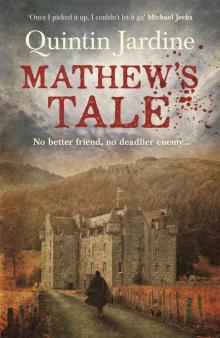
Mathew's Tale,
p.1


Copyright © 2014 Portador Ltd
The right of Quintin Jardine to be identified as the Author of the Work has been asserted by him in accordance with the Copyright, Designs and Patents Act 1988.
Apart from any use permitted under UK copyright law, this publication may only be reproduced, stored, or transmitted, in any form, or by any means, with prior permission in writing of the publishers or, in the case of reprographic production, in accordance with the terms of licences issued by the Copyright Licensing Agency.
First published as an Ebook by Headline Publishing Group in 2014
All characters in this publication are fictitious and any resemblance to real persons, living or dead, is purely coincidental.
Cataloguing in Publication Data is available from the British Library
Cover image copyright to follow
eISBN: 978 0 7553 8563 8
HEADLINE PUBLISHING GROUP
An Hachette UK Company
338 Euston Road
London NW1 3BH
www.headline.co.uk
www.hachette.co.uk
Contents
Title Page
Copyright Page
About Quintin Jardine
Praise for Quintin Jardine
Also By Quintin Jardine
About the Book
Dedication
Chapter One
Chapter Two
Chapter Three
Chapter Four
Chapter Five
Chapter Six
Chapter Seven
Chapter Eight
Chapter Nine
Chapter Ten
Chapter Eleven
Chapter Twelve
Chapter Thirteen
Chapter Fourteen
Chapter Fifteen
Chapter Sixteen
Chapter Seventeen
Chapter Eighteen
Chapter Nineteen
Chapter Twenty
Chapter Twenty-One
Chapter Twenty-Two
Chapter Twenty-Three
Chapter Twenty-Four
Chapter Twenty-Five
Chapter Twenty-Six
Chapter Twenty-Seven
Chapter Twenty-Eight
Chapter Twenty-Nine
Chapter Thirty
Chapter Thirty-One
Chapter Thirty-Two
Chapter Thirty-Three
Chapter Thirty-Four
Chapter Thirty-Five
Chapter Thirty-Six
Chapter Thirty-Seven
Chapter Thirty-Eight
Chapter Thirty-Nine
Chapter Forty
Chapter Forty-One
Chapter Forty-Two
Chapter Forty-Three
Chapter Forty-Four
Chapter Forty-Five
Chapter Forty-Six
Chapter Forty-Seven
Chapter Forty-Eight
About Quintin Jardine
Quintin Jardine was born once upon a time in the West – of Scotland rather than America, but still he grew to manhood as a massive Sergio Leone fan. On the way there he was educated, against his will, in Glasgow, where he ditched a token attempt to study law for more interesting careers in journalism, government propaganda, and political spin-doctoring. After a close call with the Brighton Bomb in 1984, he moved into the even riskier world of media relations consultancy, before realising that all along he had been training to become a crime writer.
Now, forty novels later, he never looks back. Along the way he has created/acquired an extended family in Scotland and Spain. Everything he does is for them. He can be tracked down through his website www.quintinjardine.com.
Praise for Quintin Jardine
‘Very engaging as well as ingenious, and the unraveling of the mystery is excellently done’ Allan Massie, Scotsman
‘Well constructed, fast-pased, Jardine’s narrative has many an ingenious twist and turn’ Observer
‘Remarkably assured, raw-boned, a tour de force’ New York Times
By Quintin Jardine and available from Headline
Bob Skinner series:
Skinner’s Rules
Skinner’s Festival
Skinner’s Trail
Skinner’s Round
Skinner’s Ordeal
Skinner’s Mission
Skinner’s Ghosts
Murmuring the Judges
Gallery Whispers
Thursday Legends
Autographs in the Rain
Head Shot
Fallen Gods
Stay of Execution
Lethal Intent
Dead and Buried
Death’s Door
Aftershock
Fatal Last Words
A Rush of Blood
Grievous Angel
Funeral Note
Pray for the Dying
Hour of Darkness
Primavera Blackstone series:
Inhuman Remains
Blood Red
As Easy as Murder
Deadly Business
As Serious as Death
Oz Blackstone series:
Blackstone’s Pursuits
A Coffin for Two
Wearing Purple
Screen Savers
On Honeymoon with Death
Poisoned Cherries
Unnatural Justice
Alarm Call
For the Death of Me
Standalone novels:
The Loner
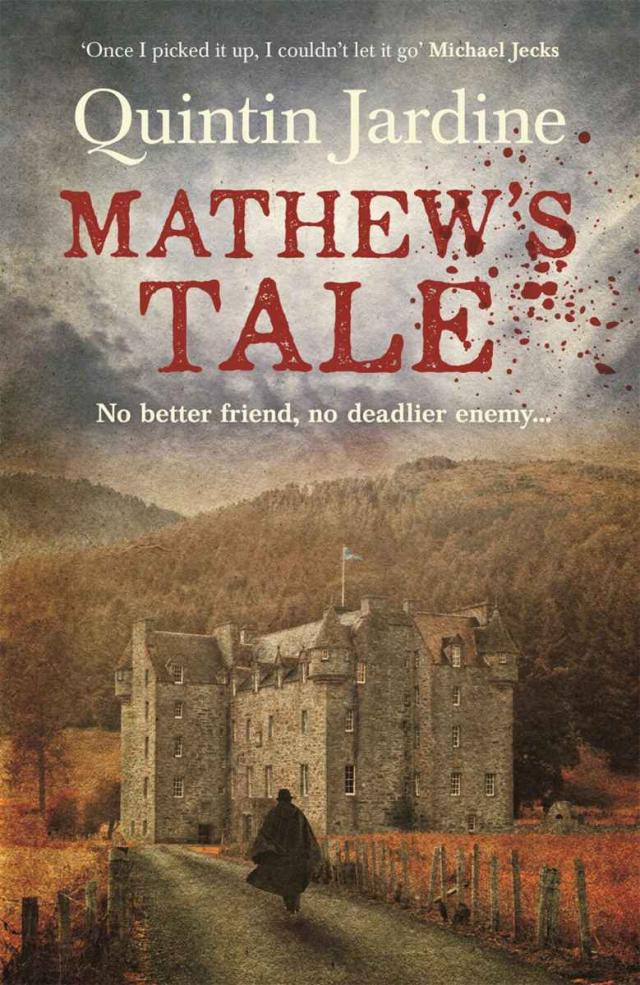
Mathew’s Tale
About the Book
1818, Carluke, Lanarkshire.
Mathew Fleming returns home to Scotland following heroic service at the Battle of Waterloo. After seven years away, he is a ghostly presence to those he left behind.
But Mathew is ambitious and soon becomes a man of influence in his county and beyond. Yet through all his success, he still hides the loss of his one true love.
When a terrible act of murder occurs, Mathew must choose between the rule of blood and the rule of law. And as a man of honour with a warrior’s instincts, he embarks on a journey of vengeance that will test every sinew of his faith in mankind . . .
This story from the past is dedicated to the future:
my grandson, Rex Masato Jardine, who joined us on February 15, 2014. On his behalf, I would like to thank his midwife Eileen McVay, her colleagues in the Simpson who helped with his delivery, and most of all his parents, Kyoko and Allan, for never giving up.
Chapter One
IF MATHEW FLEMING HAD ever been truly afraid of anyone, that man was already dead.
When he fell asleep, it was with a feeling of dread for the things he might see on his journey to the next dawn, and for those people he might meet.
Old actions, skirmishes and battles that he had fought and had thought were over.
Young comrades he had comforted, even as their blood sprayed upon him from mortal wounds; they might have let go of life, but their horror held him with an unbreakable, unyielding grip.
Relentless enemies, whom no sword cut, no musket shot could down forever, who came at him and his line in his dreams, over and over again, until finally that one, that fateful little Voltigeur bastard, broke through in the last great battle against the Emperor’s armies, his musket discarded but thrusting home his short blade even as he impaled himself on Mathew’s bayonet.
That nightmare was the worst, the one that ended with sudden wakefulness, and a scream that was not always stifled.
The others, while vivid, were not so fearful, not even the recollection of the sabre cut that had cost him his left eye when his company had been ambushed by a pack of outlaw French irregulars.
For that little Voltigeur, that wee, agile, leaping bauchle, was the only man that Mathew had ever killed at close quarters, the only enemy whose light he had seen extinguished, even though his own had been fading in the same moment. It was the Frenchman’s ghost whose forgiveness he craved yet whose curse awaited him, he was sure, in his sleep.
As he stood on the hilltop, where a great copper beech tree marked a crossroads, and looked down upon and across Carluke, bathed in May mid-morning sunshine, he was still troubled, from his victim’s latest visitation the night before, but even more by his uncertainty over what he would find there.
He had spent that night in a proper bedroom, under a roof, albeit an attic in a tavern in a place called Crossford. It had been a luxury, one of the very few he allowed himself, for one who had slept in the open air or under canvas for much of his adult life. He had made that last stop, not very many miles from his destination, because he had wanted to arrive at his native village in the fullness of the day, rather than creep in after dark.
Also it fitted his plan. He had no idea what awaited him there, whether he would be coming home to good news or bad, and so his first call would be paid on the minister. The Reverend John Barclay was the only authority figure within the small community, other than the dominie, the teacher in the parish school, but Porteous’s writ ran only among those aged under twelve. Mr Barclay knew everything that happened in Carluke, and if there was bad news to be borne, he was the man Mathew would prefer to break it.
But would the minister be there himself? It had been a full three years since one of Mathew’s letters home had been answered. Had some disaster struck? All too often, rumours of cholera and other deadly epidemics had reached the continent. They had been unsettling for the men, even though very few of them had been verified.
Mathew’s journey home had been a long one. It had been nine months since his discharge in France, a
fter the regiment had decided that a one-eyed soldier might be much more of a liability than an asset, but six years since he had enlisted, a raw-boned nineteen-year-old, as an infantryman in the King’s Own Cameron Highlanders.
He had been not only raw-boned, but also headstrong, rejecting John Barclay’s advice that he should move no further than Lanark, to complete the apprenticeship as a saddler that had been cut short by the sudden death of his father.
Robert Fleming’s business had died with him, and it was also true that the profits of the village inn were much less certain because of his passing. He had left no money behind him and when the sly, cajoling recruiters had told his son of the signing bounty of five pounds sterling, it had been too much for him to refuse.
They had been less pleased when Mathew gave all of the money to his mother, since the customary practice was for new soldiers to take their windfall with them into service, there to see it disappear rapidly down the throats of the cynical, predatory old lags in their platoon.
The young man had shrugged off his initial unpopularity, winning his new mates over by becoming a first-class infantryman, the sort that they were all pleased to have alongside them in the heat of battle. The Seventy-ninth Regiment of Foot, formed in the previous century, was renowned as one of the army’s finest and its First Battalion saw action against Bonaparte in Spain and in Holland, before the battle that had put an end to the Emperor.
Times had been hard, and the pay much poorer than the young man had been promised. He had signed on in the belief that he would be able to send money home to his mother, but soon found that all of his wages went on food and clothing. There had been plunder during the Peninsular campaign, but his Presbyterian upbringing had prevented him from taking any part in it, endearing him still further to his less scrupulous colleagues. Long before his grievous wound at Waterloo, Mathew’s plan to support his mother through his soldier’s pay had come to nothing. All that he could do was write home, to his sweetheart, Elizabeth, the Marshall girl he had grown up beside, and try to survive.
Those letters were always cheerful, hiding the reality of combat from his loved ones. Occasionally a reply would find him, usually months after it had been written. Lizzie was as positive as he was and her news of his mother . . . reading and writing had never been part of Hannah Fleming’s life . . . was always good, but three years ago her responses had dried up completely.
He had done his best to convince himself that the postal service in France had broken down, but he had been beset by anxiety from then on, impatient for the end of his seven-year enlistment. Thus, when the Breton guerrilla’s sabre cut had taken his eye the year before, he had seen it as a gift from God, and had felt a little sympathy for the man when he and his captured cronies were shot by a firing squad of Highlander musketeers. For a time afterwards he had worn an eyepatch, but it had been uncomfortable, and besides, the great scar across his face had been uncovered. After only a few months he had abandoned it; if his appearance scared some folk at first glance, they were soon won over by his smile and gentle demeanour.
Apart from the small bonus that his colonel had insisted he be paid on his discharge, the army had been good for him in another way. It had recognised his skill as a leather worker and had enabled him to complete his training.
Since leaving the line he had earned his way home, across France in the autumn, and then all the length of England, in the harshness of its winter. He had stopped in Rouen for a month, making light moccasins . . . a style taught him by a veteran of Canadian warfare . . . and selling them on the street. He had paid for his Channel crossing by repairing the ferry officers’ sea boots. He had found well-paid employment for three months on an earl’s estate near Newbury, making and renewing saddles and harnesses. When there was no more to be done there, he had moved on, avoiding the turnpike roads to save money but never going far without finding a new taker for his skills.
He had stopped off for another month in Newcastle, working as a cobbler on the dockside, then moved on to Hexham where more saddles needed repair, until finally he had crossed the border near Gretna, at the beginning of April.
By that time, Mathew Fleming was, by his standards, a well-off man. His handmade leather purse, which he wore next to his skin, was full of notes and coins, far more than the five pounds for which he had sold himself in 1812 to give his mother some reassurance. He was ready to return to look after her properly, and to fulfil the promise he had made to Lizzie before he had gone to the soldiering.
He might have made it home a month sooner had he not come upon a stage coach station in Lockerbie that was in desperate need of a saddler, and prepared to make his purse even fatter. He smiled at the memory of his last employer’s gratitude and of his willingness to help him set up in business if only he would stay in town.
That proposition was still very much on his mind as he paused on the hilltop, in the shade of the copper beech, drawing breath before the last, nervous few miles of his long journey, and allowing Gracie, the pony he had brought all the way from Orleans, to graze.
He wondered who, if anyone, was meeting the needs of his father’s old customers. By far the best of those had been Sir George Cleland, the amiable baronet who owned all the countryside around Carluke. The Laird’s patronage had always kept Robert Fleming’s feet in the sawdust, as his father had put it . . . in other words, in the village inn.
Did he still have the man that his factor had hired, full time, to replace his father? If not . . .
His musing was interrupted by the sound of hooves on the hard track, coming from behind him. He turned, to see two young men, well-dressed, on large sleek horses, bearing down upon him. They could have been no more than fifteen years old, but they carried themselves with assurance, and were comfortable on their mounts.
‘What have we got here, Greg?’ one of them called.
As Mathew’s one eye focused on them he could see that they were no ordinary pair, but twins, alike as green peas in a pod. And from that, he knew who they were. He had seen them on a few occasions as children; noisy little brats, Sir George’s sons, Gregor and Gavin, their indulgent father’s pride.
‘He looks like a vagrant to me,’ the other replied. ‘Shall we tie him across his nag and take him to the Sheriff in Lanark?’
‘Or shall we tie him to a tree and empty his pockets?’ Gavin suggested.
‘Empty them of what?’ Gregor laughed, as he looked down at Mathew. ‘Identify yourself, man.’
‘No, boy,’ he murmured. ‘I will not.’
‘Here’s an impertinent one!’ the youth chuckled. ‘Then we’ll identify you. We’ll call you One-lamp. Now what are you doing here, One-lamp? This is Cleland land.’
‘With respect, young man,’ Mathew contradicted, ‘it’s a public highway across Cleland land. It leads to Carluke, and that’s where I’m going.’
‘You’ll find nothing there to steal,’ he retorted. ‘We don’t want the likes of you here. Yes, let’s strip him and tie him to a tree, Gav. Let him cook in the sun for a bit, while he waits for the militia.’
‘No, boys,’ the traveller said, with a hard edge to his voice that had not been there before, ‘ye’ll not be doing that.’
‘And why not?’ Gavin challenged.
‘Because you’re only a couple of cheeky laddies, in want of a good arse-kicking. Because I am a soldier of the King, honourably discharged from his service, and with paper to prove it. And because,’ he chuckled, ‘you don’t have any rope, you daft little buggers! Now go on your way and learn yourselves some manners, or I might have to teach you. You wouldna’ like that, I assure you.’
The Cleland twins tried to stare him down, their four eyes to his one, before summoning enough common sense to realise that they were facing a man of his word.
‘We will see you later,’ Gavin murmured, then turned his horse, in a tactical withdrawal.
‘I do not doubt that,’ Mathew murmured as he watched the pair ride off, ‘not for one second.’
Chapter Two
BAPTISMS, MARRIAGES AND FUNERALS were all in a week’s work for John Barclay, but it was a rare occasion for the affairs of his rural congregation to fit all three into a single day, even rarer for that day to be a Friday.