Science fiction the best.., p.13
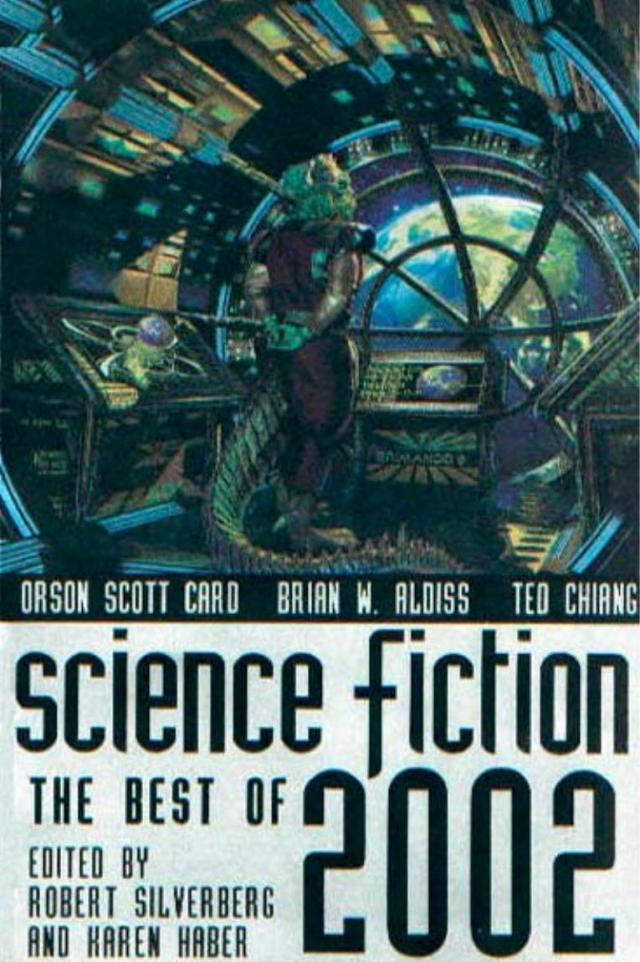
Science Fiction: The Best of 2002,
p.13


Maria deSouza:
If I’d met Tamera earlier, I might have tried to persuade her not to get her calli turned off. I doubt I would’ve succeeded; she seems pretty firm about her decision. Even so, she’s a great example of the benefits of calli. You can’t help but notice it when you talk to her. For example, at
one point I was saying how lucky she was, and she said,
“Because I’m beautiful?” And she was being totally sin-
cere! Like she was talking about her height. Can you
imagine a woman without calli saying that?
Tamera is completely unself-conscious about her
1 1 5
T E D C H I A N G
looks; she’s not vain or insecure, and she can describe
herself as beautiful without embarrassment. I gather that she’s very pretty, and with a lot of women who look like
that, I can see something in their manner, a hint of
showoffishness. Tamera doesn’t have that. Or else they
display false modesty, which is also easy to tell, but Tamera doesn’t do that either, because she truly is modest.
There’s no way she could be like that if she hadn’t been
raised with calli. I just hope she stays that way.
Annika Lindstrom, second-year student:
I think this calli thing is a terrible idea. I like it when guys notice me, and I’d be really disappointed if they
stopped.
I think this whole thing is just a way for people who,
honestly, aren’t very good-looking, to try and make
themselves feel better. And the only way they can do that is to punish people who have what they don’t. And that’s
just unfair.
Who wouldn’t want to be pretty if they could? Ask
anyone, ask the people behind this, and I bet you they’d
all say yes. Okay, sure, being pretty means that you’ll be hassled by jerks sometimes. There are always jerks, but
that’s part of life. If those scientists could come up with some way to turn off the jerk circuit in guys’ brains, I’d be all in favor of that.
Jolene Carter, third-year student:
I’m voting for the initiative, because I think it’d be a
relief if everyone had calli.
People are nice to me because of how I look, and part
of me likes that, but part of me feels guilty because I
haven’t done anything to deserve it. And sure, it’s nice to 1 1 6
L I K I N G W H A T Y O U S E E : A D O C U M E N TA R Y
have men pay attention to me, but it can be hard to make
a real connection with someone. Whenever I like a guy, I
always wonder how much he’s interested in me, versus
how much he’s interested in my looks. It can be hard to
tell, because all relationships are wonderful at the beginning, you know? It’s not until later that you find out
whether you can really be comfortable with each other. It was like that with my last boyfriend. He wasn’t happy
with me if I didn’t look fabulous, so I was never able to truly relax. But by that time I realized that, I’d already let myself get close to him, so that really hurt, finding out that he didn’t see the real me.
And then there’s how you feel around other women. I
don’t think most women like it, but you’re always com-
paring how you look relative to everyone else. Sometimes
I feel like I’m in a competition, and I don’t want to be.
I thought about getting calli once, but it didn’t seem
like it would help unless everyone else did too; getting it all by myself wouldn’t change the way others treat me.
But if everyone on campus had calli, I’d be glad to get it.
Tamera Lyons:
I was showing my roommate Ina this album of pic-
tures from high school, and we get to all these pictures of me and Garrett, my ex. So Ina wants to know all about
him, and so I tell her. I’m telling her how we were to-
gether all of senior year, and how much I loved him, and
wanted us to stay together, but he wanted to be free to
date when he went to college. And then she’s like, “You
mean he broke up with you?”
It took me a while before I could get her to tell me
what was up; she made me promise twice not to get mad.
Eventually she said Garrett isn’t exactly good-looking. I 1 1 7
T E D C H I A N G
was thinking he must be average-looking, because he
didn’t really look that different after I got my calli turned off. But Ina said he was definitely below average.
She found pictures of a couple other guys who she
thought looked like him, and with them I could see how
they’re not good-looking. Their faces just look goofy.
Then I took another look at Garrett’s picture, and I guess he’s got some of the same features, but on him they look
cute. To me, anyway.
I guess it’s true what they say: love is a little bit like calli. When you love someone, you don’t really see what
they look like. I don’t see Garrett the way others do, because I still have feelings for him.
Ina said she couldn’t believe someone who looked like
him would break up with someone who looked like me.
She said that in a school without calli, he probably
wouldn’t have been able to get a date with me. Like, we
wouldn’t be in the same league.
That’s weird to think about. When Garrett and I were
going out, I always thought we were meant to be to-
gether. I don’t mean that I believe in destiny, but I just thought there was something really right about the two
of us. So the idea that we could’ve both been in the same school, but not gotten together because we didn’t have
calli, feels strange. And I know that Ina can’t be sure of that. But I can’t be sure she’s wrong, either.
And maybe that means I should be glad I had calli, be-
cause it let me and Garrett get together. I don’t know
about that.
From a broadcast of EduNews:
Netsites for a dozen calliagnosia student organizations
around the country were brought down today in a coor-
1 1 8
L I K I N G W H A T Y O U S E E : A D O C U M E N TA R Y
dinated denial-of-service attack. Although no one
claimed responsibility, some suggest the perpetrators are retaliating for last month’s incident in which the American Association of Cosmetic Surgeons’ netsite was re-
placed by a calliagnosia site.
Meanwhile, the SemioTech Warriors announced the
release of their new “Dermatology” computer virus. This
virus has begun infecting video servers around the world, altering broadcasts so that faces and bodies exhibit conditions such as acne and varicose veins.
Warren Davidson, 1st-year student:
I thought about trying calli before, when I was in high
school, but I never knew how to bring it up with my par-
ents. So when they started offering it here, I figured I’d give it a try. ( shrugs) It’s okay.
Actually, it’s better than okay. ( pause) I’ve always hated how I look. For a while in high school I couldn’t
stand the sight of myself in a mirror. But with calli, I
don’t mind as much. I know I look the same to other peo-
ple, but that doesn’t seem as big a deal as it used to. I feel better just by not being reminded that some people are so much better-looking than others. Like, for instance: I was helping this girl in the library with a problem on her calculus homework, and afterwards I realized that she’s
someone I’d thought was really pretty. Normally I would
have been really nervous around her, but with calli, she
wasn’t so hard to talk to.
Maybe she thinks I look like a freak, I don’t know, but
the thing was, when I was talking to her I didn’t think I looked like a freak. Before I got calli, I think I was just too self-conscious, and that just made things worse. Now I’m
more relaxed.
1 1 9
T E D C H I A N G
It’s not like I suddenly feel all wonderful about myself
or anything, and I’m sure for other people calli wouldn’t help them at all, but for me, calli makes me not feel as
bad as I used to. And that’s worth something.
Alex Bibescu, professor of religious studies at Pembleton: Some people have been quick to dismiss the whole
calliagnosia debate as superficial, an argument over
makeup or who can and can’t get a date. But if you actu-
ally look at it, you’ll see it’s much deeper than that. It reflects a very old ambivalence about the body, one that’s
been part of Western civilization since ancient times.
You see, the foundations of our culture were laid in
classical Greece, where physical beauty and the body
were celebrated. But our culture is also thoroughly per-
meated by the monotheistic tradition, which devalues the
body in favor of the soul. These old conflicting impulses are rearing their heads again, this time in the calliagnosia debate.
I suspect that most calli supporters think of themselves
to be modern, secular liberals, and wouldn’t admit to be-
ing influenced by monotheism in any way. But take a
look at who else advocates calliagnosia: conservative re-
ligious groups. There are communities of all three major
monotheistic faiths—Jewish, Christian, and Muslim—
who’ve begun using calli to make their young members
more resistant to the charms of outsiders. This common-
ality is no coincidence. The liberal calli supporters may not use language like “resisting the temptations of the
flesh,” but in their own way, they’re following the same
tradition of deprecating the physical.
Really, the only calli supporters who can credibly
claim they’re not influenced by monotheism are the Neo-
1 2 0
L I K I N G W H A T Y O U S E E : A D O C U M E N TA R Y
Mind Buddhists. They’re a sect who see calliagnosia as a
step toward enlightened thought, because it eliminates
one’s perception of illusory distinctions. But the NeoMind sect is open to broad use of neurostat as an aid to meditation, which is a radical stance of an entirely different sort. I doubt you’ll find many modern liberals or conservative monotheists sympathetic to that!
So you see, this debate isn’t just about commercials
and cosmetics, it’s about determining what’s the appro-
priate relationship between the mind and the body. Are
we more fully realized when we minimize the physical
part of our natures? And that, you have to agree, is a profound question.
Joseph Weingartner:
After calliagnosia was discovered, some researchers
wondered if it might be possible to create an analogous
condition that rendered the subject blind to race or eth-
nicity. They’ve made a number of attempts—impairing
various levels of category discrimination in tandem with
face recognition, that sort of thing—but the resulting
deficits were always unsatisfactory. Usually the test subjects would simply be unable to distinguish similar-
looking individuals. One test actually produced a benign
variant of Fregoli syndrome, causing the subject to mis-
take every person he met for a family member. Unfortu-
nately, treating everyone like a brother isn’t desirable in so literal a sense.
When neurostat treatments for problems like compul-
sive behavior entered widespread use, a lot of people
thought that “mind programming” was finally here. Peo-
ple asked their doctors if they could get the same sexual tastes as their spouses. Media pundits worried about the
1 2 1
T E D C H I A N G
possibility of programming loyalty to a government or
corporation, or belief in an ideology or religion.
The fact is, we have no access to the contents of any-
one’s thoughts. We can shape broad aspects of personal-
ity, we can make changes consistent with the natural
specialization of the brain, but these are extremely
coarse-grained adjustments. There’s no neural pathway
that specifically handles resentment toward immigrants,
any more than there’s one for Marxist doctrine or foot
fetishism. If we ever get true mind programming, we’ll be able to create “race blindness,” but until then, education is our best hope.
Tamera Lyons:
I had an interesting class today. In History of Ideas,
we’ve got this T.A., he’s named Anton, and he was saying
how a lot of words we use to describe an attractive person used to be words for magic. Like the word “charm” originally meant a magic spell, and the word “glamour” did,
too. And it’s just blatant with words like “enchanting” and
“spellbinding.” And when he said that, I thought, yeah,
that’s what it’s like: seeing a really good-looking person is like having a magic spell cast over you.
And Anton was saying how one of the primary uses of
magic was to create love and desire in someone. And that
makes total sense, too, when you think about those words
“charm” and “glamour.” Because seeing beauty feels like
love. You feel like you’ve got a crush on a really good-
looking person, just by looking at them.
That made me think that maybe there’s a way I can get
back together with Garrett. Because if Garrett didn’t have calli, maybe he’d fall in love with me again. Remember
how I said before that maybe calli was what let us get to-1 2 2
L I K I N G W H A T Y O U S E E : A D O C U M E N TA R Y
gether? Well, maybe calli is actually what’s keeping us
apart now. Maybe Garrett would want to get back with
me if he saw what I really looked like.
Garrett turned eighteen during the summer, but he
never got his calli turned off because he didn’t think it was a big deal. He goes to Northrop now. So I called him
up, just as a friend, and when we were talking about
stuff, I asked him what he thought about the calli initiative here at Pembleton. He said he didn’t see what all the fuss was about, and then I told him how much I liked not
having calli anymore, and said he ought to try it, so he
could judge both sides. He said that made sense. I didn’t make a big deal out of it, but I was stoked.
Daniel Taglia, professor of comparative literature
at Pembleton:
The student initiative doesn’t apply to faculty, but ob-
viously if it passes there’ll be pressure on the faculty to adopt calliagnosia as well. So I don’t consider it prema-ture for me to say that I’m adamantly opposed to it.
This is just the latest example of political correct-
ness run amok. The people advocating calli are well-
intentioned, but what they’re doing is infantilizing us. The very notion that beauty is something we need to be protected from is insulting. Next thing you know, a student
organization will insist we all adopt music agnosia, so we don’t feel bad about ourselves when we hear gifted singers or musicians.
When you watch Olympic athletes in competition,
does your self-esteem plummet? Of course not. On the
contrary, you feel wonder and admiration; you’re in-
spired that such exceptional individuals exist. So why
can’t we feel the same way about beauty? Feminism
1 2 3
T E D C H I A N G
would have us apologize for having that reaction. It
wants to replace aesthetics with politics, and to the ex-
tent it’s succeeded, it’s impoverished us.
Being in the presence of a world-class beauty can be
as thrilling as listening to a world-class soprano. Gifted individuals aren’t the only ones who benefit from their
gifts; we all do. Or, I should say, we all can. Depriving ourselves of that opportunity would be a crime.
Commercial paid for by People for Ethical Nanomedicine: Voiceover: Have your friends been telling you that calli is cool, that it’s the smart thing to do? Then maybe you should talk to people who grew up with calli.
“After I got my calli turned off, I recoiled the first time I met an unattractive person. I knew it was silly, but I just couldn’t help myself. Calli didn’t help make me mature, it kept me from becoming mature. I had to relearn how to interact with people.”
“I went to school to be a graphic artist. I worked day
and night, but I never got anywhere with it. My teacher
said I didn’t have the eye for it, that calli had stunted me aesthetically. There’s no way I can get back what I’ve lost.”
“Having calli was like having my parents inside my
head, censoring my thoughts. Now that I’ve had it turned
off, I realize just what kind of abuse I’d been living with.”
Voiceover: If the people who grew up with calliagnosia don’t recommend it, shouldn’t that tell you something?
They didn’t have a choice, but you do. Brain damage is
never a good idea, no matter what your friends say.
Maria deSouza:
We’d never heard of the People for Ethical Nanomedi-
cine, so we did some research on them. It took some dig-
1 2 4
L I K I N G W H A T Y O U S E E : A D O C U M E N TA R Y
ging, but it turns out it’s not a grassroots organization at all, it’s an industry PR front. A bunch of cosmetics companies got together recently and created it. We haven’t
been able to contact the people who appear in the com-