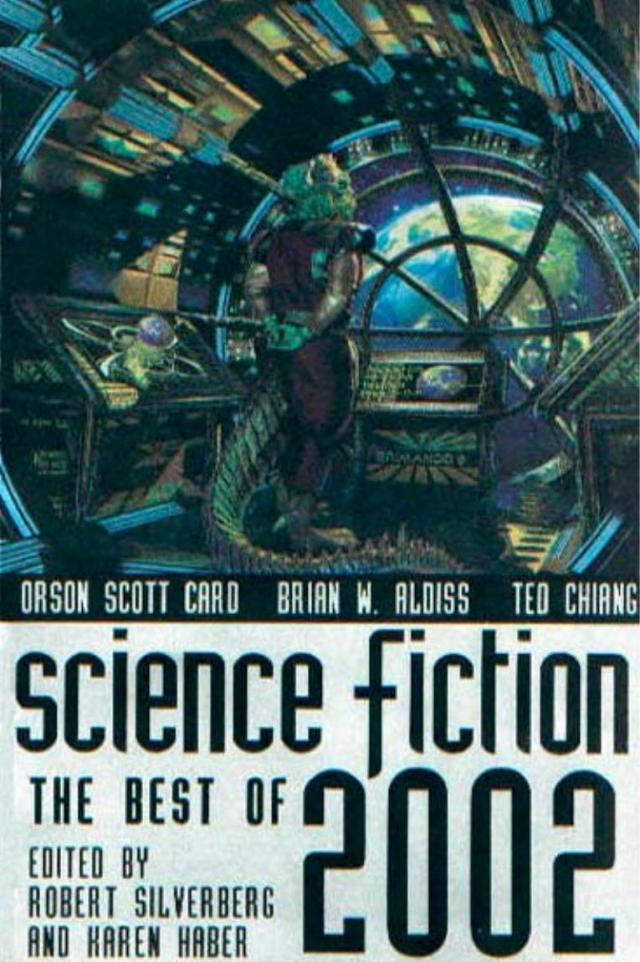
Science fiction the best.., p.33
Science Fiction: The Best of 2002,
p.33


ted down now in the shadows of the cliff and were nod-
ding sleepily, one nictitating membrane after another
slipping over their eyes. As soon as they had got here and dismounted, Kalal had walked straight down, arms out-3 1 2
B R E AT H M O S S
stretched, into the tideflower-bobbing ocean. Jalila had
followed, whooping, feeling tendrils and petals bumping
into her. It was like walking through floral soup. Kalal
had sunk to his shoulders and started swimming, which
was something Jalila still couldn’t quite manage. He
splashed around her, taunting, sending up sheets of
coloured light. They’d stripped from their clothes as they clambered out, and laid them on the hot rocks, where
they now steamed like fresh bread.
“This whole continent’s like a huge island,” Jalila said
in delayed answer to Kalal’s question. “We’d come back
to where we started.”
Kalal shook his head. “Oh, you can never do that . . .”
“Where would we be, then?”
“Somewhere slightly different. The tideflowers would
have changed, and we wouldn’t be us, either.” Kalal wet
his finger, and wrote something in naskhi script on the
hot, flat stone between them. Jalila though she recog-
nised the words of poet, but the beginning had dissolved
into the hot air before she could make proper sense of it.
Funny, but at home with her mothers, and with their
guests, and even with many of the people of her own age,
such statements as they had just made would have been
the beginning of a long debate. With Kalal, they just
seemed to hang there. Kalal, he moved, he passed on.
Nothing quite seemed to stick. There was something,
somewhere, Jalila thought, lost and empty about him.
The way he was sitting, she could see most his geni-
tals, which looked quite jaunty in their little nest of hair; like a small animal. She’d almost got as used to the sight of them as she had to the other peculiarities of Kalal’s
features. Scratching her nose, picking off some of the
petals which still clung to her skin like wet confetti, she 3 1 3
I A N R . M A C L E O D
felt no particular curiosity. Much more than Kalal’s funny body, Jalila was conscious of her own—especially her
growing breasts, which were still somewhat uneven.
Would they ever come out right, she wondered, or would
she forever be some unlovely oddity, just as Kalal seem-
ingly was? Better not to think of such things. Better to
just enjoy the feel the sun baking her shoulders, loosen-
ing the curls of her hair.
“Should we turn back?” Kalal asked eventually. “It’s
getting hotter . . .”
“Why bother with that—if we carry on, we’ll get back
to where we started.”
Kalal stood up. “Do you want a bet?”
So they rode on, more slowly, uphill through the un-
charted forest, where the urrearth trees tangled with blue fronds of Habara fungus and the birds were still and the
crackle of the dry undergrowth was the only sound in the
air. Eventually, ducking boughs, then walking, dreamily
lost and almost ready to turn back, they came to a path,
and remounted. The trees fell away, and they found they
were on a clifftop, far, far higher above the winking sea than they could possibly imagined. Midday heat clapped
around them. Ahead, where the cliff stuck out over the
ocean like a cupped hand, shimmering and yet solid, was
one of the ruined castles or geological features which the sea-leviathans had supposedly deserted before the arrival of people on this planet—a qasr. They rode slowly towards it, their hayawan’s feet thocking in the dust. It
looked like a fairy place. Part natural, but roofed and buttressed, with grey-black gables and huge and intricate
windows which flashed with the colours of the sea. Kalal
gestured for silence, dismounted from Abu, led his mount
3 1 4
B R E AT H M O S S
back into the shadowed arms of the forest, and flicked the switch in her back with hobbled her.
“You know where this is?”
Kalal beckoned.
Jalila, who knew him better than to ask questions,
followed.
Close to, much of the qasr seemed to be made of a
quartz-speckled version of the same fused stone from
which Jalila’s haramlek was constructed. But some other
bits of it appeared natural effusions of the rock. There
was a big arched door of sun-bleached and iron-studded
oak reached by a path across the narrowing cliff, but
Kalal steered Jalila to the side, and then up and around a bare angle of hot stone which seemed ready at any moment to tilt them into the distant the sea. But the way
never quite gave out, there was always another handhold.
From the confident manner in which he moved up this
near-clifface, then scrambled across the blistering black tiles of the rooftop beyond, and dropped down into the
sudden cool of a narrow passageway, Jalila guessed that
Kalal had been to this qasr before. At first, there was little sense of trespass. The place seemed old and empty—a
little-visited monument. The ceilings were stained. The
corridors were swept with the litter of winter leaves. Here and there along the walls, there were friezes, and long
strings of a script which make as little sense to Jalila, in their age and dimness, as that which Kalal had written on the hot rocks.
Then Kalal gestured for Jalila to stop, and she clus-
tered beside him and they looked down through the intri-
cate stone lattice of a mashrabiya into sunlight. It was
plain from the balcony drop beneath them that they were
3 1 5
I A N R . M A C L E O D
still high up in this qasr. Below, in the central courtyard, somehow shocking after this emptiness, a fountain
played in a garden, and water lapped from its lip and ran in steel fingers towards cloistered shadows.
“Someone lives here?”
Kalal mouthed the word tariqua. Somehow, Jalila instantly understood. It all made sense, in this Season of
Rockets, and the dim scenes and hieroglyphs carved in
the honeyed stones of this fairy castle. Tariquas were
merely human, after all, and the spaceport was nearby;
they had to live somewhere. Jalila glanced down at her
scuffed sandals, suddenly conscious that she hadn’t taken them off—but by then it was too late, and below them and
through the mashrabiya a figure had detached herself
from the shadows. The tariqua was tall and thin and
black and bent as a burnt-out matchstick. She walked
with a cane. Jalila didn’t know what she’d expected—
she’d grown older since her first encounter with Kalal,
and no longer imagined that she knew about things just
because she’d learnt of them in her dreamtent. But still, this tariqua seemed a long way from piloting the impossible distances between the stars as she moved and
clicked slowly around that courtyard fountain, and far
older and frailer than anyone Jalila had ever seen. She
tended a bush of blue flowers, she touched the fountain’s bubbling stone lip. Her head was ebony bald. Her fingers
were charcoal. Her eyes were as white and seemingly
blind as the flecks of quartz in the fused stone of this
building. Once, though, she seemed to look up towards
them. Jalila went cold. Surely it wasn’t possible that she could see them?—and in any event, there was something
about the motion of looking up which seemed habitual.
As if, like touching of the lip of the fountain, and tending 3 1 6
B R E AT H M O S S
that bush, the tariqua always looked up at this moment of the day at that particular point in the stone walls which rose above her.
Jalila followed Kalal further along the corridors, and
down stairways and across drops of beautifully clear
glass which hung on nothing far above the prismatic sea.
Another glimpse of the tariqua, who was still slowly
moving, her neck stretching like an old tortoise as she
bent to sniff a flower. In this part of the qasr, there were more definite signs of habitation. Scattered cards and
books. A moth-eaten tapestry which billowed from a
windowless arch overlooking the sea. Empty coathangers
piled like the bones of insects. An active but clearly little-used chemical toilet. Now that the initial sense of surprise had gone, there was something funny about this mixture
of the extraordinary and the everyday. Here, there was a
kitchen, and a half-chewed lump of aish on a plate
smeared with seeds. To imagine, that you could both
travel between the stars, and then eat bread and toma-
toes! Both Kalal and Jalila were red-faced and chuffing
now from suppressed and impossible hilarity. Down now
at the level of the cloisters, hunched in the shade, they studied the tariqua’s stooping back. She really did look
like a scrawny tortoise, yanked out of its shell, moving
between these bushes. Any moment now, you expected
her to start chomping on the leaves. She moved more by
touch than by sight. Amid the intricate colours of this
courtyard, and the flashing glass windchimes which tin-
kled in the far archways, as she fumbled sightlessly but
occasionally glanced at things with those odd, white
eyes, it seemed yet more likely that she was blind, or at least terribly near-sighted. Slowly, Jalila’s hilarity receded, and she began to feel sorry for this old creature
3 1 7
I A N R . M A C L E O D
who had been aged and withered and wrecked by the
strange process of travel between the stars. The Pain of Distance—now, where had that phrase come from?
Kalal was still puffing his cheeks. His eyes were water-
ing as he ground his fist against his mouth and silently
thumped the nearest pillar in agonised hilarity. Then he
let out a nasal grunt, which Jalila was sure the tariqua
must have heard. But her stance didn’t alter. It wasn’t so much as if she hadn’t noticed them, but that she already
knew that someone was there. There was a sadness and resignation about her movements, the tap of her cane . . .
But Kalal had recovered his equilibrium, and Jalila
watched his fingers snake out and enclose a flake of bro-
ken paving. Another moment, and it span out into the
sunlit courtyard in an arch so perfect that there was
never any doubt that it was going to strike the tariqua
smack between her bird-like shoulders. Which it did—but
by then they were running, and the tariqua was straight-
ening herself up with that same slow resignation. Just before they bundled themselves up the stairway, Jalila
glanced back, and felt a hot bar of light from one the
qasr’s high upper windows stream across her face. The
tariqua was looking straight towards her with those blind white eyes. Then Kalal grabbed her hand, Once again, she
was running.
Jalila was cross with herself, and cross with Kalal. It
wasn’t like her, a voice like a mingled chorus of her three mothers would say, to taunt some poor old mahwagi,
even if that mahwagi happened also to be an aged tari-
qua. But Jalila was young, and life was busy. The voice
soon faded. In any case, there was the coming moulid to
prepare for.
3 1 8
B R E AT H M O S S
The arrangement of festivals, locally, and on Habara
as a whole, was always difficult. Habara’s astronomical
year was so long that it made no sense to fix the tradi-
tional cycle of moulids by it, but at the same time, no one felt comfortable celebrating the same saint or eid in conflicting seasons. Fasting, after all, properly belonged to winter, and no one could quite face their obligations towards the Almighty with quite the same sense of surren-
der and equanimity in the middle of spring. People’s
memories faded, as well, as to how one did a particular saint in autumn, or revered a certain enlightenment in
blasting heat which you had previously celebrated by
throwing snowballs. Added to this were the logistical
problems of catering for the needs of a small and scat-
tered population across a large planet. There were travelling players, fairs, wandering sufis and priests, but they plainly couldn’t be everywhere at once. The end result
was that each moulid was fixed locally on Habara, ac-
cording to a shifting timetable, and after much discussion and many meetings, and rarely happened twice at exactly
the same time, or occurred simultaneously in different
places. Lya threw herself into these discussions with the enthusiasm of one who long been missing such complex-ities in the lonelier life up on Tabuthal. For the Moulid of First Habitation, which commemorated the time when the
Blessed Joanna had arrived on Habara at a site which
several of towns claimed, and cast the first urrearth seeds, and lived for five long Habaran years on nothing but
tideflowers and starlight, and rode the sea-leviathans
across the oceans as if they were hayawans as she waited
for her lover Pia, Lya was the leading light in the local organisations at Al Janb, and the rest of her haramlek
were expected to follow suit.
3 1 9
I A N R . M A C L E O D
The whole of Al Janb was to be transformed for a day
and a night. Jalila helped with hammering and weaving,
and tuning Pavo’s crystals and plants which would sup-
posedly transform the serraplate road between their
haramlek and the town into a glittering tunnel. More in
the forefront of Jalila’s mind were those coloured silks
which came and went at particular stall in the markets,
and which she was sure would look perfect on her. Be-
tween the planning and the worries about this or that
turning into a disaster, she worked carefully on each of
her three mothers in turn; a nudge here, a suggestion
there. Turning their thoughts towards accepting this ex-
travagance was a delicate matter, like training a new
hayawan to bear the saddle. Of course, there were wild
resistances and buckings, but you were patient, you were
stronger. You knew what you wanted. You kept to your
subject. You returned and returned and returned.
On the day when Ananke finally relented, a worrying
wind had struck up, pushing at the soft, half-formed
growths which now straggled the normal roadside weeds
into Al Janb like silvered mucus. Pavo was fretting about her creations. Lya’s life was one long meeting. Even
Ananke was anxious as they walked into Al Janb, where
faulty fresh projections flickered across of the buildings and squares like an incipient headache as the sky greyed
and hurried. Jalila, urging her birthmother on as she
paused frustratingly, was sure that the market wouldn’t
be there, or that if it was, the stall which sold the windsilks was sure to have sold out—or, even then, that the
particular ones she’d set her mind on would have
gone . . .
But it was all there. In fact, a whole new supply even
more marvellous and colourful of windsilks had been im-
3 2 0
B R E AT H M O S S
ported for this moulid. They blew and lifted like coloured smoke. Jalila caught and admired them.
“I think this might be you . . .”
Jalila turned at the voice. It was Nayra, a girl of about a standard year and a half older than her, whose mothers
were amongst the richest and most powerful in Al Janb.
Nayra herself was both beautiful and intelligent; witty
and sometimes devastatingly cruel. She was generally at
the centre of things, surrounded by a bickering and ad-
miring crowd of seemingly lesser mortals, which some-
times included Jalila. But today she was alone.
“You see, Jalila. That crimson. With your hair, your
eyes . . .”
She held the windsilk across Jalila’s face like yashmak.
It danced around her eyes. It blurred over her shoulders.
Jalila would have thought the colour too bold. But
Nayra’s gaze, which flickered without ever quite leaving
Jalila’s, her smoothing hands, told Jalila that it was right for her far better than any mirror could have. And then
there was blue—that flame colour of the summer night.
There were silver clasps, too, to hold these windsilks,
which Jalila had never noticed on sale before. The stall-
keeper, sensing a desire to purchase which went beyond
normal bargaining, drew out more surprises from a chest.
Feel! They can only be made in one place, on one planet, on one season. Look! The grubs, they hatch when they
hear the song of a particular bird, which sings once in its life before it gives up its spirit to the Almighty . . . And so on. Ananke, seeing that Jalila had found a more interested and willing helper, palmed her far more cash than
she’d promised, and left her with a smile and an oddly
sad backward glance.
Jalila spend the rest to that grey and windy afternoon