Science fiction the best.., p.16
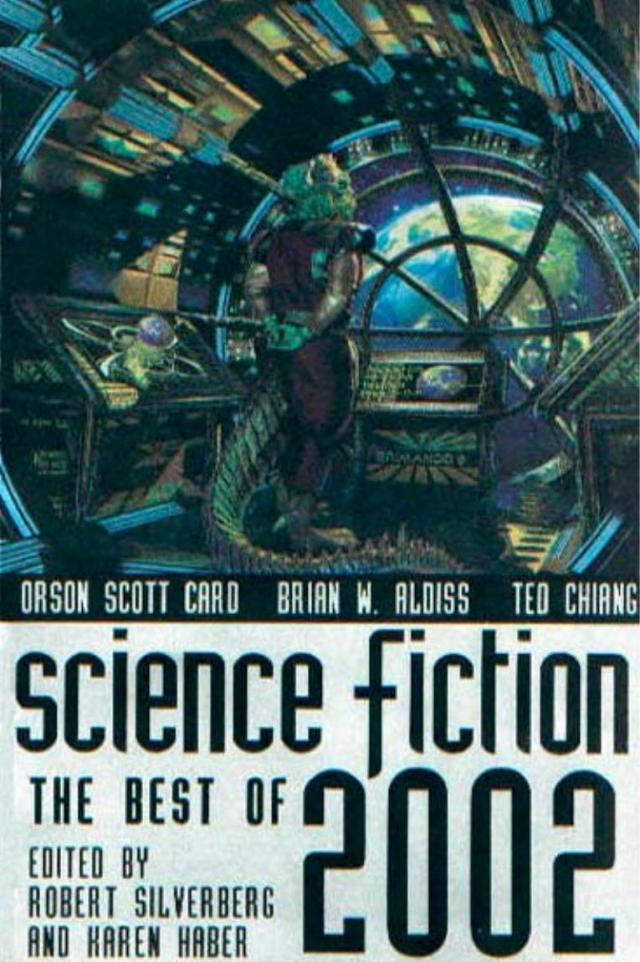
Science Fiction: The Best of 2002,
p.16


She gazed at the fingerprints he had left on the screen.
“Angels’ wings.”
It was his turn to blink. “Pardon?”
“The q-waves,” she said. “Like wings.”
He might have laughed; others often did, when Rachel
with her quicksilver thoughts and quiet speech couldn’t
find the right words. She was startled when he rubbed his chin, then nodded. “Never thought of it that way.” He
smiled at her. “I’m Edgar Kerzen. And you?”
She returned his smile with one of her own. “Rachel.”
Dawning realization: “You’re the Hawk. No one else
would’ve torn through the exam like that.”
“But so did you.”
Edgar shrugged. “I aced math and physics, but they
killed me on ethics.”
She heard the unsaid words: Let’s talk about some-
thing else. Being Rachel, she was silent. And found her-1 4 5
Y O O N H A L E E
self startled again when he accepted the silence rather
than filling it with words. She would come to treasure
that acceptance.
BLACK: KNIGHT’S SACRIFICE
The first life, first time I killed Rachel, it was too late.
She had already given her three-sentence answer to the
Pandect’s exam; won command of the starhiker Curtana, one of twenty-six ever built; and swept from the Battle of Red Lantern to the Siege of Gloria on the shredded wings
of a q-wave. After Gloria, her name passed across the re-
lays as both battle-cry (for the Network) and curse (for
the Movement). In this probability-space, her triumphs
were too great to erase, her influence too great to stop the inevitable blurring of murder and necessity.
After the siege, we had a few days to remember what
sleep was, to forget the silence of battle. Space is silent, though we want thunder with our lightning, the scream
of metal and roar of guns. I think this was true even for Rachel, because she believed in right silences and wrong silences.
By fortune or otherwise we had shared postings since
we left academy, since that first meeting in hydroponics.
Command was short on officers, but shorter still on ones
who worked together like twin heartbeats. I stood beside
her when she received the captain’s wing on her uniform
and again when we learned, over the relays, that the
scoutship Boomerang’s kamikaze destruction of a station had plunged one probability-space into war. I stood beside her and said nothing when she opened fire on Gloria
Station, another of the few q-space stopovers. It harbored 1 4 6
T H E B L AC K A B AC U S
a Movement ship determined to return to realspace, and
so it died in a ripple of incoherence.
One people, one law, said the Network. There were too many factions at a time when humanity’s defenses were
scattered across the stars: conglomerates with their mer-
chant fleets, colonies defending their autonomy, free-
traders who resented the Network’s restrictions. Once the Pancommunications Network had only been responsible
for routing transmissions between settlements and sort-
ing out discrepancies due to time dilation. Someone had
to maintain the satellite networks that knit everyone to-
gether and someone had to define a law, however, so the
Network did.
In light of this, under what circumstances is war justi-fied?
A ship’s captain has her privacy, but we were docked
and awaiting repairs, and I knew Rachel’s thoughts better than my own. She had her duty, and if that duty demanded it, she would pay in blood. Including her own, if
it came to that, but she was too damned brilliant to die in battle. Because she was the Hawk, and when it came to
her duty, she never hesitated.
5.47 minutes and three sentences.
I came upon Rachel deep in the ship’s hold, in an area
closed off for tomorrow’s repairs. Her eyes, when she
raised them to me, were the wild gray of a winter sky, unlike the carbon-scored gray of the torn bulkheads behind
her. These days our world was defined by shades of gray
and the reflections therein.
Soon we would be forced to leave the colorless haven
of q-space, since the last few stations could barely sus-
tain themselves or the remaining ships. For a while, the
Network and the Independence Movement had cannibal-
1 4 7
Y O O N H A L E E
ized any new ships who entered q-space despite the per-
ils of merging q-waves, gutting them of supplies, people, and news. Once a ship exited into realspace, our own
fluctuating history would collapse into a single outcome, and nobody was willing to plunge the realspace world
into war, especially one in the enemy’s favor. New ships
no longer showed up, and God knew what we’d done to
realspace transportation and logistics.
A few weary souls had tried to force the issue. Rachel
shot them down. She was determined to win or stop the
war in every life, every timeline, and she might even
succeed.
She noticed my presence and, for once, spoke before I
could. “Edgar. While I’m here, more people are dying.”
Her voice was restless, like the beating wings of a bird in a snowstorm.
“We’ll find out about it on relay,” I said, wishing I
could say something to comfort her, to gentle those eyes, that voice, but Rachel had never much believed in words,
even mine.
“Do you think angels fly between probability-spaces
to harvest our souls?”
I closed my eyes and saw the afterimages of a ship’s
waveform disintegration, translated into images the hu-
man mind could interpret. “I wish I knew.” I was tired of fighting and forcing myself to remember that the bright,
undulating ribbons on the tactical display represented
people and what had carried people. I wanted her to say
that we would leave and let the multiplicity of battles
end, but I knew she wouldn’t.
For a long time Rachel said nothing, lacing and unlac-
ing her fingers together. Then her hands relaxed and she
said, “How did you know to find me here?”
1 4 8
T H E B L AC K A B AC U S
Nothing but curiosity from a woman who had killed
civilians, whom I had always followed. Her duty and her
ruthlessness were a greater weapon than any battleship
the Network had left. My angel, an angel of death.
My hands were a weapon and her trust, a weakness.
“I’ll always find you, my dear,” I said, reaching out as
though to massage her shoulders, and interrupted the
balance of her breath and brain and heartbeat. She did
not fight; perhaps she knew that in other probability-
spaces, I was still hers. I thought of Red Lantern. My
memories held lights and lines in red or amber, autumn
colors; tactical screens, terse voices. My own voice, saying Aye aye, sir.
After she stopped moving, I laid her down. I was shak-
ing. Such an easy thing, to kill. Escape was the hard part, and I no longer cared.
THE DARKEST GAME
Schrödinger’s cat has far more than nine lives, and far
fewer. All of us are unknowing cats, alive and dead at
once, and of all the might-have-beens in between, we
record only one.
We had the catch-me catch-me-not of quantum
physics, then quantum computers, oracles that scanned
possibilities. When we discovered a stardrive that turned ships into waves in a sea of their own—q-space—we
thought we understood it. We even untangled navigation
in that sea and built our stations there.
Then, the echoes. Ghosts in probability-space, wave-
forms strung taut from waypoint to waypoint, snapshot
to snapshot. Enter q-space and you throw a shard of the
1 4 9
Y O O N H A L E E
universe into flux. Exit it, and the shard crystallizes, fixing history over the realspace interval. Shinaai Rei—
philosopher, physicist, and sociologist—saw it first.
Before the Boomerang, there had neither been a war nor ships that interrupted the night with their flashfire battles. Then she destroyed a civilian station, and the
world shifted into a grand game of chess, probabilities
played one on the other, ships that winged into q-space
never to return. Why take risks in war when you can try
everything at once and find out who will win?
WHITE: CANDLES
Theirs had been one of many patrolships guarding
the
satellite
network.
Sometimes
threats
breathed
through the relays, but nobody was willing to disrupt
the web of words between worlds. Rachel had known
Network duty was tedious, but didn’t mind. Edgar was
with her, and around they went, never twice tracing the
same path. Their conversations, too, were never twice
the same.
Everything had turned awry, but when smoke seared
her lungs or she had to put the crew on half-rations
again, she remembered. Edgar was all that remained from
that quiet time, and when his back was to her as he
checked a readout, she gazed fondly at the dark, tousled
hair and the steady movements of his hands.
On patrol, through the long hours, Rachel had come to
trust his motions, his words, his velvet voice and the swift thoughts behind them. Even his smile, when smiles often
made false promises. But there came dark moments, too.
1 5 0
T H E B L AC K A B AC U S
Once, after watching a convoy of tradeships streak
by, Edgar said, “What would happen if all the satellites
went out?”
She explored the idea and found it sharp to the touch.
“Candles.”
He understood. “Only a matter of time before every-
thing fails. Imagine living in a future when the worlds
drop silent one by one.”
Rachel reached out and stroked his hand. “It won’t
happen yet,” she said. Not for a long time, and we are here; the Network is here.
He folded her hand in his, and for a moment his
mouth was taut, bitter. “War would do that.”
“The exam.” Years ago, and she still remembered the
way her hands had shook afterward. What Edgar had
said, she never asked. He gave her the same courtesy.
She wondered now if he had foreseen the war and
chosen to make himself a part of it, with the quicksilver instinct she treasured. She suspected that his dreams, his visions of other probability-spaces, were clearer than
hers, which spoke merely of a battle to be won, every-
where and when. Rachel decided to ask him the next time
they were both awake and alone.
In some of her lives, she never had the opportunity.
BLACK: A RIDDLE
How long can a war go on if it never begins?
WHITE: THE BLOODY QUEEN
1 5 1
Y O O N H A L E E
The Battle of Seven Spindles. The Battle of Red Lantern.
The Siege of Gloria. The Battle of Crescent. Twenty-one
stations and four battles fought across the swirl of timelines. Rachel counted each one as it happened.
Today, insofar as there were days in q-space, she faced
the 45th ship. The Curtana was a hell of red lights and blank, malfunctioning displays; she had never been meant
to go this long without a realspace stopover. The crew, too, showed the marks of a long skirmish with their red eyes
and blank faces. They saw her as the Hawk, unassailable
and remote; she never revealed otherwise to them.
The communications officer, Thanh, glanced up from
his post and said, “The Shanghai Star requests cease-fire and withdrawal.” A standard request once, when ships
dragged governments into debt and lives were to be safe-
guarded, not spent. A standard request now, when ships
were resources to be cannibalized after they could no
longer sustain life.
Rachel did not hesitate. “No.” The sooner attrition took
its toll, the sooner they would find an end to this.
Her crew knew her too well to show any surprise. Per-
haps, by now, they were beyond it. After a pause, Thanh
said, “The captain would like to speak to you.”
“You mean he wants to know why.” For once words
came easily to her: she had carried this answer inside her heart since she understood what war meant. “Tell the
Shanghai Star that there’s no easy escape. That we can make the trappings of battle as polite as we like, and still people die. That the only kind end is a quick one.”
Rachel heard Edgar approach her from the side and
felt his warmth beside her. “They’ll die, you know,” he
murmured.
She startled herself by saying, “I’m not infallible.” Bat-1 5 2
T H E B L AC K A B AC U S
tle here, like the duels of old, was fast and fatal. A modification of the stardrive diverted part of the q-wave into a powerful harmonic. If an inverse Fourier breakdown of
the enemy ship’s waveform was used to forge the har-
monic, and directed toward that waveform, the stardrive
became an interrupter. The principle of canceling a wave
with its inverse was hardly new, but Edgar had pro-
grammed the change to the ship’s control computers be-
fore anyone else did. A battle was ninety percent
maneuver and data analysis to screen out noise from
other probability-spaces, ten percent targeting.
Her attention returned, then, to the lunge-and-parry,
circle-and-retreat of battle.
At the end, it was her fifth battle and victory. Only the Curtana remained to tell of it.
BLACK: THE TRAITOR KNIGHT
Time and again, Rachel’s crew on the Curtana speculates that she dreams of Fourier breakdowns and escape
trajectories, if she dreams at all. The Hawk never sleeps, they say where Rachel isn’t supposed to hear, and so she
never corrects the misimpression.
Sometimes I was her first officer and sometimes her
weapons officer. Either way I knew her dreams. In a hun-
dred lives, they never changed: dreams of the sea and of
the silver ships, silver stations, that were her only homes; dreams of fire that burned without smoke, death that
came without sound.
In a hundred lives and a hundred dreams I killed her a
hundred times. Once with my hands and once with a
fragment of metal. Sometimes by betraying her orders
1 5 3
Y O O N H A L E E
and letting the ship hurtle into an interrupter’s wave, or failing to report an incoming hostile. On the rare instances that I failed, I was executed by her hand. We
knew the penalty for treason.
Several times I killed her by walking away when she
called out to me as the ship’s tortured, aging structure
pinned her down. Several times more I died, by rope or
knife or shipboard accident, leaving her behind, and took her soul with me.
I have lived more probabilities than she will ever
dream. Doubtless the next will be similar. I know every
shape of her despair, every winter hymn in her heart . . .
why she looks for angels and only finds me. I am tired of killing her. Make your move and end the game.
WHITE: A CHANGE IN TACTICS
When it was her turn to sleep, Rachel dreamt: constel-
lations of fingerprints, white foam on the wind, ships
with dark wings and darker songs. But she woke always
to Edgar’s hand tracing the left side of her jaw, then her shoulder, and that touch, like her duty aboard the Curtana, defined her mornings. It was the only luxury she permitted herself or Edgar. The rest of the crew made no
complaint. His were the hardest, most heartbreaking
tasks, and they knew it.
His dreams were troubled, she knew. Sometimes they
surfaced in his words, the scars of unfought battles and
unfinished deaths, merciless might-have-beens. Stay
here, she thought. Of all the choices, one must be a quiet ending.
Perhaps he heard her, in the silence.
1 5 4
T H E B L AC K A B AC U S
BLACK: CHECK AND MATE
Rachel’s response to the ethics question took 5.47
minutes and three sentences. Mine took more lives, mine
and hers and others’, than I can count.
RACHEL’S SEASON
In space there are no seasons, and this is as true of the ships that cross the distances between humanity’s far-flung homes. But we measure our seasons anyway: by a
smile, a silence, a song. I measured mine by Rachel’s
deaths. Perhaps she will measure hers differently.
Your move, my dear.
— for JCB
1 5 5
The Discharge
Christopher Priest
Like all dreamers, I mistook disillusionment for truth.
Jean-Paul Sartre
Iemerge into my memories of life at the age of twenty. I
was a soldier, recently released from boot camp, being
marched by an escouade of black-cap military policemen
to the naval compound in Jethra Harbour. The war was