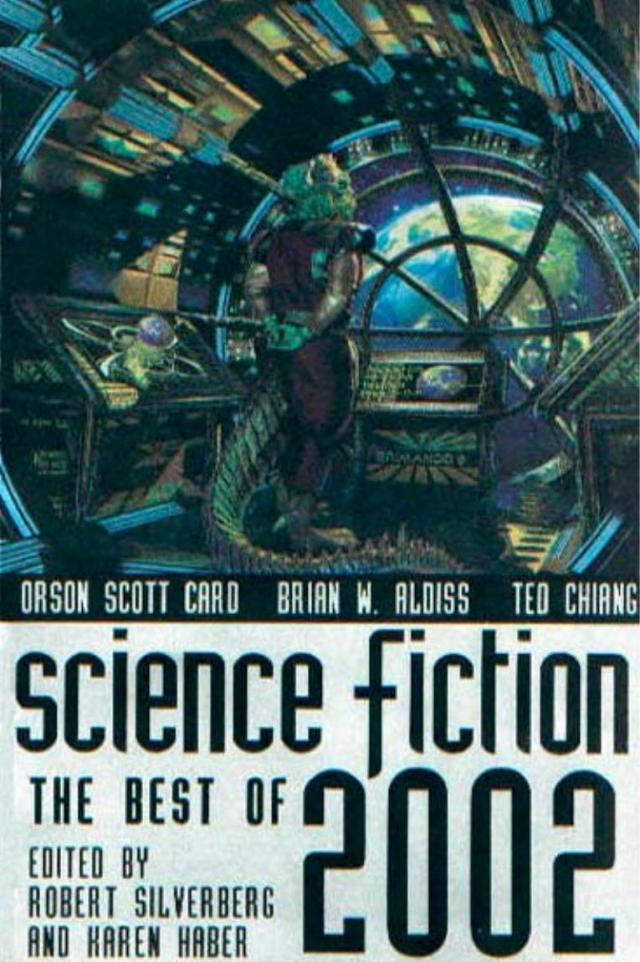
Science fiction the best.., p.41
Science Fiction: The Best of 2002,
p.41


membered Kalal turning over and over in his nervous
hands as he spoke to her future self. Here at last was the link that would bind her through the pages of destiny,
and for a moment she hitched her hand back and pre-
pared to throw it so far out into ocean that it would never be reclaimed. Then her arm relaxed. Out there, all the way across the darkness of the bay, the tideflowers of Habara were glowing.
She decided to keep it.
3 8 7
Angles
Orson Scott Card
3000
Hakira enjoyed coasting the streets of Manhattan. The
old rusted-out building frames seemed like the skeleton of some ancient leviathan that beached and died, but he
could hear the voices and horns and growling machinery
of crowded streets and smell the exhaust and cooking oil, even if all that he saw beneath him were the tops of the
trees that had grown up in the long-vanished streets. With a world as uncrowded as this one, there was no reason to
dismantle the ruins, or clear the trees. It could remain as a monument, for the amusement of the occasional visitor.
There were plenty of places in the world that were still
crowded. As always, most people enjoyed or at least
needed human company, and even recluses usually
wanted people close enough to reach from time to time.
Satellites and landlines still linked the world together, and ports were busy with travel and commerce of the
lighter sort, like bringing out-of-season fruits and veg-
etables to consumers who preferred not to travel to where the food was fresh. But as the year 3000 was about to
pass away, there were places like this that made the
3 8 8
A N G L E S
planet Earth seem almost empty, as if humanity had
moved on.
In fact, there were probably far more human beings
alive than anyone had ever imagined might be possible.
No human had ever left the solar system, and only a
handful lived anywhere but Earth. One of the Earths, any-
way—one of the angles of Earth. In the past five hundred
years, millions had passed through benders to colonize
versions of Earth where humanity had never evolved, and
now a world seemed full with only a billion people or so.
Of the trillions of people that were known to exist, the
one that Hakira was going to see lived in a two-hundred-
year-old house perched on the southern coast of this is-
land, where in ancient times artillery had been placed to command the harbor. Back when the Atlantic reached
this far inland. Back when invaders had to come by ship.
Hakira set his flivver down in the meadow where the
homing signal indicated, switched off the engine, and
slipped out into the bracing air of a summer morning
only a few miles from the face of the nearest glacier. He was expected—there was no challenge from the security
system, and lights showed him the path to follow through
the shadowy woods.
Because his host was something of a show-off, a pair
of sabertooth tigers were soon padding along beside him.
They might have been computer simulations, but know-
ing Moshe’s reputation, they were probably genetic back-
forms, very expensive and undoubtedly chipped up to
keep them from behaving aggressively except, perhaps,
on command. And Moshe had no reason to wish Hakira
ill. They were, after all, kindred spirits.
The path suddenly opened up onto a meadow, and af-
3 8 9
O R S O N S C O T T C A R D
ter only a few steps he realized that the meadow was the
roof of a house, for here and there steep-pitched skylights rose above the grass and flowers. And now, with a turn,
the path took him down a curving ramp along the face of
the butte overlooking the Hudson plain. And now he
stood before a door.
It opened.
A beaming Moshe stood before him, dressed in, of all
things, a kimono. “Come in, Hakira! You certainly took
your time!”
“We set our appointment by the calendar, not the
clock.”
“Whenever you arrive is a good time. I merely noted
that my security system showed you taking the grand
tour on the way.”
“Manhattan. A sad place, like a sweet dream you can
never return to.”
“A poet’s soul, that’s what you have.”
“I’ve never been accused of that, before.”
“Only because you’re Japanese,” said Moshe.
They sat down before an open fire that seemed real,
but gave off no smoke. Heat it had, however, so that
Hakira felt a little scorched when he leaned forward.
“There are Japanese poets.”
“I know. But is that what anyone thinks of, when they
think of the wandering Japanese?”
Hakira smiled. “But you do have money.”
“Not from money-changing,” said Moshe. “And what I
don’t have, which you also don’t have, is a home.”
Hakira looked around at the luxurious parlor. “I sup-
pose that technically this is a cave.”
“A homeland,” said Moshe. “For nine and a half cen-
turies, my friend, your people have been able to go al-
3 9 0
A N G L E S
most anywhere in the world but one, an archipelago of
islands once called Honshu, Hokkaido, Kyushu—”
Hakira, suddenly overcome by emotion, raised his
hand to stop the cruel list. “I know that your people, too, have been driven from their homeland—”
“Repeatedly,” said Moshe.
“I hope you will forgive me, sir, but it is impossible to imagine yearning for a desert beside a dead sea the way
one yearns for the lush islands strangled for nearly a
thousand years by the Chinese dragon.”
“Dry or wet, flat or mountainous, the home to which
you are forbidden to return is beautiful in dreams.”
“Who has the soul of a poet now?”
“Your organization will fail, you know.”
“I know nothing of the kind, sir.”
“It will fail. China will never relent, because to do so
would be to admit wrongdoing, and that they cannot do.
To them you are the interlopers. The toothless Peace
Council can issue as many edicts as it likes, but the Chinese will continue to bar those of known Japanese ances-
try from even visiting the islands. And they will use as
their excuse the perfectly valid argument that if you want so much to see Japan, you have only to bend yourself to
a different slant. There is bound to be some angle where
your tourist dollars will be welcome.”
“No,” said Hakira. “Those other angles are not this
world.”
“And yet they are.”
“And yet they are not.”
“Well, now, there is our dilemma. Either we will do
business or we will not, and it all hinges on that question.
What is it about that archipelago that you want. Is it the land itself? You can already visit that very land—and we
3 9 1
O R S O N S C O T T C A R D
are told that because of inanimate incoherency it is the same land, no matter what angle you dwell in. Or is your desire really not simply to go there, but to go there in defiance of the Chinese? Is it hate, then, that drives you?”
“No, I reject both interpretations,” said Hakira. “I care nothing for the Chinese. And now that you put the question in these terms, I realize that I myself have not
thought clearly enough, for while I speak of the beautiful land of the rising sun, in fact what I yearn for is the
Japanese nation, on those islands, unmolested by any
other, governing ourselves as we have from the begin-
ning of our existence as a people.”
“Ah,” said Moshe. “Now I see that we perhaps can do business. For it may be possible to grant you your heart’s desire.”
“Me and all the people of the Kotoshi.”
“Ah, the eternally optimistic Kotoshi. It means ‘this
year,’ doesn’t it? As in, ‘this year we return’?”
“As your people say, ‘Next year in Jerusalem.’ ”
“A Japan where only the Japanese have ruled for all
these past thousand years. In a world where the Japanese
are not rootless wanderers, legendary toymakers-for-hire, but rather are a nation among the nations of the world,
and one of the greatest of them. Is that not the home you wish to return to?”
“Yes,” said Hakira.
“But that Japan does not exist in this world, not even
now, when the Chinese no longer need even half the land
of the original Han China. So you do not want the Japan
of this world at all, do you? The Japan you want is a fantasy, a dream.”
“A hope.”
“A wish.”
3 9 2
A N G L E S
“A plan.”
“And it hasn’t occurred to you that in all the angles of
the world, there might not be such a Japan?”
“It isn’t like the huge library in that story, where it is believed that among all the books containing all the
combinations of all the letters that could fit in all those pages, there is bound to be a book that tells the true history of all the world. There are many angles, yes, but our ability to differentiate them is not infinite, and in many of them life never evolved and so the air is not breathable. It is an experiment not lightly undertaken.”
“Oh, of course. To find a world so nearly like our own
that a nation called Japan—or, I suppose, Nippon—exists
at all, where a language like Japanese is even spoken—
you do speak Japanese yourself, don’t you?”
“My parents spoke nothing else at home until I was
five and had to enter school.”
“Yes, well, to find such a world would be a miracle.”
“And to search for it would be a fool’s errand.”
“And yet it has been searched for.”
Hakira waited. Moshe did not go on.
“Has it been found?”
“What would it be worth to you, if it had?”
2024—ANGLE 1
“You’re a scientist,” said Leonard. “This is beneath you.”
“I have continuous video,” said Bêto. “With a mechan-
ical clock in it, so you can see the flow of time. The chair moves.”
“There is nothing you can do that hasn’t been faked by
somebody, sometime.”
3 9 3
O R S O N S C O T T C A R D
“But why would I fake it? To publish this is the end of
my career.”
“Exactly my point, Bêto. You are a geologist, of all
things. Geologists don’t have poltergeists.”
“Stay with me, Leonard. Watch this.”
“How long?”
“I don’t know. Sometimes it’s immediate. Sometimes it
takes days.”
“I don’t have days.”
“Play cards with me. As we used to in Faculdade. Look
at the chair first, though. Nothing attached to it. A normal chair in every way.”
“You sound like a magician on the stage.”
“But it is normal.”
“So it seems.”
“Seem? All right, don’t trust me. You move it. Put it where you want.”
“All right. Upside down?”
“It doesn’t matter.”
“On top of the door?”
“I don’t care.”
“And we play cards?”
“You deal.”
2090
It is the problem of memory. We have mapped the en-
tire brain. We can track the activity of every neuron, of every synapse. We have analyzed the chemical contents
of the cells. We can find, in the living brain, without surgery, exactly where each muscle is controlled, where per-
ceptions are rooted. We can even stimulate the brain to
3 9 4
A N G L E S
track and recall memory. But that is all. We cannot ac-
count for how memory is stored, and we cannot find
where.
I know that in your textbooks in secondary school and
perhaps in your early undergraduate classes you have
read that memory was the first problem solved, but that
was a misunderstanding. We discovered that after map-
ping a particular memory, if that exact portion of the
brain was destroyed—and this was in the early days, with
clumsy equipment that killed thousands of cells at a time, an incredibly wasteful procedure and potentially devastating to the subject—if that exact spot was destroyed, the memory was not lost. It could resurface somewhere else.
So for many years we believed that memory was
stored holographically, small portions in many places, so that losing a bit of a memory here or there did not cause the entire sequence to be lost. This, however, was
chimerical, for as our research became more and more
precise, we discovered that the brain is not infinite, and such a wasteful system of memory storage would use up
the entire brain before a child reached the age of three.
Because, you see no memory is lost. Some memories are hard to recover, and people often lose track of their memories, but it is not a problem of storage, it is a problem of retrieval.
Portions of the network break down, so tracks cannot
be followed. Or the routing is such that you cannot link
from memory A to memory X without passing through
memories of such power that you are distracted from the
attempt to retrieve. But, given time—or hyperstimulation
of related memory tracks—all memories can be retrieved.
All. Every moment of your life.
We cannot recover more than your perceptions and
3 9 5
O R S O N S C O T T C A R D
the sense you made of them at the time, but that does not change the fact that we can recover every moment of your childhood, every moment of this class. And we can
recover every conscious thought, though not the uncon-
scious streaming thought behind it. It is all stored . . .
somewhere. The brain is merely the retrieval mechanism.
This has led some observers to conclude that there is,
in fact, a mind, or even a soul—a nonphysical portion of
the human being, existing outside of measurable space.
But if that is so, it is beyond the reach of science. I, however, am a scientist, and with my colleagues—some of
whom once sat in the very chairs where you are sitting—I
have labored long and hard to find an explanation that
is, in fact, physical. Some have criticized this effort because it shows that my faith in the nonexistence of the
immaterial is so blind that I refuse to believe even the
material evidence of immateriality. Don’t laugh, it is a
valid question. But my answer is that we cannot validly
prove the immateriality of the mind by the sheer fact of
our inability to detect the material of which it is made.
I am happy to tell you that we have received word that
the journal Mind—and we would not have settled for anything less than the premiere journal in the field—has ac-
cepted our article dealing with our findings. By no means does this constitute an answer. But it moves the field of inquiry and reopens the possibility, at least, of a material answer to the question of memory. For we have found
that when neurons are accessed for memory, there are
many kinds of activity in the cell. The biochemical, of
course, has been very hard to decode, but other re-
searchers have accounted for all the chemical reactions
within the cell, and we have found nothing new in that
area. Nor is memory electrochemical, for that is merely
3 9 6
A N G L E S
how raw commands of the coarsest sort are passed from
neuron to neuron—rather like the difference between us-
ing a spray can as opposed to painting with a monofila-
ment brush.
Our research, of course, began in the submolecular
realm, trying to find out if in some way the brain cells
were able to make changes in the atom, in the arrange-
ment of protons and neutrons, or some information
somehow encoded in the behavior of electrons. This
proved, alas, to be a dead end as well.
But the invention of the muonoscope has changed
everything for us. Because at last we had a nondestruc-
tive means of scanning the exact state of muons through
infinitesimal passages of time, we were able to find some astonishing correlations between memory and the barely
detectable muon states of slant and yaw. Yaw, as you
know, is the constant—the yaw of a muon cannot change
during the existence of the muon. Slant also seemed to be a constant, and in the materials which had previously
been examined by physicists, that was indeed the case.
However, in our studies of brain activity during forced
memory retrieval, we have found a consistent pattern of
slant alteration within the nuclei of atoms in individual brain cells. Because the head must be held utterly still for the muonoscope to function, we could only work with
terminally ill patients who volunteered for the study and were willing to die in the laboratory instead of with their families, spending the last moments of their lives with