Science fiction the best.., p.28
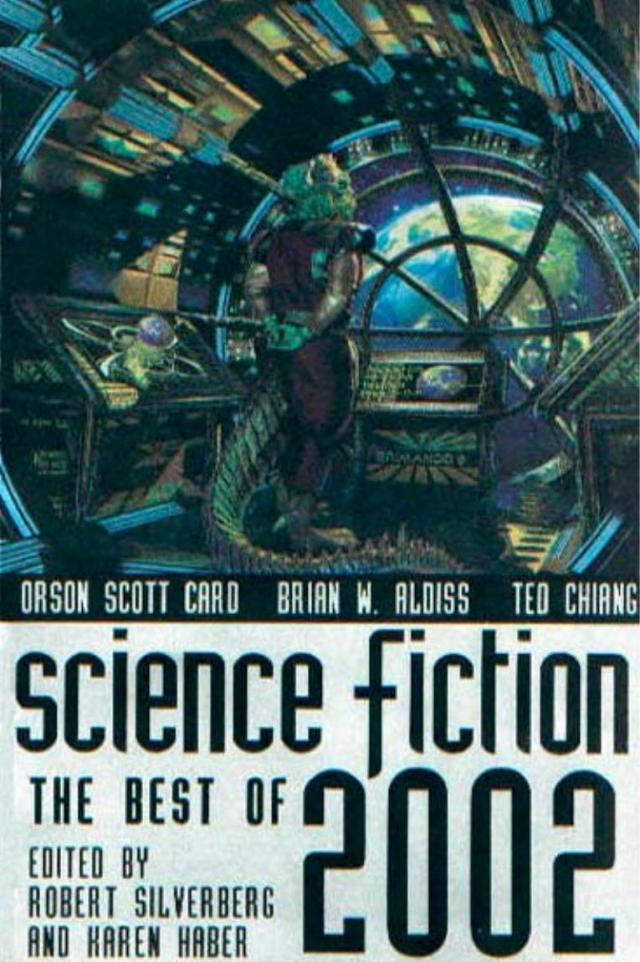
Science Fiction: The Best of 2002,
p.28


The first operation the Martians undertook upon land-
ing in Central Park was to suck away all the city’s elec-
tricity and seal it in a small spherical container
suggesting an aluminum racquetball. I believe they
wanted to make sure we wouldn’t bother them as they
went about their incomprehensible agenda, but Valerie
2 6 4
T H E WA R O F T H E WO R L DV I E W S
says they were just being quixotic. In either case, the
Martians obviously don’t need all that power. They
brought plenty with them.
I am writing by candlelight in our Delancey Street
apartment, scribbling on a legal pad with a ballpoint pen.
New York City is without functional lamps, subways, ele-
vators, traffic signals household appliances, or personal computers. Here and there, I suppose, life goes on as
usual, thanks to storage batteries, solar cells, and diesel-fueled generators. The rest of us are living in the eigh-
teenth century, and we don’t much like it.
I was taking Valerie’s kid to the Central Park Zoo
when the Phobosians and the Deimosians started up-
rooting the city’s power cables. Bobby and I witnessed
the whole thing. The Martians were obviously having a
good time. Each alien is only six inches high, but I could still see the jollity coursing through their little frames.
Capricious chipmunks. I hate them all. Bobby became ter-
rified when the Martians started wrecking things. He
cried and moaned. I did my best to comfort him. Bobby’s
a good kid. Last week he called me Second Dad.
The city went black, neighborhood by neighborhood,
and then the hostilities began. The Phobosian and the
Deimosian infantries went at each other with weapons so
advanced as to make Earth’s rifles and howitzers seem
like peashooters. Heat rays, disintegrator beams, quark
bombs, sonic grenades, laser cannons. The Deimosians
look rather like the animated mushrooms from Fantasia.
The Phobosians resemble pencil sharpeners fashioned
from Naugahyde. All during the fight, both races commu-
nicated among themselves via chirping sounds reminis-
cent of dolphins enjoying sexual climax. Their ferocity
knew no limits. In one hour I saw enough war crimes to
2 6 5
J A M E S M O R R O W
fill an encyclopedia, though on the scale of an O-gauge
model railroad.
As far as I could tell, the Battle of Central Park ended
in a stalemate. The real loser was New York, victim of a
hundred ill-aimed volleys. At least half the buildings on Fifth Avenue are gone, including the Mount Sinai Medical Center. Fires rage everywhere, eastward as far as
Third Avenue, westward to Columbus. Bobby and I were
lucky to get back home alive.
Such an inferno is clearly beyond the capacity of our
local fire departments. Normally we would seek help from
Jersey and Connecticut, but the Martians have fashioned
some sort of force-field dome, lowering it over the entire island as blithely as a chef placing a lid on a casserole dish. Nothing can get in, and nothing can get out. We are at the invaders’ mercy. If the Phobosians and the
Deimosians continue trying to settle their differences
through violence, the city will burn to the ground.
AUGUST 8
The Second Battle of Central Park was even worse
than the first. We lost the National Academy of Design,
the Guggenheim Museum, and the Carlyle Hotel. It ended
with the Phobosians driving the Deimosians all the way
down to Rockefeller Center. The Deimosians then rallied,
stood their ground, and forced a Phobosian retreat to
West 71st Street.
Valerie and I learned about this latest conflict only be-
cause a handful of resourceful radio announcers have im-
provised three ad hoc Citizens Band stations along what’s left of Lexington Avenue. We have a decent CB receiver,
2 6 6
T H E WA R O F T H E WO R L DV I E W S
so we’ll be getting up-to-the-minute bulletins until our
batteries die. Each time the newscaster named Clarence
Morant attempts to describe the collateral damage from
this morning’s hostilities, he breaks down and weeps.
Even when you allow for the shrimplike Martian
physique, the two armies are not very far apart. By our
scale, they are separated by three blocks—by theirs, per-
haps ten kilometers. Clarence Morant predicts there’ll be another big battle tomorrow. Valerie chides me for not
believing her when she had those premonitions last year
of our apartment building on fire. I tell her she’s being a Monday morning Nostradamus. How many private journals concerning the Martian invasion exist at the mo-
ment? As I put pen to paper, I suspect that hundreds,
perhaps even thousands, of my fellow survivors are
recording their impressions of the cataclysm. But I am
not like these other diary keepers. I am unique. I alone
have the power to stop the Martians before they demolish
Manhattan—or so I imagine.
AUGUST 9
All quiet on the West Side front—though nobody be-
lieves the cease-fire will last much longer. Clarence
Morant says the city is living on borrowed time.
Phobos and Deimos. When the astronomers first
started warning us of nefarious phenomena on the Mart-
ian satellites, I experienced a vague feeling of personal connection to those particular moons. Last night it all
flooded back. Phobos and Deimos are indeed a part of my
past: a past I’ve been trying to forget—those bad old days when I was the worst psychiatric intern ever to serve an
2 6 7
J A M E S M O R R O W
apprenticeship at Bellevue. I’m much happier in my pres-
ent position as a bohemian hippie bum, looking after
Bobby and living off the respectable income Valerie
makes running two SoHo art galleries.
His name was Rupert Klieg, and he was among the
dozen or so patients who made me realize I’d never be
good with insane people. I found Rupert’s rants alternately unnerving and boring. They sounded like something you’d
read in some cheesy special-interest zine for psychotics.
Paranoid Confessions. True Hallucinations. Rupert was especially obsessed with an organization called the Asaph
Hall Society, named for the self-taught scientist who discovered Phobos and Deimos. All three members of the As-
aph Hall Society were amateur astronomers and certifiable lunatics who’d dedicated themselves to monitoring the
imminent invasion of planet Earth by the bellicose
denizens of the Martian moons. Before Rupert told me his
absurd fantasy, I didn’t even realize that Mars had moons, nor did I care. But now I do, God knows.
The last I heard, they’d put Rupert Klieg away in the
Lionel Frye Psychiatric Institute, Ninth Avenue near 58th.
Valerie says I’m wasting my time, but I believe in my
bones that the fate of Manhattan lies with that particular schizophrenic.
AUGUST 10
This morning a massive infantry assault by the Pho-
bosians drove the Deimosians south to Times Square.
When I heard that the Frye Institute was caught in the
cross fire, I naturally feared the worst for Rupert. When I actually made the trek to Ninth and 58th, however, I dis-2 6 8
T H E WA R O F T H E WO R L DV I E W S
covered that the disintegrator beams, devastating in most regards, had missed the lower third of the building. I
didn’t see any Martians, but the whole neighborhood re-
sounded with their tweets and twitters.
The morning’s upheavals had left the Institute’s staff
in a state of extreme distraction. I had no difficulty
sneaking into the lobby, stealing a dry-cell lantern, and conducting a room-by-room hunt.
Rupert was in the basement ward, Room 16. The door
stood ajar. I entered. He lay abed, grasping a toy plastic telescope about ten centimeters long. I couldn’t decide
whether his keepers had been kind or cruel to allow him
this trinket. It was nice that the poor demented as-
tronomer had a telescope, but what good did it do him in
a room with no windows?
His face had become thinner, his body more gaunt, but
otherwise he was the fundamentally beatific madman I
remembered. “Thank you for the lantern, Dr. Onslo,” he
said as I approached. He swatted at a naked light bulb
hanging from the ceiling like a miniature punching bag.
“It’s been pretty gloomy around here.”
“Call me Steve. I never finished my internship.”
“I’m not surprised, Dr. Onslo. You were a lousy thera-
pist.”
“Let me tell you why I’ve come.”
“I know why you’ve come, and as Chairperson of the
Data Bank Committee of the Asaph Hall Society, I can tell you everything you want to know about Phobos and
Deimos.”
“I’m especially interested in learning how your organ-
ization knew an invasion was imminent.”
The corners of Rupert’s mouth lifted in a grotesque
smile. He opened the drawer in his nightstand, removed a
2 6 9
J A M E S M O R R O W
crinkled sheet of paper, and deposited it in my hands.
“Mass: 1.08e16 kilograms,” he said as I studied the fact
sheet, which had a cherry cough drop stuck to one corner.
“Diameter: 22.2 kilometers. Mean density: 2.0 grams per
cubic centimeter. Mean distance from Mars: 9,380 kilo-
meters. Rotational period: 0.31910 days. Mean orbital ve-
locity: 2.14 kilometers per second. Orbital eccentricity: 0.01. Orbital inclination: 1.0 degrees. Escape velocity:
0.0103 kilometers per second. Visual geometric albedo:
0.06. In short, ladies and gentlemen, I give you Phobos—”
“Fascinating,” I said evenly.
“As opposed to Deimos. Mass: 1.8e15 kilograms. Di-
ameter: 12.6 kilometers. Mean density: 1.7 grams per cu-
bic centimeter. Mean distance from Mars: 23,460
kilometers. Rotational period: 1.26244 days. Mean orbital velocity: 1.36 kilometers per second. Orbital eccentricity: 0.00. Orbital inclination: 0.9 to 2.7 degrees. Escape velocity: 0.0057 kilometers per second. Visual geometric
albedo: 0.07. Both moons look like baked potatoes.”
“By some astonishing intuition, you knew that these
two satellites intended to invade the Earth.”
“Intuition, my Aunt Fanny. We deduced it through
empirical observation.” Rupert brought the telescope to
his eye and focused on the dormant lightbulb. “Consider
this. A scant eighty million years ago, there were no
Phobes or Deems. I’m not kidding. They were all one
species, living beneath the desiccated surface of Mars.
Over the centuries, a deep rift in philosophic sensibility opened up within their civilization. Eventually they decided to abandon the native planet, never an especially
congenial place, and emigrate to the local moons. Those
favoring Sensibility A moved to Phobos. Those favoring
Sensibility B settled on Deimos.”
2 7 0
T H E WA R O F T H E WO R L DV I E W S
“Why would the Martians find Phobos and Deimos
more congenial?” I jammed the fact sheet in my pocket.
“I mean, aren’t they just . . . big rocks?”
“Don’t bring your petty little human perspective to the
matter, Dr. Onslo. To a vulture, carrion tastes like chocolate cake. Once they were on their respective worlds, the Phobes and the Deems followed separate evolutionary
paths . . . hence, the anatomical dimorphism we observe
today.”
“What was the nature of the sensibility rift?”
Rupert used his telescope to study a section of the wall
where the plaster had crumbled away, exposing the lat-
ticework beneath. “I have no idea.”
“None whatsoever?”
“The Asaph Hall Society dissolved before we could ad-
dress that issue. All I know is that the Phobes and the
Deems decided to settle the question once and for all
through armed combat on neutral ground.”
“So they came here?”
“Mars would’ve seemed like a step backward. Venus
has rotten weather.”
“Are you saying that whichever side wins the war
will claim victory in what is essentially a philosophical controversy?”
“Correct.”
“They believe that truth claims can be corroborated
through violence?”
“More or less.”
“That doesn’t make any sense to me.”
“If you were a fly, horse manure would smell like
candy. We’d better go see Melvin.”
“Who?”
“Melvin Haskin, Chairperson of our Epistemology
2 7 1
J A M E S M O R R O W
Committee. If anybody’s figured out the Phobos-Deimos
rift, it’s Melvin. The last I heard, they’d put him in a rubber room at Werner Krauss Memorial. What’s today?”
“Tuesday.”
“Too bad.”
“Oh?”
“On Tuesday Melvin always wills himself into a cata-
tonic stupor. He’ll be incommunicado until tomorrow
morning.”
I had no troubling sneaking Rupert out of the Frye In-
stitute. Everybody on the staff was preoccupied with gos-
sip and triage. The lunatic brought along his telescope
and a bottle of green pills that he called “the thin verdant line that separates me from my madness.”
Although still skeptical of my belief that Rupert held
the key to Manhattan’s salvation, Valerie welcomed him
warmly into our apartment—she’s a better therapist than I ever was—and offered him the full measure of her hospitality. Because we have a gas oven, we were able to pre-
pare a splendid meal of spinach lasagne and toasted
garlic bread. Rupert ate all the leftovers. Bobby asked him what it was like to be insane. “There is nothing that being insane is like,” Rupert replied.
After dinner, at Rupert’s request, we all played Scrab-
ble by candlelight, followed by a round of Clue. Rupert
won both games. At ten o’clock he took a green pill and
stretched his spindly body along the length of our couch, which he said was much more comfortable than his bed
at the Frye Institute. Five minutes later he was asleep.
As I write this entry, Clarence Morant is offering his
latest dispatches from the war zone. Evidently the
Deimosians are still dug in throughout Times Square. To-
morrow the Phobosians will attempt to dislodge them.
2 7 2
T H E WA R O F T H E WO R L DV I E W S
Valerie and I both hear a catch in Morant’s voice as he
tells how his aunt took him to see Cats when he was nine years old. He inhales deeply and says, “The Winter Garden Theater is surely doomed.”
AUGUST 11
Before we left the apartment this morning, Rupert re-
membered that Melvin Haskin is inordinately fond of
bananas. Luckily, Valerie had purchased two bunches at
the corner bodega right before the Martians landed. I
tossed them into my rucksack, along with some cheese
sandwiches and Rupert’s telescope, and then we headed
uptown.
Reaching 40th Street, we saw that the Werner Krauss
Memorial Clinic had become a seething mass of orange
flames and billowing gray smoke, doubtless an ancillary
catastrophe accruing to the Battle of Times Square. Ashes and sparks speckled the air. Our eyes teared up from the
carbon. The sidewalks teemed with a despairing throng of
doctors, administrators, guards, and inmates. Presumably
the Broadway theaters and hotels were also on fire, but I didn’t want to think about it.
Rupert instantly alighted on Melvin Haskin, though I
probably could’ve identified him unassisted. Even in a
milling mass of psychotics, Melvin stood out. He’d
strapped a dish-shaped antenna onto his head, the con-
cavity pointed skyward—an inverted yarmulke. A pair of
headphones covered his ears, jacked into an antique
vacuum-tube amplifier that he cradled in his arms like a
baby. Two coiled wires, one red, one black, connected the antenna to the amplifier, its functionless power cord
2 7 3
J A M E S M O R R O W
bumping against Melvin’s left leg, the naked prongs
glinting in the August sunlight. He wore a yellow terry
cloth bathrobe and matching Big Bird slippers. His frame
was massive, his skin pale, his stomach protuberant, his
mouth bereft of teeth.
Rupert made the introductions. Once again he insisted
on calling me Dr. Onslo. I pointed to Melvin’s antenna
and asked him whether he was receiving transmissions
from the Martians.
“What?” He pulled off the headphones and allowed
them to settle around his neck like a yoke.
“Your antenna, the headphones—looks like you’re