Science fiction the best.., p.6
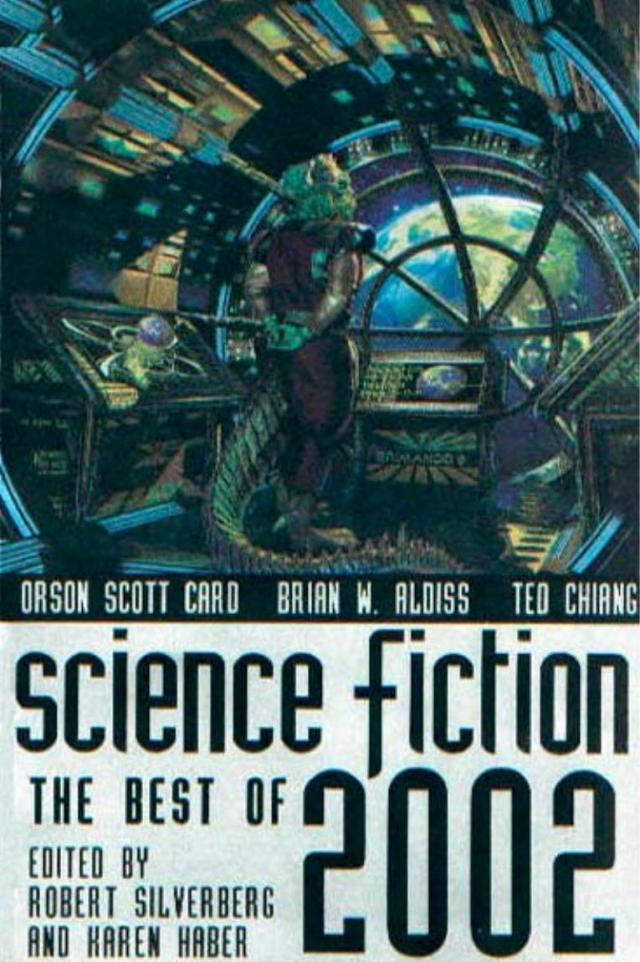
Science Fiction: The Best of 2002,
p.6


outside my skull these days, anyhow?” One of his exter-
nal threads generates an animated glyph and throws it at
her mind’s eye: she grins at his obscure humour. “Cross-
training from a new interface is going to be hard,
though.”
“You’ll do it,” she predicts. “You can always get a dis-
creet prescription for novotrophin-B.” A neurotransmitter agonist tailored for gerontological wards, it stimulates interest in the new: combined with MDMA, it’s a compo-
nent of the street cocktail called sensawunda. “That
should keep you focussed for long enough to get com-
fortable.”
“What’s life coming to, when I can’t cope with the pace of change?” he asks the ceiling plaintively.
The cat lashes its tail irritably.
“You are my futurological storm-shield,” she says,
jokingly, and moves her hand to cup his genitals. Most of her current activities are purely biological, the cat notes: 4 3
C H A R L E S S T R O S S
from the irregular sideloads, she’s using most of her
skullware to run ETItalk@home, one of the distributed
cracking engines that is trying to decode the alien gram-
mar of a message that Manfred suspects is eligible for
citizenship.
Obeying an urge that it can’t articulate, the cat sends
out a feeler to the nearest router. The cybeast has Man-
fred’s keys; he trusts it implicitly, which is unwise—his ex-wife tampered with it, after all. Tunnelling out into
the darkness, the cat stalks the net alone . . .
“Just think about the people who can’t adapt,” he says.
His voice sounds obscurely worried.
“I try not to.” She shivers. “You are thirty, you are
slowing. What about the young? Are they keeping up,
themselves?”
“I have a daughter. She’s about a hundred and sixty
million seconds old. If Pamela would let me message her
I could find out . . .”
“Don’t go there, Manfred. Please.”
In the distance, the cat hears the sound of lobster
minds singing in the void, a distant feed streaming from
their cometary home as it drifts silently out through the asteroid belt, en route to a chilly encounter beyond Neptune. The lobsters sing of alienation and obsolescence, of intelligence too slow and tenuous to support the vicious
pace of change that has sand-blasted the human world
until all the edges people cling to are jagged and brittle.
Beyond the lobsters, the cat finds an anonymous eter-
nity server: distributed file storage, unerasable, full of secrets and lies that nobody can afford to suppress. Rants, music, rip-offs of the latest Bollywood hits: the cat spiders past them all, looking for the final sample. Grabbing it—a momentary breakup in Manfred’s spectacles the only
4 4
T O U R I S T
symptom either human notices—the cat drags its prey
home, sucks it down, and diffs it against the data sample Annette’s exocortex is analysing.
“I’m sorry, my love. I just sometimes feel—” he sighs.
“Age is a process of closing off opportunities behind you.
I’m not young enough any more: I’ve lost the dynamic
optimism.”
The data sample on the pirate server differs from the
one Annette’s implant is processing.
“You’ll get it back,” she reassures him quietly, stroking his side. “You are still sad from being mugged. This also will pass. You’ll see.”
“Yeah.” He finally relaxes, dropping back into the re-
flexive assurance of his own will. “I’ll get over it, one way or another. Or someone who remembers being me
will . . .”
In the darkness, Aineko bares teeth in a silent grin. Be-
hind his feline eyes, a braid of processes running on an
abstract virtual machine asks him a question that cannot
be encoded in any human grammar. Watch and wait, he replies to the alien tourist. They’ll figure it out, sooner or later.
4 5
The Long Chase
Geoffrey A. Landis
2645, January
The war is over.
The survivors are being rounded up and converted.
In the inner solar system, those of my companions
who survived the ferocity of the fighting have already
been converted. But here at the very edge of the Oort
Cloud, all things go slowly. It will be years, perhaps decades, before the victorious enemy come out here. But
with the slow inevitability of gravity, like an outward
wave of entropy, they will come.
Ten thousand of my fellow soldiers have elected to go
doggo. Ragged prospectors and ice processors, they had
been too independent to ever merge into an effective
fighting unit. Now they shut themselves down to dumb
rocks, electing to wake up to groggy consciousness for
only a few seconds every hundred years. Patience, they
counsel me; patience is life. If they can wait a thousand or ten thousand or a million years, with patience enough
the enemy will eventually go away.
They are wrong.
The enemy, too, is patient. Here at the edge of the
Kuiper, out past Pluto, space is vast, but still not vast 4 6
T H E L O N G C H A S E
enough. The enemy will search every grain of sand in the
solar system. My companions will be found, and con-
verted. If it takes ten thousand years, the enemy will
search that long to do it.
I, too, have gone doggo, but my strategy is different. I
have altered my orbit. I have a powerful ion-drive, and
full tanks of propellant, but I use only the slightest tittle of a cold-gas thruster. I have a chemical kick-stage engine as well, but I do not use it either; using either one of them would signal my position to too many watchers.
Among the cold comets, a tittle is enough.
I am falling into the sun.
It will take me two hundred and fifty years years to
fall, and for two hundred and forty nine years, I will be a dumb rock, a grain of sand with no thermal signature, no
motion other than gravity, no sign of life.
Sleep.
2894, JUNE
Awake.
I check my systems. I have been a rock for nearly two
hundred and fifty years.
The sun is huge now. If I were still a human, it would
be the size of the fist on my outstretched arm. I am being watched now, I am sure, by a thousand lenses: am I a
rock, a tiny particle of interstellar ice? A fragment of debris from the war? A surviving enemy?
I love the cold and the dark and the emptiness; I have
been gone so long from the inner solar system that the
very sunlight is alien to me.
My systems check green. I expected no less: if I am
4 7
G E O F F R E Y A . L A N D I S
nothing else, I am still a superbly engineered piece of
space hardware. I come fully to life, and bring my ion engine up to thrust.
A thousand telescopes must be alerting their brains
that I am alive—but it is too late! I am thrusting at a full throttle, five percent of a standard gravity, and I am
thrusting inward, deep into the gravity well of the sun. My trajectory is plotted to skim almost the surface of the sun.
This trajectory has two objectives. First, so close to the sun I will be hard to see. My ion contrail will be washed out in the glare of a light a billion times brighter, and none of the thousand watching eyes will know my plans
until it is too late to follow.
And second, by waiting until I am nearly skimming
the sun and then firing my chemical engine deep inside
the gravity well, I can make most efficient use of it. The gravity of the sun will amplify the efficiency of my propellant, magnify my speed. When I cross the orbit of
Mercury outbound I will be over one percent of the speed
of light and still accelerating.
I will discard the useless chemical rocket after I ex-
haust the little bit of impulse it can give me, of course.
Chemical rockets have ferocious thrust but little staying power; useful in war but of limited value in an escape.
But I will still have my ion engine, and I will have nearly full tanks.
Five percent of a standard gravity is a feeble thrust by
the standards of chemical rocket engines, but chemical
rockets exhaust their fuel far too quickly to be able to
catch me. I can continue thrusting for years, for decades.
I pick a bright star, Procyon, for no reason whatever,
and boresight it. Perhaps Procyon will have an asteroid
4 8
T H E L O N G C H A S E
belt. At least it must have dust, and perhaps comets. I don’t need much: a grain of sand, a microscopic shard of ice.
From dust God made man. From the dust of a new
star, from the detritus of creation, I can make worlds.
No one can catch me now. I will leave, and never re-
turn.
2897, MAY
I am chased.
It is impossible, stupid, unbelievable, inconceivable! I
am being chased.
Why?
Can they not leave a single free mind unconverted? In
three years I have reached fifteen percent of the speed of light, and it must be clear that I am leaving and never
coming back. Can one unconverted brain be a threat to
them? Must their group brain really have the forced co-
operation of every lump of thinking matter in the solar
system? Can they think that if even one free-thinking
brain escapes, they have lost?
But the war is a matter of religion, not reason, and it
may be that they indeed believe that even a single brain
unconverted is a threat to them. For whatever reason, I
am being chased.
The robot chasing me is, I am sure, little different than myself, a tiny brain, an ion engine, and a large set of
tanks. They would have had no time to design something
new; to have any chance of catching me they would have
had to set the chaser on my tail immediately.
The brain, like mine, would consist of atomic spin
4 9
G E O F F R E Y A . L A N D I S
states superimposed on a crystalline rock matrix. A de-
vice smaller than what, in the old days, we would call a
grain of rice. Intelligent dust, a human had once said,
back in the days before humans became irrelevant.
They only sent one chaser. They must be very confi-
dent.
Or short on resources.
It is a race, and a very tricky one. I can increase my
thrust, use up fuel more quickly, to try to pull away, but if I do so, the specific impulse of my ion drive decreases, and as a result, I waste fuel and risk running out first. Or I can stretch my fuel, make my ion drive more efficient,
but this will lower my thrust, and I will risk getting
caught by the higher-thrust opponent behind me.
He is twenty billion kilometers behind me. I integrate
his motion for a few days, and see that he is, in fact, out-accelerating me.
Time to jettison.
I drop everything I can. The identify-friend-or-foe
encrypted-link gear I will never need again; it is dis-
carded. It is a shame I cannot grind it up and feed it to my ion engines, but the ion engines are picky about what
they eat. Two micro-manipulators I had planned to use to
collect sand grains at my destination for fuel: gone.
My primary weapon has always been my body—little
can survive an impact at the speeds I can attain—but I
have three sand-grains with tiny engines of their own as
secondary weapons. There’s no sense in saving them to
fight my enemy; he will know exactly what to expect,
and in space warfare, only the unexpected can kill.
I fire the grains of sand, one at a time, and the se-
quential kick of almost a standard gravity nudges my
5 0
T H E L O N G C H A S E
speed slightly forward. Then I drop the empty shells.
May he slip up, and run into them at sub-relativistic
closing velocity.
I am lighter, but it is still not enough. I nudge my
thrust up, hating myself for the waste, but if I don’t increase acceleration, in two years I will be caught, and my parsimony with fuel will yield me nothing.
I need all the energy I can feed to my ion drives. No
extra for thinking.
Sleep.
2900
Still being chased.
2905
Still being chased.
I have passed the point of commitment. Even if I
braked with my thrust to turn back, I could no longer
make it back to the solar system.
I am alone.
2907
Lonely.
To one side of my path Sirius glares insanely bright, a
knife in the sky, a mad dog of a star. The stars of Orion are weirdly distorted. Ahead of me, the lesser dog Pro-5 1
G E O F F R E Y A . L A N D I S
cyon is waxing brighter every year; behind me, the sun is a fading dot in Aquila.
Of all things, I am lonely. I had not realized that I still had the psychological capacity for loneliness. I examine
my brain, and find it. Yes, a tiny knot of loneliness. Now that I see it, I can edit my brain to delete it, if I choose.
But yet I hesitate. It is not a bad thing, not something
that is crippling my capabilities, and if I edit my brain too much will I not become, in some way, like them?
I leave my brain unedited. I can bear loneliness.
2909
Still being chased.
We are relativistic now, nearly three quarters of the
speed of light.
One twentieth of a standard gravity is only a slight
push, but as I have burned fuel my acceleration in-
creases, and we have been thrusting for fifteen years
continuously.
What point is there in this stupid chase? What victory
can there be, here in the emptiness between stars, a trillion kilometers away from anything at all?
After fifteen years of being chased, I have a very good
measurement of his acceleration. As his ship burns off
fuel, it loses mass, and the acceleration increases. By
measuring this increase in acceleration, and knowing
what his empty mass must be, I know how much fuel he
has left.
It is too much. I will run out of fuel first.
I can’t conserve fuel; if I lessen my thrust, he will
5 2
T H E L O N G C H A S E
catch me in only a few years. It will take another fifty
years, but the end of the chase is already in sight.
A tiny strobe flickers erratically behind me. Every in-
terstellar hydrogen that impacts his shell makes a tiny
flash of x-ray brilliance. Likewise, each interstellar proton I hit sends a burst of x-rays through me. I can feel
each one, a burst of fuzzy noise that momentarily dis-
rupts my thoughts. But with spin states encoding ten-to-
the-twentieth qbits, I can afford to have massively
redundant brainpower. My brain was designed to be
powerful enough to simulate an entire world, including
ten thousand fully-sapient and sentient free agents. I
could immerse myself inside a virtual reality indistin-
guishable from old Earth, and split myself into a hundred personalities. In my own interior time, I could spend ten thousand years before the enemy catches me and forcibly
drills itself into my brain. Civilizations could rise and fall in my head, and I could taste every decadence, lose myself for a hundred years in sensual pleasure, invent rare tortures and exquisite pain.
But as part of owning your own brain free and clear
comes the ability to prune yourself. In space, one of the first things to prune away is the ability to feel boredom, and not long after that, I pruned away all desire to live in simulated realities. Billions of humans chose to live
in simulations, but by doing so they have made them-
selves irrelevant: irrelevant to the war, irrelevant to the future.
I could edit back into my brain a wish to live in simu-
lated reality, but what would be the point? It would be
just another way to die.
The one thing I do simulate, repeatedly and obses-
5 3
G E O F F R E Y A . L A N D I S
sively, is the result of the chase. I run a million different scenarios, and in all of them, I lose.
Still, most of my brain is unused. There is plenty of
extra processing power to keep all my brain running
error-correcting code, and an occasional x-ray flash is
barely an event worth my noticing. When a cell of my
brain is irrevocably damaged by cosmic radiation, I sim-
ply code that section to be ignored. I have brainpower to spare.
I continue running, and hope for a miracle.
2355, FEBRUARY: EARTH.
I was living in a house I hated, married to a man I de-
spised, with two children who had changed with adoles-
cence from sullen and withdrawn to an active, menacing
hostility. How can I be afraid of my own offspring?
Earth was a dead end, stuck in the biological past, a
society in deep freeze. No one starved, and no one pro-