

Once our lives, p.1
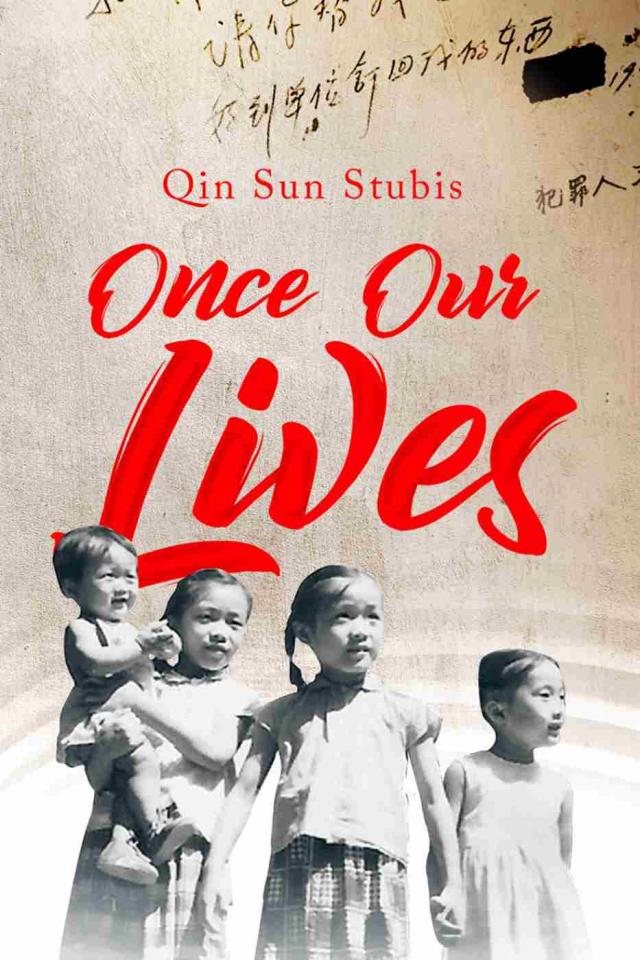
Once Our Lives,
p.1


Copyright © 2023, Qin Sun Stubis and Guernica Editions Inc.
All rights reserved. The use of any part of this publication,
reproduced, transmitted in any form or by any means, electronic,
mechanical, photocopying, recording or otherwise stored
in a retrieval system, without the prior consent of the publisher
is an infringement of the copyright law.
Guernica Editions Founder: Antonio D’Alfonso
Michael Mirolla, general editor
Sonia Di Placido, editor
Cover design: Allen Jomoc Jr.
Interior design: Jill Ronsley, suneditwrite.com
Ebook: Rafael Alt
Guernica Editions Inc.
287 Templemead Drive, Hamilton (ON), Canada L8W 2W4
2250 Military Road, Tonawanda, N.Y. 14150-6000 U.S.A.
www.guernicaeditions.com
Distributors:
Independent Publishers Group (IPG)
600 North Pulaski Road, Chicago IL 60624
University of Toronto Press Distribution (UTP)
5201 Dufferin Street, Toronto (ON), Canada M3H 5T8
Gazelle Book Services, White Cross Mills
High Town, Lancaster LA1 4XS U.K.
First edition.
Printed in Canada.
Legal Deposit—First Quarter
Library of Congress Catalog Card Number: 2022949661
Library and Archives Canada Cataloguing in Publication
Title: Once our lives : life, death, and love in the middle kingdom / Qin Sun Stubis.
Names: Stubis, Qin Sun, author.
Series: Guernica world editions ; 60.
Description: Series statement: Guernica world editions ; 60
Identifiers: Canadiana (print) 20220469784 | Canadiana (ebook)
20220469865 | ISBN 9781771837965 (softcover) | ISBN 9781771837972 (EPUB)
Subjects: LCSH: Stubis, Qin Sun. | LCSH: Chinese American authors—21st
century—Biography. | LCSH: Women—China—Biography. | LCSH:
Families—China. | LCSH: Intergenerational relations—China. |LCGFT:
Autobiographies.
Classification: LCC PR6037.T917 Z46 2023 | DDC 818/.6—dc23
To my husband, Mark,
my beacon and my sunshine
To my children,
Keaton and Halley
From memory
Through tears
With love
Contents
Cover
Title page
Copyright
Dedication
Prologue
Index of Characters and Notes on the Events
Historical & Family Timeline
Presentiment: A Family Myth
Part I – A Tale of Two Families (Shanghai, 1940s to the 1950s)
Chapter I: Charcoal Slaves
Chapter II: Life in a Shantytown
Chapter III: Escape from Shanghai
Chapter IV: Yan’s Real Family
Chapter V: A Brother Bought with Gold
Chapter VI: The Wellington Clock & Watch Shop
Chapter VII: Radio Days
Chapter VIII: Educating a Daughter—the Old-fashioned Way
Chapter IX: Treasure … and Pirates onthe China Sea
Chapter X: A Topsy-turvy World
Chapter XI: New Prospects in Life
Chapter XII: A Mother with TB: Life and Death
Chapter XIII: A Father’s Love, a Daughter’s Rebellion
Part II – Two Destinies Entwined (Zhang Ye City, Gansu Province, 1957) Chapter I: Young Pioneers
Chapter II: Oasis in the Desert
Chapter III: Welfare Warehouse
Chapter IV: A Brush with Death
Chapter V: A Friend in Need Is a Friend Indeed
Chapter VI: Engagement and Consummation of a Marriage
Chapter VII: Changing Political Winds
Chapter VIII: Disasters, Natural and Man-made
Chapter IX: Double Jeopardy
Chapter X: Exodus
Part III – The Return of the Low-down Prodigals (Shanghai, 1958-1964) Chapter I: A Daughter Is a Daughter for All That
Chapter II: Culture Shock
Chapter III: Be It Ever So Humble …
Chapter IV: Life of a Down-and-Out Family
Chapter V: Moments of Reflection
Chapter VI: A Job … with a Catch
Chapter VII: A “Single Mother”
Chapter VIII: Last Days of the Shantytown
Part IV – Rapids of Life, Where Are You Taking Us? (Shanghai, 1965 to 1975) Chapter I: Our New Home
Chapter II: Days of Innocence
Chapter III: Life Behind the Iron Curtain
Chapter IV: Wildfires of Revolution
Chapter V: To Grandmother’s House We Go
Chapter VI: Honesty and Punishment
Chapter VII: Life without Means
Chapter VIII: Great Grandmother’s Prophecy
Chapter IX: Eggs as Medicine
Chapter X: Someone Wanted Us Dead
Chapter XI: The Americans Are Coming!
Chapter XII: If Winter Comes, Can Spring Be Far Behind?
Postlude: A Prophecy Ends (Shanghai, December 1999)
Afterthoughts
Acknowledgements
About the Author
Landmarks
Cover
Half Title Page
Title Page
Copyright Page
Dedication
Epigraph
Table of Contents
Prologue
Part
Part
Part
Part
Acknowledgments
As far as I know, everything in this book is true. The stories, as hard to believe as some of them may be, happened to me personally or were told to me by the people who lived through them. Most of what follows was shared privately, sometimes confidentially, often late at night, in bed, and in hushed whispers. By hearing these accounts repeated over the years, as family histories often are, I became convinced that the stories are real, or at least as real to their now long-silent witnesses as human beings are capable of ascertaining. Although I was far too young at the time to fully take on the roles asked of me, I became the friend, confidante, and small ally of all those who told me these tales, especially my mother. It is to her, my strength and true inspiration, that this book is dedicated.
Index of Characters and
Notes on the Events
The Sun Family
Ya Zhen: The matriarch of the Sun family whose simple act of generosity as a young woman appeared to have changed her fate and the fate of generations to come
An Chu: Ya Zhen’s first-born son whose life and destiny she believed were destroyed before birth
Xin Feng: An Chu’s youngest sister, who denounced him during the Cultural Revolution
Ping: An Chu and his wife Yan’s first daughter, born in an ancient desert city along the old Silk Road during The Great Chinese Famine, which killed more than 30 million people
Qin: An Chu and Yan’s second daughter, born in a splintery shack in a Shanghai shantytown
Min: An Chu and Yan’s third daughter, a beautiful and intelligent girl, who, even as a toddler realized the disappointment of the Sun family for having all girls and swore to restore the family’s honor by having a boy
Wen: An Chu and Yan’s fourth and last daughter, who narrowly escaped the Neighborhood Family Planning Committee and was named in honor of the Cultural Revolution
The Gu Family
Yan (a.k.a. Ai Zhu and Chon Mei): A woman with three identities who was born into a well-off family in a fishing village near Ningbo and, as her fortunes plummeted, helped her family survive a series of disasters from man-made, natural, and what appeared to be supernatural causes
Arh Chin: Yan’s birth father, a first mate on an ocean-going freighter, who lived by the sea, roamed the sea, and became part of the sea
Ho De: Yan’s adoptive father, a successful Shanghai businessman who loved Western culture and ideals but was ultimately—and tragically—bound by his conservative Chinese beliefs
Jin Lai: Yan’s cruel adoptive mother and cousin of Yan’s birth mother
Chon Gao: Yan’s “brother,” related to her not by birth but by Fate’s whimsical hand in an opium den
Others
The Beggar: A mysterious visitor who some believed to be a wandering spirit
A Fortune Teller: Bearer of an ominous prophecy that appeared to come true
Yue Hua: An Chu’s first love
Hui Jing: Yan’s friend and sister actress at the Tong Yi Performing Arts Society
Pei: An Chu’s ambitious best friend in the shantytown
Lao Ma: The kindly old housekeeper at Ho De’s ancestral home who nursed Yan back to health after an ill-fated ocean voyage gone dangerously wrong
Arh Bun: A desperate laborer in Zhang Ye City in China’s “Wild West”
Historical & Family Timeline
221 BC Era of Imperial China begins
1839–1842 First Opium War
1856–1860 Second Opium War
1904 Ho De is born
1910 Jing Chuan is born
1912 Era of Imperial China ends; Republic of China founded by Sun Yat-sen
1912 Jin Lai is born
1914 Ya Zhen is born
1921 Chinese Communist Pa
rty secretly founded in Shanghai
1930s Shanghai blooms and becomes known as the “Paris of the East”
1932 Yan is born near Ningbo
1934 A mysterious beggar appears at the Sun Family’s residence in Shaoxing. Soon after, An Chu is born
1937 Start of Second Sino-Japanese War; the Sun family factory is bombed and destroyed
1939 With the Sun fortune destroyed, An Chu’s family moves to Shanghai and he is forced into child labor
1941–1945 The Pacific War during which Arh Chin perishes
1945 Sino-Japanese War ends
1946–1949 Chinese Civil War between the Nationalists and Communists
1949 Founding of the People’s Republic of China by Mao Zedong
1950 Yan Gu joins Tong Yi Performing Arts Society
1951 Jin Lai succumbs to TB
1957 An Chu and Yan answer the government’s call and join thousands of other young people to resettle and build a prosperous new frontier along the old Silk Road
1958–1962 The Great Leap Forward and The Great Chinese Famine
1958 Ping is born in the ancient desert town of Zhang Ye, home to Marco Polo and Kublai Khan
1960 Qin is born in the squalor of a Shanghai shantytown
1962 Min is born and joins her sisters in the shantytown
1966 The Cultural Revolution begins
1966 Wen is born in Shanghai’s French Quarter
1968–1975 An Chu is detained for “crimes” against the Cultural Revolution
1976 End of the Cultural Revolution
1982–1989 An Chu imprisoned for seven years for “crimes” in support of the Cultural Revolution
1989 Qin is the first of three of her parents’ “four golden phoenixes” to leave China in pursuit of a better life
1999 Ya Zhen and An Chu’s fates converge for the last time as the family prophecy seems to come true
Presentiment
A Family Myth
Everyone says my father’s life was ruined before he was born.
When I was a little girl, my grandmother Ya Zhen used to tell me one particular story about my father every time I visited her. Soon, I memorized every word of it but without really understanding what it meant. I used to wonder if she always repeated it so she wouldn’t have to talk to me. My grandmother never liked girls. As far as she was concerned, only boys had any value, and my father should have had sons instead of four worthless daughters.
I can still see myself as a little girl, walking the five long blocks to her apartment. Before I could ever finish saying “Happy Birthday, Grandmother” or “Happy New Year, Grandmother,” the way my mother taught me, she interrupted and made me sit down to hear her story—the story about herself, my father, and the old beggar.
“Listen and remember,” she said. “Your father would have had a good life if that beggar did not come to my door. I was too young and stupid to see bad luck coming. It’s too late to change anything now, but you can learn from my fate.”
When she was in a mean mood, she would say, “I bet you that beggar brought all you girls to our family,” meaning me and my three sisters.
Sure, blame the beggar for everything. You always do. I sat and listened until she was done. I doubted her fantastical story and couldn’t wait to get out of there. But on my way back home, I always turned around a couple of times to make sure no beggar was following me.
When I grew older, I went to my father and asked if Grandmother’s story was true. My father laughed. “Do you believe in spirits and ghosts? Do you think dead people can walk around, talk to you, and control you? Your grandmother is old-fashioned. She believes in a lot of strange things.”
I felt silly.
Now that my father is gone and I am a grown woman, I wish I had asked him more questions. Whenever I have a painful longing to see him again, I try to replay his life in my head, seeing him the way I knew him when I was growing up. As my mind wanders back, I am startled to see the shadow of my grandmother’s story creeping like a stubborn vine over my father’s path as if it contains some dark truth. Then, it seems that a spell had indeed been cast over his life. I find myself haunted by the story that I have been told so many times, a story that happened so long ago when my grandmother Ya Zhen was just nineteen years old.
Tap. Tap. Tap. The knocking at the front door was so faint that it could have been the sea breeze gently rocking it back and forth in its thick wooden frame. But Ya Zhen knew someone was outside waiting for her. She went to the kitchen and fetched a big bowl in which she had carefully hidden some delicious fried fish, meat, and vegetables under a generous mountain of yesterday’s leftover rice. Holding the bowl with one hand and her swollen belly with the other, she slowly made her way to the front door.
Of course, he was there. The old beggar nodded silently, shuffled his rag-covered feet, and stared greedily at the rice bowl, searching for any traces of the treasures buried underneath. His nostrils flared, sucking in every faint scent escaping from the bowl. In those hard times, amid foreign wars and the Great Depression, beggars were usually given some stale rice and a sympathetic look. People could not afford to give away what they did not have enough of themselves, but Ya Zhen had married into a wealthy family, and food was plentiful.
She felt a special attachment to this beggar whose daily visits had started a week before. For some reason she could not explain, she waited for his gentle knock and eager eyes and fed him herself instead of ordering the servants to take care of the matter.
Who was he? Where was he from? Where did he live? Ya Zhen did not know and never asked. But she knew he could starve to death if she did not feed him, and she pitied him. She was feeling unusually sensitive these days. Her first baby was coming, and she was scared. Women often died during childbirth in remote sea villages such as hers where doctors did not exist. Somehow, in her Buddhist mind, keeping this old man alive made her feel more secure, as if she was ensuring the future for herself and her baby.
A few weeks before, the village fortune teller had been summoned to the house and brought both good and bad news about her baby. As big and round as a banquet table, she rolled into the sitting room with a gigantic smile and a hungry-looking mouth full of shiny gold teeth.
“Show me your daughter-in-law’s birth records,” she said importantly, with half-closed eyes, ready to do business.
Ya Zhen’s mother-in-law bowed as she presented her with a package wrapped in red satin.
The fortune teller’s pudgy fingers fumbled with the soft, slippery fabric before managing to open the packet. Her eager eyes fixed instantly on the stack of silver tucked discreetly inside. She grabbed the coins, sized up the amount, and dropped them into her pocket before picking up the documents and studying them with intense concentration.
“Good, good,” she kept on repeating as she nodded her round head. Her golden earrings danced with her words.
Then, she frowned, opened her eyes and mouth wide, wider, and even wider, as if she couldn’t believe what she saw. “No, not good, not good at all …”
She narrowed her eyes and mouth until they were shut tightly. She swayed slowly back and forth and, for a moment, looked as if she were in a trance. Her face showed the sufferings of a tortured soul.
Anxiety filled the room. The silence became unbearable as everyone waited nervously for her imminent, prophetic speech.
“First, the good news,” she finally said. “Your daughter-in-law is very fertile and will have many grandchildren for you.”
Everyone sighed with relief.
“But she is a Tiger, and it is not good to have her first baby in a Dog year. Her life is too strong, and the baby could have a hard time coming out, which can hurt the mother, or the baby, or both.” Her eyes darted around her audience as she slowed her words almost to a halt, pleased to see the tension building up in the room.
“Don’t worry. I can do something … a lot, in fact, to change that. Just add another twenty pieces of silver.” Her voice was firm, and her palm was open.
“Good. Now you shouldn’t worry anymore. I’ll take care of it,” she said cheerfully as she deposited the silver into her pocket.


