Science fiction the best.., p.1
Science Fiction: The Best of 2002,
p.1
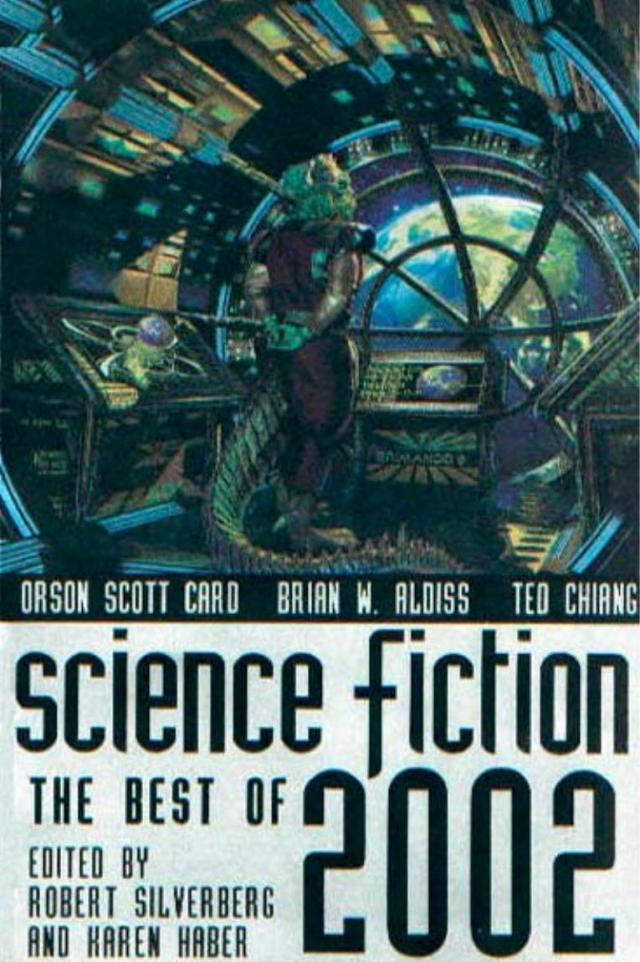


R O B E R T S I L V E R B E R G a n d K A R E N H A B E R
SCIENCE FICTION
THE BEST OF 2002
ROBERT SILVERBERG’s many novels include The Alien
Years; the most recent volume in the Majipoor Cycle, The King of Dreams; the bestselling Lord Valentine trilogy; and the classics Dying Inside and A Time of Changes.
Sailing to Byzantium, a collection of some of his award-winning novellas, was published by ibooks in 2000. Science Fiction 101—Robert Silverberg’s Worlds of Wonder, an examination of the novellas that inspired him as a young
writer, was published in March 2001, followed by Cronos, a collection of three time-travel pieces published in August 2001. He has been nominated for the Nebula and
Hugo awards more times than any other writer; he is a
five-time winner of the Nebula and a four-time winner of
the Hugo.
KAREN HABER is the acclaimed editor of the Hugo
Award-nominated Meditations on Middle Earth, and the forthcoming Explorations of The Matrix. She also created the bestselling The Mutant Season series of novels, of which she co-authored the first volume with her husband, Robert Silverberg. She is a respected journalist and an accomplished fiction writer. Her short fiction has appeared in The Magazine of Fantasy and Science Fiction, Full Spectrum 2, and Women of Darkness.
FANTASY AND SCIENCE FICTION
published by ibooks, inc.:
Science Fiction: The Best of 2001
Fantasy: The Best of 2001
Robert Silverberg & Karen Haber, Editors
The Ultimate Cyberpunk
Pat Cadigan, Editor
The Ultimate Halloween
Marvin Kaye, Editor
SCIENCE FICTION
THE BEST OF 2002
R O B E R T S I L V E R B E R G
and K A R E N H A B E R
Editors
ibooks
new york
w w w. i b o o k s i n c . c o m
Science
Fiction:
The
Best
of 2002
Palm
Science Fiction: The Best of 2002
Copyright © 2003 by ibooks, Inc.
Introduction copyright © 2003 by Agberg, Ltd.
An ibooks, Inc. ebook
ibooks, Inc.
24 West 25th St.
New York, NY 10010
The ibooks World Wide Web Site Address is:
http://www.ibooksinc.com
ISBN: 1-59176-597-8
MS Reader
Copyright © 2003 by ibooks, Inc.
Contents
INTRODUCTION
vii
Robert Silverberg and Karen Haber
TOURIST
1
Charles Stross
THE LONG CHASE
46
Geoffrey A. Landis
COELACANTHS
63
Robert Reed
LIKING WHAT YOU SEE: A DOCUMENTARY 97
Ted Chiang
THE BLACK ABACUS
142
Yoon Ha Lee
THE DISCHARGE
156
Christopher Priest
ABOARD THE BEATITUDE
211
Brian W. Aldiss
DROPLET
239
Benjamin Rosenbaum
THE WAR OF THE WORLDVIEWS
264
James Morrow
BREATHMOSS
291
Ian R. MacLeod
v
C O N T E N T S
ANGLES
388
Orson Scott Card
v i
INTRODUCTION
This is the second in an annual series of anthologies
intended to bring together in one convenient volume the
best science-fiction stories of the year. It is one of three such anthologies now being published, and, like the other two, it reflects the tastes and prejudices of editors who have had decades of experience in reading and writing science fiction. That these three anthologies have such widely differing contents is a tribute not only to the ability of experts to disagree but also to the wealth of fine shorter material being produced today in the science-fiction world.
Such annual anthologies are a long-standing tradition
in science fiction. The first of all the Year’s Best Science Fiction anthologies appeared in the summer of 1949. It was edited by Everett F. Bleiler and T.E. Dikty, a pair of schol-arly science-fiction readers with long experience in the
field, and it was called, not entirely appropriately (since it drew entirely on material published in 1948), The Best Science Fiction Stories: 1949.
Science fiction then was a very small entity indeed—a
handful of garish-looking magazines with names like
Planet Stories and Thrilling Wonder Stories, a dozen or so books a year produced by semi-professional publishing
houses run by old-time s-f fans, and the very occasional
short story by the likes of Robert A. Heinlein in The Satur-vii
INTRODUCTION
day Evening Post or some other well-known slick magazine. So esoteric a species of reading-matter was it that Bleiler and Dikty found it necessary to provide their book, which was issued by the relatively minor mainstream publishing house of Frederick Fell, Inc., with two separate
introductory essays explaining the nature and history of
science fiction to uninitiated readers.
In those days science fiction was at its best in the short lengths, and the editors of The Best Science Fiction: 1949
had plenty of splendid material to offer. There were two
stories by Ray Bradbury, both later incorporated in The Martian Chronicles, and Wilmar Shiras’s fine superchild story “In Hiding,” and an excellent early Poul Anderson
story, and one by Isaac Asimov, and half a dozen others,
all of which would be received enthusiastically by modern readers. The book did fairly well, by the modest sales standards of its era, and the Bleiler-Dikty series of annual
anthologies continued for another decade or so.
Toward the end of its era the Bleiler-Dikty collection
was joined by a very different sort of Best of the Year
anthology edited by Judith Merril, whose sophisticated literary tastes led her to go far beyond the s-f magazines,
offering stories by such outsiders to the field as Jorge Luis Borges, Jack Finney, Donald Barthelme, and John Stein-beck cheek-by-jowl with the more familiar offerings of
Asimov, Theodore Sturgeon, Robert Sheckley, and Clifford
D. Simak. The Merril anthology, inaugurated in 1956, also lasted about a decade; and by then science fiction had
become big business, with new magazines founded, shows
like Star Trek appearing on network television, dozens and then hundreds of novels published every year. Since the
1960s no year has gone by without its Best of the Year col-viii
INTRODUCTION
lection, and sometimes two or three simultaneously. Such
distinguished science-fiction writers as Frederik Pohl,
Harry Harrison, Brian Aldiss, and Lester del Rey took their turns at compiling annual anthologies, along with veteran book editors like Donald A. Wollheim and Terry Carr.
In modern times the definitive Year’s Best Anthology
has been the series of encyclopedic collections edited by Gardner Dozois since 1984. Its eighteen mammoth volumes so far provide a definitive account of the genre in
the past two decades. More recently a second annual com-
pilation has arrived, edited by an equally keen observer of the science-fiction scene, David A. Hartwell. And if there is room in the field for two sets of opinions about the
year’s outstanding work, perhaps there is room for a third.
And so, herewith, yet another Year’s Best Science Fiction anthology, in which a long-time writer/editor and his
writer/editor wife have gathered a group of the science-
fiction stories of 2002 that gave them the greatest reading pleasure.
—Robert Silverberg
—Karen Haber
ix
Tourist
by Charles Stross
Spring-Heeled Jack runs blind, blue fumes crackling
from his heels: his right hand, outstretched for balance, clutches a mark’s stolen memories. His victim is just sitting up on the hard stones of the pavement, wondering
what’s happened; maybe he looks after the fleeing youth,
but the tourist crowds block the view and in any case he
has no hope of catching the mugger. Hit-and-run amne-
sia is what the polis call it, but to Spring-Heeled Jack it’s just more loot to buy fuel for his Russian army-surplus
motorised combat boots.
The victim of the mugging sits on the cobblestones
clutching his aching temples. What happened? he wonders.
The universe is a brightly coloured blur of fast-moving
shapes augmented by deafening noises. His glasses are re-
booting continuously: they panic every eight hundred mil-
liseconds, whenever they realise that they’re alone on his personal area network without the comforting support of a memory hub to tell them where to send his incoming sensory feed. Two of his mobile phones are bickering
moroni-
cally, disputing ownership of his grid bandwidth.
A tall blonde clutching an electric chainsaw sheathed
in pink bubble-wrap leans over him curiously: “you al-
right?” she asks.
1
C H A R L E S S T R O S S
“I—” he shakes his head, which hurts. “Who am I?” His
medical monitor is alarmed because his blood pressure
has fallen: his pulse is racing, and a host of other biometrics suggest that he’s going into shock.
“I think you need an ambulance,” the woman an-
nounces. She mutters at her lapel: “phone, call an ambu-
lance.” She waves a finger vaguely at the victim then
wanders off, chainsaw clutched under one arm, as if em-
barrassed at the idea of involving herself: typical southern eacutemigreacute behaviour in the Athens of the
North. The man shakes his head again, eyes closed, as a
flock of girls on powered blades skid around him in a
elaborate loops. A siren begins to warble, over the bridge to the north.
Who am I? wonders the man on the pavement. “I’m
Manfred,” he says with a sense of stunned wonder. He
looks up at the bronze statue of a man on a horse that
looms above the crowds on this busy street corner. Some-
one has plastered a Hello Cthulhu! holo on the plaque
that names its rider: languid fluffy pink tentacles wave at him in an attack of kawai. “I’m Manfred—Manfred. My memory. What’s happened to my memory?” Elderly
Malaysian tourists point at him from the open top deck of a passing tour bus. He suddenly burns with a sense of
horrified urgency. I was going somewhere, he recalls.
What was I doing? It was amazingly important, he thinks, but he can’t remember what exactly it was. He was going
to see someone about—it’s on the tip of his tongue—
Welcome to the eve of the third decade: a time of chaos.
Most of the thinking power on the planet is now man-
ufactured rather than born; there are ten microprocessors for every human being, and the number is doubling every
2
T O U R I S T
fourteen months. Population growth in the developing
world has stalled, the birth rate dropping below replace-
ment level: in the wired nations, more forward-looking
politicians are looking for ways to enfranchise their nascent AI base.
Space exploration is still stalled on the cusp of the second recession of the century. The Malaysian government
has announced the goal of placing an Imam on Mars
within ten years, but nobody else cares enough to try.
The Space Settlers Society is still trying to interest Dis-neyCorp in the media rights to their latest L5 colony plan, unaware that there’s already a colony out there and it
isn’t human: first-generation uploads, Californian spiny
lobsters in wobbly symbiosis with elderly expert systems, thrive aboard an asteroid mining project established by
the Franklin Trust. (The lobsters had needed sanctuary,
away from a planet overflowing with future-shocked pri-
mates. In return for Franklin beaming a copy of their
state vector out over the deep space tracking network,
they agreed to run his cometary Von Neumann factory.)
Two years ago JPL, the ESA, and the uploaded lobster
colony on comet Kruschev-7 picked up an apparently ar-
tificial signal from outside the solar system; most people don’t know, and of those who do, even fewer care. After
all, if NASA can’t even put a man on the moon . . .
Portrait of a wasted youth:
Jack is seventeen years and eleven months old. He has
never met his father; he was unplanned, and Pa managed
to kill himself in a building site accident before the Child Support could garnish his income for the upbringing. His
mother raised him in a two bedroom association flat in
Hawick. She worked in a call centre when he was young,
3
C H A R L E S S T R O S S
but business dried up: humans aren’t needed on the end of a phone any more. Now she works in a drop-in business
shop, stacking shelves for virtual fly-by-nights that come and go like tourists in the Festival season—but humans
aren’t in demand for shelf stacking either, these days.
His mother sent Jack to a local religious school, where
he was regularly excluded and effectively ran wild from
the age of twelve. By thirteen, he was wearing a parole
cuff for shoplifting: by fourteen he’d broken his collar-
bone in a car crash while joyriding and the dour presby-
terian sheriff sent him to the Wee Frees, who completed
the destruction of his educational prospects with high
principles and an illicit tawse.
Today he’s a graduate of the hard school of avoiding
public surveillance cameras, with distinctions in steganographic alibi construction. Mostly this entails high-
density crime—if you’re going to mug someone, do so
where there are so many by-standers that they can’t pin
the blame on you. But the Polis expert systems are catch-
ing up with him: if he keeps it up at this rate, in another four months they’ll have a positive statistical correlation that will convince even a jury of his peers that he’s guilty as fuck—and then he’ll go down to Saughton for four
years.
But Jack doesn’t understand the meaning of a Gauss-
ian distribution or the significance of a chi-squared test, and the future still looks bright to him as he pulls on the chunky spectacles he ripped off the tourist gawking at the statue on North Bridge. And after a moment, when they
begin whispering into his ears in stereo and showing him
pictures of the tourist’s vision, it looks even brighter.
“Gotta make a deal, gotta close a deal,” whisper the
glasses. “Get a runner, liberate the potential.” Weird graphs 4
T O U R I S T
in lurid colours are filling up his peripheral vision, like the hallucinations of a drugged marketroid.
“Who the fuck are ye?” asks Jack, intrigued by the
bright lights and icons.
“I am you, you are we, got a deal to close,” murmur
the glasses. “Dow Jones down fifteen points, Federated
Confidence up three, incoming briefing on causal decou-
pling of social control of skirt hem lengths, shaving pattern of beards, and emergence of multidrug antibiotic
resistance in gram negative bacilli: accept?”
“Ah can tak it,” Jack mumbles, and a torrent of images
crashes down on his eyeballs and jackhammers its way in
through his ears like the superego of a disembodied giant.
Which is actually what he’s stolen: the glasses and waist pouch he grabbed from the tourist are stuffed with
enough hardware to run the entire internet, circa the turn of the millennium. They’ve got bandwidth coming out
the wazoo, distributed engines running a bazillion in-
scrutable search tasks, and a whole slew of high-level
agents that collectively form a large chunk of the society of mind that is their owner’s personality. Their owner is an agalmic entrepreneur, a posthuman genius locii of the
net who catalyses value wherever he goes, leaving money
trees growing in his footprints. This man doesn’t believe in zero-sum games, in a loser for every winner. And Jack
has stolen his memories. There are microcams built into
the frame of the glasses, pickups in the ear-pieces; everything is spooled into the holographic cache in the belt
pack, before being distributed for remote storage. At four months per terabyte, memory storage is cheap: what
makes this bunch so unusual is that their owner—Man-
fred—has cross-indexed them with his agents.
In a very real sense, the glasses are Manfred, regard-5
C H A R L E S S T R O S S
less of the identity of the soft machine with its eyeballs behind the lenses. And it is a very puzzled Manfred picks himself up and, with a curious vacancy in his head—except for a hesitant request for information about acces-
sories for Russian army boots—dusts himself off, and
heads for his meeting on the other side of town.
“Something, he is not there, something is wrong,” says the woman. She raises her mirrorshades and rubs her left