Selected poems, p.26
Selected Poems,
p.26


Guettent, ayant pour lit la planche de leurs bancs.
Soit. Moltke nous canonne et Bismarck nous affame.
Paris est un héros, Paris est une femme;
Il sait être vaillant et charmant; ses yeux vont,
Souriant et pensifs, dans le grand ciel profond,
Du pigeon qui revient au ballon qui s’envole.
C’est beau: le formidable est sorti du frivole.
Moi, je suis là, joyeux de ne voir rien plier.
Je dis à tous d’aimer, de lutter, d’oublier,
De n’avoir d’ennemi que l’ennemi; je crie:
Je ne sais plus mon nom, je m’appelle Patrie!
Quant aux femmes, soyez très fière, en ce moment
Où tout penche, elles sont sublimes simplement.
Ce qui fit la beauté des Romaines antiques,
C’étaient leurs humbles toits, leurs vertus domestiques,
Leurs doigts que l’âpre laine avait faits noirs et durs,
Leurs courts sommeils, leur calme, Annibal près des murs,
Et leurs maris debout sur la porte Colline.
Ces temps sont revenus. La géante féline,
La Prusse tient Paris, et, tigresse, elle mord
Ce grand cœur palpitant du monde à moité mort.
Eh bien, dans ce Paris, sous l’étreinte inhumaine,
L’homme n’est que Français, et la femme est Romaine.
Elles acceptent tout, les femmes de Paris,
Leur âtre éteint, leurs pieds par le verglas meurtris,
Au seuil noir des bouchers les attentes nocturnes,
La neige et l’ouragan vidant leurs froides urnes,
La famine, l’horreur, le combat, sans rien voir
Que la grande patrie et que le grand devoir;
Et Juvénal au fond de l’ombre est content d’elles.
Le bombardement fait gronder nos citadelles.
Dès l’aube, le tambour parle au clairon lointain;
La diane réveille, au vent frais du matin,
La grande ville pâle et dans l’ombre apparue;
Une vague fanfare erre de rue en rue.
On fraternise, on rêve un succès; nous offrons
Nos cœurs à l’espérance, à la foudre nos fronts.
La ville par la gloire et le malheur élue
Voit arriver les jours terribles et salue.
Eh bien, on aura froid! eh bien, on aura faim!
Qu’est cela? C’est la nuit. Et que sera la fin?
L’aurore. Nous souffrons, mais avec certitude.
La Prusse est le cachot et Paris est Latude.
Courage! on refera l’effort des jours anciens.
Paris avant un mois chassera les Prussiens.
Ensuite nous comptons, mes deux fils et moi, vivre
Aux champs, auprès de vous, qui voulez bien nous suivre,
Madame, et nous irons en mars vous en prier
Si nous ne sommes pas tués en février.
Letter to a Woman
(Via balloon sent up, January 10)
Horrific, festive Paris is at war. Greetings, friend.
We are one world, we are one soul, we are one end.
Everyone gives everything; no thought is selfish here.
We have no sun, nothing to lean on, and no fear.
All will be well, provided we don’t ever sleep.
Schmitz’s war reports are so dull they make you weep.
It’s Aeschylus translated by the eighteenth-century.
I paid fifteen francs for four eggs – not for me,
But for my George and my Jeannine. Our daily fare?
We are eating horse and rat and donkey, even bear.
Paris is so well barricaded, guarded, dark,
Surrounded, that our stomachs resemble Noah’s ark.
Every creature, well– or ill-regarded, worse than that,
Pours into our bodies: mammoth, pygmy, dog and cat.
Everything goes in: mice meet elephants in there.
Trees are being cut down, chopped up, split up. None is spared.
The Champs-Elysées has been tossed onto the flames.
We’ve numbness in our fingers and frost on our panes.
No fires to dry our clothes or wash with anymore.
We wear the same shirts every day now. In this war
Dark murmurs permeate each neighbourhood at night.
It’s the crowd; sometimes voices that are itching to fight,
Sometimes song, sometimes shouting, loud and bellicose.
The Seine is slowly dragging archipelagoes
Of hesitant ice chunks, through which the gunboats snake
Leaving a foamy track behind them in their wake.
We live on nothing and on everything, as if impervious.
On our linenless tables, where hunger waits for us,
A potato, torn from its crypt (the frozen sod),
Is queen and, as in Egypt, every onion is a god.
We don’t have any coal, but our bread is always black;
No lamp gas; as if Paris were snuffed out by the attack,
Darkness at six o’clock at night. Tempestuous
Bombings make a terrifying noise on top of us.
I made my inkwell from the shrapnel of a bomb.
Assassinated Paris doesn’t cry out in alarm.
All the bourgeois are keeping guard along the walls.
These fathers, husbands, brothers, shelled with bombs and cannon balls,
Wrapped in their cloaks and wearing kepis, gaze ahead,
Watching and waiting, with a bench plank for a bed.
So be it. Moltke shells us; Bismarck starves us; we won’t bow.
Paris is a hero and a woman. It knows how
To be brave and charming through it all, and its eyes,
Smiling and thoughtful, search the depths of the skies
For pigeons returning and balloons sent on their way.
The frivolous gives birth to the incredible today.
And I am there, glad to see that nothing’s yielded yet,
Telling everyone to love, to fight, and to forget,
To have one enemy, the enemy; somehow
I’ve lost my name; I have become ‘The Homeland’ now.
The women? You can be proud of them. At this time
When everything’s on edge, they are simply sublime.
What made all the women of Rome especially
Beautiful was their humble roofs and their economy,
Their fingers that the rough wool had made black and hard,
Their sleeplessness, their calmness when their husbands were on guard
At the Colline gate and Hannibal was at their walls.
Those days have returned. Holding Paris in its claws,
The giant tigress, Prussia, bites into and tears apart
This dead-to-the-world yet still palpitating heart.
And so, in this inhuman embrace, left alone,
The men are only French, but the women are of Rome.
They accept everything and let what is suffice:
Hearths without fire, feet bruised by pavement ice,
Butchers on the threshold, night attacks in waves and turns,
The wind and the snowstorms pouring out their frozen urns,
Fighting, famine, dread, not being able to see
Anything except a great nation and great duty;
And Juvenal’s ghost is glad, wherever he is.
Bombings make the walls groan inside our fortresses.
Drums answer bugles from the moment that dawn breaks.
In the cold, morning air, the reveille sounds and wakes
The giant city, pale and draped in shadows like a sheet.
A fanfare wanders as though lost from street to street.
We fraternize, we dream of our victory, we expose
Our hearts to hope, our bodies to the cannon’s heavy blows.
Elected by misfortune and by glory, the city
Greets each horrific day with equanimity.
So we’ll be cold? we will go hungry then, my friend?
What are cold and hunger? Only night. Where will it end?
In dawn. We are enduring with a kind of certainty.
Prussia is the prison-house; Paris, the escapee.
We will bring back the old resolve. Have no doubt:
We will expel the Prussians before the month is out.
Then we, my sons and I, would like to live near you
In the country, where we’ll see you, and you can visit too,
Madame: we’ll invite you there in March and be merry,
If we haven’t in the meantime been killed in February.
From L’Art d’être grand-père (1877)
Fenêtres ouvertes
LE MATIN. – EN DORMANT
J’entends des voix. Lueurs à travers ma paupière.
Une cloche est en branle à l’église Saint-Pierre.
Cris des baigneurs. Plus près! plus loin! non, par ici!
Non, par là! Les oiseaux gazouillent, Jeanne aussi.
Georges l’appelle. Chant des coqs. Une truelle
Racle un toit. Des chevaux passent dans la ruelle.
Grincement d’une faulx qui coupe le gazon.
Chocs. Rumeurs. Des couvreurs marchent sur la maison.
Bruits du port. Sifflement des machines chauffées.
Musique militaire arrivant par bouffées.
Brouhaha sur le quai. Voix françaises. Merci.
Bonjour. Adieu. Sans doute il est tard, car voici
Que vient tout près de moi chanter mon rouge-gorge.
Vacarme de marteaux lointains dans une forge.
L’eau clapote. On entend haleter un steamer.
Une mouche entre. Souffle immense de la mer.
From The Art of Being a Grandfather
Open Windows
MORNING. HALF ASLEEP.
I hear voices. Lights hit my eyes and the bedroom wall.
A bell swings into motion at the church of Saint Paul.
Vacationer’s shouts: ‘Over here – there – no, go through,
No, around!’ The birds are chirping; Jeannine chirps too.
George calls her. Cocks are crowing. A trowel suddenly
Scrapes the roof. Horses tromp up and down the alley.
The grating of a scythe as it cuts through the grass.
Shocks. Noises. Footfalls overhead when roofers pass.
Port sounds. Whistles from machines: a boat departs.
Military music arrives in spurts and starts.
Uproars on the dock. French voices: ‘Merci.
Bonjour. Adieu.’ It must be late for now I see
A red-breasted robin coming close to sing to me.
The pounding of hammers in a forge far-away.
Water splashing. Steamboats panting on their way.
A fly comes in. The immense breath of the sea.
Jeanne endormie («Elle dort…»)
Elle dort; ses beaux yeux se rouvriront demain;
Et mon doigt qu’elle tient dans l’ombre emplit sa main;
Moi, je lis, ayant soin que rien ne la réveille,
Des journaux pieux; tous m’insultent; l’un conseille
De mettre à Charenton quiconque lit mes vers;
L’autre voue au bûcher mes ouvrages pervers;
L’autre, dont une larme humecte les paupières,
Invite les passants à me jeter des pierres;
Mes écrits sont un tas lugubre et vénéneux
Où tous les noirs dragons du mal tordent leurs nœuds;
L’autre croit à l’enfer et m’en déclare apôtre;
L’un m’appelle Antechrist, l’autre Satan, et l’autre
Craindrait de me trouver le soir au coin d’un bois;
L’un me tend la ciguë et l’autre me dit: Bois!
J’ai démoli le Louvre et tué les otages;
Je fais rêver au peuple on ne sait quels partages;
Paris en flamme envoie à mon front sa rougeur;
Je suis incendiaire, assassin, égorgeur,
Avare, et j’eusse été moins sombre et moins sinistre
Si l’empereur m’avait voulu faire ministre;
Je suis l’empoisonneur public, le meurtrier;
Ainsi viennent en foule autour de moi crier
Toutes ces voix jetant l’affront, sans fin, sans trêve;
Cependant l’enfin dort, et, comme si son rêve
Me disait: – Sois tranquille, ô père, et sois clément! –
Je sens sa main presser la mienne doucement.
Jeannine Asleep (‘She’s asleep …’)
She’s asleep. Her bright eyes will reopen tomorrow.
Her hand is holding onto my finger. She rests.
I am reading all the pious journals, taking care
Not to wake her. All insult me. One suggests
To throw whoever reads my poems into Charenton.
Another consigns them to the flames. And then there’s one
With tears moistening his lids abundantly
Urging every passerby to throw a stone at me.
My writings are ‘a venomous, lugubrious mess
Where Evil’s black dragons twist their tails without rest’.
One says I’m ‘hell’s apostle’, one ‘the devil’s brother’.
One calls me the Antichrist, one Satan, and another
Wouldn’t want to meet me at night. One holds a cup
Of hemlock out to me; another yells, ‘Drink up!’
I destroyed the Louvre and I killed the hostages.
My brow is red from Paris – Paris burning, that is.
I’ve made people dream about who knows what kind of loot.
I’m an agitator, murderer, butcher, and, to boot,
A miser. And I would have been less stern and sinister
If the emperor had wished to make me his minister.
I poison the public; I’m the public’s assassin.
That is why these voices, shrill, relentless, and harassing,
Are crowding around me to let out their screams.
But the child is sleeping, and – as if in her dreams
She were saying to me, ‘Be at peace, father, and be kind!’ –
I can feel her tiny hand gently squeezing mine.
From La Légende des siècles (1859, 1877, 1883)
La Conscience
Lorsque avec ses enfants vêtus de peaux de bêtes,
Échevelé, livide au milieu des tempêtes,
Caïn se fut enfui de devant Jéhovah,
Comme le soir tombait, l’homme sombre arriva
Au bas d’une montagne en une grande plaine;
Sa femme fatiguée et ses fils hors d’haleine
Lui dirent: – Couchons-nous sur la terre, et dormons. –
Caïn, ne dormant pas, songeait au pied des monts.
Ayant levé la tête, au fond des cieux funèbres
Il vit un œil, tout grand ouvert dans les ténèbres,
Et qui le regardait dans l’ombre fixement.
– Je suis trop près, dit-il avec un tremblement.
Il réveilla ses fils dormant, sa femme lasse,
Et se remit à fuir sinistre dans l’espace.
Il marcha trente jours, il marcha trente nuits.
Il allait, muet, pâle et frémissant aux bruits,
Furtifs, sans regarder derrière lui, sans trêve,
Sans repos, sans sommeil. Il atteignit la grève
Des mers dans le pays qui fut depuis Assur.
– Arrêtons-nous, dit-il, car cet asile est sûr.
Restons-y. Nous avons du monde atteint les bornes. –
Et, comme il s’asseyait, il vit dans les cieux mornes
L’œil à la même place au fond de l’horizon.
Alors il tressaillit en proie au noir frisson.
– Cachez-moi, cria-t-il; et, le doigt sur la bouche,
Tous ses fils regardaient trembler l’aïeul farouche.
Caïn dit à Jabel, père de ceux qui vont
Sous des tentes de poil dans le désert profond:
– Étends de ce côté la toile de la tente. –
Et l’on développa la muraille flottante;
Et, quand on l’eut fixée avec des poids de plomb:
Vous ne voyez plus rien? dit Tsilla, l’enfant blond,
La fille de ses fils, douce comme l’aurore;
Et Caïn répondit: – Je vois cet œil encore! –
Jubal, père de ceux qui passent dans les bourgs
Soufflant dans des clairons et frappant des tambours,
Cria: – Je saurai bien construire une barrière. –
Il fit un mur de bronze et mit Caïn derrière.
Et Caïn dit: – Cet œil me regarde toujours!
Hénoch dit: – Il faut faire une enceinte de tours
Si terrible, que rien ne puisse approcher d’elle.
Bâtissons une ville avec sa citadelle.
Bâtissons une ville, et nous la fermerons. –
Alors Tubalcaïn, père des forgerons,
Construisit une ville énorme et surhumaine.
Pendant qu’il travaillait, ses frères, dans la plaine,
Chassaient les fils d’Énos et les enfants de Seth;
Et l’on crevait les yeux à quiconque passait;
Et, le soir, on lançait des flèches aux étoiles.
Le granit remplaça la tente aux murs de toiles,
On lia chaque bloc avec des nœuds de fer,
Et la ville semblait une ville d’enfer;
L’ombre des tours faisait la nuit dans les campagnes;
Ils donnèrent aux murs l’épaisseur des montagnes;
Sur la porte on grava: «Défense à Dieu d’entrer.»
Quand ils eurent fini de clore et de murer,
On mit l’aïeul au centre en une tour de pierre.
Et lui restait lugubre et hagard. – O mon père!
L’œil a-t-il disparu? dit en tremblant Tsilla.
Et Caïn répondit: – Non, il est toujours là.
Alors il dit: –Je veux habiter sous la terre
Comme dans son sépulchre un homme solitaire;
Rien ne me verra plus, je ne verrai plus rien. –
On fit donc une fosse, et Caïn dit: C’est bien!
Puis il descendit seul sous cette voûte sombre.
Quand il se fut assis sur sa chaise dans l’ombre
Et qu’on eut sur son front fermé le souterrain,
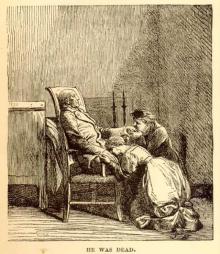
L’œil était dans la tombe et regardait Caïn.