Selected poems, p.1
Selected Poems,
p.1


Fyfield Books present poetry and prose by great as well as sometimes overlooked writers from British and Continental literatures. Clean texts at affordable prices, Fyfield Books make available authors whose works endure within our literary tradition.
The series takes its name from the Fyfield elm mentioned in Matthew Arnold’s ‘The Scholar Gypsy’ and in his ‘Thyrsis’. The elm stood close to the building in which the Fyfield series was first conceived in 1971.
Roam on! The light we sought is shining still
Dost thou ask proof? Our tree yet crowns the hill,
Our Scholar travels yet the loved hill-side
from ‘Thyrsis’
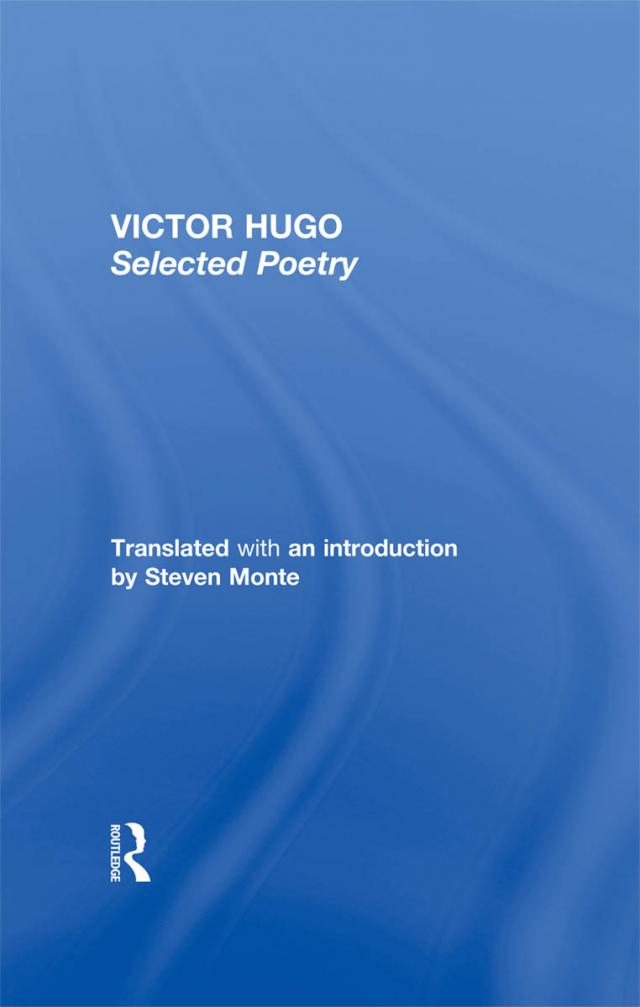
SELECTED POEMS
VICTOR HUGO (1802–1885), one of France’s most distinguished writers, was an accomplished playwright and novelist as well as a poet.
STEVEN MONTE is Collegiate Assistant Professor and Harper Fellow, Humanities, at the University of Chicago. He studied Comparative Literature at Princeton and Yale. His critical study, Invisible Fences: Prose Poetry as a Genre in French and American Literature was published in 2000. His poems and translations have appeared in The Paris Review, The Boston Review, The New Republic and other journals.
VICTOR HUGO
Selected Poetry
Translated with an introduction by
STEVEN MONTE
Published in USA and Canada in 2002 by
Routledge
270 Madison Avenue
New York, NY 10016
www.routledge-ny.com
Routledge is an imprint of the Taylor & Francis Group
By arrangement with Carcanet Press Ltd.
First published in Great Britain in 2001 by
Carcanet Press Limited
This impression 2002
Introduction and editorial matter Copyright
Steven Monte © 2001, 2002
The right of Steven Monte to be identified as the editor of this work has been asserted by him in accordance with the Copyright, Designs and Patents Act of 1988
All rights reserved
Cataloguing-in-Publication data is available from the Library of Congress.
ISBN 0-415-94075-3 (hb), 0-415-94076-1 (pb).
ISBN 978-1-136-06850-8 (epub)
All rights reserved. No part of this book may be reprinted or reproduced or utilized in any form or by any electronic, mechanical or other means, now known or hereafter invented, including photocopying and recording or in any information storage or retrieval system, without permission in writing from the publishers.
for my parents
Contents
Introduction
from Odes et Ballades (1822, 1823, 1824, 1826, 1828)
À Mes Odes
from Les Orientales (1829)
La Captive
Clair de lune
Les Djinns
Rêverie
Extase
from Les Feuilles d’automne (1831)
La Pente de la rêverie
Soleils couchants (II)
Soleils couchants (VI)
from Les Chants du crépuscule (1835)
À la Colonne
from Les Voix intérieures (1837)
À Albert Durer
«Jeune homme, ce méchant fait …»
La Vache
from Les Rayons et les ombres (1840)
«Comme dans les étangs …»
Écrit sur le vitre d’une fenêtre flammande
Tristesse d’Olympio
Oceano Nox
Nuits de juin
from Les Châtiments (1853)
Souvenir de la nuit du 4
Ce que le poëte se disait en 1848
L’Expiation
Au Peuple
Stella
«Sonnez, sonnez toujours …»
«Cette nuit, il pleuvait …»
from Les Contemplations (1856)
Autrefois (1830–1843)
«Le poëte s’en va dans les champs …»
Mes Deux Filles
«Le firmament est plein de la vaste clarté …»
À André Chénier
La Vie aux champs
Réponse à un acte d’accusation
Vere Novo
La Fête Chez Thérèse
«Heureux l’homme …»
Halte en marchant
Le Rouet d’Omphale
Lettre
Paroles dans l’ombre
Écrit au bas d’un crucifix
«L’enfant, voyant l’aïeule à filer occupée …»
Magnitudo Parvi
Aujourd’hui (1843–1855)
«Oh! je fus comme fou dans le premier moment …»
«Elle avait pris ce pli dans son âge enfantin …»
«Elle était pâle, et pourtant rose …»
«O souvenirs! printemps! aurore! …»
Veni, Vidi, Vixi
«Demain, dès l’aube …»
À Villequier
Mors
Le Mendiant
Paroles sur la dune
Mugitusque boum
«Je payai le pêcheur qui passa son chemin …»
Pasteurs et troupeaux
«J’ai cueilli cette fleur pour toi …»
«O strophe du poëte …»
«Un spectre m’attendait …»
«Un jour, le morne esprit …»
Éclaircie
Nomen, Numen, Lumen
À Celle qui est restée en France
from Les Chansons des rues et des bois (1865)
Saison des semailles. Le soir.
«Les enfants lisent, troupe blonde …»
La Méridienne du lion
from L’Année Terrible (1872)
«J’entreprend de conter l’année …»
Du Haut de la muraille de Paris
1er Janvier
Lettre à une femme
from L’Art d’être grand-père (1877)
Fenêtres ouvertes
Jeanne endormie («Elle dort …»)
from La Légende des siècles (1859, 1877, 1883)
La Conscience
Boozendormi
Première Rencontre du Christ avec le tombeau
L’Hydre
Mahomet
Le Parricide
Le Travail des captifs
La Rose de l’Infante
Après la Bataille
La Sœur de Charité
Après les Fourches Caudines
from La Fin de Satan (1886)
Et Nox Facta Est
from Toute la Lyre (1888)
«L’hexamètre …»
À Théophile Gautier
Notes
Index of Titles
Index of First Lines
Contents
from Odes and Ballads
To My Odes
from Orientalia
The Captive
Moonlight
The Djinns
Reverie
Rapture
from Autumn Leaves
The Slope of Reverie
Setting Suns (II)
Setting Suns (VI)
from The Songs of Daybreak
To the Column
from Inner Voices
To Albrecht Dürer
‘The war that scoundrel wages …’
The Cow
from Sunbeams and Shadows
‘Just as in a forest’s drowsy pools …’
Written on the pane of a Flemish window
Olympio’s Sadness
Oceano Nox
June Nights
from Punishments
Memory of the Night of the Fourth
What the poet said to himself in 1848
The Expiation
To the People
Stella
‘Blow forever, trumpets of thought …’
‘It was raining that night …’
from Contemplations
Former Times
‘The poet goes away into the fields …’
My Two Daughters
‘The clarity that fills …’
To André Chénier
Life in the Fields
Reply to an Act of Accusation
Vere Novo
The Party at Thérèse’s
‘Happy the man …’
A Stop in the Middle of a Walk
The Spinning Wheel of Omphale
Letter
Words Spoken in the Shadows
Written on the Bottom of a Crucifix
‘Seeing her grandmother occupied spinning wool …’
Magnitudo Parvi
Today
‘I felt I had gone mad …’
‘She had formed this habit …’
‘She was pale …’
‘Oh spring! oh dawn! oh memories!
Veni, Vidi, Vixi
‘Tomorrow, at dawn …’
At Villequier
Mors
The Beggar
Words on the Dunes
Mugitusque Boum
‘I paid the fisherman …’
Shepherds and Flocks
‘I gathered this flower for you on the hill …’
‘Strophe of the poet …’
‘A shade was waiting …’
‘One day the solemn spirit …’
Clearing
Nomen, Numen, Lumen
To the One Who Stayed Behind in France
from Songs of the Streets and the Woods
Sowing Season. Evening.
‘The troop of children read and spell …’
The Lio
n’s Midday Sleep
from The Horrific Year
‘I’m setting out to narrate that horrific year …’
On Top of Paris’s Ramparts
1 January
Letter to a Woman
from The Art of Being a Grandfather
Open Windows
Jeannine Asleep (‘She’s asleep …’)
from The Legend of the Centuries
Conscience
Boaz Asleep
Christ’s First Encounter with the Tomb
The Hydra
Mohammed
The Parricide
The Work of the Prisoners
The Infanta’s Rose
After the Battle
The Sister of Mercy
After the Batde of the Caudine Forks
from The End of Satan
Et Nox Facta Est
from All the Lyre
‘The hexameter …’
To Théophile Gautier
Introduction
WHEN ASKED WHO the greatest French poet was, André Gide replied, ‘Victor Hugo – alas!’ This response sums up the attitude of more than a few modern readers. Yet Hugo’s reputation as a poet, dramatist, and novelist was almost unassailable in his own time: for many of his contemporaries he was the most important literary figure of the nineteenth century. His life (1802–1885) almost spanned the century, and when he died at the age of eighty-three an estimated one million people visited his casket, which was placed for a day of viewing under the Arc de Triomphe. This sort of admiration and attention no doubt contributed something to the response of Gide’s generation, and grudging praise has remained the staple of Hugo criticism to the present day – occasionally punctured by harsher assessments and the impassioned defences of a few champions.
But in spite of the lament-filled tone with which the French sometimes evoke Hugo, his stature as a poet has never really been questioned in France. French schoolchildren continue to learn by heart poems like ‘Tomorrow, at dawn …’ and poets themselves recognize if nothing else his importance and influence. Even academic criticism of Hugo has undergone a resurgence since the 1950s. In English-speaking countries, however, Hugo is still almost unknown as a poet. The old film The Hunchback of Notre Dame, the more recent Disney cartoon Notre-Dame de Paris, and the Broadway musical based on Les Misérables have helped promote his novels perhaps, and there is a slight chance that the general reader has heard of Hugo’s plays Hernani and The King Takes his Amusement through Verdi’s operas Ermani and Rigoletto, or through the controversy Hernani sparked and the battle it helped wage on behalf of romanticism. But Hugo’s poems? Most Anglophone readers would be hard-pressed to name even one title. This situation seems especially odd in view of the popularity of other nineteenth-century French poets. The poems of Charles Baudelaire and Arthur Rimbaud, for example, are widely available in translation and occupy a space in our poetic imagination. The last English-language poets to praise Hugo highly may be Swinburne and Tennyson, and translations of Hugo are mostly old and out of print.
Given the beauty and power of Hugo’s poetry, there is no satisfactory explanation of why it has not received more attention in the English-speaking world. It is true that by the time Hugo had become wildly famous the literary movement and aesthetic he stood for was on the wane, if not in disrepute, in Britain and America. It is also true that some of his work, such as his political poetry, is directed toward a specifically French audience. And naturally there are some translation difficulties: Hugo’s use of the alexandrine, for example, has a significance that is hard to grasp outside the context of French poetry. Nevertheless, much of Hugo’s poetry seems well suited to a modern audience, in spite or because of its romantic features; meaningful and moving to readers of English whatever its French aspects; and more accessible, on the whole, than the poetry of Rimbaud, Mallarmé, and Valéry – all of whom owe a great deal to Hugo. An English-language audience for Hugo’s poetry is an event waiting to happen.
Hugo’s Life
The best introduction to Hugo is the poetry itself, though some initial biographical and stylistic remarks can be helpful. As he often pointed out after he became famous, Hugo was the son of an officer in Napoleon’s army and a woman from the Vendée (a strongly monarchist region of France). This split background was made tangible to the young Hugo by his parents’ estrangement, separation and eventual divorce. At first at least, Victor and his brothers sided with their mother, entering the literary scene in their teens by collaborating on a journal, The Literary Conservative. Hugo’s early poems courted favour with the restored monarchy, and the King rewarded him with a pension for his ‘Ode on the Death of the Duke de Berry’, an elegy to an assassinated member of the royal family. After his mother died in 1821, Hugo began to have more contact with his father, and throughout the 1820s gradually adopted new political and aesthetic views. His first collection of verse, Odes and Other Poems, appeared in 1822, the same year as Alfred de Vigny’s Poèmes and two years after Alphonse de Lamartine’s Méditations. Over the next few years Hugo reworked and expanded this volume into Odes (1823) and New Odes (1824), then finally into Odes and Ballads (1826, 1828). Shortly after the publication of Odes and Other Poems, Victor married Adèle Foucher, a woman to whom his brother Eugène had also tendered some affections. Eugène went mad the night of the wedding, and afterwards was placed in an asylum, where he died in 1837. This instance of insanity was one of several in the Hugo family.
Victor Hugo’s breakthrough volume of verse was Orientalia (1829), a tour de force of poetic forms, images, and diction inspired by contemporary views of the Middle East and literary examples such as Byron and Goethe. While the subject matter of these poems is largely conventional, the technical mastery of pieces like ‘Djinns’ and ‘The Captive’ is astounding, and the poems toward the end of the volume look forward to his more personal lyrics of the next decade. By the 1830s, Hugo had established himself as the leader of the romantic movement in France, largely because of the uproar surrounding his play Hernani. At its first performance on 25 February 1930, bohemian romantics flocked to the Comédie Française to show their raucous support for Hugo in what became known as the Battle of Hernani. At this time, romanticism was closely linked with liberal politics: the aesthetic war over Hugo’s plays continued in reviews after the première, pitted romanticism against classicism and liberalism against conservatism. Hugo then built on his literary success with his novel Notre-Dame de Paris (1831), increased involvement in the theatre, and four more collections of lyric poetry:Autumn Leaves (1831), The Songs of Daybreak (1835), Inner Voices (1837), and Sunbeams and Shadows (1840). The poems of this decade are mostly personal, sometimes domestic lyrics, though occasionally Hugo ventures into the political, especially in the first half of The Songs of Daybreak and in odes like ‘To the Column’, which show the poet growing more and more enamoured of the Napoleonic legend.
For all of the confident declarations and idyllic reflections in his poetry, Hugo’s private life became increasingly complicated in the 1830s and 1840s. Several poems allude to a kind of ideal domestic life with his four children, wife, and friends gathering around the fire, playing games, and exchanging stories. Whatever domestic bliss existed, however, was punctured in the early 1830s by Madame Hugo’s affair with Hugo’s close friend, Charles-Augustin Sainte– Beuve. (Sainte-Beuve, France’s most eminent nineteenth-century critic, later wrote an autobiographical novel, Volupté, that recalls this lovers’ triangle.) Hugo in turn had an affair with an actress, Juliette Drouet, and she became his permanent mistress, leaving the theatre and devoting her life to him. Hugo often travelled with Drouet and many of his love poems are addressed to her, but he gradually began to have other affairs, including a scandalous one with a married woman, Léonie Biard, whose husband’s detectives caught her and Hugo in bed with each other. In his later life, Hugo became notorious for his flings, which he recorded in code in order to keep them secret from his wife and mistress.
Ostensibly busy with political and social affairs, Hugo did not publish any collections of poetry between 1841 and 1853. In 1841, he was elected to the Académie Française. This mostly honorific post (83 francs a month for contributing to the dictionary of the French language) opened up new social and political doors for him. He became a regular visitor to the royal family and especially to Louis-Philippe, conversing with the King late into the night. Hugo did not own land or pay enough taxes to stand for Parliament, but as a member of the Academy he could be elevated to the peerage and take his place in the upper chamber. (Louis-Philippe helped him to achieve this in 1845.) Meanwhile, tragedy had struck in Hugo’s private life. His favourite child, Léopoldine, and her husband, Charles Vacquerie, had drowned at Villequier on 4 September 1843, just three months after their wedding. As evidenced in poems like ‘To the One Who Stayed Behind in France’, up until his exile Hugo marked this event with annual visits to Léopoldine’s grave. He also wrote many poems about his daughter over the years and organized his collection of poems, Les Contemplations (1855), around her death, breaking it into two volumes, ‘Former Times (1830–1843)’ and ‘Today (1843–1855)’.