You dont know us negroes.., p.12
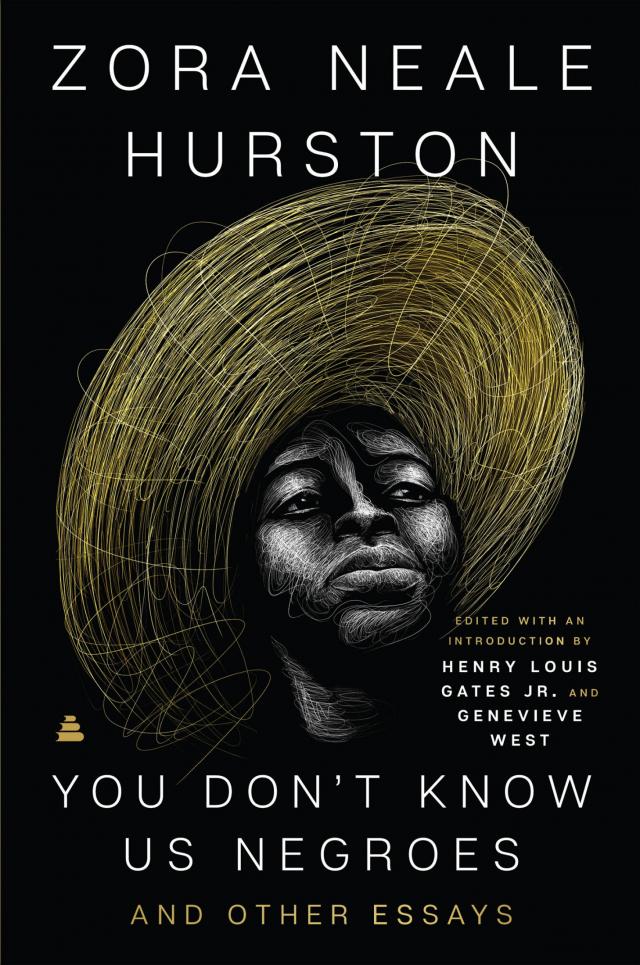
You Don't Know Us Negroes and Other Essays,
p.12


Show some folks a genuine bit of Negroness and they rear and pitch like a mule in a tin stable. “But where is the misplaced preposition?” they wail. “Where is the Am it and I’se?”
Nobody didn’t tell me, but I heard.
And then again you know they held a convention about this Negro in print and made out resolutions and by-laws. So no writer won’t have to go thinking up things by themselves and be shocking editors with stories that are so far from the laws and statutes made and provided that they just can’t be true.
The rules and regulations of this Margarine Negro calls for two dumb Negroes who chew up dictionaries and spit out grammar. They will and must go into some sort of business, and mess it all up. The big one always taking advantage of the little one. A fanatical religious scene, or a hoodoo dance (though there is no such thing in the popular Negro concept in America) is dragged in for no other reason than to prove that the author has gone deep into Negro life, and in the end the little fellow triumphs and the big fellow departs the scene urging his feet to more speed. If a villain is needed, go catch a mulatto and stick him into the plot. Yaller niggers being all and always wrong. This is the same plot that I have been reading under different titles and by various authors for ever so long.
Oh yes, and another thing. All Negro characters must have pop eyes. The only time when they are excused from popping is when they are rolling in fright. Authors must be orthodox on their eye-pops. Editors evidently keep special research workers to investigate the past lives of authors who turn in Negro stories. Special delivery rejection slips for those found unsound on this fright-and-eye business. Somewhere there must be some schismatic writers in this matter which seems so fraught with peril to the American nation, but they have been iron-fisted down. No editor is bound to burn the heretic on the spot but he must send him a rejection slip as cold as a milk-shake or take the consequences.
From all this I learned that most white people have seen our shows but not our lives. If they have not seen a Negro show they have seen a minstrel or at least a black-face comedian and that is considered enough. They know all about us. We say, “Am it?” And go into a dance. By way of catching breath we laugh and say “Is you is, or is you ain’t” and grab our banjo and work ourselves into a sound sleep.4 First thing on waking we laugh or skeer ourselves into another buck and wing, and so life goes.
All of which may be very good vaudeville, but I’m sorry to be such an image-breaker and say we just don’t live like that. I can see that Miller and Lyles made a greater impression upon the nation than is generally admitted.5 Shuffle Along and Runnin’ Wild were both excellent entertainment and admirably adapted to the purpose for which they were written. But when their humorous distortions are set down in serious stories as actual Negro life, you have something else again. A cross between the duck-billed platypus and a dictionary gone crazy through the hips.
Whenever I pick up one of the popular magazines and read one of these mammy cut tales I often wonder whether the author actually believes that his tale is probable or whether he knows it is flapdoodle and is merely concerned about the check. Anyway, the deformity reminds me of that Negro folk rhyme about:
Li’ boy, li’ boy, who made yo’ britches?
Mama did de cuttin’ and pop did de stitches.
So I look with interest upon its warm reception and am reminded of a story of Hans Andersen about the shadow that finally took the place of the man who threw it.6
III
Needless to say, this attitude on the part of editors and producers is deforming the Negro writers themselves.
They naturally want to escape the solitude and suffering of the desert, so Hagar goes not forth to hunger and thirst with Ishmael. She sits outside the patriarch’s tent door and fawns upon Isaac.
This near-Negro literature is the consequence of the hasty generalization that we Negroes are obvious and simple because, at a glance, we seem to be so. It is assumed by most outsiders that we were the very first commodity to be wrapped in cellophane. They think that if a person opens his mouth to laugh, the casual bystander may glance down the laughing throat and see all the deep-set emotions, including the liver. After that glance, of course, the peeper knows all, and tells more. But roughly to paraphrase Josh Billings, it’s better not to know so much, than to know so much that ain’t so.7 Even Belasco was wed to the formula.8 He commissioned Wallace Thurman to dramatize a Negro novel, but when Thurman turned in the finished work, Belasco rejected it with the statement: “It does not contain the simple Negro that we all know.”
What is actually known about us? Very little. Certainly little that we do not wish to tell. Because we do not refuse to answer questions does not mean that we welcome probings. We are a polite people. So we say something, and usually what we say is what is expected of us, rather than the truth. The Indian resists curiosity with silence, but we offer the feather-bed resistance. That is, the probe enters, but never comes out. Gets smothered under irrelevant detail and laughter. The questioner leaves us feeling very pleased with him or herself.
You see, we have experienced the white man long enough to know that nothing pleases him more than to find out what he thought all along was the truth. So that’s what makes the answers easy. And then again, we say a white man is always wanting to know into other folks’s business. All right, mold yourself an image and set it outside the doorway. When he comes he will seize it and drag it away—thinking he has the real you. Then when he is gone, you can say your say and sing your song.
It is tremendously interesting to note that there are some white writers like what the rabbit said when he heard a dog barking way down the creek right after the dogs and rabbits had held a convention and agreed that dogs wasn’t to run no more rabbits. When Brer Dog urged Brer Rabbit not to pay no attention to the barking because of the agreement, Brer Rabbit said, “Yeah, dat’s so, but you know all de dogs ain’t been to dat convention. Some of ’em ain’t got no better sense than to run all over dat convention and tear up all dem laws.”
There is a group of writers who evidently didn’t attend the convention, so the rules don’t worry them. DuBose Heyward, and that author of the Congaree Sketches, Julia Peterkin, T. S. Stribling and Paul Green.9 Each of these writers has looked further than the too-obvious outside. DuBose Heyward has come nearest the true inside of Negro life. He is positively startling in his accuracy at times. It is obvious that Julia Peterkin has made a collection of Negro sayings and folk ways, but despite her Carolina plantation she does not assemble her material in a pattern to give a true picture. There is more to the life of every people than striking aspects. One could collect the highest peaks of the whole world, but put together they would not be a continent. Just a collection of bristling peaks. No nuances of valleys and plains. One may hold all of the elements of Negro life within the hand, but proportion and stress are important. Indeed it is these two elements that differentiate individuals as well as races.
Stribling is another of those souls who have sought beyond the laugh along with that author of the Congaree Sketches, he is going somewhere. All these whom I have mentioned are earnest seekers, halted only by the barrier that exists somewhere in every Negro mind for the white man.
Then there is the school of the wise-crack. The best known of these writers are Roark Bradford and Octavus Roy Cohen.10 I always think of them in connection with minstrel shows and black-face comedians. For their work looks just as much like Negro life as Al Jolson looks like a Negro.11 The same sort of thing, too.
We will pass over Cohen and his nothing else but slapstick, for he makes no pretense of reality. He is merely concerned with telling an amusing story.
But Roark Bradford is something else again. He runs some journalistic wise-cracks through his typewriter, then wraps himself in the robes of a savant and passes it out as deep inside stuff on the Negro.
Take his Ol’ Man Adam an’ His Chillun, for instance. It’s got just about as much Negro folk-lore in it as Cal Coolidge had in him. I must give him credit, though. He hinted at one. Where he says something about Peter and the rock that was turned to bread. So he must have passed by some Negroes who were talking. It’s just about as much as he would have heard in passing. It’s a very good story, the way we tell it, but the way he’s got it all mommucked up, it’s not worth doodly squat.
The Green Pastures is a swell spectacle because Marc Connelly is a great dramatist and Richard B. Harrison is a great actor.12 The best scenes owe nothing to the Negro at all, and certainly nothing to Roark Bradford unless Mr. Connelly wants to thank him for reminding him that it was in the Bible. It is good Old Testament and Marc Connelly. The reverence comes not from the wise-cracking lines, but from the dignity of Richard B. Harrison’s acting. The Negro’s idea of heaven is certainly not dusting out a plantation boss’s office with aprons on their wings. Nothing like work and bossy white folks in our heavenly concept. If Roark Bradford had even spoken to one Negro preacher, even one sister in the Amen corner—he would have heard something about the gold-gilded Hallelujah Avenue, the diamond-studded Amen Street, the mile-high diamond vases, the ten-mile hanging lamps, the golden shoes that sing sol, me sol, do, at every step of the silver-shining wearer.
Oh no, if he puts what he knows about Negro religion on paper, he’s a got-dat-wrong all down the line.
And then take this John Henry business that he is strowing all over. All wrong.
John Henry is no more a culture hero in Negro folk-lore than Casey Jones is in White. There is nothing to the legend except the ballad, and it is even more recent than Casey Jones. It is the celebration in song—not of a legendary character, but of an event. Judge of its age by the fact that he attempts to beat something as recent as a steam-drill driving spikes, and drops dead from heart-strain. John Henry is a railroad song and incident, and trying to transplant him to the Mississippi plantation and levees is just as ridiculous as making Casey Jones out a football hero. Not a thing back of it but Roark Bradford’s typewriter.
And the stories of John Henry’s miraculous birth according to Bradford—his being a forty pound baby, and so on, are not bits of Negro folk-lore at all. They are well known Paul Bunyan stories from the lumber camps of the Northwest. Consult Dr. Ruth Benedict, Department of Anthropology, Columbia University, and she will point out the proper numbers of the Journal of American Folk-Lore to those who might want to know really.
Now, there is a John, sometimes called Jack, who is the great human culture hero in our folk-lore. But he is at least two hundred years old in tradition. He is always beside Ole Massa, sometimes with him, sometimes against him, but always the smarter of the two. Ole Massa out-thinks Ike, Big Boy and Fat Sam, but never John. He even out-smarts the Devil, and in Negro folk-lore the Devil is smarter than God. John or Jack is evidently our slavery time wish fulfillment ideal. That’s why we say Jack beat the Devil. But this Bradford version of John Henry is just a big old Georgia something-ain’t-so.
IV
And now, there’s another side to this fictionized butter, too. While the white writers have been putting it in the street that we laugh and laugh and hold no malice, the Negro writers have set out to prove that we can pout.
With slight exception the novels have been sociological. At the lowest, a prolonged wail on the tragedy of being a Negro, filled with incidents of escape, and in a varying key, a catalog of incidents intended to show starkly the pity of it all. A forlorn pacing of a cage barred by racial hatred.
This, too, is an insincere picture of the American scene. The number of mixed bloods who pass for white is highly over-stated. Because of many complications they are necessarily few. The passing is usually temporary and usually has to do with earning a living. At that, many who could pass with ease have never done so for even a day, and would feel most uncomfortable if called upon to do it at all. Only a few self-conscious Negroes feel tragic about their race, and make a cage for themselves. The great majority of us live our own lives and spread our jenk in our own way, unconcerned about other people. Sufficient unto ourselves. At any rate, very few grief-hackled bodies have been found. So any literature that proposes to point out to the world fourteen million frustrated Negroes is also insincere. There is certainly more outspoken racial prejudice in the South than elsewhere, but it is also the place of the strongest inter-racial attachment. The situation is so contradictory, paradoxical and what not, that only a Southerner could ever understand it. And Northern Negroes, unless they have spent years in residence and study, know no more about Negro life in the South than Northern white folks do. Thus a great deal of literary postures and distortion has come from Negro pens.
V
I don’t need to go to the wilderness like Elijah and get bread brought to me by the ravens.13 In the first place, I can cook better biscuits than any old black bird I ever expect to see. And then again I wouldn’t like to depend on those ravens. I notice that birds are mighty forgetful creatures at times. I don’t need to cross the sea in a whale’s belly like Jonah; I don’t need to lay on one side for forty days like Isaiah and I don’t need to cry like Jeremiah.14 I’m going to sit right here on this porch chair and prophesy that these are the last days of the know-nothing writers on Negro subjects.
Both editors and readers are clamoring for something that makes their side meat taste like ham, for to tell the truth, Negro reality is a hundred times more imaginative and entertaining than anything that has ever been hatched up over a typewriter. From now on, the writers must back their rubbish with something more substantial than the lay-figure of the past decade. Go hard or go home. Instead of coloring up coconut grease in the kitchen, go buy a cow and treat the public to some butter.
Biddy, biddy, bend, my story is end,
Turn loose the rooster and hold the hen.
Fannie Hurst
Somebody said one day in writing that Fannie Hurst was the only woman writer in America who looked like what she was.1 Right away I knew what he meant. It is true that she is a stunning wench, but that was not all that he saw with his eyes. He meant that she had something more to show than a head, two legs, two arms, and what holds them together. He was saying that she looked like a Somebody to him. And that is right. She does.
It is not just her grooming either, though she knows very well what to do with those kind of eyes and her white skin and black hair. She knows what black and white and red can do for her looks and she does it. She and the Queen of Sheba both know what to look like when calling on the king.2 She has got something else besides clothes that sprangle out from her when she moves. It is something like a rainbow wrapped and tied around her shoulder that glints and gleams.
And if you stay around Fannie Hurst you are not going to take a good look at her and go on off to sleep either. No, you will hop from one emotion to the other so fast that not one suspicion of sleep will dim your eyes. She is apt to wring you dry and be bored with you long before you are through with her. You will pay attention, for Fannie Hurst is a person of the most contradictory moods and statements of anyone in public life. But if you study her out, she is the very essence of consistency. She is the repository of talents and not the usual assembly of female parts and thoughts. What the gods within her direct today may be absolutely repudiated by what they dictate tomorrow, and that is as it should be. So it is ridiculous to go and get your mob-size measure and attempt to take her size.
She is a writer because she had to be one. She had money when she was born, so she did not need to try for that. She had looks and sex appeal so she did not need a career as a mating device. She had place in the social scheme. She writes because she must. But that must is inside of her, and has nothing to do with a publisher’s order. If everything she writes is not a Humoresque, Back Street, a Lummox, or a Vertical City, it is not a play to the gallery.3 It is because the gods inside have failed her for the moment.
Personally, Fannie Hurst is a little girl who is tall for her age. You can just see her playing doll-house with grown-up tools. One moment a serious worker controlled by her genii; the next instant playing make-believe with all her heart. Playing it so that it is impossible for you to doubt that for her it is true while it lasts. Then you can understand her. You can just see the child in St. Louis wandering around the big house with no other children to play with. She could not run loose in the streets because her people were never poor. There were too many good carpets and lace curtains in her house for it to be over-run with just anybody’s children, either. She did not even have a cousin near her own age. She had her little life all to herself. She was the little girl with the long curls who looked out of the big window until she got tired. Then she would fiddle with the lace curtains until she was told to stop. She put up with adult company as long as she could stand it, and you can see her when she hit upon the glorious device of making up her playmates out of her own head.
She did not feel any great yearning for degrees, but she went to college anyway. She took her bachelor’s degree at a college in St. Louis, but prefers to think of Columbia University as her Alma Mater because there she felt a spiritual tie that she never felt in St. Louis. By the time she entered college she was putting her fancies on paper. She sent things out to the publications, but no success to speak of in those days when she was learning to use her tools, so she decided to come East and fight it out with these editor-people at close range. That brought her to New York and to Jacques Danielson.4 Not before she had tried briefly the career of waitress, elevator operator, and a few other odd jobs like that to gain experience. That period was short because she met Jacques Danielson, and that sensitive musician wanted to take her under a roof that he paid for and keep her. But at the same time he understood her dreams and agreed to the separate domiciles that the writer might not be destroyed by the musician and vice versa. So they made that agreement of three nights a week together which has been given so much publicity. However I have known him to sneak up the back stairs to spend some extra evenings with his wife and I have never seen her make the first move to drive him off.