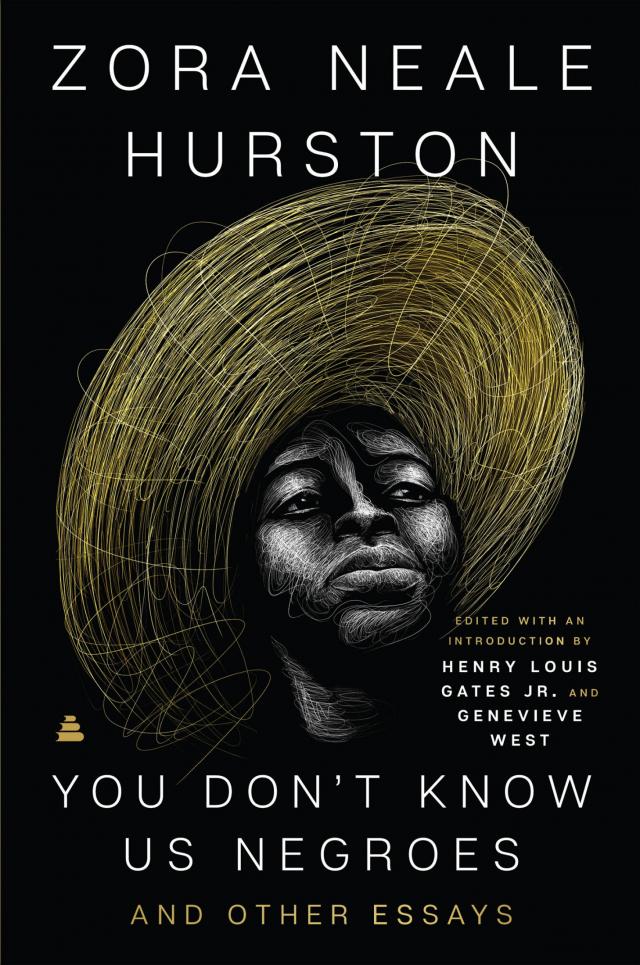
You dont know us negroes.., p.3
You Don't Know Us Negroes and Other Essays,
p.3


Along with her belief in the benefits of Black schooling for Black children by Black educators—by extension for and by the Black community—Hurston stakes out a controversial position that separate could be, practically speaking, equal. She argues,
If there are not adequate Negro schools in Florida, and there is some residual, some inherent and unchangeable quality in white schools, impossible to duplicate anywhere else, then I am the first to insist that Negro children of Florida be allowed to share this boon. But if there are adequate Negro schools and prepared instructors and instructions, then there is nothing different except the presence of white people.
Her claim is conditional, based on an if. One of the foundational premises of “Which Way the NAACP?” is that “in every state in the South the identical text-books are issued to White and Negro schools.” History has not borne out this assumption by Hurston—which is at the foundation of her reasoning. Hurston’s assertion that white is not necessarily better is true, but so is the reality that Black students and white students almost never used the same textbooks at the same time. The Black schools would get the used, outdated textbooks discarded from white schools. And new lab facilities were often reserved for white students only. Despite this flaw in her thinking, in many ways, what Hurston imagined came to pass. Even as schools desegregated, structural racism persisted and created new problems. Black teachers were fired so white teachers could remain, and truancy laws that existed prior to 1954 continued to be enforced selectively. Integrating schools did not necessarily improve the education of Black students.
“Which Way the NAACP?” also conveys anxieties about communism and government overreach, as well as her growing conservatism. Hurston abhorred communism and similar ideologies, because they cast African Americans in the role of objects, as a people doomed to react to forces beyond their control, as a race without agency. Hurston repeatedly returns to the theme of Black agency throughout her essays. To see Black people as victims, she deeply believes, is to succumb to the ultimate form of anti-Black racism. She was increasingly distrustful of outsiders—whether Communists influenced by Russia or white and NAACP leaders from the North. While white outsiders undermine the agency of Black people, so, too, she argues, do Black people aligned with the NAACP. She still sees an elitism in the organization’s leadership, one she traces back to its founding, and she wonders why the organization has not “found a home” in the “hearts” of the larger Black population. She fails to see the “advancement” gained when Black students are assaulted by white students in integrated bathrooms. And she correctly points out that integrated schools in the North had not led to equality or social mingling.
Underlying the move to desegregate, she fears, is self-loathing, a failure among rising middle-class African Americans to love themselves, their traditions, their culture regardless of what whites think. The fight for desegregation, she believes, flies in the face of all she has argued for in her fiction and nonfiction alike. She explains:
In close to a century of education and progress by the American Negro, self-consciousness of race and an inferiority complex stemming out of the past, we should have come to the place where notice by the Whites and the bolstering of proximity as a sign of tolerance would be utterly unnecessary. Not what counts with the majority in the nation, but what counts within ourselves should have arrived by now.
Pride in self and in traditional Black culture permeates her argument, much as it does in her all-Black novels, short stories, plays, and ethnographies. What white people think does not and should not matter. In this sense, remarkably, Hurston was a proto-Black cultural nationalist, a forerunner of an artistic and political philosophy that would become central tenets of the Black Arts Movement, born circa 1966. And rarely is Hurston credited with voicing these attitudes well before that movement commenced. In her fictional worlds, Hurston pointed people in this direction by demonstrating that Black people lived full, complex lives without white people. It was a depiction that countered the oversimplified two-dimensional Black-white opposition found in so much writing by both Black and white writers from the period. Here, in her opposition to court-ordered desegregation, she argues explicitly for the cultural pride and the cultural politics imbued in her fiction.
In essence, we recognize in Hurston’s position a consistency in the whole, self-sufficient Black world she portrays in her fiction and the whole, self-sufficient Black world for which she advocates in her argument opposing Brown v. Board. It stemmed from a complicated blend of mourning for something being lost or undermined—Black agency—and umbrage at the insult the court decision implied. Black people wanted to end segregation, but they didn’t want to admit, or cede to, the notion that anything all Black was inherently inferior, substandard, or downright bad. Hurston supported integration for Black people as equals, not as second-class citizens. In this, once again, she was making an argument that Black Nationalist political and aesthetic proponents would draw upon and elaborate upon a decade or so later. Integration had its place, and was a noble social goal, but meaningful integration could only take place between cultural equals.
Hurston was an intrepid observer and tireless reporter. Her fiction, nonfiction, and ethnographic work bears witness to this. In 1952, she essentially became a beat reporter for the Pittsburgh Courier, turning her formidable powers of observation to Ruby McCollum’s murder trial and the community of Live Oak, Florida. On Sunday morning, August 3, 1952, Ruby McCollum, a wealthy, married African American mother of four, walked into Dr. C. LeRoy Adams’s office and shot him dead. Adams was white, a medical doctor, and a recently elected state senator. McCollum admitted to the crime, but the question of motive and the disputed nature of their relationship made the trial a powder keg that attracted national and international headlines. While many questions remain unanswered, what seems clear is that McCollum and the physician had engaged in a yearslong sexual relationship. He fathered one of her children, and at the time of the murder she had become pregnant with a second. Hurston describes the notion that white men were entitled to use Black women for sexual gratification as “Paramour Rights,” which dated back to enslavement. Whether their relationship was entirely consensual remains uncertain. Ruby’s husband was an important local figure, but his illegal, lucrative gambling business depended upon bribes of powerful white men, like Adams, and Ruby’s mental health was in decline.
At trial, the prosecution contended—and the community publicly concurred—that the murder resulted from a dispute over a $100 medical bill, but Hurston’s writings make it clear that that was unlikely. She argues the community’s response “amounted to a mass delusion of mass illusion. A point of approach to the motive for the slaying of the popular medico and politician had been agreed upon, and however bizarre and unlikely it might appear to the outside public, it was going to be maintained and fought for.” It was a white narrative to which African Americans acquiesced, understandably, rather than put their own lives at risk. McCollum’s attorney hoped for a second-degree murder conviction rather than a determination of premeditated murder, which required the death penalty. With strenuous objections from the prosecution to Ruby’s testimony, only bits of her story were admitted into evidence. McCollum’s trial by an all-white, all-male jury of her “peers” and subsequent sentence to the electric chair was a national travesty rooted in America’s racist (and sexist) past that made it impossible for the accused to face a fair trial. McCollum’s conviction was later overturned, but after being declared incompetent to stand trial a second time, she was committed to the Florida State Hospital, where she remained until 1974, at which time she was released on the grounds that she posed no threat. She died in 1992, claiming that she had retained no memory of the shooting.
Hurston describes the trial as unfolding beneath “a smothering blanket of silence.” That silence may have been the consequence of Live Oak’s Black community holding its collective breath. Less than a decade earlier, in 1944, Willie James Howard, a Black fifteen-year-old, had been lynched in Live Oak for the outrage of sending all of his coworkers, including a white girl, Christmas cards. When Ruby’s husband, Sam McCollum, learned what she had done, he reportedly said, “Ruby’s as good as dead . . . and so am I. They’ll have to kill us now.”7 He immediately took his children and fled in hopes of escaping that violence.
Those in Live Oak who had been closest to the McCollum family were the most vocal in their condemnations of Ruby. It was a defensive pose, Hurston surmised, that would help safeguard those close associates from racial violence. Hurston, like other members of the press, was unable to speak directly with the accused. Who had the courage to talk to Hurston about Ruby and Sam? We don’t know. Much of what Hurston relates about McCollum’s early life had to have come from family and friends who clearly spoke on the condition of anonymity. At times Hurston even quotes people without attribution, concealing her sources, a protective decision for a reporter. In a more literary sense, these anonymous voices take on a communal choral quality, echoing the role of the chorus in a Greek tragedy similar to the store porch we see in her Eatonville fiction.
Hurston’s reporting on McCollum’s trial is restrained by the politics of race and gender in the South, so what boils under the surface, submerged out of view, is essential. Hurston was, after all, a Black woman reporting from a community she describes as “hostile.”8 She knew about Howard’s lynching, too. Even she, as a reporter, was limited in what she could safely articulate, so she creates gaps—silences—to illustrate the racialized power dynamics at play. As with the questions about Ruby’s motive, it is never clear why the prosecuting attorney and the judge (both of whom knew the victim well) wanted her silenced. Was it the implication that Adams had been manipulating (and even drugging) McCollum for years to preserve his sexualized power over her? Or did the drive to silence stem from Sam McCollum’s illegal dealings? Ruby McCollum’s husband had died of a heart attack the day after Ruby’s arrest, so limiting her testimony protected everyone involved with Sam’s illegal dealings—except Ruby.
As the prosecution tried to convince the all-white male jury that the dispute between McCollum and Adams was over a bill, Hurston tells us the prosecuting state’s attorney said, “‘You all know that a good way to get them (Negroes) mad is to try to collect. You’ve seen ’em mull’ (sullen). Black [the prosecuting attorney] cautioned the jury not to be deceived by Ruby’s behavior on the stand. He warned that she was highly intelligent, wealthy, but full of sly cunning.” A representative of the state legal system, the prosecuting attorney, blatantly invoked racist stereotypes of African Americans without rebuke. No wonder Hurston, as she says in “Crazy for This Democracy,” wanted to sample true American democracy for herself. Like women’s gender equality, it was still just a mirage.
Hurston took the judge at his word when he impaneled the jury—that McCollum deserved a fair trial. And yet Hurston watched, horrified, as events unfolded. She explains her changed thinking about Judge Hal W. Adams (of no relation to the doctor) this way: “He will never consent for any human being to be sent to their death without permitting the jury to hear their side of the story. He won’t! Judge Adams won’t! It was only when he exhibited anger and threatened Cannon [McCollum’s attorney] with contempt of Court if he persisted, that I wilted back, first in my soul and then in my seat. My disillusionment was terrible. My faith had been so strong.” Her naiveté—despite her lived experience—allowed her to believe that Ruby’s story would eventually come out. Tragically, it did not.
Hurston reached conclusions about the shooting that did not make it into newspapers. She came to believe that the doctor was trying to end his affair with Ruby at the time of the shooting, but she was, in Hurston’s words, “refus[ing] to fade out of the picture.”9 With LeRoy Adams’s election to the State Senate and his eye on the governor’s mansion, the physician may have needed to end things. There were other theories as well. Adams had ordered a pistol that fired bird shot rather than a conventional bullet that could be forensically tied back to the weapon.10 The implication is that Adams may have been planning to use the gun to kill McCollum. At the same time, Ruby said she was caught between two guns. Whose guns? Is it possible she shot Adams in self-defense? Or was she a woman scorned? It is impossible to know. While Hurston’s reporting made much of Black America an eyewitness to the trial, her writings tell us more about the cultural moment, the politics of race and gender, in northern Florida than they do about Ruby McCollum’s motives. An all-white, all-male jury sat on the case of a Black woman who admitted to murdering one of the community’s leading white citizens. Never was she able to tell her story in court. Her confession, it seems, was story enough. In today’s era of the “#MeToo” and “Black Lives Matter” movements, Hurston’s dispatches on the Ruby McCollum case serve as a blunt reminder of the long history of the intersection of race, gender, and violence in America and the steep price that Black Americans have paid—and continue to pay—in an unjust criminal justice system.
Zora Neale Hurston’s politics have been criticized over the years. Her contemporaries Richard Wright, Sterling Brown, and Ralph Ellison accused her of pandering to racist stereotypes in her writings, but the volume you hold in your hands demonstrates that was simply not the case. In fact, it brings to the fore Hurston’s lifelong attempt to reclaim traditional Black folk culture from racist and classist degradations, to share with her readers the “race pride” she felt, to build the race from within. She was often constrained—by her patron, by her publishers, by the limits of what white publishers would print. To acknowledge that material reality doesn’t make her one of those “handkerchief-head[s],” as she put it in 1955. Rather, it grounds her writings in a particular cultural and historical moment, one full of closed doors for a Black woman who wanted to do more than clean homes. It makes her remarkable contributions to American arts and letters, her place in American culture as an icon of African American, modern, and women’s literature, all the more inspiring. She wrote in her visually inspired vernacular that “every tub must sit on its own bottom.” With a long-overdue collection of her best essays finally in the hands of readers, Hurston can now do just that.
HENRY LOUIS GATES JR. AND GENEVIEVE WEST
Part One
On the Folk
Bits of Our Harlem
We looked up from our desk and he was standing before us, tall, gaunt and middle-aged. In his hand was one of those tin receptacles for charity-begging. Like all other long-suffering Harlemites we shuddered. Beggars with tin cups are so numerous. He smiled and stood there. We tried to look austere—some money-seekers may be easily intimidated—but not so our hero.
“Well, what can I do for you?” we asked, looking the visitor in the face for the first time.
“A few pennies for homeless children,” he answered.
We felt that it was useless to struggle so we donated a dime. No sooner had the coin rattled to the bottom of the cup than we received a hearty “Thank yuh. God will shorely bless yuh.”
We looked closely at his face this time and saw fanatic fires burning in the small eyes set in a thin freckled face. But our eyes rested longest on the mouth and environs.
The short, thin upper-lip showed his Caucasian admixture, but a full drooping under-lip spoke for the Negro blood in him. A fringe of scrubby rusty-red hair completely encircled the whole. When he spoke, four teeth showed forlornly in the bottom jaw. We are still wondering if there were any others scattered about in his aging gums.
“You don’t know me, do you?” he asked.
“I am afraid I haven’t had the pleasure,” we answered.
“Well, they calls me th’ black Longfellow.”1
We brightened. “These be gray days, and a sweet singer in Israel is to be highly honored. Would you favor us with a selection or two?”
“Shorely, shorely; but drop in a few mo’ pennies, please.”
What are a few pennies against the songs of an immortal bard? We dropped in six cents.
The poet cleared his throat and sang:
“God Shall Without a Doubt Heal Every Nation”
“There shall be no sickness, no sorrow after while,
There shall be no sickness, no sorrow, after while,
There wil’ be no more horror,
Watch for joy and not for sorrow,
God shall heal up every nation tomorrow, after while.
God will bring good things to view after while,
God shall make all things new,
Every child of God will without a doubt be called a Jew,
God will make us all one nation, after while.”
“Ain’t that beautiful, now?” the poet asked. I’ll recite yuh another one.”
Before we could protest he was in the midst of
“The Automobiles”
“Once horses and camels was the style,
Now they fly ’round in automobile,
They don’t look at a policeman’s sign,
Sometimes they run over chillun,
Sometimes over a divine,
When they are drunk with devils’ wine,
They scoots—”
But we had fled into the inner office with our fingers in our ears.