Complete works of freder.., p.1084
Complete Works of Frederick Marryat,
p.1084


“Caressed by generous publishers!! Truly, I may say that such a metaphor I never met afore. Authors must no longer write to their publishers in plain unvarnished language to inform them that they have books, like razors, to sell; but, refined by your tuition, despatch a perfumed billet-doux with — My dear Colburn, or My dear Bentley, ‘Are you inclined to caress me? If so, come immediately. — Yours ever.’
“Such a communication from many of. our fair authoresses will, I have no doubt, be well received; and I think I see Mr. Bentley impatiently pulling on his boots, or Mr. Colburn rubbing his hands with delight, till the carriage comes to the door; or Mr. Longman, senior, with truly parental solicitude forbidding the disappointed Thomas or William from responding in person to the dangerous communication.
“But a want of more time and space compels me to finish my prologue. The curtain rises and once more the hebdomadal little Joey appears upon the scene.”
* * * * *
It is to be surmised that Captain Marryat continued to find Wimbledon “triste and dull,” as in the spring of 1841, we find him again in lodgings in town, and busy on the first part of ‘Masterman Ready,’ which was translated both into French and German, as indeed were many of his works, some having found their way into the Spanish and Swedish languages. Again he writes to his friend:
“120, Pall Mall, Feb. 18, 1841.
“My DEAR Mrs. S — ,
“That you may not think me unkind in refusing your invitation, I must tell you that I am much worse than I have made myself out in my former letters. I fell down as if I had been shot, a few days ago, and have been ever since obliged to be very quiet, and am not permitted to drink anything but water, or undergo the least excitement, and you would offer me every description in the shape of beauty, mirth, revelry, and feasting, putting yourself out of the question. No, for my sins, sins in the shape of three volumes chiefly, and heavy sins too, I must now submit to mortification and penance. I am positively forbidden to write a line, but you may tell William and Dunny that the little book is finished and will be out at Easter, when they will be able to read it. I have been amusing myself with drawing all the illustrations myself and they will do very well, independent of saving me a great deal of money. Tell Mrs. — I have received no letters from her, which I regret very much, but I have been so long confined to my room that I have not been to the club for weeks. Of course I shall obey her wishes, but why they should be burnt I cannot imagine; however, a lady’s request is law to me; I will execute your order at I Fortnum & Mason’s, if I can crawl up there this afternoon, but I move very slowly now, for my chest is very bad and my head not much better. I wish you a great deal of pleasure, and I have no doubt but that there will be many happy faces about you on Monday night; and I am glad to find that you are well enough to go through the fatigue. My kind regards to all, and
“Yours ever,
“F. MARRYAT.”
At this time he took a house in town, No. 3, Spanish Place, Manchester Square, where he remained for more than a year; and it was whilst resident there, surrounded by his friends (amongst whom he numbered Lady Blessington, Lady Morgan, Lady Stepney, Charles Dickens, Harrison Ainsworth, George Cruikshank, Alfred d’Orsay, John Forster, Sir L. B. Lytton, Edwin Landseer, Clarkson Stanfield, and many others of equal celebrity), that, for a while, he rested from the labours of authorship. It was here that, in the tiniest of houses, furnished according to his own taste, a very gem in point of its adornments — rich in pictures and objets dart, clothed in velvet and decorated with hot-house flowers — he received visitors who made the little rooms brilliant with their conversation and their wit; and mixing with the gayest votaries of the world himself, formed a circle of acquaintance that extended from Devonshire House to Little Pedlington.
The following letters from and to Captain Marryat were written about this time:
“Liverpool,
“Tuesday, Sept. 8.
“MY DEAR CAROLINE, (His sister-in-law, Mrs. Charles Marryat)
“This morning, at half-past eight o’clock, I put Coz on board of the Shenandoah, and, having seen her towed out for half a mile by the tug, I considered that I had done my duty. I therefore put my hands in my pockets and walked back again, meditating upon the bales of cotton, bars of iron, casks of flour, and various other articles which impeded my passage. I left her “as well as could be expected.” She kept her spirits up very well to the last moment, and then she began to pump. I leave this for the good town of Whitehaven this evening, and from thence proceed to Cockermouth Castle, where I shall stay a week and no longer if I can get away. After which return to Liverpool and so on to London, and then to pay you a visit. Rather annoying that you should be away at the time; but I hope you will be amused, at all events. Give my love to George and Gina, and tell them that, as sure as there are snakes in Wirginny, I will come down and see them as soon as I have nothing very pressing to do.
“Coz has not written to my mother, or any one, so you are the sole proprietor of the important intelligence contained in this letter. You can communicate it if you please, and think you will find favour in the sight of ruling power. Adieu, Dieu vous bénisse. Kind regards to Charles. Coz desired me to say that she loved you very much. So do I, and am, ever yours,
“F. MARRYAT.”
“3, Spanish Piece,
“Thursday.
“My DEAR CAROLINE,
“I hope to come down to see you some time next week, but at this present moment I hardly know whether I stand upon my head or my heels, so very busy and so very much annoyed I have been with various circumstances. When I do come I’ll talk you ‘clean out of sight,’ as the Yankees say. Love to all, and ever yours truly,
“F. MARRYAT.”
“Devonshire Terrace, “July 16, 1842.
“MY DEAR MARRYAT,
“Most unquestionably and undoubtedly I expect you at six to day, to dinner. I should have sent you a reminder, but when the invitation has been given at dinner time, I have a delicacy in doing so, lest it should seem to intimate a suspicion that the invited one was drunk.
“Faithfully yours always,
“CHARLES DICKENS.
“I think I can give you some hock today which will do your leg good.”
“Devonshire Terrace, “January 3.
“MY DEAR MARRYAT,
“Friday next — twelfth night — is the anniversary of my son and heir’s birthday; on which occasion I am going to let off a magic lantern and other strong engines.
“I have asked some children of a larger growth (nearly all of whom you know) to come and make merry. If you are in town, and will join as early as half-past seven or so, you will give us very great pleasure.
“Faithfully yours always,
“CHARLES DICKENS.”
About this period Count d’Orsay took a portrait of him, in coloured crayons, one of a series of likenesses of which the first attempt was made on his own face.
His likeness of Captain Marryat is a failure, and, what is worse, the irregular features are vulgarised; but, as Alfred d’Orsay, in these sketches, failed to make himself handsome, he must be forgiven if he did not fashion Adonises out of less perfect clay.
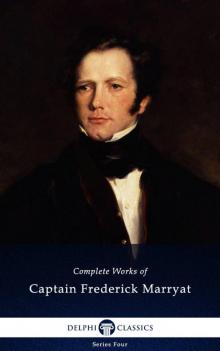
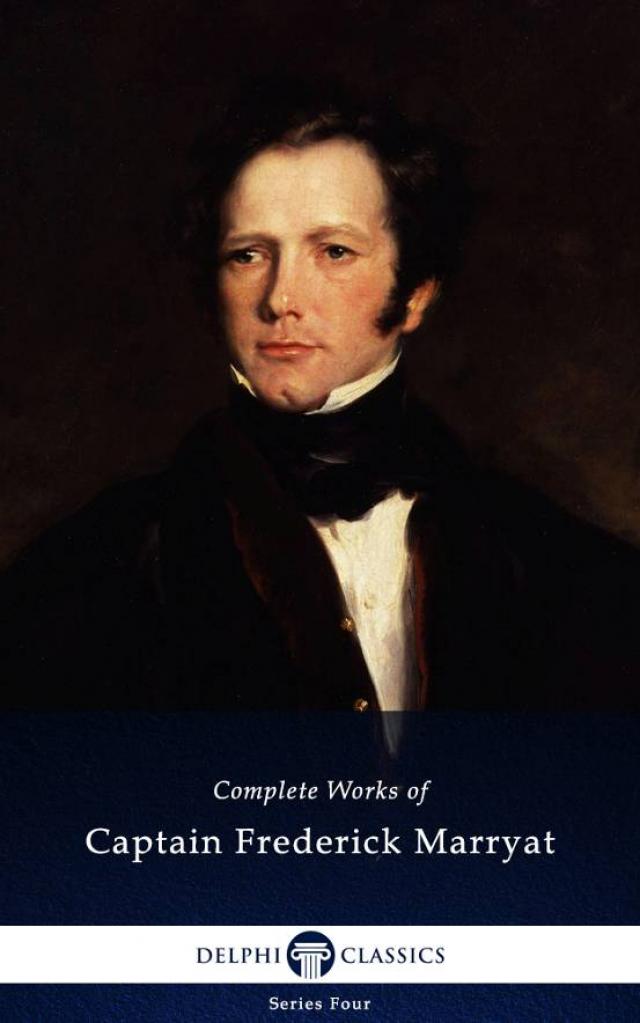
The portrait of Captain Marryat was painted in oils by Simpson, the favourite pupil of Sir Thomas Lawrence, and originally executed to head the first number of the ‘Metropolitan Magazine.’ He was also drawn in water colours, by Behnes, which drawing was afterwards engraved as a frontispiece to the ‘Pirate and Three Cutters’; but Simpson’s portrait is considered more like him than any other. His bust was taken by Carew.
Although not handsome, Captain Marryat’s personal appearance was very prepossessing. In figure he was upright and broad shouldered for his height, which measured 5 ft. 10 in. His hands, without being undersized, were remarkably perfect in form, and modelled by a sculptor at Rome on account of their symmetry. The character of his mind was borne out by his features, the most salient expression of which was the frankness of an open heart. The firm decisive mouth, and massive thoughtful forehead, were redeemed from heaviness by the humorous light that twinkled in his deep-set grey eyes, which, bright as diamonds, positively flashed out their fun, or their reciprocation of the fun of others. As a young man, dark crisp curls covered his head; but later in life, when, having exchanged the sword for the pen and the ploughshare, he affected a soberer and more patriarchal style of dress and manner, he wore his grey hair long, and almost down to his shoulders. His eyebrows were not alike, one being higher up and more arched than the other, which peculiarity gave his face a look of inquiry, even in repose. In the upper lip was a deep cleft, and in his chin as deep a dimple — a pitfall for the razor, which, from the ready growth of his dark beard, he was often compelled to use twice a day. Like most warm-hearted people he was quick to take offence, and no one could have decided, after an absence of six months, with whom he was friends and with whom he was not. One who knew him as intimately as it was possible for any man to do, writes of him in these words:
“His faults proceeded from an over active mind, which could never be quiet — morning, noon, or night. If he had no one to love, he quarrelled for want of something better to do; he planned for himself and for everybody, and changed his mind ten times a day. His restlessness of spirit would have quickly worn out the body of a less vigorous man.”
This restless activity of spirit was visible in him indeed at all times: he would get up in the middle of the night or before dawn, and, bursting into his brother’s room, rouse him from sleep with some newly hatched plan of starting at once for Austria, buying a château in Hungary, or camping out in the desert for three years, by which means a great fortune would be realised; and grave would be his indignation when the disturbed sleeper turned wearily on his pillow, and entreated him to let him go to sleep again. But when in a good humour, Captain Marryat could be charming, especially with young people, though his manners were brusque and, at first, somewhat alarmed them. His knowledge of nature was most extensive, and he might often be seen surrounded by an audience of delighted little ones, listening with open eyes and mouths to his descriptions of the wonders of the deep or the natural history of the creation.
About this time Captain Marryat sold the copyright of his celebrated ‘Code of. Signals’ to Mr. Richardson, of Cornhill, and subsequently made a fresh agreement with the same gentleman, by which, on; condition of his adding to or altering the flags as required, he was entitled to receive a fourth part of the profits on all copies sold during his lifetime. The year following this arrangement they jointly cleared a profit of between five and six hundred pounds.
In 1842 the second and third volumes of ‘Masterman Ready’ made their appearance. By this time Captain Marryat was beginning to long for a quieter life, and to contemplate taking up his residence altogether at Langham Manor, and the following letter to his sister-in-law, Mrs. Charles Marryat, was written in the early part of the summer of 1843:
“Mr DEAR CAROLINE,
“I am really so immersed in business — what with getting furniture for Langham, printing a book to pay for said furniture, and, moreover, a knee which might be better — that I cannot come to you this week. I hardly know if I can promise next week, as I leave for Langham on Thursday or Friday. All I can say is, I will if I can, if it is only for one day, as I am as anxious to see you as you are to see me. I will try on Monday or Tuesday, but the weather is against me; this too solid flesh of ours does melt most terribly. Where are you going to? Somewhere, I presume. Suppose, you wait till I have been down to Langham and put things to rights. I have no curtains, but I have four spare beds to offer you; and, if you bring down your cook, you might contrive to exist. I can promise you plenty of game, plenty of sea breezes, but no bathing; you must go on to Cromer for that. By-the-by, what a nice plan it would be to put the nurses and children at Cromer, while you staid part of the time with me. You can go nearly the whole way by steam. Think of this, and when we meet the affair shall be canvassed.
“Yours very truly,
“F. MARRYAT.”
CHAPTER V.
Settles at Langham — The Manor House — Dogs and pony — Tastes — The poor of the village—’ Monsieur Violet’ — Correspondence.
THERE is something almost touching in the way in Which men of talent in the vigour of their manhood, and the zenith of their fame will retire, from the busy and brilliant life in which they have taken a foremost part, into comparative obscurity. Captain Marryat, whilst the remembrance of the services he had rendered to his country was still fresh in the world’s memory, and his literary fame was growing daily more assured, whilst his social qualities and bodily strength were unimpaired by so much as a suspicion of the terrible disease that afterwards assailed them, suddenly banished himself into a corner of the great agricultural county of Norfolk, and brought all the resources of his wealthy mind to bear upon the cultivation of stock. Yet he seems to have anticipated such a finale to his active career, for in the unpublished fragment of his ‘Life of Lord Napier,’ there occur these words:
“Most sailors when they retire from the service turn to agriculture, and, generally speaking, they make very good farmers. There appears something very natural in this. When Adam was created a man in full vigour he naturally took to the labours of the field. And what is a sailor — who, although he has run all over the world, has in fact never lived on it — when you plant him onshore, but a sort of Adam — a new creature, starting into existence as it were in his prime? For all his former life has been, as far as terrestrial affaire are concerned, but a deep sleep. There have been many definitions of man by various philosophers, all of them extremely absurd; it appears to me that the true definition of man is, that he is a creative animal, which no other living creature is. It is true that he cannot, like his God, start a being into life, but he imitates his creative power as far as he is able: he builds; he plants; he changes the face of nature; he raises woods where nothing higher than the thistle waved to the breeze, he levels forests and turns the site of them into verdure and fertility. Examine all the greatest pleasures of man, and you will find that they consist in imitating the Deity in his creative power, and the more refined the intellect, the higher the aspirations of the soul, the greater the delight received from these noble attempts.”
* * * * *
When Captain Marryat revisited his country house he found that the tenant who rented the larger farm on the estate had not only taken all he could out of the land without putting anything in it, but had attempted to turn an honest (?) penny by fitting up the drawing-rpom of the manor, then uninhabited, with rows of beds, which he let out to tramps at twopence a night. Into the boudoir the birds of the air had been allowed free entrance, and as its walls and ceiling were painted to imitate rose-covered trellis work and sky, the simple country sparrows had been deluded into the idea that they had discovered umbrageous shelter, and built their nests there accordingly. The mimic birds, which were pictured flying about or settled on the branches, were by Audubon, and the feathered bipeds of Langham had acknowledged his talent as a naturalist and painter by fraternizing with them, although, from the fact of their being chiefly specimens from the tropics, they could hardly have recognised them as old acquaintances.
This boudoir, from having mirrors set in the panels of the folding doors, which, when opened to face each other, reflected the trellised pillars backward and forward until their number appeared interminable, was called by the village people the “Boom of a Thousand Columns” — a name so suggestive of the palaces in the ‘Arabian Nights,’ or the Café des Milles Colonnes at Paris, that it would never be supposed to have emanated from the thick and muddy brains of the Norfolk peasantry. Langham Manor, without having any great architectural pretensions, had a certain unconventional prettiness of its own. It was a cottage in the Elizabethan style, built after the model of one at Virginia Water belonging to His late Majesty George IV., with latticed windows opening on to flights of stone steps ornamented with vases of flowers, and leading down from the long, narrow diningroom, where (surrounded by Clarkson Stanfield’s illustrations of ‘Poor Jack,’ with which the walls were clothed) Captain Marryat composed his later works, to the lawn behind. The house was thatched and gabled, and its pinkish-white walls and round porch were covered with roses and ivy, which in some parts climbed as high as the roof itself. When he wrote in the dining-room, he always selected a corner of the table that commanded a view of the lawn, on which his favourite bull, Ben Brace, was generally tethered; and here, with his papers scattered about him and a couple of dogs at his feet, he would settle himself down to play the part of a country gentleman, These dogs, great pets of his, were two very beautiful, but utterly useless, creatures; Zinny, a large-eyed black-and-tan spaniel of the King Charles breed, with a broad short head weighed down by a combination of humility and length of ear, who never dared to trespass beyond his master’s boots, but from that lowly position languished and cringed and rolled over, a deprecating mass of stupidity and floss silk; and Juno, a tiny black Italian greyhound; all spring and activity, with slender limbs and almost hairless skin, who would leap upon the author’s table and indulge in a wild scamper over his papers, and when rebuked for her forwardness, creep under his coat and lie there blissfully contented.
Captain Marryat tried very hard to be a regular farmer. He built model cottages and instituted model pigsties; but both cottagers and pigs proved averse to anything like a progressive movement. He turned his attention to guano, and made himself master of Ben Brace’s pedigree: put on gaiters, and, mounting a rough, thickset, shooting pony, rode about from dyke to ditch, and from ditch to dyke, standing patiently for hours whilst he watched the men drain the “Fox Covert” or exorcise the will-o’-the-wisp from the “Decoy Meadow “; but for all that, he was a farmer in theory only, and not in practice. Yet there, are few in that country side that have not something to tell of him, and most of its poorer inhabitants preserve a reverential memory, and have a loving word to say, of one whose talent and cordiality went hand in hand to win him golden opinions, if his skill in farming was not entitled to honest admiration.