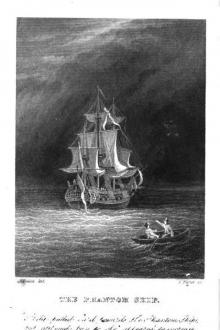
Complete works of freder.., p.247
Complete Works of Frederick Marryat,
p.247


‘My lords,’ said he, addressing the governor and bishop, ‘the schooner has not shown any colours, although our own are hoisted. I am come down to know your pleasure. Defence we can make none; and I fear that we are at the mercy of a pirate.’
‘A pirate!’ ejaculated several, beating their breasts, and calling upon their saints.
‘Silence, my good people, silence,’ quietly observed the bishop; ‘as to what it may be best to do,’ continued he, turning to the captain, ‘I cannot advise; I am a man of peace, and unfit to hold a place in a council of war. Don Ribiera, I must refer the point to you and your sons. Tremble not, my dear Teresa; are we not under the protection of the Almighty.’
‘Holy Virgin, pity us!’ exclaimed Teresa.
‘Come, my sons,’ said Don Ribiera, ‘we will go on deck and consult: let not any of the men follow us; it is useless risking lives which may yet be valuable.’
Don Ribiera and his sons followed the captain to the quarter-deck, and with him and Antonio they held a consultation.
‘We have but one chance,’ observed the old man, after a time; ‘let us haul down our colours as if in submission; they will then range up alongside, and either board us from the schooner, or from their boats; at all events, we shall find out what she is, and, if a pirate, we must sell our lives as dearly as we can. If, when we haul down the colours, she ranges up alongside, as I expect she will, let all the men be prepared for a desperate struggle.’
‘You are right, Antonio,’ replied the governor; ‘go aft, captain, and haul down the colours! — let us see what she does now. Down, my boys! and prepare the men to do their duty.’
As Antonio had predicted, so soon as the colours were hauled down, the schooner ceased firing and made sail. She ranged up on the quarter of the ship, and up to her main peak soared the terrific black flag; her broadside was poured into the Indiaman, and before the smoke had cleared away there was a concussion from the meeting sides, and the bearded pirates poured upon her decks.
The crew of the Portuguese, with the detachment of troops, still formed a considerable body of men. The sight of the black flag had struck ice into every heart, but the feeling was resolved into one of desperation.
‘Knives, men, knives!’ roared Antonio, rushing on to the attack, followed by the most brave.
‘Blood for blood!’ cried the second mate, aiming a blow at the old man.
‘You have it,’ replied Antonio, as his knife entered the pirate’s heart, while, at the same moment, he fell and was himself a corpse.
The struggle was deadly, but the numbers and ferocity of the pirates prevailed. Cain rushed forward followed by Hawkhurst, bearing down all who opposed them. With one blow from the pirate-captain, the head of Don Ribiera was severed to the shoulder; a second struck down the eldest son, while the sword of Hawkhurst passed through the body of the other. The Portuguese captain had already fallen, and the men no longer stood their ground. A general massacre ensued, and the bodies were thrown overboard as fast as the men were slaughtered. In less than five minutes there was not a living Portuguese on the bloody decks of the ill-fated ship.
CHAPTER IX
THE CAPTURE
‘Pass the word for not a man to go below, Hawkhurst!’ said the pirate-captain.
‘I have, sir; and sentries are stationed at the hatchways. Shall we haul the schooner off?’
‘No, let her remain; the breeze is faint already: we shall have a calm in half an hour. Have we lost many men?’
‘Only seven, that I can reckon; but we have lost Wallace’ (the second mate).
‘A little promotion will do no harm,’ replied Cain; ‘take a dozen of our best men and search the ship, there are others alive yet. By the bye, send a watch on board of the schooner; she is left to the mercy of the Kroumen, and — —’
‘One who is better out of her,’ replied Hawkhurst.
‘And those we find below — —’ continued the mate.
‘Alive!’
‘True; we may else be puzzled where to find that portion of her cargo which suits us,’ said Hawkhurst, going down the hatchway to collect the men who were plundering on the main deck and in the captain’s cabin.
‘Here, you Maltese! up, there! and look well round if there is anything in sight,’ said the captain, walking aft.
Before Hawkhurst had collected the men and ordered them on board of the schooner, as usual in those latitudes, it had fallen a perfect calm.
Where was Francisco during this scene of blood? He had remained in the cabin of the schooner. Cain had more than once gone down to him, to persuade him to come on deck and assist at the boarding of the Portuguese, but in vain — his sole reply to the threats and solicitations of the pirate was —
‘Do with me as you please — I have made up my mind — you know I do not fear death — as long as I remain on board of this vessel, I will take no part in your atrocities. If you do respect my mother’s memory, suffer her son to seek an honest and honourable livelihood.’
The words of Francisco were ringing in the ears of Cain as he walked up and down on the quarter-deck of the Portuguese vessel, and, debased as he was, he could not help thinking that the youth was his equal in animal and his superior in mental courage. He was arguing in his own mind upon the course he should pursue with respect to Francisco, when Hawkhurst made his appearance on deck, followed by his men, who dragged up six individuals who had escaped the massacre. These were the bishop; his niece; a Portuguese girl, her attendant; the supercargo of the vessel; a sacristan; and a servant of the ecclesiastic: they were hauled along the deck and placed in a row before the captain, who cast his eyes upon them in severe scrutiny. The bishop and his niece looked round, the one proudly meeting the eye of Cain, although he felt that his hour was come; the other carefully avoiding his gaze, and glancing round to ascertain whether there were any other prisoners, and if so, if her betrothed was amongst them; but her eye discovered not what she sought — it was met only by the bearded faces of the pirate crew, and the blood which bespattered the deck.
She covered her face with her hands.
‘Bring that man forward,’ said Cain, pointing to the servant. ‘Who are you?’
‘A servant of my lord the bishop.’
‘And you?’ continued the captain.
‘A poor sacristan attending upon my lord the bishop.’
‘And you?’ cried he to a third.
‘The supercargo of this vessel.’
‘Put him aside, Hawkhurst!’
‘Do you want the others?’ inquired Hawkhurst significantly.
‘No.’
Hawkhurst gave a signal to some of the pirates, who led away the sacristan and the servant. A stifled shriek and a heavy plunge in the water were heard a few seconds after. During this time the pirate had been questioning the supercargo as to the contents of the vessel and her stowage, when he was suddenly interrupted by one of the pirates, who, in a hurried voice, stated that the ship had received several shot between wind and water and was sinking fast. Cain, who was standing on the slide of the carronade with his sword in his hand, raised his arm and struck the pirate a blow on the head with the hilt, which, whether intended or not, fractured his skull, and the man fell upon the deck.
‘Take that, babbler, for your intelligence; if these men are obstinate, we may have worked for nothing.’
The crew, who felt the truth of their captain’s remark, did not appear to object to the punishment inflicted, and the body of the man was dragged away.
‘What mercy can we expect from those who show no mercy even to each other?’ observed the bishop, lifting his eyes to heaven.
‘Silence!’ cried Cain, who now interrogated the supercargo as to the contents of the hold — the poor man answered as well as he could— ‘the plate! the money for the troops — where are they?’
‘The money for the troops is in the spirit-room, but of the plate I know nothing; it is in some of the cases belonging to my lord the bishop.’
‘Hawkhurst! down at once to the spirit-room and see to the money; in the meantime I will ask a few questions of this reverend father.’
‘And the supercargo — do you want him any more?’
‘No; he may go.’
The poor man fell down on his knees in thankfulness at what he considered his escape: he was dragged away by the pirates, and it is scarcely necessary to add that in a minute his body was torn to pieces by the sharks, who, scenting their prey from a distance, were now playing in shoals around the two vessels.
The party on the quarter-deck were now (unperceived by the captain) joined by Francisco, who, hearing from the Krouman, Pompey, that there were prisoners still on board, and amongst them two females, had come over to plead the cause of mercy.
‘Most reverend father,’ observed Cain, after a short pause, ‘you have many articles of value in this vessel?’
‘Take that, babbler, for your intelligence; if these men are obstinate, we may have worked for nothing.’
‘None,’ replied the bishop, ‘except this poor girl; she is, indeed, beyond price, and will, I trust, soon be an angel in heaven.’
‘Yet is this world, if what you preach be true, a purgatory which must be passed through previous to arriving there, and that girl may think death a blessing compared to what she may expect if you refuse to tell me what I would know. You have good store of gold and silver ornaments for your churches — where are they?’
‘They are among the packages entrusted to my care.’
‘How many may you have in all?’
‘A hundred, if not more.’
‘Will you deign to inform me where I may find what I require?’
‘The gold and silver are not mine, but are the property of that God to whom they have been dedicated,’ replied the bishop.
‘Answer quickly; no more subterfuge, good sir. Where is it to be found?’
‘I will not tell, thou blood-stained man; at least, in this instance, there shall be disappointment, and the sea shall swallow up those earthly treasures to obtain which thou hast so deeply imbrued thy hands. Pirate! I repeat it, I will not tell.’
‘Seize that girl, my lads!’ cried Cain; ‘she is yours, do with her as you please.’
‘Save me! oh, save me!’ shrieked Teresa, clinging to the bishop’s robe.
The pirates advanced and laid hold of Teresa. Francisco bounded from where he stood behind the captain, and dashed away the foremost.
‘Are you men?’ cried he, as the pirates retreated. ‘Holy sir, I honour you. Alas! I cannot save you,’ continued Francisco mournfully. ‘Yet will I try. On my knees — by the love you bore my mother — by the affection you once bore me — do not commit this horrid deed. My lads!’ continued Francisco, appealing to the pirates, ‘join with me and entreat your captain; ye are too brave, too manly, to injure the helpless and the innocent — above all, to shed the blood of a holy man, and of this poor trembling maiden.’
There was a pause — even the pirates appeared to side with Francisco, though none of them dared to speak. The muscles of the captain’s face quivered with emotion, but from what source could not be ascertained.
At this moment the interest of the scene was heightened. The girl who attended upon Teresa, crouched on her knees with terror, had been casting her fearful eyes upon the men which composed the pirate crew; suddenly she uttered a scream of delight as she discovered among them one that she well knew. He was a young man, about twenty-five years of age, with little or no beard. He had been her lover in his more innocent days; and she, for more than a year, had mourned him as dead, for the vessel in which he sailed had never been heard of. It had been taken by the pirate, and, to save his life, he had joined the crew.
‘Filippo! Filippo!’ screamed the girl, rushing into his arms. ‘Mistress! it is Filippo; and we are safe.’
Filippo instantly recognised her; the sight of her brought back to his memory his days of happiness and of innocence; and the lovers were clasped in each other’s arms.
‘Save them! spare them! — by the spirit of my mother! I charge you,’ repeated Francisco, again appealing to the captain.
‘May God bless thee, thou good young man!’ said the bishop, advancing and placing his hand upon Francisco’s head.
Cain answered not; but his broad expanded chest heaved with emotion — when Hawkhurst burst into the group.
‘We are too late for the money, captain; the water is already six feet above it. We must now try for the treasure.’
This intelligence appeared to check the current of the captain’s feelings.
Now, in one word, sir,’ said he to the bishop, ‘where is the treasure? Trifle not, or, by Heaven — —’
‘Name not Heaven,’ replied the bishop; ‘you have had my answer.’
The captain turned away, and gave some directions to Hawkhurst, who hastened below.
‘Remove that boy,’ said Cain to the pirates, pointing to Francisco. ‘Separate those two fools,’ continued he, looking towards Filippo and the girl, who were sobbing in each other’s arms.
‘Never!’ cried Filippo.
‘Throw the girl to the sharks! Do you hear? Am I to be obeyed?’ cried Cain, raising his cutlass.
Filippo started up, disengaged himself from the girl, and drawing his knife, rushed towards the captain to plunge it in his bosom.
With the quickness of lightning the captain caught his uplifted hand, and, breaking his wrist, hurled him to the deck.
‘Indeed!’ cried he, with a sneer.
‘You shall not separate us,’ said Filippo, attempting to rise.
‘I do not intend it, my good lad,’ replied Cain. ‘Lash them both together and launch them overboard.’
This order was now obeyed; for the pirates not only quailed before the captain’s cool courage, but were indignant that his life had been attempted. There was little occasion to tie the unhappy pair together; they were locked so fast in each other’s arms that it would have been impossible almost to separate them. In this state they were carried to the entering port, and cast into the sea.
‘Monster!’ cried the bishop, as he heard the splash, ‘thou wilt have a heavy reckoning for this.’
‘Now bring these forward,’ said Cain, with a savage voice.
The bishop and his niece were led to the gangway.
‘What dost thou see, good bishop?’ said Cain, pointing to the discoloured water, and the rapid motion of the fins of the sharks, eager in the anticipation of a further supply.
‘I see ravenous creatures after their kind,’ replied the bishop, ‘who will, in all probability, soon tear asunder these poor limbs; but I see no monster like thyself. Teresa, dearest, fear not; there is a God, an avenging God, as well as a rewarding one.’
But Teresa’s eyes were closed — she could not look upon the scene.
‘You have your choice; first torture, and then your body to those sharks for your own portion; and as for the girl, this moment I hand her over to my crew.’
‘Never!’ shrieked Teresa, springing from the deck and plunging into the wave.
There was a splash of contention, the lashing of tails, until the water was in a foam, and then the dark colour gradually cleared away, and nought was to be seen but the pure blue wave and the still unsatiated monsters of the deep.
‘The screws — the screws! quick! we’ll have the secret from him,’ cried the pirate captain, turning to his crew, who, villains as they were, had been shocked at this last catastrophe. ‘Seize him!’
‘Touch him not!’ cried Francisco, standing on the hammock nettings; ‘touch him not! if you are men.’
Boiling with rage, Cain let go the arm of the bishop, drew his pistol, and levelled it at Francisco. The bishop threw up the arm of Cain as he fired; saw that he had missed his aim, and clasping his hands, raised his eyes to heaven in thankfulness at Francisco’s escape. In this position he was collared by Hawkhurst, whose anger overcame his discretion, and who hurled him through the entering port into the sea.
‘Officious fool!’ muttered Cain, when he perceived what the mate had done. Then, recollecting himself, he cried, ‘Seize that boy and bring him here.’
One or two of the crew advanced to obey his orders; but Pompey and the Kroumen, who had been attentive to what was going on, had collected round Francisco, and a scuffle ensued. The pirates, not being very determined, nor very anxious to take Francisco, allowed him to be hurried away in the centre of the Kroumen, who bore him safely to the schooner.
In the meantime Hawkhurst, and the major part of the men on board of the ship, had been tearing up the hold to obtain the valuables, but without success. The water had now reached above the orlop-deck, and all further attempts were unavailing. The ship was settling fast, and it became necessary to quit her, and haul off the schooner, that she might not be endangered by the vortex of the sinking vessel. Cain and Hawkhurst, with their disappointed crew, returned on board the schooner, and before they had succeeded in detaching the two vessels a cable’s length, the ship went down with all the treasure so coveted. The indignation and rage which were expressed by the captain as he rapidly walked the deck in company with his first mate — his violent gesticulations — proved to the crew that there was mischief brewing. Francisco did not return to the cabin; he remained forward with the Kroumen, who, although but a small portion of the ship’s company, were known to be resolute and not to be despised. It was also observed that all of them had supplied themselves with arms, and were collected forward, huddled together, watching every motion and manœ uvre, and talking rapidly in their own language. The schooner was now steered to the north-westward under all press of sail. The sun again disappeared, but Francisco returned not to the cabin — he went below, surrounded by the Kroumen, who appeared to have devoted themselves to his protection. Once during the night Hawkhurst summoned them on deck, but they obeyed not the order; and to the expostulation of the boatswain’s mate, who came down, they made no reply. But there were many of the pirates in the schooner who appeared to coincide with the Kroumen in their regard for Francisco. There are shades of villainy in the most profligate of societies; and among the pirate’s crew some were not yet wholly debased. The foul murder of a holy man — the cruel fate of the beautiful Teresa — and the barbarous conduct of the captain towards Filippo and his mistress, were deeds of an atrocity to which even the most hardened were unaccustomed. Francisco’s pleadings in behalf of mercy were at least no crime; and yet they considered that Francisco was doomed. He was a general favourite; the worst-disposed of the pirates, with the exception of Hawkhurst, if they did not love, could not forbear respecting him; although, at the same time, they felt that if Francisco remained on board the power even of Cain himself would soon be destroyed. For many months Hawkhurst, who detested the youth, had been most earnest that he should be sent out of the schooner. Now he pressed the captain for his removal in any way, as necessary for their mutual safety, pointing out to Cain the conduct of the Kroumen, and his fears that a large proportion of the ship’s company were equally disaffected. Cain felt the truth of Hawkhurst’s representation, and he went down to his cabin to consider upon what should be done.