Complete works of freder.., p.445
Complete Works of Frederick Marryat,
p.445


“Mynheer Kloots, if you please, I’ll leave the ship directly. Let my boat come alongside — I must have the largest boat for the Honourable Company’s service — for the papers and myself.”
“I’m afraid not, Mynheer Von Stroom,” replied Kloots; “our boats will hardly hold the men as it is, and every man’s life is as valuable to himself as yours is to you.”
“But, Mynheer, I am the Company’s supercargo. I order you — I will have one — refuse if you dare.”
“I dare, and do refuse,” replied the captain, taking his pipe out of his mouth.
“Well, well,” replied Mynheer Von Stroom, who now lost all presence of mind— “we will, sir — as soon as we arrive — Lord help us! — we are lost. O Lord! O Lord!” And here Mynheer Von Stroom, not knowing why, hurried down to the cabin, and in his haste tumbled over the bear Johannes, who crossed his path, and in his fall his hat and flowing wig parted company with his head.
“O! mercy! where am I? Help — help here! for the Honourable Company’s supercargo!”
“Cast off there in the boats, and come on board,” cried Mynheer Kloots, “we have no time to spare. Quick now, Philip, put in the compass, the water, and the biscuit; we must leave her in five minutes.”
So appalling was the roar of the breakers, that it was with difficulty that the orders could be heard. In the mean time Mynheer Von Stroom lay upon the deck, kicking, sprawling, and crying for help.
“There is a light breeze off the shore,” cried Philip, holding up his hand.
“There is, but I’m afraid it is too late. Hand the things into the boats, and be cool, my men. We have yet a chance of saving her, if the wind freshens.”
They were now so near to the breakers that they felt the swell in which the vessel lay becalmed turned over here and there on its long line, but the breeze freshened and the vessel was stationary! The men were all in the boats, with the exception of Mynheer Kloots, the mates, and Mynheer Von Stroom.
“She goes through the water now,” said Philip.
“Yes, I think we shall save her,” replied the captain: “steady as you go, Hillebrant,” continued he to the first mate, who was at the helm. “We leave the breakers now — only let the breeze hold ten minutes.”
The breeze was steady, the Ter Schilling stood off from the land, again it fell calm, and again she was swept towards the breakers; at last the breeze came off strong, and the vessel cleaved through the water. The men were called out of the boats; Mynheer Von Stroom was picked up along with his hat and wig, carried into the cabin, and in less than an hour the Ter Schilling was out of danger.
“Now we will hoist up the boats,” said Mynheer Kloots, “and let us all, before we lie down to sleep, thank God for our deliverance.”
During that night the Ter Schilling made an offing of twenty miles, and then stood to the southward; towards the morning the wind again fell, and it was nearly calm.
Mynheer Kloots had been on deck about an hour, and had been talking with Hillebrant upon the danger of the evening, and the selfishness and pusillanimity of Mynheer Von Stroom, when a loud noise was heard in the poop-cabin.
“What can that be?” said the captain; “has the good man lost his senses from the fright? Why, he is knocking the cabin to pieces.”
At this moment the servant of the supercargo ran out of the cabin.
“Mynheer Kloots, hasten in — help my master — he will be killed — the bear! — the bear!”
“The bear! what Johannes?” cried Mynheer Kloots. “Why, the animal is as tame as a dog. I will go and see.”
But before Mynheer Kloots could walk into the cabin, out flew in his shirt the affrighted supercargo. “My God! my God! am I to be murdered? — eaten alive?” cried he, running forward, and attempting to climb the fore-rigging.
Mynheer Kloots followed the motions of Mynheer Von Stroom with surprise, and when he found him attempting to mount the rigging, he turned aft and walked into the cabin, when he found to his surprise that Johannes was indeed doing mischief.
The panelling of the state cabin of the supercargo had been beaten down, the wig boxes lay in fragments on the floor, the two spare wigs were lying by them, and upon them were strewed fragments of broken pots and masses of honey, which Johannes was licking up with peculiar gusto.
The fact was, that when the ship anchored at Table Bay, Mynheer Von Stroom, who was very partial to honey, had obtained some from the Hottentots. This honey his careful servant had stowed away in jars, which he had placed at the bottom of the two long boxes, ready for his master’s use during the remainder of the voyage. That morning, the servant fancying that the wig of the previous night had suffered when his master tumbled over the bear, opened one of the boxes to take out another. Johannes happened to come near the door, and scented the honey. Now, partial as Mynheer Von Stroom was to honey, all bears are still more so, and will venture everything to obtain it. Johannes had yielded to the impulse of his species, and, following the scent, had come into the cabin, and was about to enter the sleeping berth of Mynheer Stroom, when the servant slammed the door in his face; whereupon Johannes beat in the panels, and found an entrance. He then attacked the wig-boxes, and, by showing a most formidable set of teeth, proved to the servant, who attempted to drive him off, that he would not be trifled with. In the meanwhile, Mynheer Von Stroom was in the utmost terror: not aware of the purport of the bear’s visit, he imagined that the animal’s object was to attack him. His servant took to his heels after a vain effort to save the last box, and Mynheer Von Stroom, then finding himself alone, at length sprang out of his bed-place, and escaped, as we have mentioned, to the forecastle, leaving Johannes master of the field, and luxuriating upon the spolia opima. Mynheer Kloots immediately perceived how the case stood. He went up to the bear and spoke to him, then kicked him, but the bear would not leave the honey, and growled furiously at the interruption. “This is a bad job for you, Johannes,” observed Mynheer Kloots; “now you will leave the ship, for the supercargo has just grounds of complaint. Oh, well! you must eat the honey, because you will.” So saying, Mynheer Kloots left the cabin, and went to look after the supercargo, who remained on the forecastle, with his bald head and meagre body, haranguing the men in his shirt, which fluttered in the breeze.
“I am very sorry, Mynheer Von Stroom,” said Kloots, “but the bear shall be sent out of the vessel.”
“Yes, yes, Mynheer Kloots; but this is an affair for the most puissant Company — the lives of their servants are not to be sacrificed to the folly of a sea-captain. I have nearly been torn to pieces.”
“The animal did not want you; all he wanted was the honey,” replied Kloots. “He has got it, and I myself cannot take it from him. There is no altering the nature of an animal. Will you be pleased to walk down into my cabin until the beast can be secured? He shall not go loose again.”
Mynheer Von Stroom who considered his dignity at variance with his appearance, and who perhaps was aware that majesty deprived of its externals was only a jest, thought it advisable to accept the offer. After some trouble with the assistance of the seamen, the bear was secured and dragged away from the cabin, much against his will, for he had still some honey to lick off the curls of the full-bottomed wigs. He was put into durance vile, having been caught in the flagrant act of burglary on the high seas. This new adventure was the topic of the day, for it was again a dead calm, and the ship lay motionless on the glassy wave.
“The sun looks red as he sinks,” observed Hillebrant to the captain, who with Philip was standing on the poop; “we shall have wind before to-morrow, if I mistake not.”
“I am of your opinion,” replied Mynheer Kloots. “It is strange that we do not fall in with any of the vessels of the fleet. They must all have been driven down here.”
“Perhaps they have kept a wider offing.”
“It had been as well if we had done the same,” said Kloots. “That was a narrow escape last night. There is such a thing as having too little as well as having too much wind.”
A confused noise was heard among the seamen, who were collected together and, looking in the direction of the vessel’s quarter, “A ship! No — Yes, it is!” was repeated more than once.
“They think they see a ship,” said Schriften, coming on the poop. “He! he!”
“Where?”
“There in the gloom!” said the pilot, pointing to the darkest quarter in the horizon, for the sun had set.
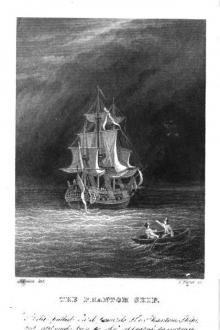
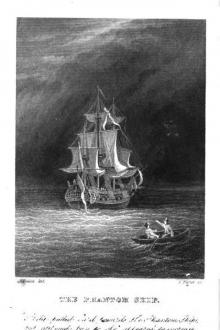
The captain, Hillebrant, and Philip directed their eyes to the quarter pointed out, and thought they could perceive something like a vessel. Gradually the gloom seemed to clear away, and a lambent pale blaze to light up that part of the horizon. Not a breath of wind was on the water — the sea was like a mirror — more and more distinct did the vessel appear, till her hull, masts, and yards were clearly visible. They looked and rubbed their eyes to help their vision, for scarcely could they believe that which they did see. In the centre of the pale light, which extended about fifteen degrees above the horizon, there was indeed a large ship about three miles distant; but although it was a perfect calm, she was to all appearance buffeting in a violent gale, plunging and lifting over a surface that was smooth as glass, now careening to her bearing, then recovering herself. Her topsails and mainsail were furled, and the yards pointed to the wind; she had no sail set, but a close-reefed foresail, a storm staysail, and trysail abaft. She made little way through the water, but apparently neared them fast, driven down by the force of the gale. Each minute she was plainer to the view. At last she was seen to wear, and in so doing, before she was brought to the wind on the other tack, she was so close to them that they could distinguish the men on board: they could see the foaming water as it was hurled from her bows; hear the shrill whistle of the boatswain’s pipes, the creaking of the ship’s timbers, and the complaining of her masts; and then the gloom gradually rose, and in a few seconds she had totally disappeared!
“God in heaven!” exclaimed Mynheer Kloots.
Philip felt a hand upon his shoulder, and the cold darted through his whole frame. He turned round and met the one eye of Schriften, who screamed in his ear —
“Philip Vanderdecken — that’s the Flying Dutchman!”
Chapter Ten.
The sudden gloom which had succeeded to the pale light, had the effect of rendering every object still more indistinct to the astonished crew of the Ter Schilling. For a moment or more not a word was uttered by a soul on board. Some remained with their eyes still strained towards the point where the apparition had been seen, others turned away full of gloomy and foreboding thoughts. Hillebrant was the first who spoke: turning round to the eastern quarter, and observing a light on the horizon, he started, and seizing Philip by the arm, cried out, “What’s that?”
“That is only the moon rising from the bank of clouds,” replied Philip, mournfully.
“Well!” observed Mynheer Kloots wiping his forehead, which was damped with perspiration, “I have been told of this before, but I have mocked at the narration.”
Philip made no reply. Aware of the reality of the vision, and how deeply it interested him, he felt as if he were a guilty person.
The moon had now risen above the clouds, and was pouring her mild pale light over the slumbering ocean. With a simultaneous impulse, every one directed his eyes to the spot where the strange vision had last been seen; and all was a dead, dead calm.
Since the apparition the pilot, Schriften, had remained on the poop; he now gradually approached Mynheer Kloots, and looking round, said —
“Mynheer Kloots, as pilot of this vessel, I tell you that you must prepare for very bad weather.”
“Bad weather!” said Kloots, rousing himself from a deep reverie.
“Yes, bad weather, Mynheer Kloots. There never was a vessel which fell in with — what we have just seen but met with disaster soon afterwards. The very name of Vanderdecken is unlucky — He! he!”
Philip would have replied to this sarcasm, but he could not; his tongue was tied.
“What has the name of Vanderdecken to do with it?” observed Kloots.
“Have you not heard, then? The captain of that vessel we have just seen is a Mynheer Vanderdecken — he is the Flying Dutchman!”
“How know you that, pilot?” inquired Hillebrant.
“I know that, and much more, if I chose to tell,” replied Schriften; “but never mind, I have warned you of bad weather, as is my duty;” and, with these words, Schriften went down the poop-ladder.
“God in heaven! I never was so puzzled and so frightened in my life,” observed Kloots. “I don’t know what to think or say. — What think you, Philip? was it not supernatural?”
“Yes,” replied Philip, mournfully. “I have no doubt of it.”
“I thought the days of miracles had passed,” said the captain, “and that we were now left to our own exertions, and had no other warnings but those the appearance of the heavens gave us.”
“And they warn us now,” observed Hillebrant. “See how that bank of clouds has risen within these five minutes — the moon has escaped from it but it will soon catch her again — and see, there is a flash of lightning in the north-west.”
“Well, my sons, I can brave the elements as well as any man, and do my best. I have cared little for gales or stress of weather; but I like not such a warning as we have had tonight. My heart’s as heavy as lead, and that’s the truth. Philip, send down for the bottle of schnapps, if it is only to clear my brain a little.”
Philip was glad of an opportunity to quit the poop; he wished to have a few minutes to recover himself and collect his own thoughts. The appearance of the Phantom Ship had been to him a dreadful shock; not that he had not fully believed in its existence; but still, to have beheld, to have been so near that vessel — that vessel in which his father was fulfilling his awful doom — that vessel on board of which he felt sure that his own destiny was to be worked out — had given a whirl to his brain. When he had heard the sound of the boatswain’s whistle on board of her, eagerly had he stretched his earing to catch the order given — and given, he was convinced, in his father’s voice. Nor had his eyes been less called to aid in his attempt to discover the features and dress of those moving on her decks. As soon, then, as he had sent the boy up to Mynheer Kloots Philip hastened to his cabin and buried his face in the coverlid of his bed, and then he prayed — prayed until he had recovered his usual energy and courage, and brought his mind to that state of composure which could enable him to look forward calmly to danger and difficulty, and feel prepared to meet it with the heroism of a martyr.
Philip remained below not more than half an hour. On his return to the deck, what a change had taken place! He had left the vessel floating motionless on the still waters, with her lofty sails hanging down listlessly from the yards. The moon then soared aloft in her beauty, reflecting the masts and sails of the ship in extended lines upon the smooth sea. Now all was dark: the water rippled short and broke in foam; the smaller and lofty sails had been taken in, and the vessel was cleaving through the water; and the wind, in fitful gusts and angry moanings, proclaimed too surely that it had been awakened up to wrath, and was gathering its strength for destruction. The men were still busy reducing the sails, but they worked gloomily and discontentedly. What Schriften, the pilot, had said to them, Philip knew not; but that they avoided him and appeared to look upon him with feelings of ill-will, was evident. And each minute the gale increased.
“The wind is not steady,” observed Hillebrant: “there is no saying from which quarter the storm may blow: it has already veered round five points. Philip, I don’t much like the appearance of things, and I may say with the captain that my heart is heavy.”
“And, indeed, so is mine,” replied Philip; “but we are in the hands of a merciful Providence.”
“Hard a-port! flatten in forward! brail up the trysail, my men! Be smart!” cried Kloots, as from the wind’s chopping round to the northward and westward, the ship was taken aback, and careened low before it. The rain now came down in torrents, and it was so dark that it was with difficulty they could perceive each other on the deck.
“We must clew up the topsails while the men can get upon the yards. See to it forward, Mr Hillebrant.”
The lightning now darted athwart the firmament, and the thunder pealed.
“Quick! quick, my men, let’s furl all!”
The sailors shook the water from their streaming clothes, some worked, others took advantage of the night to hide themselves away, and commune with their own fears.
All canvass was now taken off the ship, except the fore-staysail, and she flew to the southward with the wind on her quarter. The sea had now risen, and roared as it curled in foam, the rain fell in torrents, the night was dark as Erebus, and the wet and frightened sailors sheltered themselves under the bulwarks. Although many had deserted from their duty, there was not one who ventured below that night. They did not collect together as usual — every man preferred solitude and his own thoughts. The Phantom Ship dwelt on their imaginations and oppressed their brains.
It was an interminably long and terrible night — they thought the day would never come. At last the darkness gradually changed to a settled sullen grey gloom — which was day. They looked at each other, but found no comfort in meeting each other’s eyes. There was no one countenance in which a beam of hope could be found lurking. They were all doomed — they remained crouched where they had — sheltered themselves during the night, and said nothing.
The sea had now risen mountains high, and more than once had struck the ship abaft. Kloots was at the binnacle, Hillebrant and Philip at the helm, when a wave curled high over the quarter, and poured itself in resistless force upon the deck. The captain and his two mates were swept away, and dashed almost senseless against the bulwarks — the binnacle and compass were broken into fragments — no one ran to the helm — the vessel broached to — the seas broke clear over her, and the mainmast went by the board.