Complete works of freder.., p.436
Complete Works of Frederick Marryat,
p.436


“Well, Philip, what did you hear me say?” inquired his mother, with tremulous anxiety.
“You said, mother, that there was money in that room which would save us; and then you screamed and raved, and said that you preferred death. Now, mother, what is there in that chamber, and why has it been so long shut up? Either I know that, or I go to sea.”
At the commencement of this address of Philip, his mother appeared to be transfixed, and motionless as a statue; gradually her lips separated, and her eyes glared; she seemed to have lost the power of reply; she put her hand to her right side, as if to compress it, then both her hands, as if to relieve herself from excruciating torture: at last she sank, with her head forward, and the blood poured out of her mouth.
Philip sprang from the table to her assistance, and prevented her from falling on the floor. He laid her on the couch, watching with alarm the continued effusion.
“Oh! mother — mother, what is this?” cried he, at last, in great distress.
For some time his mother could make him no reply; she turned further on her side, that she might not be suffocated by the discharge from the ruptured vessel, and the snow-white planks of the floor were soon crimsoned with her blood.
“Speak, dearest mother, if you can,” repeated Philip in agony; “What shall I do? — what shall I give you? God Almighty! what is this?”
“Death, my child, death!” at length replied the poor woman, sinking into a state of unconsciousness.
Philip, now much alarmed, flew out of the cottage, and called the neighbours to his mother’s assistance. Two or three hastened to the call; and as soon as Philip saw them occupied in restoring his mother, he ran as fast as he could to the house of a medical man, who lived about a mile off; — one Mynheer Poots, a little, miserable, avaricious wretch but known to be very skilful in his profession. Philip found Poots at home, and insisted upon his immediate attendance.
“I will come — yes, most certainly,” replied Poots, who spoke the language but imperfectly; “but, Mynheer Vanderdecken, who will pay me?”
“Pay you! my uncle will, directly that he comes home.”
“Your uncle, de Skipper Vanbrennen: no, he owe me four guilders, and he has owed me for a long time. Besides his ship may sink.”
“He shall pay you the four guilders, and for this attendance also,” replied Philip in a rage; “come directly, — while you are disputing, my mother may be dead.”
“But, Mr Philip, I cannot come, now I recollect. I have to see the child of the Burgomaster at Terneuse,” replied Mynheer Poots.
“Look you, Mynheer Poots,” exclaimed Philip, red with passion; “you have but to choose, — will you go quietly, or must I take you there? You’ll not trifle with me.”
Here Mynheer Poots was under considerable alarm, for the character of Philip Vanderdecken was well known.
“I will come by-and-by, Mynheer Philip, if I can.”
“You’ll come now, you wretched old miser,” exclaimed Philip, seizing hold of the little man by the collar, and pulling him out of his door.
“Murder! murder!” cried Poots, as he lost his legs, and was dragged along by the impetuous young man.
Philip stopped, for he perceived that Poots was black in the face.
“Must I then choke you, to make you go quietly? for, hear me, go you shall, alive or dead.”
“Well, then,” replied Poots, recovering himself, “I will go, but I’ll have you in prison to-night: and, as for your mother, I’ll not — no, that I will not — Mynheer Philip, depend upon it.”
“Mark me, Mynheer Poots,” replied Philip, “as sure as there is a God in heaven, if you do not come with me, I’ll choke you now; and when you arrive, if you do not your best for my poor mother, I’ll murder you there. You know that I always do what I say, so now take my advice, come along quietly, and you shall certainly be paid, and well paid — if I sell my coat.”
This last observation of Philip, perhaps, had more effect than even his threats. Poots was a miserable little atom, and like a child in the powerful grasp of the young man. The doctor’s tenement was isolated, and he could obtain no assistance until within a hundred yards of Vanderdecken’s cottage; so Mynheer Poots decided that he would go — first, because Philip had promised to pay him, and secondly, because he could not help it.
This point being settled, Philip and Mynheer Poots made all haste to the cottage; and on their arrival, they found his mother still in the arms of two of her female neighbours, who were bathing her temples with vinegar. She was in a state of consciousness, but she could not speak; Poots ordered her to be carried up stairs and put to bed, and pouring some acids down her throat, hastened away with Philip to procure the necessary remedies.
“You will give your mother that directly, Mynheer Philip,” said Poots, putting a phial into his hand; “I will now go to the child of the Burgomaster, and will afterwards come back to your cottage.”
“Don’t deceive me,” said Philip, with a threatening look.
“No, no, Mynheer Philip, I would not trust to your uncle Vanbrennen for payment, but you have promised, and I know that you always keep your word. In one hour I will be with your mother; but you yourself must now be quick.”
Philip hastened home. After the potion had been administered, the bleeding was wholly stopped; and in half an hour, his mother could express her wishes in a whisper. When the little doctor arrived, he carefully examined his patient, and then went down stairs with her son into the kitchen.
“Mynheer Philip,” said Poots, “by Allah! I have done my best, but I must tell you that I have little hopes of your mother rising from her bed again. She may live one day or two days, but not more. It is not my fault, Mynheer Philip,” continued Poots, in a deprecating tone.
“No, no; it is the will of Heaven,” replied Philip, mournfully.
“And you will pay me, Mynheer Vanderdecken?” continued the doctor after a short pause.
“Yes,” replied Philip in a voice of thunder, and starting from a reverie. After a moment’s silence, the doctor recommenced:
“Shall I come to-morrow, Mynheer Philip? You know that will be a charge of another guilder: it is of no use to throw away money or time either.”
“Come to-morrow, come every hour, charge what you please; you shall certainly be paid,” replied Philip, curling his lip with contempt.
“Well, it is as you please. As soon as she is dead the cottage and the furniture will be yours, and you will sell them of course. Yes, I will come. You will have plenty of money. Mynheer Philip, I would like the first offer of the cottage, if it is to let.”
Philip raised his arm in the air as if to crush Mynheer Poots, who retreated to the corner.
“I did not mean until your mother was buried,” said Poots, in a coaxing tone.
“Go, wretch, go!” said Philip, covering his face with his hands, as he sank down upon the blood-stained couch.
After a short interval, Philip Vanderdecken returned to the bedside of his mother, whom he found much better; and the neighbours, having their own affairs to attend to, left them alone. Exhausted with the loss of blood, the poor woman slumbered for many hours, during which she never let go the hand of Philip, who watched her breathing in mournful meditation.
It was about one o’clock in the morning when the widow awoke. She had in a great degree recovered her voice, and thus she addressed her son: —
“My dear, my impetuous boy, and have I detained you here a prisoner so long?”
“My own inclination detained me, mother. I leave you not to others until you are up and well again.”
“That, Philip, I shall never be. I feel that death claims me; and O my son, were it not for you, how should I quit this world rejoicing! I have long been dying, Philip, — and long, long have I prayed for death.”
“And why so, mother?” replied Philip, bluntly; “I’ve done my best.”
“You have, my child, you have: and may God bless you for it. Often have I seen you curb your fiery temper — restrain yourself when justified in wrath — to spare a mother’s feelings. ’Tis now some days that even hunger has not persuaded you to disobey your mother. And, Philip, you must have thought me mad or foolish to insist so long, and yet to give no reason. I’ll speak — again — directly.”
The widow turned her head upon the pillow, and remained quiet for some minutes; then, as if revived, she resumed:
“I believe I have been mad at times — have I not, Philip? And God knows I have had a secret in my heart enough to drive a wife to frenzy. It has oppressed me day and night, worn my mind, impaired my reason, and now, at last, thank Heaven! it has overcome this mortal frame: the blow is struck, Philip — I’m sure it is. I wait but to tell you all, — and yet I would not,— ‘twill turn your brain as it has turned mine, Philip.”
“Mother,” replied Philip, earnestly, “I conjure you, let me hear this killing secret. Be heaven or hell mixed up with it, I fear not. Heaven will not hurt me and Satan I defy.”
“I know thy bold, proud spirit, Philip, — thy strength of mind. If any one could bear the load of such a dreadful tale, thou couldst. My brain, alas! was far too weak for it; and I see it is my duty to tell it to thee.”
The widow paused as her thoughts reverted to that which she had to confide; for a few minutes the tears rained down her hollow cheeks; she then appeared to have summoned resolution, and to have regained strength.
“Philip, it is of your father I would speak. It is supposed — that he was — drowned at sea.”
“And was he not, mother?” replied Philip, with surprise.
“O no!”
“But he has long been dead, mother?”
“No, — yes, — and yet — no,” said the widow, covering her eyes. Her brain wanders, thought Philip, but he spoke again:
“Then where is he, mother?”
The widow raised herself, and a tremor visibly ran through her whole frame, as she replied —
“In Living Judgment.”
The poor woman then sank down again upon the pillow, and covered her head with the bedclothes, as if she would have hid herself from her own memory. Philip was so much perplexed and astounded, that he could make no reply. A silence of some minutes ensued when, no longer able to bear the agony of suspense, Philip faintly whispered —
“The secret, mother, the secret; quick, let me hear it.”
“I can now tell all, Philip,” replied his mother, in a solemn tone of voice. “Hear me, my son. Your father’s disposition was but too like your own; — O may his cruel fate be a lesson to you, my dear, dear child! He was a bold, a daring, and, they say, a first-rate seaman. He was not born here, but in Amsterdam; but he would not live there, because he still adhered to the Catholic religion. The Dutch, you know, Philip, are heretics, according to our creed. It is now seventeen years or more that he sailed for India, in his fine ship the Amsterdammer, with a valuable cargo. It was his third voyage to India, Philip, and it was to have been, if it had so pleased God, his last, for he had purchased that good ship with only part of his earnings, and one more voyage would have made his fortune. O! how often did we talk over what we would do upon his return, and how these plans for the future consoled me at the idea of his absence, for I loved him dearly, Philip, — he was always good and kind to me! and after he had sailed, how I hoped for his return! The lot of a sailor’s wife is not to be envied. Alone and solitary for so many months, watching the long wick of the candle and listening to the howling of the wind — foreboding evil and accident — wreck and widowhood. He had been gone about six months, Philip, and there was still a long dreary year to wait before I could expect him back. One night, you, my child, were fast asleep; you were my only solace — my comfort in my loneliness. I had been watching over you in your slumbers: you smiled and half pronounced the name of mother; and at last I kissed your unconscious lips, and I knelt and prayed — prayed for God’s blessing on you, my child, and upon him too — little thinking, at the time, that he was so horribly, so fearfully cursed.”
The widow paused for breath, and then resumed. Philip could not speak. His lips were sundered, and his eyes riveted upon his mother, as he devoured her words.
“I left you and went down stairs into that room, Philip, which since that dreadful night has never been re-opened. I sate me down and read, for the wind was strong, and when the gale blows, a sailor’s wife can seldom sleep. It was past midnight, and the rain poured down. I felt unusual fear, — I knew not why, I rose from the couch and dipped my finger in the blessed water, and I crossed myself. A violent gust of wind roared round the house and alarmed me still more. I had a painful, horrible foreboding; when, of a sudden, the windows and window-shutters were all blown in, the light was extinguished, and I was left in utter darkness. I screamed with fright — but at last I recovered myself, and was proceeding towards the window that I might reclose it, when whom should I behold, slowly entering at the casement, but — your father, — Philip! — Yes, Philip, — it was your father!”
“Merciful God!” muttered Philip, in a low tone almost subdued into a whisper.
“I knew not what to think, — he was in the room; and although the darkness was intense, his form and features were as clear and as defined as if it were noon-day. Fear would have inclined me to recoil from, — his loved presence to fly towards him. I remained on the spot where I was, choked with agonising sensations. When he had entered the room, the windows and shutters closed of themselves, and the candle was relighted — then I thought it was his apparition, and I fainted on the floor.
“When I recovered I found myself on the couch, and perceived that a cold (O how cold!) and dripping hand was clasped in mine. This reassured me, and I forgot the supernatural signs which accompanied his appearance. I imagined that he had been unfortunate, and had returned home. I opened my eyes, and beheld my loved husband and threw myself into his arms. His clothes were saturated with the rain; I felt as if I had embraced ice — but nothing can check the warmth of woman’s love, Philip. He received my caresses but he caressed not again: he spoke not, but looked thoughtful and unhappy. ‘William — William,’ cried I; ‘speak, to your dear Catherine.’
“‘I will,’ replied he, solemnly, ‘for my time is short.’
“‘No, no, you must not go to sea again; you have lost your vessel but you are safe. Have I not you again?’
“‘Alas! no — be not alarmed, but listen? for my time is short. I have not lost my vessel, Catherine, but I have lost! — Make no reply, but listen; I am not dead, nor yet am I alive. I hover between this world and the world of spirits. Mark me.’
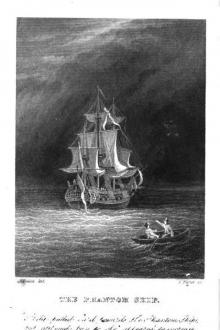
“‘For nine weeks did I try to force my passage against the elements round the stormy Cape, but without success; and I swore terribly. For nine weeks more did I carry sail against the adverse winds and currents, and yet could gain no ground and then I blasphemed, — ay, terribly blasphemed. Yet still I persevered. The crew, worn out with long fatigue, would have had me return to the Table Bay; but I refused; nay, more, I became a murderer — unintentionally, it is true, but still a murderer. The pilot opposed me, and persuaded the men to bind me, and in the excess of my fury, when he took me by the collar, I struck at him; he reeled; and, with the sudden lurch of the vessel, he fell overboard, and sank. Even this fearful death did not restrain me; and I swore by the fragment of the Holy Cross, preserved in that relic now hanging round your neck, that I would gain my point in defiance of storm and seas, of lightning, of heaven, or of hell, even if I should beat about until the Day of Judgment.’
“‘My oath was registered in thunder, and in streams of sulphurous fire. The hurricane burst upon the ship, the canvass flew away in ribbons; mountains of seas swept over us, and in the centre of a deep o’erhanging cloud, which shrouded all in utter darkness, were written in letters of livid flame, these words — Until the Day of Judgement.’
“‘Listen to me, Catherine, my time is short. One hope alone remains, and for this am I permitted to come here. Take this letter.’ He put a sealed paper on the table. ‘Read it, Catherine, dear, and try if you can assist me. Read it, and now farewell — my time is come.’
“Again the window and window-shutters burst open — again the light was extinguished, and the form of my husband was, as it were, wafted in the dark expanse. I started up and followed him with outstretched arms and frantic screams as he sailed through the window; — my glaring eyes beheld his form borne away like lightning on the wings of the wild gale, till it was lost as a speck of light, and then it disappeared. Again the windows closed, the light burned, and I was left alone!
“Heaven, have mercy! My brain! — my brain! — Philip! — Philip!” shrieked the poor woman; “don’t leave me — don’t — don’t — pray don’t!”
During these exclamations the frantic widow had raised herself from the bed, and, at the last, had fallen into the arms of her son. She remained there some minutes without motion. After a time Philip felt alarmed at her long quiescence; he laid her gently down upon the bed, and as he did so her head fell back — her eyes were turned — the widow Vanderdecken was no more.
Chapter Two.
Philip Vanderdecken, strong as he was in mental courage, was almost paralysed by the shock when he discovered that his mother’s spirit had fled; and for some time he remained by the side of the bed, with his eyes fixed upon the corpse, and his mind in a state of vacuity. Gradually he recovered himself; he rose, smoothed down the pillow, closed her eyelids, and then clasping his hands, the tears trickled down his manly cheeks. He impressed a solemn kiss upon the pale white forehead of the departed, and drew the curtains round the bed.
“Poor mother!” said he, sorrowfully, as he completed his task, “at length thou hast found rest, — but thou hast left thy son a bitter legacy.”