Complete works of freder.., p.475
Complete Works of Frederick Marryat,
p.475


It was two hours before the procession, which had paraded through almost every important street in Goa, arrived at the cathedral in which the further ceremonies were to be gone through. The barefooted culprits could now scarcely walk, the small sharp flints having so wounded their feet, that their tracks up the steps of the cathedral were marked with blood.
The grand altar of the cathedral was hung with black cloth, and lighted up with thousands of tapers. On one side of it was a throne for the Grand Inquisitor, on the other, a raised platform for the Viceroy of Goa, and his suite. The centre aisle had benches for the prisoners and their godfathers; the other portions of the procession falling off to the right and left to the side aisles, and mixing for the time with the spectators. As the prisoners entered the cathedral, they were led into their seats, those least guilty sitting nearest to the altar, and those who were condemned to suffer at the stake being placed the farthest from it.
The bleeding Amine tottered to her seat, and longed for the hour which was to sever her from a Christian world. She thought not of herself, nor of what she was to suffer: she thought but of Philip; of his being safe from these merciless creatures — of the happiness of dying first, and of meeting him again in bliss.
Worn with long confinement, with suspense and anxiety, fatigued and suffering from her painful walk, and the exposure to the burning sun, after so many months’ incarceration in a dungeon, she no longer shone radiant with beauty; but still there was something even more touching in her care-worn yet still perfect features. The object of universal gaze, she walked with her eyes cast down, and nearly closed; but occasionally, when she did look up, the fire that flashed from them spoke the proud soul within, and many feared and wondered, while more pitied that one so young, and still so lovely, should be doomed to such an awful fate. Amine had not taken her seat in the cathedral more than a few seconds, when, overpowered by her feelings and by fatigue she fell back in a swoon.
Did no one step forward to assist her? to raise her up, and offer her restoratives? No — not one. Hundreds would have done so, but they dared not: she was an outcast, excommunicated, abandoned, and lost; and should any one, moved by compassion for a suffering fellow-creature, have ventured to raise her up he would have been looked upon with suspicion, and most probably have been arraigned, and have had to settle the affair of conscience with the Holy Inquisition.
After a short time two of the officers of the Inquisition went to Amine and raised her again in her seat, and she recovered sufficiently to enable her to retain her posture.
A sermon was then preached by a Dominican monk, in which he portrayed the tender mercies, the paternal love of the Holy Office. He compared the Inquisition to the ark of Noah, out of which all the animals walked after the deluge, but with this difference highly in favour of the Holy Office, that the animals went forth from the ark no better than they went in, whereas those who had gone into the Inquisition with all the cruelty of disposition, and with the hearts of wolves, came out as mild and patient as lambs.
The public accuser then mounted the pulpit, and read from it all the crimes of those who had been condemned, and the punishments which they were to undergo. Each prisoner, as his sentence was read, was brought forward to the pulpit by the officers to hear it, standing up, with his wax candle lighted in his hand. As soon as the sentences of all those whose lives had been spared were read the Grand Inquisitor put on his priestly robes, and followed by several others, took off from them the ban of excommunication (which they were supposed to have fallen under), by throwing holy water on them with a small broom.
As soon as this portion of the ceremony was over, those who were condemned to suffer, and the effigies of those who had escaped by death, were brought up one by one, and their sentences read; the winding up of the condemnation of all was in the same words, “that the Holy Inquisition found it impossible, on account of the hardness of their hearts and the magnitude of their crimes, to pardon them. With great concern it handed them over to secular justice to undergo the penalty of the laws; exhorting the authorities at the same time to show clemency and mercy towards the unhappy wretches, and if they must suffer death, that at all events it might be without the spilling of blood.” What mockery was this apparent intercession not to shied blood, when, to comply with their request, they substituted the torment and agony of the stake!
Amine was the last who was led forward to the pulpit, which was fixed against one of the massive columns of the centre aisle, close to the throne occupied by the Grand inquisitor. “You, Amine Vanderdecken,” cried the public accuser. At this moment an unusual bustle was heard in the crowd under the pulpit, there was struggling and expostulation, and the officers raised their wands for silence and decorum — but it continued.
“You, Amine Vanderdecken, being accused—”
Another violent struggle; and from the crowd darted a young man, who rushed to where Amine was standing, and caught her in his arms.
“Philip! Philip!” screamed Amine falling on his bosom; as he caught her, the cap of flames fell off her head and rolled along the marble pavement. “My Amine — my wife — my adored one — is it thus we meet? My lord, she is innocent. Stand off, men,” continued he to the officers of the Inquisition, who would have torn them asunder: “stand off, or your lives shall answer for it.”
This threat to the officers, and the defiance of all rules, were not to be borne; the whole cathedral was in a state of commotion, and the solemnity of the ceremony was about to be compromised. The Viceroy and his followers had risen from their chairs to observe what was passing, and the crowd was pressing on, when the Grand Inquisitor gave his directions, and other officers hastened to the assistance of the two who had led Amine forward, and proceeded to disengage her from Philip’s arms. The struggle was severe. Philip appeared to be endued with the strength of twenty men; and it was some minutes before they could succeed in separating him and when they had so done, his struggles were dreadful.
Amine, also, held by two of the familiars, shrieked, as she attempted once more, but in vain, to rush into her husband’s arms. At last, by a tremendous effort, Philip released himself; but as soon as he was released, he sank down helpless on the pavement; the exertion had caused the bursting of a blood-vessel, and he lay without motion.
“Oh God! Oh God! they have killed him! monsters — murderers! — let me embrace him but once more!” cried Amine, frantically.
A priest now stepped forward — it was Father Mathias — with sorrow in his countenance; he desired some of the bystanders to carry out Philip Vanderdecken, and Philip, in a state of insensibility, was borne away from the sight of Amine, the blood streaming from his mouth.
Amine’s sentence was read — she heard it not, her brain was bewildered. She was led back to her seat, and then it was that all her courage, all her constancy and fortitude gave way; and during the remainder of the ceremony, she filled the cathedral with her wild hysterical sobbing; all entreaties or threats being wholly lost upon her.
All was now over except the last and most tragical scene of the drama. The culprits who had been spared were led back to the Inquisition by their godfathers, and those who had been sentenced were taken down to the banks of the river to suffer. It was on a large open space, on the left of the custom-house, that this ceremony was to be gone through. As in the cathedral raised thrones were prepared for the Grand Inquisitor and the who, in state headed the procession, followed by an immense concourse of people. Thirteen stakes had been set up, eight for the living, or the dead. The executioners were sitting on, or standing by, the piles of wood and faggots, waiting for their victims. Amine could not walk she was at first supported by the familiars, and then carried by them, to the stake which had been assigned for her. When they put her on her feet opposite to it, her courage appeared to revive, she walked boldly up, folded her arms and leant against it.
The executioners now commenced their office: the chains were passed round Amine’s body — the wood and faggots piled around her. The same preparations had been made with all the other culprits, and the confessors stood by the side of each victim. Amine waved her hand indignantly to those who approached her, when Father Mathias, almost breathless, made his appearance from the crowd, through which he had forced his way.
“Amine Vanderdecken — unhappy woman! had you been counselled by me this would not have been. Now it is too late, but not too late to save your soul. Away then with this obstinacy — this hardness of heart; call upon the blessed Saviour, that he may receive your spirit — call upon his wound’s for mercy. It is the eleventh hour, but not too late. Amine,” continued the old man with tears, “I implore you, I conjure you. At least, may this load of trouble be taken from my heart.”
“‘Unhappy woman!’ you say?” replied she, “say rather, ‘unhappy priest:’ for Amine’s sufferings will soon be over, while you must still endure the torments of the damned. Unhappy was the day when my husband rescued you from death. Still more unhappy the compassion which prompted him to offer you an asylum and a refuge. Unhappy the knowledge of you from the first day to the last. I leave you to your conscience — if conscience you retain — nor would I change this cruel death for the pangs which you in your future life will suffer. Leave me — I die in the faith of my forefathers, and scorn a creed that warrants such a scene as this.”
“Amine Vanderdecken,” cried the priest on his knees, clasping his hands in agony.
“Leave me, Father.”
“There is but a minute left — for the love of God—”
“I tell you then, leave me — that minute is my own.”
Father Mathias turned away in despair, and the tears coursed down the old man’s cheeks. As Amine said, his misery was extreme.
The head executioner now inquired of the confessors whether the culprits died in the true faith? If answered in the affirmative, a rope was passed round their necks and twisted to the stake, so that they were strangled before the fire was kindled. All the other culprits had died in this manner; and the head executioner inquired of Father Mathias, whether Amine had a claim to so much mercy. The old priest answered not, but shook his head.
The executioner turned away. After a moment’s pause, Father Mathias followed him, and seized him by the arm saying, in a faltering voice, “Let her not suffer long.”
The Grand Inquisitor gave the signal, and the fires were all lighted at the same moment. In compliance with the request of the priest, the executioner had thrown a quantity of wet straw upon Amine’s pile, which threw up a dense smoke before it burst into flames.
“Mother! mother! I come to thee!” were the last words heard from Amine’s lips.
The flames soon raged furiously, ascending high above the top of the stake to which she had been chained. Gradually they sunk down; and only when the burning embers covered the ground, a few fragments of bones hanging on the chain were all that remained of the once peerless and high-minded Amine.
Chapter Forty One.
Years have passed away since we related Amine’s sufferings and cruel death; and now once more we bring Philip Vanderdecken on the scene. And during this time, where has he been? A lunatic — at one time frantic, chained, coerced with blows; at others, mild and peaceable. Reason occasionally appeared to burst out again, as the sun on a cloudy day, and then it was again obscured. For many years there was one who watched him carefully, and lived in hope to witness his return to a sane mind; he watched in sorrow and remorse — he died without his desires being gratified. This was Father Mathias!
The cottage at Terneuse had long fallen into ruin; for many years it waited the return of its owners, and at last the heirs-at-law claimed and recovered the substance of Philip Vanderdecken. Even the fate of Amine had passed from the recollection of most people; although her portrait over burning coals, with her crime announced beneath it, still hangs — as is the custom in the church of the Inquisition — attracting from its expressive beauty, the attention of the most careless passers-by.
But many, many years have rolled away — Philip’s hair is white — his once powerful frame is broken down — and he appears much older than he really is. He is now sane; but his vigour is gone. Weary of life, all he wishes for is to execute his mission — and then to welcome death.
The relic has never been taken from him: he has been discharged from the lunatic-asylum, and has been provided with the means of returning to his country. Alas! he has now no country — no home — nothing in the world to induce him to remain in it. All he asks is — to do his duty and to die.
The ship was ready to sail for Europe; and Philip Vanderdecken went on board — hardly caring whither he went. To return to Terneuse was not his object; he could not bear the idea of revisiting the scene of so much happiness and so much misery. Amine’s form was engraven on his heart, and he looked forward with impatience to the time when he should be summoned to join her in the land of spirits.
He had awakened as from a dream, after so many years of aberration of intellect. He was no longer the sincere Catholic that he had been; for he never thought of religion without his Amine’s cruel fate being brought to his recollection. Still he clung on to the relic — he believed in that — and that only. It was his god — his creed — his everything — the passport for himself and for his father into the next world — the means whereby he should join his Amine — and for hours would he remain holding in his hand that object so valued — gazing upon it — recalling every important event in his life, from the death of his poor mother, and his first sight of Amine, to the last dreadful scene. It was to him a journal of his existence, and on it were fixed all his hopes for the future.
“When! oh when is it to be accomplished?” was the constant subject of his reveries. “Blessed indeed will be the day when I leave this world of hate, and seek that other in which the weary are at rest.”
The vessel on board of which Philip was embarked as a passenger was the Nostra Señora da Monte, a brig of three hundred tons, bound for Lisbon. The captain was an old Portuguese, full of superstition, and fond of arrack — a fondness rather unusual with the people of his nation. They sailed from Goa, and Philip was standing abaft, and sadly contemplating the spire of the cathedral, in which he had last parted with his wife, when his elbow was touched, and he turned round.
“Fellow-passenger, again!” said a well-known voice — it was that of the pilot Schriften.
There was no alteration in the man’s appearance; he showed no marks of declining years; his one eye glared as keenly as ever.
Philip started, not only at the sight of the man, but at the reminiscences which his unexpected appearance brought to his mind. It was but for a second, and he was again calm and pensive.
“You here again, Schriften?” observed Philip. “I trust your appearance forebodes the accomplishment of my task.”
“Perhaps it does,” replied the pilot; “we both are weary.”
Philip made no reply; he did not even ask Schriften in what manner he had escaped from the fort; he was indifferent about it; for he felt that the man had a charmed life.
“Many are the vessels that have been wrecked, Philip Vanderdecken, and many the souls summoned to their account by meeting with your father’s ship, while you have been so long shut up,” observed the pilot.
“May our next meeting with him be more fortunate — may it be the last!” replied Philip.
“No, no! rather may he fulfil his doom, and sail till the day of judgment!” replied the pilot, with emphasis.
“Vile caitiff! I have a foreboding that you will not have your detestable wish. Away! — leave me! or you shall find, that although this head is blanched by misery, this arm has still some power.”
Schriften scowled as he walked away; he appeared to have some fear of Philip, although it was not equal to his hate. He now resumed his former attempts of stirring up the ship’s company against Philip, declaring that he was a Jonah, who would occasion the loss of the ship, and that he was connected with the Flying Dutchman. Philip very soon observed that he was avoided; and he resorted to counter-statements, equally injurious to Schriften, whom he declared to be a demon. The appearance of Schriften was so much against him, while that of Philip, on the contrary, was so prepossessing, that the people on board hardly knew what to think. They were divided: some were on the side of Philip — some on that of Schriften; the captain and many others looking with equal horror upon both, and longing for the time when they could be sent out of the vessel.
The captain, as we have before observed, was very superstitious, and very fond of his bottle. In the morning he would be sober and pray; in the afternoon he would be drunk and swear at the very saints whose protection he had invoked but a few hours before.
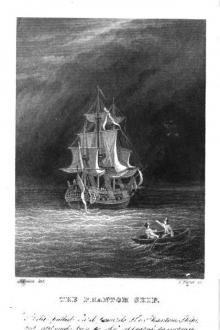
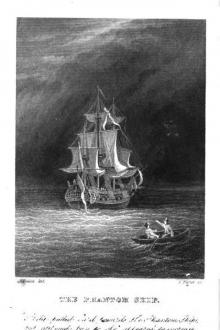
“May holy Saint Antonio preserve us, and keep us from temptation,” said he, on the morning after a conversation with the passengers about the Phantom Ship. “All the saints protect us from harm,” continued he, taking off his hat reverentially and crossing himself. “Let me but rid myself of these two dangerous men without accident, and I will offer up a hundred wax candles, of three ounces each, to the shrine of the Virgin, upon my safe anchoring off the tower of Belem.” In the evening he changed his language.