Complete works of freder.., p.855
Complete Works of Frederick Marryat,
p.855


“And you replied — ?”
“And I replied, that my permission was a matter of no consequence, for that you were entirely your own mistress, and that my influence would be exerted only to induce you to follow your own judgment and inclinations, and to consult for your own happiness.”
“Answered like a good and wise brother. And then he — ?”
“Asked, whether I could form any opinion of the state of your feelings. To which I replied, that I could only say that I had reason to suppose that your hand and heart were neither of them engaged, and that the field was open to him if he chose to make a trial. But that I had no opportunity of judging how you felt toward him. I also said, that I thought you knew very little of each other, and that his attachment must have grown up too rapidly to have taken a very strong root. But there I found I was mistaken. For he assured me that it was from esteem of your character, and admiration of your energy, courage, and constancy under adversity, not from the mere prettiness of your face, or niceness of your manners, that he first began to love you. And I since ascertained that there is scarce an incident of your life with which he has not made himself acquainted, and that in the most delicate and guarded manner. I confess, Valerie, that it has raised him greatly in my estimation to find that he looks upon marriage as a thing so serious and solemn, and does not rush into it from mere fancy for a pretty face and lady-like accomplishments.”
“I think so too, Auguste,” I replied. “But I wish we knew a little more about him. His character and principles, I mean.”
Auguste looked at me for a moment, in great surprise. “What an exceedingly matter-of-fact girl you are, Valerie; I never knew any one in the least like you. Do you know I am afraid you are a little—” and he paused a moment, as if he hardly knew how to proceed.
“A little hard and cold, is it not, dear Auguste?” said I, throwing my arms about him. “No, no, indeed I am not; but I have been cast so long on my own sole resources, and obliged to rely only on my own energy and clear-sightedness, that I always try to look at both sides of the question, and not to let my feelings overpower me, until I have proved that it is good and wise to do so. Consider, too, Auguste, that on this step depends the whole happiness or misery of a girl’s existence.”
“You are right, Valerie, and I am wrong. But tell me, do you love him?”
“I do, Auguste. I like him better than any man I have ever seen. He is the only man of whom I could think as a husband — and I have for some time past been fearful of liking him — loving him, too much, not knowing, though I did believe and hope, that he reciprocated my feelings. And now, if I knew but a little more of his principles and character, I would not hesitate.”
“Then you need not hesitate, dearest Valerie; for, as if to obviate this objection, he showed me, in the most delicate manner, private letters from his oldest and most intimate friends, and especially from Mr — , a most respectable clergyman, who lives at Hendon, by whom he was educated, and with whom he has maintained constant intercourse and correspondence ever since. This alone speaks very highly in his favour, and the terms in which he writes to his pupil, are such as prove them both to be men of the highest character for worth, integrity, and virtue. He has proposed, moreover, that I should ride down with him to-morrow to Hendon, to visit Mr — , and to hear from his own lips yet more of his character and conduct, that is to say, if I can give him any hopes of ultimate success.”
“Well, Auguste,” I replied, “I think with you, that all this speaks very highly in favour of your friend; and I think that the best thing you can do, is to take this ride which he proposes, and see his tutor. In the meantime, I will drive down to Kew, and speak with our good friend, Judge Selwyn, on the subject. To-morrow evening I will see the Count, and hear whatever he desires to say to me.”
This was a very matter-of-fact way of dealing with the affair, certainly; but what Auguste had said, was in some sort true. I was in truth rather a matter-of-fact girl, and I never found that I suffered by it in the least; for I certainly was not either worldly or selfish, and the feelings do, as certainly, require to be guided and controlled by sober reason.
After coming to this conclusion, I showed Madame d’Albret’s letter to Auguste, and we came to the decision, also, that, under the circumstances, Auguste should immediately, on his return, communicate the fact of my being alive and in good circumstances, to my father; leaving it at his discretion to inform my mother of the facts or not, as he might judge expedient.
At a very early hour next morning, I took a glass-coach and drove down to Kew, where I arrived, greatly to the astonishment of the whole family, just as they were sitting down to breakfast; and, when I stated that I had come to speak on very urgent business with the Judge, he desired my carriage to return to town, and proposed to carry me back himself, so that we might kill two birds, as he expressed it, with one stone, holding a consultation in his carriage, while on his way to court.
As soon as we got into the coach, while I was hesitating how to open the subject, which was certainly a little awkward for a young girl, the Judge took up the discourse —
“Well, Valerie,” he said, “I suppose you want to know the result of the inquiries which you were so unwilling that I should make about the Count de Chavannes. Is not that true?”
“It is perfectly true, Judge — though I do not know how you ever have divined it.”
“It is lucky, at least, that I consulted my own judgment, rather than your fancy; for otherwise I should have had no information to give you.”
“But as it is, Judge?”
“Why as it is, Mademoiselle Valerie, you may marry him as soon as ever he asks you, and think yourself a very lucky young lady into the bargain. He has a character such as not one man in fifty can produce. He is rich, liberal without being extravagant, never plays, is by no means dissipated, and in all respects is a man of honour, ability, and character; such is what I have learned from a quarter where there can be no mistake.”
I was a good deal affected for a moment or two, and was very near bursting into tears. The good Judge took my hand in his, and spoke soothingly and almost caressingly, bidding me confide in him altogether, and he would advise me, as if he were my own father.
I did so accordingly; and, while he approved highly of all that I had done, and of the delicate and gentlemanly manner in which the Count had acted, he fully advised me to deal frankly and directly with him. “You like him, I am sure, Valerie; indeed, I believe I knew that before you did yourself, and I have no doubt he will make you an admirable husband. Tell him all, show him this letter of your friend Madame d’Albret’s, about your mother, and if he desires it, as I dare say he will, marry him at once, and set out together with Auguste, for France, when his leave of absence is expired, and go directly to Paris with your husband. As a married woman, your parents will have no authority of any kind over you, and I think it is your duty to do so.”
I agreed with him at once; and, when in the evening Auguste returned with the Count from a visit to his former tutor, which had been in all respects satisfactory, and left me alone with Monsieur de Chavannes, everything was determined without difficulty.
Love-scenes and courtships, though vastly interesting to the actors, are always the dullest things in the world to bystanders; I shall therefore proceed at once to the end, merely stating that the Count was all, and did all, that the most exigeante of women could have required — that from the first to the last he was full of delicacy, of tenderness, and honour, and that after twelve years of a happy life with him, I have never had cause to repent for a moment that I consented to give him the hand, which he so ardently desired.
The joy of Madame Gironac can be imagined better than described, as well as the manner in which she bustled about my trousseau and my outfit for France, as it was determined that the Judge’s plan should be adopted to the letter, and that we should start directly from St George’s to Dover and Calais.
Never, perhaps, was a marriage more rapidly organised and completed. The law-business was expedited with all speed by Charles Selwyn; Madame Bathurst, the Jervises, the Gironacs, and the Selwyns were alone present at the wedding, and, though we were all dear friends, there was no affectation of tears or lamentable partings; for we knew that in heaven’s pleasure, we should all meet again within a few months, as, after our wedding tour was ended, Monsieur de Chavannes proposed to take up his abode in England, the land of his choice, as of his education.
There was no bishop to perform the ceremony, nor any duke to give away the bride. No long array of liveried servants with favours in their buttons and in their hats — no pompous paragraph in the morning papers to describe the beauties of the high-bred bride and the dresses of her aristocratic bridesmaids — but two hearts were united as well as two hands, and Heaven smiled upon the union.
A quick and pleasant passage carried us to Paris, where I was received with raptures by my good old friend, Madame Paon, and with sincere satisfaction by Madame d’Albret, who was proud to recognise her old protégée in the new character of the Comtesse de Chavannes, a character which she imagined reflected no small credit on her tuition and patronage.
The threatened émeute having passed over, Auguste easily obtained a renewal of his leave of absence in order to visit his family at Pau, and, as he preceded us by three days, and travelled with the utmost diligence, he outstripped us by nearly a week, and we found both my parents prepared to receive us, and both really happy at the prosperous tidings.
My poor mother was indeed dying; had we come two days later we should have been too late, for she died in my arms on the day following our arrival, enraptured to find herself relieved from the heinous crime of which she had so long believed herself guilty, and blessing me with her dying lips.
My father who had always loved me, and who had erred through weakness of head only, seemed never to weary of sitting beside me, of holding my hand in his, and of gazing in my face. With Monsieur de Chavannes’ consent, the whole of my little earnings, amounting now to nearly 3500 pounds, was settled on him for his life, and then on my sisters, and the income arising from it, though a mere trifle in England, in that cheap region sufficed with what he possessed of his own, to render his old age affluent and happy.
Thus all my trials ended; and, if the beginning of my career was painful and disastrous, the cares and sorrows of Valerie de Chatenoeuf had been more than compensated by the happiness of Valerie de Chavannes.
I may as well mention here that a few years afterwards, Lionel Dempster married my second sister, Elisée, a very nice and very handsome girl, and has settled very close to the villa which the Count purchased on his return from France, near Windsor, on the lovely Thames, ministering not a little by their company to the bliss of our happy, peaceful life.
My eldest brother, Auguste, is now a Lieutenant-Colonel of the Line, having greatly distinguished himself in Algeria; Nicholas, who never returned to France, has acquired both renown and riches by his musical abilities, and all the younger branches of the family are happily provided for.
I have three sweet children, one boy, and two little girls, and the difficulties and sorrows I experienced, owing to an evil and injudicious course of education, have been so far of use, that they have taught me how to bring up my own children, even more to love and honour than to obey.
Perfect happiness is not allotted to any here below; but few and short have been the latter sorrows, and infinite the blessings vouchsafed by a kind Providence, to the once poor and houseless, but now rich, and honoured, and, better than all, loved Valerie.
THE END
The Shorter Fiction
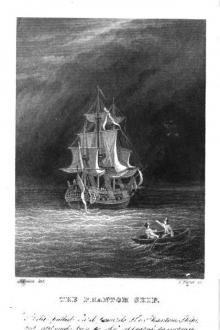
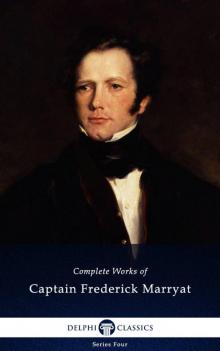
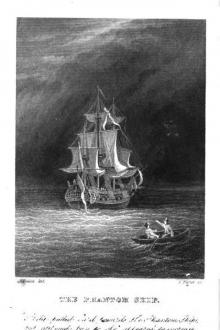
After being educated privately at home, Marryat joined the Royal Navy in 1806 as a Midshipman aboard the HMS Imperieuse (the ship depicted in the foreground)
THE PACHA OF MANY TALES
CONTENTS
Prefatory Note
Chapter I
STORY OF THE CAMEL-DRIVER.
Chapter II
STORY OF THE GREEK SLAVE.
Chapter III
STORY OF THE MONK.
Chapter IV
STORY OF THE MONK.
Chapter V
HUCKABACK.
Chapter VI
Chapter VII
MANUSCRIPT OF THE MONK,
RECORDING THE DISCOVERY OF THE ISLAND OF MADEIRA.
Chapter VIII
Chapter IX
THIRD VOYAGE OF HUCKABACK.
Chapter X
FOURTH VOYAGE OF HUCKABACK.
Chapter XI
FIFTH VOYAGE OF HUCKABACK.
Chapter XII
SIXTH VOYAGE OF HUCKABACK.
Chapter XIII
THE LAST VOYAGE OF HUCKABACK.
Chapter XIV
THE SCARRED LOVER.
Chapter XV
THE STORY OF HUDUSI.
Chapter XVI
Chapter XVII
TALE OF THE ENGLISH SAILOR.
Chapter XVIII
THE WATER-CARRIER.
Chapter XIX
THE WONDROUS TALE OF HAN.
Chapter XX
STORY OF THE OLD WOMAN.
Chapter XXI
Chapter XXII
Prefatory Note
The Pacha of Many Tales, as indeed its title suggests, is constructed in direct imitation of the Arabian Nights. A Pacha of olden days, enchanted by the stories of Schezehezerade, becomes emulous of the great Haroun, and determines to procure his own stock of entertainment. By the assistance of a wily barber-vizier he succeeds in the attempt, and listens with greedy credulity to the marvellous histories herein set forth.
On one occasion an English sailor is dragged into the august presence, and demands, with all the dogged independence of his race, the reasons for such treatment.
“You must tell lies, and you will have gold,” replies the vizier.
“Tell lies,” says Jack Tar, “that is, spin yarns. Well, I can do that.”
The volume before us could not be more suggestively described. It is a collection of admirable short stories of intrigue and adventure, traveller’s wonders narrated with a perfect air of good faith and no regard for truth or probability. All the countries on the globe, and many existing only in the imagination, are called into requisition to produce a brilliant phantasmagoria of manners and customs. The stories move rapidly and defy criticism by the very occasion of their being, invented to amuse and astonish a jaded autocrat.
Hence we feel no shock in reading of an island where the commonest utensils are made of gold, a nursery of whales, five months in the interior of an iceberg, or a journey among the clouds during a thunderstorm. The demand for brevity strengthens Marryat’s style, and saves him from padding. He is very happy in contriving expediences, and evinces considerable wit in the conception, for instance, of Yussuf the water-carrier. Some of the stories, again, are really dramatic, and the “Second Voyage of Huckaback” () reaches a height of weird horror that recalls, without paling before the thought, certain passages in The Ancient Mariner.
* * * * *
The Pacha of Many Tales was first published in The Metropolitan Magazine, 1831-1835. During its appearance Marryat printed in the same magazine (in 1833) a drama, The Monk of Seville, of which the plot is almost exactly identical with The Story of the Monk (). “Port Royal Tom,” the shark, and his Government pension, also appear in Jacob Faithful, Chap. XXV.
The Pacha of Many Tales is here printed, with a few corrections, from the second edition in 3 vols. A.K. Newman & Co., 1844.
R.B.J
Chapter I
Every one acquainted with the manners and customs of the East must be aware, that there is no situation of eminence more unstable, or more dangerous to its possessor, than that of a pacha. Nothing, perhaps, affords us more convincing proof of the risk which men will incur, to obtain a temporary authority over their fellow-creatures, than the avidity with which this office is accepted from the sultan; who, within the memory of the new occupant, has consigned scores of his predecessors to the bowstring. It would almost appear, as if the despot but elevated a head from the crowd, that he might obtain a more fair and uninterrupted sweep for his scimitar, when he cut it off; only exceeded in his peculiar taste by the king of Dahomy, who is said to ornament the steps of his palace with heads, fresh severed, each returning sun, as we renew the decoration of our apartments from our gay parterres. I make these observations, that I may not be accused of a disregard to chronology, in not precisely stating the year, or rather the months, during which flourished one of a race, who, like the flowers of the Cistus, one morning in all their splendour, on the next, are strewed lifeless on the ground to make room for their successors. Speaking of such ephemeral creations, it will be quite sufficient to say, “There was a Pacha.”
Would you inquire by what means he was raised to the distinction? It is an idle question. In this world, preeminence over your fellow-creatures can only be obtained, by leaving others far behind in the career of virtue or of vice. In compliance with the dispositions of those who rule, faithful service in the one path or the other will shower honour upon the subject, and by the breath of kings he becomes ennobled to look down upon his former equals.
And as the world spins round, the why is of little moment. The honours are bequeathed, but not the good, or the evil deeds, or the talents by which they were obtained. In the latter, we have but a life interest, for the entail is cut off by death. Aristocracy in all its varieties is as necessary, for the well binding of society, as the divers grades between the general and the common soldier are essential in the field. Never then inquire, why this or that man has been raised above his fellows; but, each night as you retire to bed, thank Heaven that you are not a King.
And if I may digress, there is one badge of honour in our country, which I never contemplate without serious reflection rising in my mind. It is the bloody hand in the dexter chief of a baronet, — now often worn, I grant, by those who, perhaps, during their whole lives have never raised their hands in anger. But my thoughts have returned to days of yore — the iron days of ironed men, when it was the symbol of faithful service in the field — when it really was bestowed upon the “hand embrued in blood;” and I have meditated, whether that hand, displayed with exultation in this world, may not be held up trembling in the next — in judgment against itself.