Complete works of freder.., p.395
Complete Works of Frederick Marryat,
p.395


Tum tum, tum tum, tumty tumty tum, replied the fiddle.
“Let’s hang him at once.”
“No,” replied Short.
Jansen took out his snickerree, looked at Short, and made a motion with the knife, as if passing it across the dog’s throat.
“No,” replied Short.
“Let’s launch him overboard at night,” said one of the men.
“But how is one to get the brute out of the cabin?” said Cobb; “if it’s done at all it must be done by day.”
Short nodded his head.
“I will give him a launch the first opportunity,” observed Jemmy Ducks, “only — (continued he in a measured and lower tone) — I should first like to know whether he really is a dog or not.”
“A tog is a tog,” observed Jansen.
“Yes,” replied one of the forecastle men, “we all know dog is a dog, but the question is — is this dog a dog?”
Here there was a pause, which Jemmy Ducks filled up by again touching the strings of his fiddle.
The fact was, that, although every one of the sailors wished the dog was overboard, there was not one who wished to commit the deed, not on account of the fear of its being discovered who was the party by Mr Vanslyperken, but because there was a great deal of superstition among them. It was considered unlucky to throw any dog or animal overboard; but the strange stories told about the way in which Snarleyyow first made his appearance in the vessel, added to the peculiarly diabolical temper of the animal, had often been the theme of midnight conversation, and many of them were convinced that it was an imp of Satan lent to Vanslyperken, and that to injure or to attempt to destroy it would infallibly be followed up with terrible consequences to the party, if not to the vessel and all the crew. Even Short, Coble, and Jansen, who were the boldest and leading men, although when their sympathies were roused by the suffering of poor Smallbones they were anxious to revenge him, had their own misgivings, and, on consideration, did not like to have anything to do with the business. But each of them kept their reflections to themselves, for, if they could not combat, they were too proud to acknowledge them.
The reader will observe that all their plans were immediately put an end to until this important question, and not a little difficult one, was decided — Was the dog a dog?
Now, although the story had often been told, yet, as the crew of the cutter had been paid off since the animal had been brought on board, there was no man in the ship who could positively detail, from his own knowledge, the facts connected with his first appearance — there was only tradition, and to solve this question, to tradition they were obliged to repair.
“Now, Bill Spurey,” said Coble, “you know more about this matter than any one, so just spin us the yarn, and then we shall be able to talk the matter over soberly.”
“Well,” replied Bill Spurey, “you shall have it just as I got it word for word, as near as I can recollect. You know I wasn’t in the craft when the thing came on board, but Joe Geary was, and it was one night when we were boozing over a stiff glass at the new shop there, the Orange Boven, as they call it, at the Pint of Portsmouth — and so, you see, falling in with him, I wished to learn something about my new skipper, and what sort of a chap I should have to deal with. When I learnt all about him, I’d half-a-dozen minds to shove off again, but then I was adrift, and so I thought better of it. It won’t do to be so nice in peace times, you know, my lads, when all the big ships are rotting in Southampton and Cinque Port muds. Well, then, what he told me I recollect as well — ay, every word of it — as it he had whispered it into my ear but this minute. It was a blustering night, with a dirty south-wester, and the chafing of the harbour waves was thrown up in foams, which the winds swept up the street, they chasing one another as if they were boys at play. It was about two bells in the middle watch, and after our fifth glass, that Joe Geary said as this: —
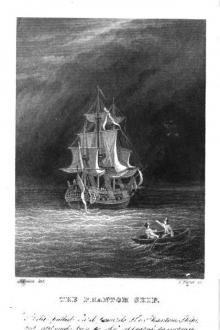
“It was one dark winter’s night when we were off the Texel, blowing terribly, with the coast under our lee, clawing off under storm canvas, and fighting with the elements for every inch of ground, a hand in the chains, for we had nothing but the lead to trust to, and the vessel so flogged by the waves, that he was lashed to the rigging, that he might not be washed away; all of a sudden the wind came with a blast loud enough for the last frump, and the waves roared till they were hoarser than ever; away went the vessel’s mast, although there was no more canvas on it than a jib pocket-handkerchief, and the craft rolled and tossed in the deep troughs for all the world like a wicked man dying in despair; and then she was a wreck, with nothing to help us but God Almighty, fast borne down upon the sands which the waters had disturbed, and were dashing about until they themselves were weary of the load; and all the seamen cried unto the Lord, as well they might.
“Now they say, that he did not cry as they did, like men and Christians, to Him who made them and the waters which surrounded and threatened them; for Death was then in all his glory, and the foaming crests of the waves were as plumes of feathers to his skeleton head beneath them; but he cried like a child — and swore terribly as well as cried — talking about his money, his dear money, and not caring about his more precious soul.
“And the cutter was borne down, every wave pushing her with giant force nearer and nearer to destruction, when the man at the chains shrieked out— ‘Mark three, and the Lord have mercy on our souls!’ and all the crew, when they heard this, cried out— ‘Lord save us, or we perish!’ But still they thought that their time was come, for the breaking waves were under their lee, and the yellow waters told them that, in a few minutes, the vessel, and all who were on board, would be shivered in fragments; and some wept and some prayed as they clung to the bulwarks of the unguided vessel, and others in a few minutes thought over their whole life, and waited for death in silence. But he, he did all; he cried, and he prayed, and he swore, and he was silent, and at last he became furious and frantic; and when the man said again and again, ‘The Lord save us!’ he roared out at last, ‘Will the devil help us, for—’ In a moment, before these first words were out of his mouth, there was a flash of lightning, that appeared to strike the vessel, but it harmed her not, neither did any thunder follow the flash; but a ball of blue flame pitched upon the knight heads, and then came bounding and dancing aft to the taffrail, where he stood alone, for the men had left him to blaspheme by himself. Some say he was heard to speak, as if in conversation, but no one knows what passed. Be it as it may, on a sudden he walked forward as brave as he could be, and was followed by this creature, who carried his head and tail slouching as he does now.
“And the dog looked up and gave one deep bark, and as soon as he had barked the wind appeared to lull — he barked again twice, and there was a dead calm — he barked again thrice, and the seas went down — and he patted the dog on the head, and the animal then bayed loud for a minute or two, and then, to the astonishment and fear of all, instead of the vessel being within a cable’s length of the Texel sands in a heavy gale, and without hope, the Foreland lights were but two miles on our beam with a clear sky and smooth water.”
The seaman finished his legend, and there was a dead silence for a minute or two, broken first by Jansen, who in a low voice said, “Then te tog is not a tog.”
“No,” replied Cobb, “an imp sent by the devil to his follower in distress.”
“Yes,” said. Short.
“Well, but,” said Jemmy Ducks, who for some time had left off touching the strings of his fiddle, “it would be the work of a good Christian to kill the brute.”
“It’s not a mortal animal, Jemmy.”
“True, I forgot that.”
“Gifen by de tyfel,” observed Jansen.
“Ay, and christened by him too,” continued Coble. “Who ever heard any Christian brute with such a damnable name?”
“Well, what’s to be done?”
“Why,” replied Jemmy Ducks, “at all events, imp o’ Satan or not, that here Smallbones fought him to-day with his own weapons.”
“And beat him too,” said. Coble.
“Yes,” said Short.
“Now, it’s my opinion, that Smallbones ar’nt afraid of him,” continued Jemmy Ducks, “and devil or no devil, he’ll kill him, if he can.”
“He’s the proper person to do it,” replied Coble; “the more so, as you may say that he’s his natural enemy.”
“Yes, mein Got, de poy is de man,” said Jansen.
“We’ll put him up to it at all events, as soon as he is out of his hammock,” rejoined Jemmy Ducks.
A little more conversation took place, and then it was carried unanimously that Smallbones should destroy the animal, if it was possible to destroy it.
The only party who was not consulted was Smallbones himself, who lay fast asleep in his hammock. The consultation then broke up, and they all went below.
Chapter Six.
In which as often happens at Sea when Signals are not made out, Friends exchange Broadsides.
Notwithstanding all the precautions of the party on the forecastle, this consultation had been heard by no less a person than the huge Corporal Van Spitter, who had an idea that there was some mystery going on forward, and had contrived to crawl up under the bulwark, and throw himself down on the fore-staysail, which lay between two of the guns. Having so done without being perceived, for it was the very moment that the party were all listening to Bill Spurey’s legend of the dog’s first appearance on board, he threw a part of the sail over his fat carouse, and thus remained undiscovered during the remainder of the colloquy. He heard them all descending below, and remained still quiet, till he imagined that the forecastle was clear. In the meantime, Mr Vanslyperken who had been walking the deck abaft, unaccompanied by his faithful attendant (for Snarleyyow remained coiled up on his master’s bed), was meditating deeply how to gratify the two most powerful passions in our nature, love and revenge: at one moment thinking of the fat fair Vandersloosh, and of hauling in her guilders, at another reverting to the starved Smallbones and the comfort of a keel-hauling. The long conference on the forecastle had not been unperceived by the hawk’s eye of the lieutenant, and as they descended he walked forward to ascertain if he could not pick up some straggler who, unsupported by his comrades, might be induced by fear to acquaint him with the subject of the discussion. Now, just as Mr Vanslyperken came forward, Corporal Van Spitter had removed the canvas from his body, and was about to rise from his bed, when he perceived somebody coming forward. Not making it out to be the lieutenant, he immediately dropped down again and drew the canvas over him. Mr Vanslyperken perceived this manoeuvre, and thought he had now caught one of the conspirators, and, moreover, one who showed such fear as to warrant the supposition that he should be able to extract from him the results of the night’s unusually long conference.
Mr Vanslyperken walked up to where the corporal lay as quiet but not quite so small as a mouse. It occurred to Mr Vanslyperken that a little taste of punishment in esse would very much assist the threats of what might be received in posse; so he laid aside his speaking-trumpet, looked round, picked up a handspike, and raising it above his head, down it came, with all the force of the lieutenant’s arm, upon Corporal Van Spitter, whose carcase resounded like a huge kettle-drum.
“Tunder and flame!” roared the corporal under the canvas, thinking that one of the seamen, having discovered him eavesdropping, had thus wreaked his revenge, taking advantage of his being covered up, and pretending not to know him. “Tunder and flame!” roared the corporal, muffled up in the canvas, and trying to extricate himself; but his voice was not recognised by the lieutenant, and, before he could get clear of his envelope, the handspike had again descended; when up rose the corporal, like a buffalo out of his muddy lair, half blinded by the last blow, which had fallen on his head, ran full butt at the lieutenant, and precipitated his senior officer and commander headlong down the fore-hatchway.
Vanslyperken fell with great force, was stunned, and lay without motion at the foot of the ladder, while the corporal, whose wrath was always excessive when his blood was up, but whose phlegmatic blood could not be raised without some such decided stimulus as a handspike, now turned round and round the forecastle, like a bull looking for his assailants; but the corporal had the forecastle all to himself, and, as he gradually cooled down, he saw lying close to him the speaking-trumpet of his senior officer.
“Tousand tyfels,” murmured Corporal Van Spitter, “but it must have been the skipper. Got for dam, dis is hanging matter!” Corporal Van Spitter was as cool as a cucumber as soon as he observed what a mistake he had made; in fact he quivered and trembled in his fat. “But then,” thought he, “perhaps he did not know me — no, he could not, or he never would have handspiked me.” So Corporal Van Spitter walked down the hatchway, where he ascertained that his commandant lay insensible. “Dat is good,” thought he; and he went aft, lighted his lantern, and, as a ruse, knocked at the cabin-door. Receiving no answer but the growl of Snarleyyow, he went in, and then ascended to the quarter-deck, looked round him, and inquired of the man at the wheel where Mr Vanslyperken might be. The man replied that he had gone forward a few minutes before, and thither the corporal proceeded. Of course, not finding him, he returned, telling the man that the skipper was not in the cabin or the forecastle, and wondering where he could be. He then descended to the next officer in command, Dick Short, and called him.
“Well,” said Short.
“Can’t find Mr Vanslyperken anywhere,” said the corporal.
“Look,” replied Dick, turning round in his hammock.
“Mein Got, I have looked de forecastle, de quarter-deck, and de cabin — he not anywhere.”
“Overboard,” replied Dick.
“I come to you, sir, to make inquiry,” said the corporal.
“Turn out,” said Dick, suiting the action to the words, and lighting with his feet on the deck in his shirt.
While Short was dressing himself, the corporal summoned up all his marines; and the noise occasioned by this turn out, and the conversation overheard by those who were awake, soon gave the crew of the cutter to understand that some accident had happened to their commander. Even Smallbones had it whispered in his ear that Mr Vanslyperken had fallen overboard, and he smiled as he lay in the dark, smarting with his wounds, muttering to himself that Snarleyyow should soon follow his master. By the time that Short was on the quarterdeck, Corporal Van Spitter, who knew very well where to look for it, had, very much to the disappointment of the crew found the body of Mr Vanslyperken, and the marines had brought it aft to the cabin, and would have laid it on the bed, had not Snarleyyow, who had no feeling in his composition, positively denied its being put there.
Short came down and examined his superior officer.
“Is he dead,” inquired the corporal with alarm.
“No,” replied Short.
“Vat can it be then?” said the corporal.
“Stunned,” replied Short.
“Mein Got! how could it happen?”
“Tumbled,” replied Short.
“What shall we do, sir?” rejoined the corporal.
“Bed,” replied Short, turning on his heel, and a minute after turning into his hammock.
“Mein Got, the dog will not let him go to bed,” exclaimed the corporal.
“Let’s put him in,” said one of the marines; “the dog won’t bite his master.”
So the marines lifted up the still insensible Mr Vanslyperken, and almost tossed him into his standing bed-place, right on the body of the snarling dog, who, as soon as he could disengage himself from the weight, revenged himself by making his teeth meet more than once through the lantern cheek of his master, and then leaping off the bed, retreated growling under the table.
“Well, you are a nice dog,” exclaimed one of the marines, looking after Snarleyyow in his retreat.
Now, there was no medical assistance on board so small a vessel. Mr Vanslyperken was allowed a small quantity of medicine, unguents, etcetera; but these he always sold to an apothecary as soon as he had procured them from the authorities. The teeth of the dog had, however, their effect, and Mr Vanslyperken opened his eyes, and in a faint voice cried, “Snarleyyow.” Oh, if the dog had any spark of feeling, how must he then have been stung with remorse at his ingratitude to so kind a master! But he apparently showed none, at least report does not say that any symptoms were manifest.
After a little burnt oakum had excoriated his nose, and a certain quantity of the cold salt-water from alongside had wetted through his bed-clothes, Mr Vanslyperken was completely recovered, and was able to speak and look about him. Corporal Van Spitter trembled a little as his commandant fixed his eyes upon him, and he redoubled his attention.
“Mein Got, Mynheer Vanslyperken, how was this happen?” exclaimed the corporal in a pathetic tone. Whereupon Mr Vanslyperken ordered every one to leave the cabin but Corporal Van Spitter.
Mr Vanslyperken then communicated to the corporal that he had been knocked down the hatchway by one of the men when he went forward; that he could not distinguish who it was, but thought it must have been Jansen from his size. Corporal Van Spitter, delighted to find that his skipper was on a wrong scent, expressed his opinion in corroboration of the lieutenant’s; after which a long consultation took place relative to mutiny, disaffection, and the proper measures to be taken. Vanslyperken mentioned the consultation of the men during the first watch, and the corporal, to win his favour, was very glad to be able to communicate the particulars of what he had overheard, stating that he had concealed himself for that purpose.
“And where did you conceal yourself?” said Vanslyperken, with a keen inquiring look: for it immediately occurred to him that, unless it was under the sail, there could be no concealment for such a huge body as that of the corporal; and he had his misgivings. But the corporal very adroitly observed, that he stood at the lower step of the fore-ladder, with his head level with the coamings; and had, by this means, overheard the conversation unperceived, and had only walked away when the party broke up. This restored the confidence of Mr Vanslyperken, and a long discussion took place, in which it was agreed between them, that the only way to prevent Snarleyyow from being destroyed, was to try some means to make away quietly with poor Smallbones. But this part of the conversation was not carried to any length: for Mr Vanslyperken, indignant at having received such injury in his face from his ungrateful cur, did not, at that moment, feel the current of his affection run so strong as usual in that direction. After this, the corporal touched his hat, swung round to the rightabout in military style, and left the cabin.