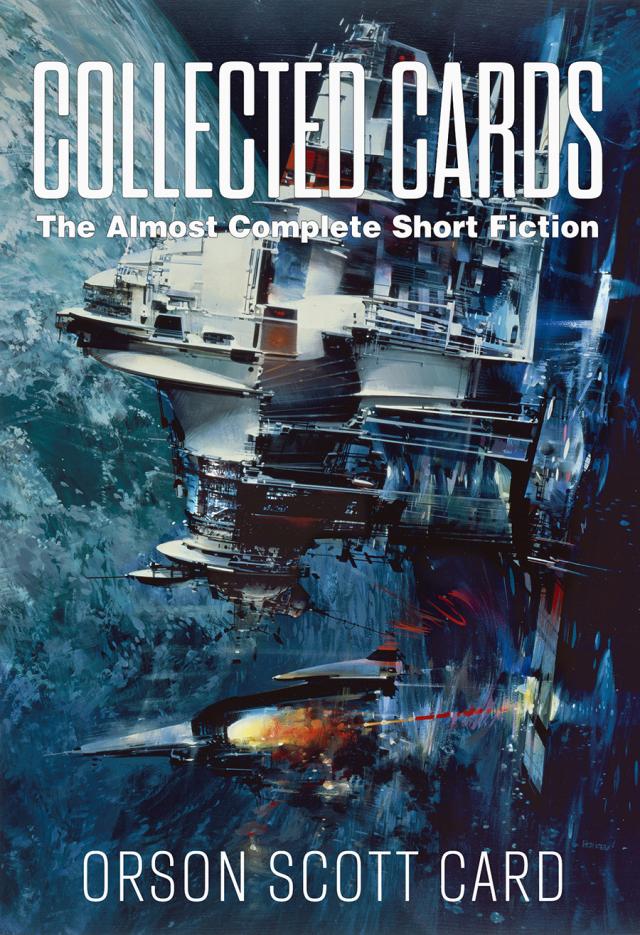
Collected cards the almo.., p.132
Collected Cards: The Almost Complete Short Fiction,
p.132


At the end of the quarter, though, it finally dawned on me that in all the time we were in class together, I had never seen one of his own stories. He hadn’t written a damn thing. And there was his grade on the bulletin board—A.
I talked to Armand.
“Oh, Doc writes,” he assured me. “Better than you do, and you got an A. God knows how, you don’t have the talent for it.”
“Why doesn’t he turn it in for the rest of the class to read?”
Armand shrugged. “Why should he? Pearls before swine.”
Still it irritated me. After watching Doc disembowel more than one writer, I didn’t think it was fair that his own work was never put on the chopping block.
The next quarter he turned up in a graduate seminar with me, and I asked him. He laughed and told me to forget it. I laughed back and told him I wouldn’t. I wanted to read his stuff. So the next week he gave me a three-page manuscript. It was an unfinished fragment of a story about a man who honestly thought his wife had left him even though he went home to find her there every night. It was some of the best writing I’ve ever read in my life. No matter how you measure it. The stuff was clear enough and exciting enough that any moron who likes Harold Robbins could have enjoyed it. But the style was rich enough and the matter of it deep enough even in a few pages that it made most other “great” writers look like chicken farmers. I reread the fragment five times just to make sure I got it all. The first time I had thought it was metaphorically about me. The third time I knew it was about God. The fifth time I knew it was about everything that mattered, and I wanted to read more.
“Where’s the rest?” I asked. He shrugged. “That’s it,” he said.
“It doesn’t feel finished.”
“It isn’t.”
“Well, finish it! Doc, you could sell this anywhere, even the New Yorker. For them you probably don’t even have to finish it.”
“Even the New Yorker. Golly.”
“I can’t believe you think you’re too good for anybody, Doc. Finish it. I want to know how it ends.”
He shook his head. “That’s all there is. That’s all there ever will be.”
And that was the end of the discussion.
But from time to time he’d show me another fragment. Always better than the one before. And in the meantime we became closer, not because he was such a good writer—I’m not so self-effacing I like hanging around with people who can write me under the table—but because he was Doc Murphy. We found every decent place to get a beer in Salt Lake City—not a particular time-consuming activity. We saw three good movies and another dozen that were so bad they were fun to watch. He taught me to play poker well enough that I broke even every weekend. He put up with my succession of girlfriends and prophesied that I would probably end up married again. “You’re just weak willed enough to try to make a go of it,” he cheerfully told me.
At last, when I had long since given up asking, he told me why he never finished anything.
I was two and a half beers down, and he was drinking a hideous mix of Tab and tomato juice that he drank whenever he wanted to punish himself for his sins, on the theory that it was even worse than the Hindu practice of drinking your own piss. I had just got a story back from a magazine I had been sure would buy it. I was thinking of giving it up. He laughed at me.
“I’m serious,” I said.
“Nobody who’s any good at all needs to give up writing.”
“Look who’s talking. The king of the determined writers.” He looked angry. “You’re a paraplegic making fun of a one-legged man,” he said.
“I’m sick of it.”
“Quit then. Makes no difference. Leave the field to the hacks. You’re probably a hack, too.”
Doc hadn’t been drinking anything to make him surly, not drunk-surly, anyway. “Hey, Doc, I’m asking for encouragement.”
“If you need encouragement, you don’t deserve it. There’s only one way a good writer can be stopped.”
“Don’t tell me you have a selective writer’s block. Against endings.”
“Writer’s block? Jesus, I’ve never been blocked in my life. Blocks are what happen when you’re not good enough to write the thing you know you have to write.”
I was getting angry. “And you, of course, are always good enough.”
He leaned forward, looked at me in the eyes. “I’m the best writer in the English language.”
“I’ll give you this much. You’re the best who never finished anything.”
“I finish everything,” he said. “I finish everything, beloved friend, and then I burn all but the first three pages. I finish a story a week, sometimes. I’ve written three complete novels, four plays. I even did a screenplay. It would’ve made millions of dollars and been a classic.”
“Says who?”
“Says—never mind who says. It was bought, it was cast, it was ready for filming. It had a budget of thirty million. The studio believed in it. Only intelligent thing I’ve ever heard of them doing.”
I couldn’t believe it. “You’re joking.”
“If I’m joking, who’s laughing? It’s true.”
I’d never seen him looked so poisoned, so pained. It was true, if I knew Doc Murphy, and I think I did. Do. “Why?” I asked.
“The Censorship Board.”
“What? There’s no such thing in America.”
He laughed. “Not full-time anyway.”
“Who the hell is the Censorship Board?”
He told me:
When I was twenty-two I lived on a rural road in Oregon, he said, outside of Portland. Mailboxes out on the road. I was writing, I was a playwright, I thought there’d be a career in that; I was just starting to try fiction. I went out one morning after the mailman had gone by. It was drizzling slightly. But I didn’t much care. There was an envelope there from my Hollywood agent. It was a contract. Not an option—a sale. A hundred thousand dollars. It had just occurred to me that I was getting wet and I ought to go in when two men came out of the bushes—yeah, I know, I guess they go for dramatic entrances. They were in business suits. God, I hate men who wear business suits. The one guy just held out his hand. He said, “Give it to me now and save yourself a lot of trouble.” Give it to him? I told him what I thought of his suggestion. They looked like the mafia, or like a comic parody of the mafia, actually.
They were about the same height, and they seemed almost to be the same person, right down to a duplicate glint of fierceness in the eyes; but then I realized that my first impression had been deceptive. One was blond, one dark-haired; the blond had a slightly receding chin that gave his face a meek look from the nose down; the dark one had once had a bad skin problem and his neck was treeish, giving him an air of stupidity, as if a face had been pasted on the front of the neck with no room for a head at all. Not mafia at all. Ordinary people.
Except the eyes. That glint in the eyes was not false, and that was what had made me see them wrong at first. Those eyes had seen people weep, and had cared, and had hurt them again anyway. It’s a look that human eyes should never have.
“It’s just the contract, for Christ’s sake,” I told them, but the dark one with acne scars only told me again to hand it over.
By now, though, my first fear had passed; they weren’t armed, and so I might be able to get rid of them without violence. I started back to the house. They followed me.
“What do you want my contract for?” I asked. “That film will never be made,” says Meek, the blond one with the missing chin. “We won’t allow it to be made.”
I’m thinking who writes their dialogue for them, do they crib it from Fenimore Cooper? “Their hundred thousand dollars says they want to try. I want them to.”
“You’ll never get the money, Murphy. And this contract and that screenplay will pass out of existence within the next four days. I promise you that.”
I ask him, “What are you, a critic?”
“Close enough.”
By now I was inside the door and they were on the other side of the threshold. I should have closed the door, probably, but I’m a gambler. I had to stay in this time because I had to know what kind of hand they had. “Plan to take it by force?” I asked.
“By inevitability,” Tree says. And then he says, “You see, Mr. Murphy, you’re a dangerous man; with your IBM Self-Correcting Selectric II typewriter that has a sluggish return so that you sometimes get letters printed a few spaces in from the end. With your father who once said to you, Billy, to tell you the honest-to-God truth, I don’t know if I’m your father or not. I wasn’t the only guy your Mom had been seeing when I married her, so I really don’t give a damn if you live or die.”
He had it right down. Word for word, what my father told me when I was four years old. I’d never told anybody. And he had it word for word.
CIA, Jesus. That’s pathetic.
No, they weren’t CIA. They just wanted to make sure that I didn’t write. Or rather, that I didn’t publish.
I told them I wasn’t interested in their suggestions. And I was right—they weren’t muscle types. I closed the door and they just went away.
And then the next day as I was driving my old Galaxy along the road, under the speed limit, a boy on a bicycle came right out in front of me. I didn’t even have a chance to brake. One second he wasn’t there, and the next second he was. I hit him. The bicycle went under the car, but he mostly came up the top. His foot stuck in the bumper, jammed in by the bike. The rest of him slid up over the hood, pulling his hip apart and separating his spine in three places. The hood ornament disemboweled him and the blood flowed up the windshield like a heavy rainstorm, so that I couldn’t see anything except his face, which was pressed up against the glass with the eyes open. He died on the spot, of course. And I wanted to.
He had been playing Martians or something with his brother. The brother was standing there near the road with a plastic ray gun in his hand and a stupid look on his face. His mother came out of the house screaming. I was screaming, too. There were two neighbors who saw the whole thing. One of them called the cops and ambulance. The other one tried to control the mother and keep her from killing me. I don’t remember where I was going. All I remember is that the car had taken an unusually long time starting that morning. Another minute and a half, I think—a long time, to start a car. If it. had started up just like usual, I wouldn’t have hit the kid. I kept thinking that—it was all just a coincidence that I happened to be coming by just at that moment. A half-second sooner and he would have seen me and swerved. A half-second later and I would have seen him. Just coincidence. The only reason the boy’s father didn’t kill me when he came home ten minutes later was because I was crying so damn hard. It never went to court because the neighbors testified that I hadn’t a chance to stop, and the police investigator determined that I hadn’t been speeding. Not even negligence. Just terrible, terrible chance.
I read the article in the paper. The boy was only nine, but he was taking special classes at school and was very bright, a good kid, ran a paper route and always took care of his brothers and sisters. A real tear-jerker for the consumption of the subscribers. I thought of killing myself. And then the men in the business suits came back. They had four copies of my script, my screenplay. Four copies is all I had ever made—the original was in my file.
“You see, Mr. Murphy, we have every copy of the screenplay. You will give us the original.”
I wasn’t in the mood for this. I started closing the door.
“You have so much taste,” I said. I didn’t care how they got the script, not then. I just wanted to find a way to sleep until when I woke up the boy would still be alive.
They pushed the door open and came in. “You see, Mr. Murphy, until we altered your car yesterday, your path and the boy’s never did intersect. We had to try four times to get the timing right, but we finally made it. It’s the nice thing about time travel. If you blow it, you can always go back and get it right the next time.”
I couldn’t believe anyone would want to take credit for the boy’s death. “What for?” I asked.
And they told me. Seems the boy was even more talented than anyone thought. He was going to grow up and be a writer. A journalist and critic. And he was going to cause a lot of problems for a particular government some forty years down the line. He was especially going to write three books that would change the whole way of thinking of a large number of people. The wrong way.
“We’re all writers ourselves,” Meek says to me. “It shouldn’t surprise you that we take our writing very seriously. More seriously than you do. Writers, the good writers, can change people. And some of the changes aren’t very good. By killing that boy yesterday, you see, you stopped a bloody civil war some sixty years from now. We’ve already checked and there are some unpleasant side effects, but nothing that can’t be coped with. Saved seven million lives. You shouldn’t feel bad about it.”
I remembered the things they had known about me. Things that nobody could have known. I felt stupid because I began to believe they might be for real. I felt afraid because they were calm when they talked of the boy’s death. I asked, “Where do I come in? Why me?”
“Oh, it’s simple. You’re a very good writer. Destined to be the best of your age. Fiction. And this screenplay. In three hundred years they’re going to compare you to Shakespeare and the poor old bard will lose. The trouble is, Murphy, you’re a godawful hedonist and a pessimist to boot, and if we can just keep you from publishing anything, the whole artistic mood of two centuries will be brightened considerably. Not to mention the prevention of a famine in seventy years. History makes strange connections, Murphy, and you’re at the heart of a lot of suffering. If you never publish, the world will be a much better place for everyone.”
You weren’t there, you didn’t hear them. You didn’t see them, sitting on my couch, legs crossed, nodding, gesturing like they were saying the most natural thing in the world. From them I learned how to write genuine insanity. Not somebody frothing at the mouth; just somebody sitting there like a good friend, saying impossible things, cruel things, and smiling and getting excited and—Jesus, you don’t know. Because I believed them. They knew, you see. And they were too insane, even a madman could have come up with a better hoax than that. And I’m making it sound as if I believed them logically, but I didn’t, I don’t think I can persuade you, either, but trust me—if I know when a man is bluffing or telling the truth, and I do, these two were not bluffing. A child had died, and they knew how many times I had turned the key in the ignition. And there was truth in those terrible eyes when Meek said, “If you willingly refrain from publishing, you will be allowed to live. If you refuse, then you will die within three days. Another writer will kill you—accidently, of course. We only have authority to work through authors.”
I asked them why. The answer made me laugh. It seems they were from the Authors’ Guild. “It’s a matter of responsibility. If you refuse to take responsibility for the future consequences of your acts, we’ll have to give the responsibility to somebody else.”
And so I asked them why they didn’t just kill me in the first place instead of wasting time talking to me.
It was Tree who answered, and the bastard was crying, and he says to me, “Because we love you. We love everything you write. We’ve learned everything we know about writing from you. And we’ll lose it if you die.”
They tried to console me by telling me what good company I was in. Thomas Hardy—they made him give up novels and stick to poetry which nobody read and so it was safe. Meek tells me, “Hemingway decided to kill himself instead of waiting for us to do it. And there are some others who only had to refrain from writing a particular book. It hurt them, but Fitzgerald was still able to have a decent career with the other books he could write, and Perelman gave it to us in laughs, since he couldn’t be allowed to write his real work. We only bother with great writers. Bad writers aren’t a threat to anybody.”
We struck a sort of bargain. I could go on writing. But after I had finished everything, I had to burn it. All but the first three pages. “If you finish it at all,” says Meek, “we’ll have a copy of it here. There’s a library here that—uh, I guess the easiest way to say it is that it exists outside time. You’ll be published, in a way. Just not in your own time. Not for about eight hundred years. But at least you can write. There are others who have to keep their pens completely still. It breaks our hearts, you know.”
I knew all about broken hearts, yes sir, I knew all about it. I burned all but the first three pages.
There’s only one reason for a writer to quit writing, and that’s when the Censorship Board gets to him. Anybody else who quits is just a gold-plated jackass. “Swap” Morris doesn’t even know what real censorship is. It doesn’t happen in libraries. It happens on the hoods of cars. So go on, become a real estate broker, sell insurance, follow Santa Claus and clean up the reindeer poo, I don’t give a damn. But if you give up something that I will never have, I’m through with you. There’s nothing in you for me.
* * *
So I write. And Doc reads it and tears it to pieces; everything except this. This he’ll never see. This he’d probably kill me for, but what the hell? It’ll never get published. No, no I’m too vain. You’re reading it, aren’t you? See how I put my ego on the line? If I’m really a good enough writer, if my work is important enough to change the world, then a couple of guys in business suits will come make me a proposition I can’t refuse, and you won’t read this at all, but you are reading it, aren’t you? Why am I doing this to myself? Maybe I’m hoping they’ll come and give me an excuse to quit writing now, before I find out that I’ve already written as well as I’m ever going to. But here I thumb my nose at those goddam future critics and they ignore me, they tell exactly what my work is worth.