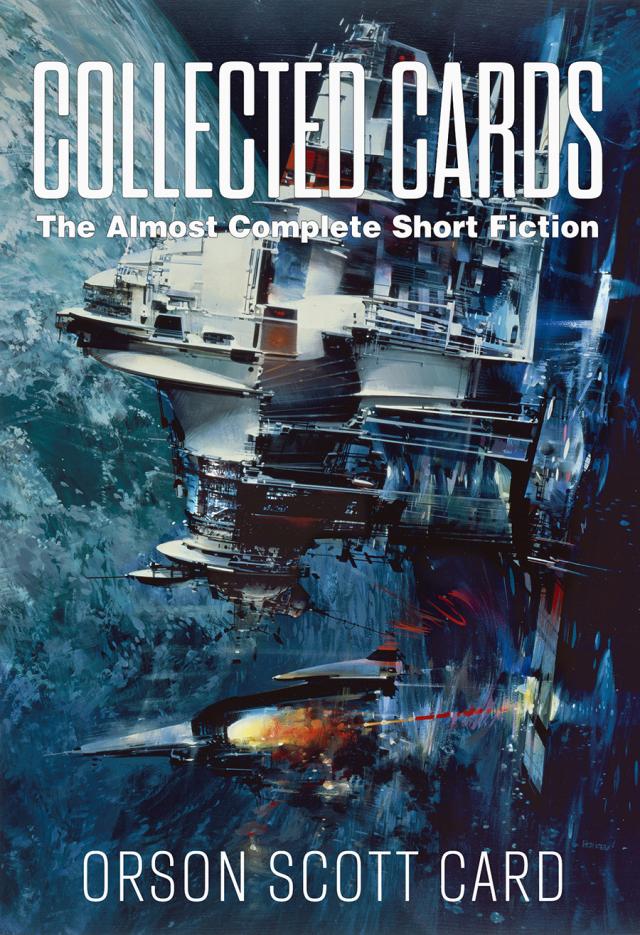
Collected cards the almo.., p.178
Collected Cards: The Almost Complete Short Fiction,
p.178


Deaver walked on back into the orchard and kept walking till he got to the truck. The sheriff was standing there alone, leaning on the hood.
“Where you been, Teague?”
“Judge still coming?”
“He’s come and gone. I’ve got the warrant.”
“I’m sorry to hear that,” said Deaver.
“The girl’s home safe,” said the sheriff. “But she’s sure pissed off at you.”
Deaver’s heart sank. She told. Probably lies.
“She says she was just doing a little hugging and kissing, and along you come and make her go home.”
Well, she lied, all right, but it was a decent kind of lie, one that wouldn’t get anybody in trouble. “Yeah, that’s it,” said Deaver. “Ollie, though, he didn’t appreciate my help. His father’s out there now, talking him into coming home.”
“Right,” said the sheriff. “Well, the way it looks to me, there’s no harm done, and the judge isn’t calling for blood either, since he believes whatever his sweet little girl tells him. So I don’t plan to use this warrant tonight. And if everybody behaves themselves tomorrow then these show gypsies can do their pageant and move on down the road.”
“No bad report on them?” said Deaver.
“Nothing to report,” said the sheriff. Then he sort of smiled. “Heck, you were right, Teague. They’re just a family with the same kind of problems we got here in Hatchville. Sure talk funny, though, don’t they?”
“Thanks, Sheriff.”
“Good night, range rider.” The sheriff walked away.
Moments later, Scarlett and Katie and Toolie were out of their tents, standing beside Deaver, watching the sheriff get in his car and drive off.
“Thank you,” whispered Scarlett.
“You were terrific,” said Toolie.
“Yeah,” said Deaver. “Where do I sleep?”
“It’s a warm night,” said Toolie. “I’m sleeping on the truck, if that’s all right with you.”
“Better than lying on the ground,” said Deaver.
As he was getting ready for bed, Marshall and Ollie came back to the camp. Scarlett came out of her tent and made a big to-do about his hurt wrist, putting a sling on his arm and all. Deaver just sort of stayed back out of the way, not even watching, just laying out his bedroll and then standing there leaning on the audience side of the truck, listening to the scraps of conversation he could hear. Which actually was quite a lot, since Marshall and Scarlett hardly knew how to talk without making the sound carry across an open field. Nobody said much about how Ollie’s wrist came to be hurt.
One thing, though, that maybe changed everything. It was when Marshall said, “I think I’d better play Washington the next time we do Glory of America. You know how to do Toolie’s parts, don’t you, Ollie? As long as Deaver’s with us, he can run lights and you can fill a spot on stage. Let Papa go home and retire.”
Deaver couldn’t hear what Ollie said.
“There’s no rush to decide these things,” said Marshall. “But if you do decide to join the outriders, I don’t think you need to use Deaver’s right to apply. I think I could write a letter to Royal that would get you a fair chance.”
Again, Ollie’s answer was too quiet to hear.
“I just don’t think it’s right to take away one of Deaver’s choices if we don’t have to. It’s about time I wrote to Royal anyway.”
This time it was Scarlett who answered, so Deaver could hear just fine. “You can write to Royal all you like Marsh, but the only way Parley and Donna can retire is if Ollie comes on stage, and the only way he can do that is if Deaver runs the lights and sound.”
“Well, sometime before we get to Moab, I’ll ask Deaver if he’d like to stay,” said Marshall. “Since he can probably hear us talking right now, that’ll give him plenty of time to decide on his answer.”
Deaver smiled and shook his head. Of course they knew he was listening—these show people always know when there’s an audience. Right at the moment Deaver figured he’d probably say yes. Sure, it’d be sticky for a while with Ollie, partly because of beating him up tonight, but mostly because Ollie had some bad habits with local girls and he wasn’t going to cure them overnight. Ollie still might end up needing to get away and join the outriders. Deaver could teach him to ride, just in case. And if Ollie left, then Dusty’d have to move up to doing some more grown-up parts. It wouldn’t be long till his voice changed, judging from the height he was getting.
Or things might not work out between Deaver and Katie, in which case it was a good thing the right to apply was good for a year. All kinds of things might change. But it’d all work out. The most important change was the one Marshall made tonight, to take some of the old-man parts and give the leads to Toolie. It meant real change in the way the company ran, and changes like that wouldn’t be undone no matter what else happened. No way to guess the future, but it was a sure thing the past would never come back again.
After a while things quieted down and Deaver stripped down to his underwear and crawled inside his bedroll. He tried closing his eyes, but that didn’t take him any closer to sleep, so he opened them again and looked at the stars. That was when he heard footsteps coming around the front of the truck. He could tell without looking that it was Katie. She came on over to where Deaver was lying, his bedroll spread out on the pyramid curtain.
“Are you all right, Deaver?” Katie asked.
“Softest bed I’ve slept on in a year,” he said.
“I meant—Ollie was walking kind of doubled over, and it looked like he hurt his hand a little. I wondered if you were OK.”
“He just fell a couple of times.”
She looked at him steady for a while. “All right, I guess if you wanted to tell what really happened, you would.”
“Guess so.”
Still she stood there, not going away, not saying anything.
“What’s the show tomorrow?” he asked.
“The Book of Mormon one,” she said. “No decent parts for women. I spend half my time in drag.” She laughed lightly, but Deaver thought she sounded tired. The moonlight was shining full on her face. She looked a little tired, too, eyes heavy-lidded, her hair straggling beside her face. Kind of soft-looking, that’s how she was in the moonlight. He remembered being angry at her tonight. He remembered kissing her. Both memories were a little embarrassing now.
“Sorry I got so mad at you tonight,” said Deaver.
“I should only have people mad at me for that reason—because they liked my show better than I did.”
“I’m sorry, anyway.”
“Maybe you’re right. Maybe pageants really are important. Maybe I just get tired of doing them over and over again. I think it’s time we took a vacation, did a real play. We could get town people somewhere to take parts in the play. Maybe they’d like us better if they were part of a show.”
“Sure.” Deaver was tired, and it all sounded fine to him.
“Are you staying with us, Deaver?” she asked.
“I haven’t been asked.”
“But if Daddy asks you.”
“I think maybe.”
“Will you miss it? Riding the range?”
He chuckled. “No ma’am.” But he knew that if the question was a little different, if she’d asked, Will you miss your dream of riding out on the prairie with Royal Aal, then the answer would’ve been yes, I miss it already.
But I’ve got a new dream now, or maybe just the return of an old dream, a dream I gave up on years ago, and the hope of joining the outriders, that was just a substitute, just a make-do. So let’s just see, let’s find out over the next few weeks and months and maybe years just how much room there is in this family for one more person. Because I’m not signing on for a pageant wagon. I’m not signing on to be a hireling. I’m signing on to be family, and if I find out there’s no place for me after all, then I’ll have to go searching for another dream altogether.
He thought all that, but he didn’t say anything about it. He’d already said too much tonight. No reason to risk getting in more trouble.
“Deaver,” she whispered. “Are you asleep?”
“Nope.”
“I really do like you, and it wasn’t all an act.”
That was pretty much an apology, and he accepted it. “Thanks, Katie. I believe you.” He closed his eyes.
He heard a rustle of cloth, a slight movement of the truck as more of her weight leaned against it. She was going to kiss him, he knew it, and he waited for the brush of her lips against his. But it didn’t come. Again the truck moved slightly and she was gone. He heard her feet moving across the dewy grass toward the tents.
The sky was clear and the night was cool. The moon was high now, as near to straight up as it was going to get. Tomorrow it might well rain—it had been four days since the last storm, and that was about as long as you got around here. So tomorrow there might be a storm, which meant tying little tents over all the lights, and if it got bad enough, putting off the show till the next night. Or canceling and moving on. It felt a little strange, thinking how he was now caught up in a new rhythm—tied to the weather, tied to the shows, and which towns had seen which ones within the last year, but above all tied to these people, their wishes and customs and habits and whims. It was kind of scary, too, that he’d be following along, not always doing things his own way.
But why should he be scared? There was going to be change anyway, no matter what. With Bette dead, even if he stayed with the range riders there’d be a new horse to get used to. And if he’d applied to the outriders, that’d all be new. So it wasn’t as though his life wasn’t going to get turned upside down anyway.
Sleep came sooner than he thought it would. He dreamed, a deep hard dream that seemed like the most important thing in his life. In his dream he remembered something he hadn’t been able to think of in his whole life: what his real name was, the name his own parents gave him, back before the mobbers killed them. In his dream he saw his mother’s face, and heard his father’s voice. But as he woke in the morning, the dream fading, he tried to think of that voice, and all he could hear inside his head was an echo of his own voice; and the face of his mother faded into Katie’s face. And when he shaped his true name with silent lips, he knew that it wasn’t true anymore. It was the name of a little boy who got lost somewhere and was never found again. Instead he murmured the name he had spent his life earning. “Deaver Teague.”
He smiled a little at the sound of it. It wasn’t a bad name at all, and he kind of liked imagining what it could mean someday.
Prentice Alvin and the No-Good Plow
Alvin, he was a blacksmith’s prentice boy,
He pumped the bellows and he ground the knives,
He chipped the nails, he het the charcoal fire,
Nothing remarkable about the lad
Except for this: He saw the world askew,
He saw the edge of light, the frozen liar
There in the trees with a black smile shinin cold,
Shiverin the corners of his eyes.
Oh, he was wise.
The blacksmith didn’t know what Alvin saw.
He only knew the boy was quick and slow:
Quick with a laugh and a good or clever word,
Slow at the bellows with his brain a-busy,
Quick with his eyes like a bright and sneaky bird,
Slow at the forge when the smith was in a hurry.
Times the smith, he liked him fine. And times
He’d bellow, “Hell and damnation, hammer and tong,
You done it wrong!”
One day when the work was slow, the smith was easy.
“Off to the woods with you, Lad, the berries are ripe.”
And Alvin gratefully let the bellows sag
And thundered off in the dust of the summer road.
Ran? He ran like a colt, he leaped like a calf,
Then his feet were deep in the leafmeal forest floor,
He was moss on the branches, swingin low and lean,
His fingers were part of the bark, his glance was green—
And he was seen.
He was seen by the birds that anyone can see,
Seen by the porcupines that hid in the bushes,
Seen by the light that slipped among the trees,
Seen by the dark that only he could see.
And the dark reached out and stumbled Alvin down,
Laid him laughin and pantin on the ground,
And the dark snuck up on every edge of him,
Frost a-comin on from everywhere,
Ice in his hair.
Ice in the summertime, and Alvin shook,
Crackin ice aloud in the miller’s pond,
A mist of winter flowin through the wood,
Fingerin his face, and where it touched
He was numb, he was stricken dumb, his chin all chattery.
Where are the birds? he wondered. When did they go?
Get back to the edge, you Dark, you Cold, you Snow!
Get north, you Wind, it’s not your time to blow!
I tell you, No!
No! he cried, but the snow was blank and deep
And didn’t answer, and the fog was thick
And didn’t answer, and his flimsy clothes
Were wet, and his breath was sharp as ice in his lung
Splittin him like a rail. It made him mad.
He yelled, though the sound froze solid at his teeth
And the words dropped out and broke as they were said
And his tongue went thick, and his lips were even number:
“Dammit, it’s summer!”
With the snow like stars of death in your eyes? “It’s summer!”
The wind a-ticklin at your thighs? “It’s summer!”
Your breath a fog of ice? “Let it be spring!
Let it be autumn, let it be anything!”
But the edge of the world had found him, and he knew
That the fire of the forges would be through,
That the air would be thick and harsh at the end of the earth
And all the flames a-dancin in his hearth,
What were they worth?
“Oh, you can cheat the trees, so dumb and slow,
And you can jolly the birds that summer’s through,
But you can’t fool me! I’ll freeze to death before
I let you get away with a lie so bold!”
And he laughed as he was swallowed by the cold,
He sang as the ice a-split him to the core,
He whispered in his pain that it wasn’t true.
“You can bury me deep as hell in your humbug snow,
But I know what I know.”
And look at that! A red-winged bird a-singin!
Look at that! The leaves all thick and green!
He touched the bark so warm in the summer sun,
He buried his hands in the soil and said, “I’m jiggered.”
“Oh, blacksmith’s prentice boy,” said the red-winged bird.
“Took you long enough,” said Prentice Alvin.
“Came now, didn’t I? So don’t get snippety.”
“Just see to it you don’t go off again.
Where you been?”
“I been,” said the red-winged bird, “to visit the sun.
I been to sing to the deaf old man in the moon.
And now I’m here to make a maker of you,
Oh yes, I’ll make you something before I’m through.”
“I’m something now,” said the lad, “and I like it fine.”
“You’re a smithy boy,” said the bird, “and it ain’t enough.
Bendin horseshoes! Bangin on the black!
Why, there be things to make that can’t be told,
So bright and gold!”
A thousand things, that bird was full of talk,
And on he sang and Alvin listened tight.
Till home he came at dark, his eyes so bright,
His smile so ready but his mood like rock,
He was full of birdsong, full of dreams of gold,
Dreams of what he’d draw from the smithy fire.
“How old is old?” he asked the smith. “How tall
Do I have to be for hammer and tong?
It’s been so long.”
The smith, he spied him keen, he saw his eyes,
He saw how flames were leapin in the green.
“A redbreast bird been talkin,” said the smith,
His voice as low as memory. “So young,
But not so young, so little but so tall.
Hammer and tong, my lazy prentice boy,
Let’s see if they fit your hand, let’s see if the heft
Is right for your arm, the right side or the left,
See how you lift.”
Out they went to the forge beside the road,
Out and stoked the fire till it was hot.
The tongs fit snug in Alvin’s dexter hand,
And the hammer hefted easy in his left,
And the smith had a face like grief, although he laughed.
“Go on,” says he. “I’m watchin right behind.”
The flames leaped up, and Alvin shied the heat,
But deep in the fire he held the iron rod
Till it was red.
“Now bend it,” cried the smith, “now make a shoe!”
Alvin raised the hammer over his head,
Ready for the swing. But it wouldn’t fall.
“Strike,” the blacksmith whispered, “bend and shape.”
But the red of the black was the red of a certain bird;
Behind his eyes he saw the iron true:
It was already what it ought to be.
“I can’t,” he said, and the blacksmith took the tool
And whispered, “Fool.”
The hammer clattered against the stone of the wall,
But Alvin, he took heed where the hammer fell.
“There’s some can lift the hammer,” said the smith,
“And some can strike,” and then he spoke an oath
So terrible that Alvin winced to hear.
“I’m shut of you,” said the smith. “What’s iron for?
To be hot and soft for a man of strength to beat,
To turn the fat of your empty flesh to meat
For the years to eat.”
When the smith was gone, poor Alvin like to died,