Collected cards the almo.., p.444
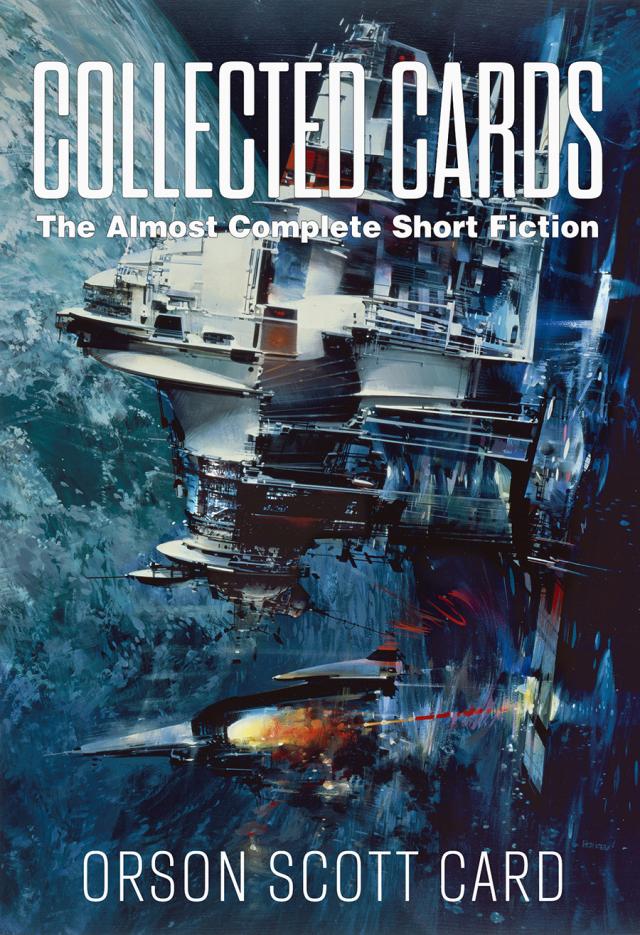
Collected Cards: The Almost Complete Short Fiction,
p.444


It means that the job will have to be done all over again, facing a new enemy, a lethal disease agent that has the capability of destroying human life on every world, undoing all that Graff had achieved.
With that thought he mentally sneered at himself, at his arrogance. Oh, yes, a hundred forty billion humans dead or transformed into heaven knows what, no survivors—but it’s all about undoing Graff’s achievement.
Once Graff was resigned to the inevitable, he set to work preparing to meet the Delphiki children. Not children anymore, and quite possibly very large adults, depending on how far the giantism had proceeded before they were able to alter their own genomes to stop it.
They had altered their own genomes. That was the single most important thing. Altered the DNA in every cell in their bodies—including, presumably, spermatozoa and oocytes, so they would only pass along genes with the giantism switched off.
This meant that the Delphikis had done some of what the Descoladores had done—created a mechanism for altering the entire organism-wide genome without killing the organism.
This feat had also been accomplished by Ender’s stepdaughter, Ela, but she had created it while Jane held her Outside, where protean creatures—aiúas?—could assemble exactly the virus she had designed. That wasn’t science, it was magic, because it couldn’t be replicated. It was an elevated sort of wishing-really-hard. But it worked—the Descolada was defanged on the world called Lusitania.
On the other hand, what the Delphikis had done was science. If they could adapt their methods to solve the Descolada virus, they could transmit their methods throughout the human universe, to be replicated by scientists everywhere.
Jane had only a little information on the Delphikis. It was a matter of public record that when Bean went into space, he took with him the three children doomed to hyper-brilliance and death by unstoppable giantism. Their names: Andrew, Bella, and Cincinnatus, though Jane assured him that they called each other Ender, Carlotta, and Sergeant. Graff vaguely remembered Bean’s being connected to a nun named Carlotta, so that name made sense. Sergeant made none.
“Why don’t you have more than this?” Graff asked her.
“Because this was all I could get from the available sources.”
“You can’t get into their ship’s computer?”
“Did I mention these children were brilliant? So are their firewalls through the ansible.”
“And you can’t get through them?”
“Of course I could batter them down. And then run into whatever they had behind it. What I can’t do is get through undetected.”
Graff chuckled. “Which is why you need me. Reconnaissance.”
“Negotiation.”
“No, I think I’m your Trojan horse.”
“I’m not waging war with them, Minister. I need their willing—no, enthusiastic—cooperation.”
“So I’m public relations?”
“You’re the minister of foreign affairs.”
“They’re not foreign, are they?”
“They’ve been away from human civilization their whole lives,” Jane reminded him. “And genetically, they might regard themselves as no longer human. Because they rewrote their code. So you may be seen, in their ship, as an alien intruder.”
“So I should prepare to die?”
“‘A wise man lives his life prepared to die, and prepared, equally, to live.’”
“A quotation?”
“From the book The Hive Queen,” said Jane.
“Written by the ‘Speaker for the Dead.’”
“Written by Andrew Wiggin. He wrote another book, titled, so far, The Death of Human. Valentine is looking for a posthumous publisher.”
“Can’t wait.”
“Well, I can’t. But I don’t have to—I read every page while he was typing it. The life cycle of the pequeninos, on Lusitania.”
“Should I read it?”
“It’s a fully detailed account of their Descolada-shaped life cycle.”
“So it’s a warning.”
“It’s a declaration of war. It would be lovely if you could enlist the Delphiki geniuses in that war.”
“I’ll do my best.”
“On our side, preferably.”
“Well, it’s a good thing you told me that before I negotiated the opposite treaty.”
* * *
It didn’t take all that long for Graff to get up to speed on Jane’s information about the Delphikis. The most time-consuming thing was reading Ender’s Death of Human, which made depressing reading. It was impossible to believe that a virus—a double helix of DNA, after all, not an organism—could adapt itself intelligently enough to combine two organisms into a single life cycle.
The sentient, speaking pequeninos—piggies, as the first explorers had called them—were, in effect, the larva stage, and the imago was the massive, branchy deciduous tree that had formerly been their habitat. Surely the trees had not been sentient before the Descolada came to their world. Only when pequenino DNA and body structures were incorporated into the tree that grew from the pequenino’s corpse would the trees have become self-aware.
Not your ordinary plant. And from Ender’s careful description, the trees didn’t communicate the way forests did on Earth and the colonies, passing chemicals and bacteria through interlaced root systems, and molecules pushed into the air to be borne by wind to all the nearby trees. No, the trees of Lusitania seemed to be all of one species—no effort at biodiversity—and their communication was like that of the Hive Queens—instantaneous. Simultaneous. No time lag at all. What one tree knew, all the trees of Lusitania knew.
That ability, too, must have come from the Descolada virus, which made Graff wonder if the virus, too, was instantaneously communicating with the people who created it on its home world. Did they already know everything the virus had done on Lusitania? Did they know about the arrival of humans, about the Descolada plague that nearly wiped out the colony when settlement began? Were they directing and controlling it? Had they issued a directive to the virus: Destroy these newly arrived humans?
That would make it a deliberate war. Nothing accidental like the Formics’ “invasion” of Earth, which had really been an attempt at colonization that did not recognize that humans were sentient.
They know what we are, and they want us dead.
Graff shook that idea out of his head. That was a ridiculous level of speculation, far beyond anything the data suggested.
After The Death of Human, Graff turned to the report by Ender’s stepdaughter, Ela. If Graff hadn’t already heard of it from Jane, he would have dismissed Ela’s account of going “Outside” and creating her anti-Descolada virus by thinking about it with perfect concentration.
What mattered was that she had appended the whole genome of the pequenino version of the Descolada—“DesP”—and the whole genome of her much simpler anti-Descolada—“ADes.” The strings of proteins meant nothing to him, beyond a vague theoretical knowledge of how DNA worked. But to the Delphiki geniuses, assuming they were in fact all that smart, it might be like handing them a roadmap to a small town.
“I’m ready,” he said.
Jane took a moment to respond. “Unlikely.”
“No likelihood about it, no probability. I am, at this moment, as ready as I’m going to be.”
“You can’t possibly have studied the genomes. You only glanced at them.”
“There’s no reason for me to study them, and you know it. The DNA stuff is between them and Ender’s stepdaughter. She seems to be a clever one. Did he adopt the family in order to get her?”
“He adopted the family because they needed a father,” said Jane. Icily, he thought. Does she have that level of control, to be able to put thinly veiled nastiness into her voice?
“So her ability was just a bonus?” asked Graff. Now let’s see if she can hear the irony in my voice.
“Her ability was a result,” said Jane. “Her real parents were both very notable scientists, the most important pequenologists. But she was nonfunctional until Ender married their mother and adopted all the children who would allow him.”
“My point,” said Graff, “is that the conversation is between Ela and the Delphikis. There’s no reason I should try to learn such an abstruse language when they have no need of my participation in that conversation.”
Again, a pause. But Graff was reasonably sure the pause was not thinking time—Jane didn’t need any detectable amount of time to reach a conclusion. Her pauses were decorative. Or manipulative. Trying to make him sweat? He had been sweated by some of the meanest sons-of-bitches ever to rise to rank in the nasty bureaucracy of the International Fleet and the Hegemony. Jane was an amateur at it. Unconvincing because Graff knew that she would never let emotion or ambition interfere with doing the right thing—whatever she understood that to be.
Finally she spoke. “Your point is valid. You are mentally limited and making sense of the genomes would delay you too long. Since you are not on the same intellectual level as the Delphiki—”
“Cool your jets, Miz Jane,” said Graff. “If I couldn’t work with people who are smarter than me in their own field, my career would have been ‘solitary, poor, nasty, brutish, and short.’”
“I’m so impressed that you used the entire phrase instead of just ‘nasty, brutish, and short,’ as most people do.”
“Civilization means division of labor. If every person had to master every skill, we’d still be competing with baboons for lebensraum.”
“You aren’t going to be able to impress the Delphiki on any level, in any subject,” said Jane.
“If you build up my confidence any more, there’ll be no putting up with me.”
“Here’s how we’re going to do this,” said Jane. “I’m going to bring us close to their ship—rather suddenly, so they’ll know they’re dealing with a technology far superior to theirs.”
“Oh, you can try to impress them?”
“Because I really am smarter than they are,” said Jane.
“Why do we need them, then?”
“In some subjects. Like space travel. And metaphysics.”
“But they’ve got you on genetics?”
“They’ve spent their whole lives learning genomes forward and backward, figuring out what every sequence codes for, learning to alter it just as Ela did with the Descolada. Only they couldn’t go Outside to build their anti-Anton virus. They fixed their own genetic death sentence without any extraordinary tech.”
“So they are smarter than you,” said Graff. “It’s all right, you can admit it.”
“They’re inhumanly smart.”
“So are you,” said Graff.
“I’m humanly smart,” said Jane. “The sum of known human knowledge. But I haven’t attempted to extend the bounds of human knowledge, except for the little matter of exploring where I came from and how the Hive Queens made me. That led me Outside—my only original contribution to human knowledge.”
“You’re going to bring our ships close together in a magical way.”
“If they try to run, I’ll hold them in place.”
“You can do that without getting trapped in their ship?”
“I think I can do it without any presence inside their ship’s computer,” said Jane. “We’ll see.”
“Now we’re there. Do we dock? Does our ship have the right fittings?”
“Their ship has the standard fittings of about three thousand years ago. I made sure this ship was similarly equipped. The ships can dock and mate.”
“Then I enter their ship and they blow me to smithereens.”
“We can dock, but we aren’t going to,” said Jane.
“I put on a suit and float over to them?” asked Graff. “I don’t like wearing the suit and going out into the cold. A bit of a claustrophobia thing.”
“No suit. No spacewalk.”
“You’re just going to put me on board their ship instantaneously.”
“The only way to fly.”
“I’m betting you know exactly where they are inside their ship.”
“I do,” said Jane.
“So are you sending me right to them?”
“Two of them. Ender and Carlotta will be together right now, sharing their main meal of the day. But Sergeant eats alone, and only comes to see them when they call a meeting.”
“Sergeant is the dangerous one.”
“Which is why I choose not to spring a surprise on him,” said Jane. “And you’re wrong—they’re all dangerous in the extreme.”
“But Sergeant is the volatile one. Primed to blow up at any time.”
“Yes,” said Jane. “So you have a chance to get acquainted with the others first. Am I not thoughtful? Am I not taking good care of you?”
“That remains to be seen. Any plan to pull me out of there if things go south?”
“Not really,” said Jane. “I trust you to keep things manageable without my intervention.”
“In other words, I’m expendable, and if I fail, you’ll try direct contact with them, while I lie there in a pool of my own blood.”
“I hope they’re more fastidious than to spill you everywhere. They’d just have to clean you up.”
“Do you have some weird idea that I’ll accomplish more if I’m terrified?”
“Most people do.”
“Most people fumble around like paramecia, pumping their cilia and bumping into things. I’m an amoeba. I function best when I’m placid, oozing my way around.”
“You’ll do fine,” said Jane.
“When will I do all this fineness?”
“Now,” said Jane.
* * *
Graff was standing at one end of a mess hall in a fairly standard military messenger ship from the time of the Formic Wars. At the far end of a long table sat two adults—one male, one female—wearing loose-fitting clothing that was neither flattering nor ugly. Graff knew immediately that these were Andrew and Carlotta. They both looked more like Petra; Sergeant, he knew, looked more like Bean. Julian, that is. Would they care which name he used to refer to their father? Jane said they always called him “the Giant” while he was alive. But now that he’s dead? And not that long ago, by their relativistic reckoning.
Without making any particular noise, Graff pulled out a chair and sat down at his end of the table. Carlotta was looking into the display space above a desk, occasionally poking and twisting something that was invisible to Graff. Andrew was leaning back in his chair, reading something, it seemed, though from Graff’s angle he couldn’t begin to guess what Andrew was reading in the holospace above his desk.
Graff wanted to make some snide remark to Jane about how it wasn’t polite to drop in without calling ahead, but of course Jane wasn’t present in this ship, or at least not the way she had been in the ship Graff woke up in.
“We do know you’re here,” said Carlotta. “In case you didn’t want to speak first.”
“I was afraid I should have made more noise,” said Graff.
“Your ship’s computer notified our ship’s computer that you were coming,” said Carlotta. “Now I’m trying to grasp the technology your computer says it is using for interstellar flight.”
“I only found out about it yesterday,” said Graff. “Whatever ‘yesterday’ means, here in space.”
“You’re supposedly the real Colonel Graff,” said Andrew. “Supposedly you knew our father.”
“I knew him,” said Graff, “about as well as he allowed anyone to know him.”
“No bedtime storytelling?” asked Carlotta.
“But plenty of putting him under arrest because he threatened to wreck the whole war effort by telling Ender Wiggin what he didn’t need to know.”
“He made that as a threat?” asked Andrew quietly.
“No, no, I was extrapolating. He guessed things that he shouldn’t have guessed, but, well—”
“He was the Giant,” said Andrew. “An annoyingly perceptive man, apparently from the start.”
“He wouldn’t have batted an eye when you appeared,” said Carlotta, “and we seem to have inherited his aplomb.”
“You look more like your mother,” said Graff.
“That’s right, you knew everybody,” said Carlotta.
“I knew all the children to some degree,” said Graff, “though all these years later I can’t promise that I haven’t forgotten most of them.”
“Well,” said Andrew, “only a few of them actually mattered. To the war, I mean.”
“And your parents were in that select number,” said Graff. “Ender’s Jeesh. The elite commanders who actually fought the war.”
“The Giant always made sure to tell us that the pilots and soldiers on the scene fought the war,” said Andrew. “All he did was bark orders into a headset. And when he made a mistake, those real fighters were the ones who died.”
“That was the plan, and it worked,” said Graff.
“The Giant always reminded us of that,” said Carlotta. “He also told us that everybody thought of you as their real enemy.”
“Part of the plan,” said Graff.
“Except Ender Wiggin,” said Carlotta.
“Except Ender Wiggin,” echoed Andrew Delphiki. “He never lost track of the fact that the real enemy was the Hive Queen. Nothing ever distracted him from that.”
“He wasn’t easily distracted,” said Graff.
“But the Giant said that Ender was wrong. You were the real enemy. The Hive Queen was just the opponent in a game.”
Graff gave himself a moment before he answered. “I don’t believe your father ever said any such thing.”
“We lived with him for many years,” said Carlotta. “More than you did. And you think you knew him?”
“I knew him well enough to be sure he would never say anything that stupid.”
“You don’t know how bitter and angry he was at the end,” said Andrew. “You don’t know how much invective was directed toward you.”
“I’m flattered to think that at the end of his life, Julian Delphiki even remembered that I existed. My guess is that the only thing he thought about was the three of you. How to help you overcome the giantism from Anton’s Key without losing the intellectual sharpness.”