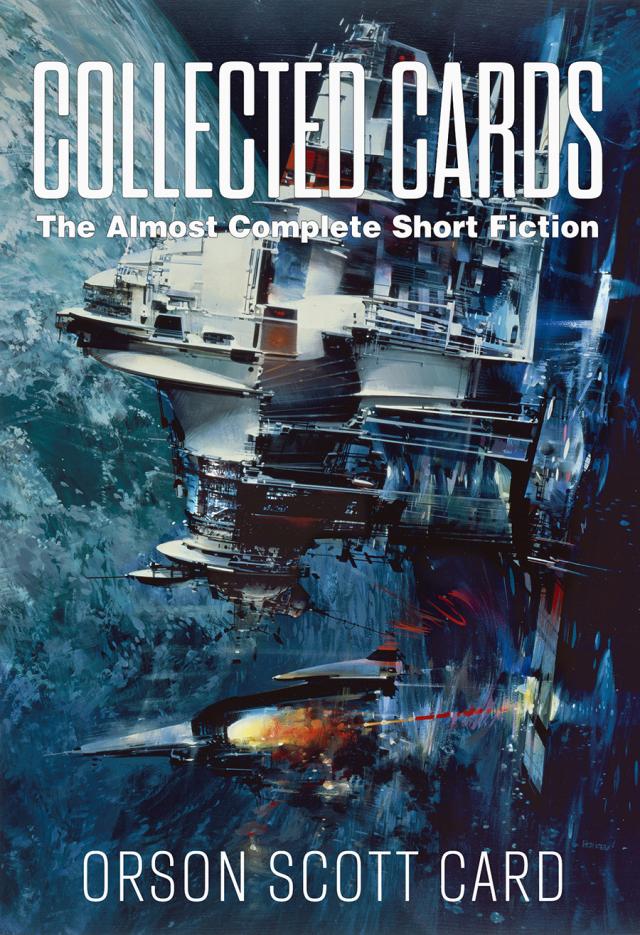
Collected cards the almo.., p.212
Collected Cards: The Almost Complete Short Fiction,
p.212


“You’re wrong,” said Jane. “If Path suddenly disappears from all ansibles at once, they might just as easily conclude that this world is in rebellion just like Lusitania—after all, they shut down their ansible, too. And what did Starways Congress do? They sent a fleet with the MD Device on it.”
“Lusitania was already in rebellion before their ansible was shut down.”
“Do you think Congress isn’t watching you? Do you think they’re not terrified of what might happen if the godspoken of Path ever discover what has been done to them? If a few primitive aliens and a couple of xenologers frightened them into sending a fleet, what do you think they’ll do about the mysterious disappearance of a world with so many brilliant minds who have ample reason to hate Starways Congress? How long do you think this world would survive?”
Qing-jao was filled with a sickening dread. It was always possible that this much of Jane’s story was true: that there were people in Congress who thought that the godspoken of Path had been created solely by genetic manipulation. And if there were such people, they might act as Jane described. What if a fleet came against Path? What if Starways Congress had ordered them to destroy the whole world without any negotiation? Then her reports would never be known, and everything would be gone. It would all be for nothing. Could that possibly be the desire of the gods? Could Starways Congress still have the mandate of heaven and yet destroy a world?
“Remember the story of I Ya, the great cook,” said Jane. “His master said one day, ‘I have the greatest cook in all the world. Because of him, I have tasted every flavor known to man except the taste of human flesh.’ Hearing this, I Ya went home and slaughtered his own son, cooked his flesh, and served it to his master, so that his master would lack nothing that I Ya could give him.”
This was a terrible story. Qing-jao had heard it as a child, and it made her weep for hours. What about the son of I Ya? she had cried. And her father had said, A true servant has sons and daughters only to serve his master. For five nights she had woken up screaming from dreams in which her father roasted her alive or carved slices from her onto a plate, until at last Han Fei-tzu came to her and embraced her and said, “Don’t believe it, my Gloriously Bright daughter. I am not a perfect servant. I love you too much to be truly righteous. I love you more than I love my duty. I am not I Ya. You have nothing to fear at my hands.” Only after Father said that to her could she sleep.
This program, this Jane, must have found Father’s account of this in his journal, and now was using it against her. Yet even though Qing-jao knew she was being manipulated, she couldn’t help but wonder if Jane might not be right.
“Are you a servant like I Ya?” asked Jane. “Will you slaughter your own world for the sake of an unworthy master like Starways Congress?”
Qing-jao could not sort out her own feelings. Where did these thoughts come from? Jane had poisoned her mind with her arguments, just like Demosthenes before her—if they weren’t the same person all along. Their words could sound persuasive, even as they ate away at the truth.
But did Qing-jao have the right to risk the lives of all the people of Path? What if she was wrong? How could she know anything? Whether everything Jane said was true or everything she said was false, the same evidence would lie before her. Qing-jao would feel exactly as she felt now whether it was the gods or some brain disorder.
Why, in all this uncertainty, didn’t the gods speak to her? Why, when she needed the clarity of their voice, didn’t she feel dirty and impure when she thought one way, clean and holy when she thought the other? Why were the gods leaving her unguided at this cusp of her life?
In the silence of Qing-jao’s inward debate, Wang-mu’s voice came as cold and harsh as the sound of metal striking metal. “It will never happen,” said Wang-mu.
Qing-jao only listened, unable even to bid Wang-mu to be still.
“What will never happen?” asked Jane.
“What you said—Starways Congress blowing up this world.”
“If you think they wouldn’t do it you’re even more of a fool than Qing-jao thinks,” said Jane.
“Oh, I know they’d do it. Han Fei-tzu knows they’d do it—he said they were evil enough men to commit any terrible crime if it suited their purpose.”
“Then why won’t it happen?”
“Because you won’t let it happen,” said Wang-mu. “Since blocking off every ansible message from Path might well lead to the destruction of this world, you won’t block those messages. They’ll get through. Congress will be warned. You will not cause Path to be destroyed.”
“Why won’t I?”
“Because you are Demosthenes,” said Wang-mu. “Because you are full of truth and compassion.”
“lam not Demosthenes,” said Jane.
The face in the terminal display wavered, then changed into the face of one of the aliens. A pequenino, its porcine snout so disturbing in its strangeness. A moment later, another face appeared, even more alien: it was a bugger, one of the nightmare creatures that had once terrified all of humanity. Even having read The Hive Queen and the Hegemon, so that she understood who the buggers were and how beautiful their civilization had been, when Qing-jao saw one face to face like this, even in a computer display, it still frightened her.
“I am not human,” said Jane, “even when I choose to wear a human face. How do you know, Wang-mu, what I will and will not do? Buggers and piggies both, they killed human beings without a second thought.”
“Because they didn’t understand what death meant to us. You understand. You said it yourself—you don’t want to die.”
“Do you think you know me. Si Wang-mu?”
“I think I know you,” said Wang-mu, “because you wouldn’t have any of these troubles if you had been content to let the fleet destroy Lusitania.”
The apparition in the display became again the face named Jane. “I suppose not,” she said.
Relief came to Qing-jao like the first strong breath to a swimmer who nearly drowned. “You can’t stop me,” she said triumphantly. “I can send my message!”
Qing-jao walked to the terminal and sat down before Jane’s watching face. But she knew that the image in the display was an illusion. If Jane watched, it was not with those human eyes. It was with the visual sensors of the computer. It was all electronics, infinitesimal machinery but machinery nonetheless. Not a living soul; it was irrational to feel ashamed under that illusionary gaze.
“Mistress,” said Wang-mu.
“Later,” said Qing-jao.
“If you do this, Jane will die. They’ll shut down the ansibles and kill her.”
“What doesn’t live cannot die,” said Qing-jao.
“The only reason you have the power to kill her is because of her compassion.”
“If she seems to have compassion it’s an illusion—she was programmed to simulate compassion, that’s all.”
“Mistress, if you kill every manifestation of this program, so that no part of her remains alive, how are you different from Ender the Xenocide, who killed all the buggers three thousand years ago?”
“Maybe I’m not different,” said Qing-jao. “Maybe Ender also was the servant of the gods.”
Wang-mu knelt beside Qing-jao and wept on the skirt of her gown. “I beg you, Mistress, don’t do this evil thing.”
But Qing-jao wrote her report. It stood as clear and simple in her mind as if the gods had given the words to her. “To Starways Congress: The seditious writer known as Demosthenes is a woman now on or near Lusitania. She has control of or access to a program that has infested all ansible computers, causing them to fail to report messages from the fleet and concealing the transmission of Demosthenes’s own writings. The only solution to this problem is to extinguish the program’s control over ansible transmissions by disconnecting all ansibles from their present computers and bringing clean new computers online, all at once. For the present I have neutralized the program, allowing me to send this message and probably allowing you to send your orders to all worlds; but that cannot be guaranteed now and certainly cannot be expected to continue indefinitely, so you must act quickly. I suggest you set a date exactly twenty standard weeks from today for all ansibles to go offline at once for a period of at least one standard day. All the new ansible computers, when they go online, must be completely unconnected to any other computer; from now on ansible messages must be manually reentered at each ansible computer so that electronic contamination will never be possible again. If you retransmit this message immediately to all ansibles, using your code of authority, my report will become your orders; no further instructions will be needed and Demosthenes’s influence will end. If you do not act immediately, I will not be responsible for the consequences.”
To this report Qing-jao affixed her father’s name and the authority code he had given her, her name would mean nothing to Congress, but his name would be heeded, and the presence of his authority code would ensure that it was received by all the people who had particular interest in his statements.
The message finished, Qing-jao looked up into the eyes of the apparition before her. With her left hand resting on Wang-mu’s shuddering back, and her right hand over the transmit key, Qing-jao made her final challenge. “Will you stop me or will you allow this?”
To which Jane answered, “Will you kill a raman who has done no harm to any living soul, or will you let me live?”
Qing-jao pressed the transmit button. Jane bowed her head and disappeared.
It would take several seconds for the message to be routed by the house computer to the nearest ansible; from there, it would go instantly to every Congress authority on every one of the Hundred Worlds and many of the colonies as well. On many receiving computers it would be just one more message in the queue; but on some, perhaps hundreds, Father’s code would give it enough priority that already someone would be reading it, realizing its implications, and preparing a response. If Jane in fact had let the message through.
So Qing-jao waited for a response. Perhaps the reason no one answered immediately was because they had to contact each other and discuss this message and decide, quickly, what had to be done. Perhaps that was why no reply came to the empty display above her terminal.
The door opened. It would be Mu-pao with the game computer. “Put it in the comer by the north window,” said Qing-jao without looking. “I may yet need it, though I hope not.”
“Qing-jao.”
It was Father, not Mu-pao at all. Qing-jao turned to him, knelt at once to show her respect—but also her pride. “Father, I’ve made your report to Congress. While you communed with the gods, I was able to neutralize the enemy program and send the message telling how to destroy it. I’m waiting for their answer.”
She waited for Father’s praise.
“You did this?” he asked. “Without waiting for me? You spoke directly to Gloriously Bright
Congress and didn’t ask for my consent?”
“You were being purified, Father. I fulfilled your assignment.”
“But then—Jane will be killed.”
“That much is certain,” said Qing-jao. “Whether contact with the Lusitania Fleet will be restored then or not, I can’t be sure.” Suddenly she thought of a flaw in her plans. “But the computers on the fleet will also be contaminated by this program! When contact is restored, the program can retransmit itself and—but then all we’ll have to do is blank out the ansibles one more time . . . .”
Father was not looking at her. He was looking at the terminal display behind her. Qing-jao turned to see.
It was a message from Congress, with the official seal displayed. It was very brief, in the clipped style of the bureaucracy.
Han:
Brilliant work.
Have transmitted your suggestions as our orders.
Contact with the fleet already restored.
Did daughter help per your note 14FE.3A?
Medals for both if so.
“Then it’s done,” murmured Father. “They’ll destroy Lusitania, the pequeninos, all those innocent people.”
“Only if the gods wish it,” said Qing-jao. She was surprised that Father sounded so morose.
Wang-mu raised her head from Qing-jao’s lap, her face red and wet with weeping. “And Jane and Demosthenes will be gone as well,” she said.
Qing-jao gripped Wang-mu by the shoulder, held her an arm’s length away. “Demosthenes is a traitor,” said Qing-jao. But Wang-mu only looked away from her, turned her gaze up to Han Fei-tzu. Qing-jao also looked to her father. “And Jane—Father, you saw what she was, how dangerous.”
“She tried to save us,” said Father, “and we’ve thanked her by setting in motion her destruction.”
Qing-jao couldn’t speak or move, could only stare at Father as he leaned over her shoulder and touched the save key, then the clear key.
“Jane,” said Father. “If you hear me. Please forgive me.”
There was no answer from the terminal.
“May all the gods forgive me,” said Father. “I was weak in the moment when I should have been strong, and so my daughter has innocently done evil in my name.” He shuddered. “I must—purify myself.” The word plainly tasted like poison in his mouth. “That will last forever, too, I’m sure.”
He stepped back from the computer, turned away, and left the room. Wang-mu returned to her crying. Stupid, meaningless crying, thought Qing-jao. This is a moment of victory. Except Jane has snatched the victory away from me so that even as I triumph over her, she triumphs over me. She has stolen my father. He no longer serves the gods in his heart, even as he continues to serve them with his body.
Yet along with the pain of this realization came a hot stab of joy: I was stronger. I was stronger than Father, after all. When it came to the test, it was I who served the gods, and he who broke, who fell, who failed. There is more to me than I ever dreamed of. I am a worthy tool in the hands of the gods; who knows how they might wield me now?
Quotations from the poems of Li Qing-jao are from James Cryer, trans., Plum Blossom: Poems of Li Ch’in-Chao (Carolina Wren Press, 1984), by permission of the translator.
Quotations from the words of Han Fei-tzu are from Burton Watson, trans., Han Fei Tzu: Basic Writings (Columbia University Press, 1964) by permission of the publisher.
Feed the Baby of Love
Orson Scott Card was born in Washington, grew up in Utah, and now lives in Greensboro, North Carolina. He was educated at Brigham Young University and served as a Mormon missionary in Brazil from 1971 into 1973. Returning to Utah, he ran a repertory theatre in Provo where he wrote and produced more than a dozen plays. In the late 1970s, through 1982, he was a teacher, first at the University of Utah, later at Notre Dame.
Card saw his first book published in 1978; he has become a major name in science fiction with such novels as Ender’s Game (1985) and Speaker of the Dead (1986), both of which garnered a hatful of prizes, including the Hugo and Nebula Awards.
His theme as a writer embraces personal growth and transformation, and this theme is strongly echoed here in his contribution to The Bradbury Chronicles.
Orson Scott Card links Dandelion Wine’s boyhood world of 1928 with our present world of the 1990s in this sharply effective portrait of a woman who has reached a special turning point in her life.
The longest story in this book—and one of the most creatively powerful.
W.F.N.
When Rainie Pinyon split this time she didn’t go south, even though it was October and she didn’t like the winter cold. Maybe she thought that this winter she didn’t deserve to be warm, or maybe she wanted to find some unfamiliar territory—whatever. She got on the bus in Bremerton and got off it again in Boise. She hitched to Salt Lake City and took a bus to Omaha. She got herself a waitressing job, using the name Ida Johnson, as usual. She quit after a week, got another job in Kansas City, quit after three days, and so on and so on until she came to a tired-looking cafe in Harmony, Illinois, a small town up on the bluffs above the Mississippi. She liked Harmony right off, because it was pretty and sad—half the storefronts brightly painted and cheerful, the other half streaked and stained, the windows boarded up. The kind of town that would be perfectly willing to pick up and move into a shopping mall, only nobody wanted to build one here and so they’d just have to make do. The help wanted sign in the cafe window was so old that several generations of spiders had lived and died on webs between the sign and the glass.
“We’re a five-calendar cafe,” said the pinched-up overpainted old lady at the cash register.
Rainie looked around and sure enough, there were five calendars on the walls.
“Not just because of that Blue Highways book, either, I’ll have you know. We already had these calendars up before he wrote his book. He never stopped here but he could have.”
“Aren’t they a little out of date?” asked Rainie.
The old lady looked at her like she was crazy.
“If you already had the calendars up when he wrote the book, I mean.”
“Well, not these calendars,” said the old lady. “Here’s the thing, darlin’. A lot of diners and whatnot put up calendars after that Blue Highways book said that was how you could tell a good restaurant. But those were all fakes. They didn’t understand. The calendars have all got to be local calendars. You know, like the insurance guy gives you a calendar and the car dealer and the real estate guy and the funeral home. They give you one every year, and you put them all up because they’re your friends and your customers and you hope they do good business.”