Collected cards the almo.., p.352
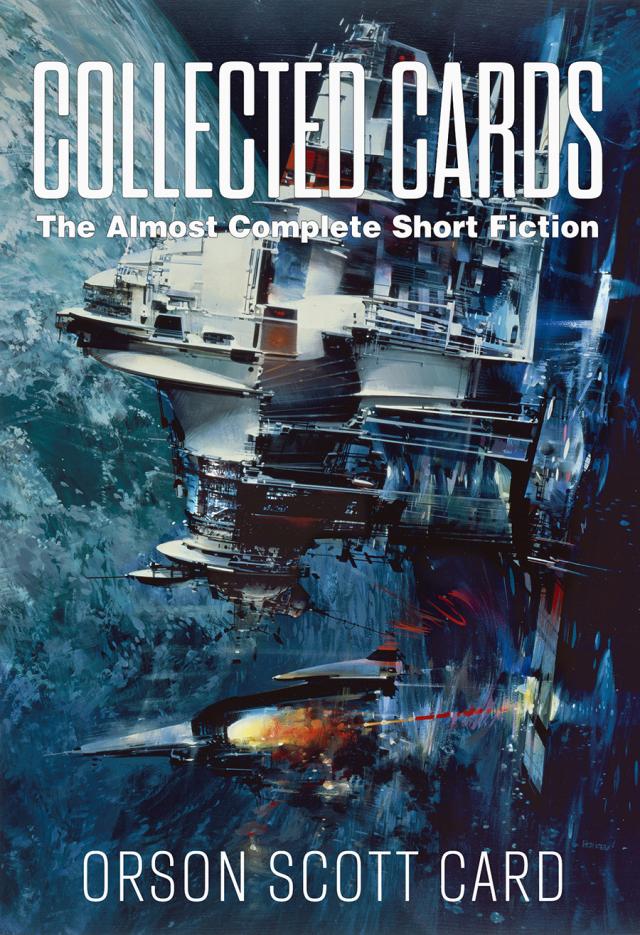
Collected Cards: The Almost Complete Short Fiction,
p.352


Two soldiers appeared in the doorway. One of them was Marcellus. “What happened here?”
“I saw a man was hiding behind the tapestry. Mother called for help. I slew him through the cloth. I didn’t see his face until he fell.”
He did not turn to look at Mother. Everything he said was true; it was up to her if she wanted to correct what he said and tell them that it was her son she feared, and not the hidden observer.
For that was what he surely was. Polonius must have been meeting with Mother and Laertes, and when Laertes left and spoke to Hamlet in the hallway, Polonius hid himself—with Mother’s consent—so he could hear what was said.
She had consented to let this man spy on him. Their first private meeting since he came home, and she had asked Polonius to stay and spy. What did she think that Hamlet would do?
I killed a man. A good and decent man, who served his King and Queen well.
No, she killed him. By ordering him to spy on her son, she killed him. By calling out for help that she didn’t need, she killed him. Did she think he would ever raise his hand against her? Apparently she did. And now Polonius was dead because of it.
“Tell King Claudius,” said Hamlet. “I will bear whatever penalty he sets for me. It was my hand killed him. A mistake—but the mistake was his, hiding behind a curtain in my mother’s chamber. How could he imagine this would end?”
Hamlet turned to his mother, who still sat on the floor, her face stricken. “I know what you are; what you never understood was what I am.”
“You know nothing,” she said.
“If that’s true,” he said, “whose fault is that?”
He left the room, still holding his dagger. If he had passed King Claudius on the way, he would have put the blade in him on the spot. But Claudius was protected, for the moment, and Hamlet found his way out into the graveyard again, still holding the bloody dagger. Horatio was gone. He saw no one. He plunged the dagger into the grass and dirt of Yorick’s grave, and washed it with the damp of the grass and wiped it on his own doublet.
He could hear the tumult in the castle. A woman screaming. Men shouting. But no soldiers came for him. Mother must be standing with the story of its being an accident. She was honest enough to know that the fault was hers, and would not accuse him of murder.
Too little honesty, too late. Poor Polonius. An old fool, dead for doing what Kings and Queens commanded.
And then a strange, exhilarating thought:
I’ve killed a man. It was easy. As natural as breathing. Now there’s nothing stopping me from doing what must be done.
It was as if he heard his father’s voice, that deep spectral sound that had shivered him to the soul that night on the battlements: Good, my son. Well done, my son. Hurry up and finish it, my son.
It came more quickly than he thought it would. By torchlight, in the great hall.
Hamlet was in the garden where his father had died. Horatio brought him his sword. “Laertes is looking for you,” he said.
“I don’t have time for Laertes. He must know I didn’t mean to kill his father,” said Hamlet.
“It’s not his father,” said Horatio. “It’s his sister.”
“Ophelia? I didn’t touch her.”
“She killed herself. Walked out into the sea, dressed in her heaviest gown. A funeral gown. Two soldiers went in after her, and a boat was launched, but when they brought her body back, she was dead.”
“And for that he wants to kill me?”
“He blames you. Between killing her father and trifling with her affections—”
“I don’t want to fight Laertes.”
“Hamlet—he’s been practicing for four years in order to fight you.
“What? We were friends! Until this afternoon I thought we still were!”
“It’s not what you think. He meant to kill your father. But he believed that in order to kill him, he’d have to fight you first. He knew that nobody could beat you with a sword—but he was determined to try. Now your father is dead, but his rage isn’t. If you leave, just stay away for a few days—take ship for the Orkneys, Hamlet, I beg you to do it. Laertes will be back in his right mind before you return.”
“But I won’t be,” said Hamlet. “My father is unburied.”
“He’s also dead,” said Horatio. “You aren’t, and so far neither is Laertes.”
“And neither is Claudius.”
“Exactly. Leave bad enough alone, Hamlet.”
But Hamlet had already strapped on his sword and was striding toward the castle.
“O God!” cried Horatio. “Stop him! Stop this all!”
The torches flickered and danced. Several courtiers were already there, as were the King and Queen. Laertes was pacing up and down in front of them, shouting, demanding justice, vengeance, satisfaction. “My sister’s dead body is still drenched in seawater and I’ll have the heart’s blood of the rogue who drowned her!”
“No one drowned her but herself,” said King Claudius.
It galled Hamlet to hear his uncle plead for him. “Enough talk!” he cried from the far end of the chamber. “Do you want my heart, Laertes? You had it all our lives; it still belongs to you. Take it now, if you can!”
Their swords drawn, they fairly flew at each other across the room, blades flashing. Everyone moved out of the way, behind the arches, trusting in the stone pillars that held up the ceiling to keep them safe.
How many times had they fought, as boys? Laertes had learned much since then. There was no playfulness about it now. Laertes’s every blow and thrust was intended to kill or maim; he moved in a fury, taking no pause for breath.
Yet Hamlet saw very quickly that Laertes could not win unless he let him. It was not a lack of skill—Laertes was as good a swordsman as Hamlet had ever seen. Nor was it Laertes’s rage: He fought with control, with a furious calm that made no mistakes.
He simply wasn’t quick enough. All his practice and study with the sword in France had made him an interesting opponent, but not one that could defeat Hamlet, even with his lack of practice. Laertes had new and clever moves that Hamlet had not seen before; but he understood them at once and countered them and that was it.
“Laertes, stop this,” Hamlet said. “You aren’t good enough. You won’t win.”
“Then I’ll die,” said Laertes. “I have nothing left but this. You’ve taken it all from me.”
“I’ve taken nothing from you. I grieve at your father’s death. Your sister’s suicide destroys me. I cared for her as much as I could for any woman, and I wished no harm on either of them. Nor do I wish to hurt you.”
“Kill me or die,” said Laertes.
“The only way I’ll die is if you poisoned your blade and some of it spills on me,” said Hamlet.
Laertes’s answer was a furious onslaught. But he drew no blood. He didn’t even nick the clothing Hamlet wore.
Hamlet maneuvered the fight so that his back was to his mother and King Claudius.
“I have only one enemy in this room,” said Hamlet, “and it isn’t you. It’s the man who killed my father, married his widow, and stole the crown.”
He could hear people gasping at his words. And Mother cried out, “He didn’t! It’s a lie! Who told you such a thing!”
Hamlet gave a twist and a spin and Laertes’s sword flew up to the ceiling and then clattered back down a dozen yards away. With his opponent disarmed, Hamlet whirled on King Claudius.
“The ghost of my father told me!” cried Hamlet. “How you poured poison in his ear while he lay asleep in the garden! I swore an oath to avenge him, and this day I honor my father’s command!”
Uncle Claudius was rising to his feet—to fight? to flee? it mattered not a whit. For Hamlet ran him through the heart and had the sword back out again in time to whirl and face Laertes, who was running at him from behind, his sword again in hand.
There was not time for finesse. With Claudius’s blood still hot on the blade, it went through Laertes’s heart as well.
“No!” cried Hamlet.
“O God!” cried Horatio. “O God, how could you punish them all for my sin!”
“Your sin?” said Hamlet.
“I killed your father!”
Hamlet stared at him dumbfounded. Horatio, unarmed, tore open his shirt. “Here’s my heart! Kill me! I’m the one you vowed to murder to avenge your father! I’m the one who killed him!”
Hamlet staggered back, turned a little, touched his uncle, who lay sprawled across the table while Mother wept over him.
“But Father said—”
“He lied! The old bastard lied!” cried Horatio. “Why didn’t you tell me what he said? I would have told you. I thought you knew the truth—I offered to let you kill me right there in the garden! I thought you understood!”
“Offered? But I never—why would you kill him?”
“Because he was evil. Because of what he did to us. All of us. The Companions. All the boys but you!”
Behind him, Hamlet heard his mother wail.
“What did he do?” asked Hamlet.
“He had us,” said Horatio. “All of us, one by one, over and over again. Told us how much we owed him. Our duty to the King. How to thank him.”
“Thank him?”
“With our bodies! You’ve never heard of such a thing? You read the Greeks and Romans and you never heard of it?”
“But you never told me.”
“He swore he’d kill us if we told.”
“All of you?”
“It twisted us. I saw it in the others. Rosencrantz and Guildenstern, they could never look at women. Laertes—he told me, even before he left for France, that his stick was broken and would never grow again. And me—I thought I was all right. I thought . . .”
He broke down and wept.
Mother’s voice came from behind him. “When I found what he was doing to the Companions, I almost killed him myself. I caught him fondling you when you were practically a baby, Hamlet. I held a knife at his throat and vowed that I’d have his blood if he ever touched you or was alone with you again. I’d tell the barons and they’d kill him themselves. He took a solemn oath never to touch you and he kept it. I didn’t know what he did with the Companions until—until Laertes came to me and told. Then I made him dissolve the Companions and let them all go free. But it was too late.”
“Too late,” echoed Horatio. “A few months ago, a new page came to the castle. I taught him. He followed me everywhere like a dog. I delighted in his company. And then one day I found myself . . . I had him naked, I was telling him how a boy shows love to his friend and teacher . . . the words your father used, the very words. I was the worst of all of them! I was like him! I stopped myself. I told the boy to dress and never come near me again. That I was evil. A monster. And then I went out into the garden to kill your father. There he was, asleep. As if the devil had a right to rest in such a place! I took my dagger and poised it over him. Then with my other hand I clamped his mouth closed, holding his head in place, and then I pushed the dagger down into his ear and through his brain. He twitched, he pissed, he shat, he died. And that’s where your mother and Claudius found me. I was working up the courage to put the knife into my own heart. They took it from me, and then your mother washed the blood as best she could and Claudius and I carried the body to the icehouse and wrapped it. Hamlet, it was me.”
“He said it was poison in his ear.”
“The blade must have felt cold at first, and then it burned going in,” said Horatio. “He never turned his face. He never saw.”
“But spirits . . . don’t they know?”
“Maybe he did,” said Horatio. “But he wanted Claudius dead because he was the King your father never knew how to become. He lied to you! He used you as surely as he used the rest of us!”
“What have I done?” whispered Hamlet.
“Your father’s ghost appeared to you?” said Mother.
“He said that Claudius . . .”
“I know the things he’d say,” she said. “Oh, the liar. The monster. I should have killed him when I could. Better to have my hands stained with a husband’s blood than all the evil that has come from letting him survive!” She fumbled for something in the waistband of her dress. “It was my fault, all of it!” she said. “I should have denounced him to the barons!”
She found what she was looking for—a small phial. Before Hamlet could reach to stop her, she had it open and drank it down.
“I love you, Hamlet,” she said. “I tried to protect you. Horatio did only what I should have done. What the law of God demanded.” Then the poison struck and she cried out in agony. She threw herself upon the body of King Claudius, cried out his name, and died.
Hamlet turned to face Horatio, who was still standing there, bare-chested, head bowed, waiting for the blade.
“Keep your oath,” said Horatio. “Kill the killer of your father.”
“If you had told me,” said Hamlet. “If I’d known, do you think I’d have shed a drop of blood to avenge him?”
Hamlet knelt beside Laertes. “What my father meant to do to me, he did to you instead, my friend. All my friends. And now how many suffered, and how many died, to protect me from the monster whose blood half-fills my veins?”
Then he staggered to his feet and went to his mother’s body, which lay half overspreading Claudius’s. “Mother, you did for me what you could; you thought it was enough; and it was. He never touched me. And you, Uncle Claudius, what a good King you were. You should have been King all along. I would to God you had been my father.”
Hamlet was still holding the sword, but when he turned again to Horatio, he let it fall. “I forbid you to die,” he said to Horatio. “You are the one good man still living. You did justice on a devil. You served me well, and the King, and the kingdom. I command you to live. When Fortinbras comes, hail him King of Denmark. Let the kingdoms be united. Tell him that he has the vengeance he long wanted, and now I charge him to be a good King to Norse and Danes alike.”
“Tell him yourself.”
“My father deserved to die,” said Hamlet. “There was no sin in what you did. But how will the deaths of my mother and my uncle and good Laertes and Polonius and Ophelia be avenged? If only I had let Laertes kill me. But I didn’t, and now his blood joins the others.”
“You’re innocent of any wrong,” said Horatio.
“God gave me only one gift—to know how to handle a blade. Too bad it took me this long to learn where the point of it most needed to be put.”
Then Hamlet drew his dagger and pushed it, smoothly, unhesitatingly, into his own chest, between the ribs, just beside the breastbone. It found his heart—he felt it as a searing agony. He heard it as a song.
As he fell to his knees, he could hear Horatio weeping. “Live,” Hamlet whispered one last time.
“I will,” said Horatio. “Ah, Hamlet, I love you!”
Then Hamlet’s body slumped onto the floor.
But his spirit did not go where his body went. His spirit arose and looked around the hall. To where Laertes’s spirit held his father’s and his sister’s hands; then they arose into heaven. To where his mother and Claudius, bright spirits both, embraced each other, and also rose into the air, toward the bright light awaiting them.
And finally to the dark shadowy corner where his father’s spirit stood, laughing, laughing, laughing. “Welcome to hell, my beautiful son. At last we’ll be together as I always longed for us to be.”
2009
The Man in the Tree
The kingdom of Iceway has no eastern border. It runs up against Icekame, the frozen mountains that are always deep in snow, and its glaciers creep downward year after year, plowing the poor soil and stony earth of the high valleys before them.
Many miles below these valleys, in his city of Kamesham on the Graybourn, King cares nothing for that edge of his kingdom. Beyond Icekame there are no marauding hordes eager to pour over the high passes. There is only the Forest Deep, where no one dwells but thornmages, who seek no visitors and never leave.
From a king’s point of view, Icekame was better than a border. On that edge of his kingdom, there was no one who coveted his crown or his lands, and he need not spare thought or money to guard that border. And the higher you journey up the valleys, the poorer the people are, so there’s no purpose in trying to tax them. You could only do it once, and then, deprived of the slight margin of survival, they would either die or become expensive refugees farther down the valley.
So the people in the high valleys were left alone. Poor and powerless, scrabbling in their poor soil for food enough to last out the winter, eking out a bit of meat by killing a bird or a squirrel now and then, they buried many a child, and a man was old at forty.
Between hunger and loss, however, they found time to live. The children had games and rhymes and contests and grand adventures between the work they did to help their families survive. They got older and felt the stirring of the hot sap of love rising through them like trees in spring. The women built their mud-daubed hovels and symbolically sang their lovers into husbands at the hearth, and then babies came and they delighted in them and taught them and raged at them and clung to them for however long they might survive.
The people in the King’s city of Kamesham would think these highvalley folk lived like animals. But in truth these villagers lived pure human life. They needed each other to survive, and knew it. They had no conspiracies and no secrets, no ambitions and no feuds. They couldn’t afford the luxury of treating any man or woman or child as expendable.
The highvalley villagers knew what the King in Kamesham did not think about: every passage over Icekame into the Forest Deep. In high summer, when the crops were doing well and could take care of themselves, families would pack up a bit of food and hike over a pass and then down the other side.
As they walked, the parents taught the children what they could and could not take in this place: Food enough for meals while they were there, but nothing to carry away. Water enough to drink, but nothing for the return journey.