Collected cards the almo.., p.331
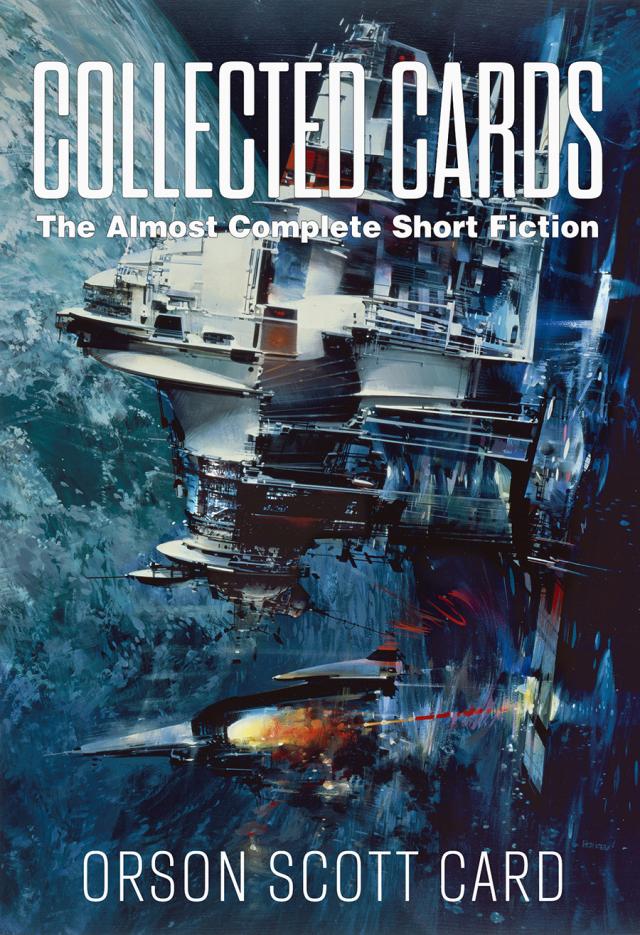
Collected Cards: The Almost Complete Short Fiction,
p.331


There were some careful questions, easily answered, and they moved on. However jovial a presenter might be, the answer was always the same. No answers.
After the papers were presented, the data examined, the statistical results questioned and upheld, the heads of the projects gathered in one small room at the top of the old Hyatt Regency. Todd Halking and Val Lassiter arrived together. Only a couple of men were already there. On impulse, Todd walked to the chalkboard at one end of the room and wrote on it, “Abandon hope all ye who enter here.”
“Not funny,” Val said when Todd sat down next to him.
“Come on. They’ll die laughing.”
Val looked at Todd quizzically. “Get a grip, Todd,” he said.
Todd smiled. “I have a grip. If not on myself, then on reality.”
Everyone who came into the room saw the sign on the chalkboard. Some chuckled a little. Finally someone got up and erased the message.
The room was only half full. Todd got up and left the room, his aging bladder more demanding than it had been a few years—a few weeks!—before. He washed his hands afterward, and looked at himself in the mirror. He was haggard. His face cried out Death. He smiled at himself. The smile was ghastly. He went back to the room.
He was not yet seated when a military-looking man entered and said, “Ladies and gentlemen, the President of the United States.” Everybody stood and applauded. The president walked in. No one could have recognized him from the publicity pictures. They all dated from his second campaign, and then he had not been bald.
“Well, you’ve done it,” the president said. “And within my term of office. Thank you. The effort was magnificent. The results are remarkably thorough, I’m told by those who should know.”
The president coughed into a handkerchief. He sounded like he had pleurisy.
“And if you’re right,” he said. “If you’re right, the picture is pretty grim.”
The president laughed. Todd wondered why. But a few of the scientists laughed, too. Including Anne Hallam, the geneticist. She spoke. “To the dinosaurs things once looked grim, too. A million mammals chewing on their eggs.”
“The dinosaurs died out,” the president said.
“No,” Hallam answered. “Only the ones that hadn’t become birds or mammals or some more viable type of reptile.” She smiled at them all. Hope springs eternal, Todd thought. “It’s small comfort,” she went on, “but one thing this early aging has done: The species has shorter generations. We’re better able to adapt genetically. Whatever happens, when mankind gets out of this we will not be the same as we were when we went in.”
“Yes,” Todd said cheerfully. “We’ll all be dead.”
Anne looked at him in irritation, and several people coughed. But the mood of joviality the president had set at first was gone now. Val wrote on his notebook and shoved it toward Todd as the president started talking again.
“You’re speaking of aeons and species,” the president said. “I must think of nations and societies. Ours is dying. If what you say is true, in a few years it will be dead. The nation. The way we live. Civilization, if I may use the romantic word.”
Todd read Val’s note. It said: “Shut your mouth, you bastard, it’s bad enough already.”
Todd smiled at Val. Val glared back.
People were telling the president: It’s hardly that bleak, we weathered the worst already.
“Oh yes,” the president agreed. “We lasted through the depression. We adapted to the collapse of world trade. We made the transition from the cities back to the farms, we have endured the death of huge industry and global interreactions. We have adapted to having our population cut in half, in less than half.”
“What clever little adapters we are, Mr. President,” Todd said, aware that he was breaking protocol to interrupt the president, and not particularly giving a damn. “But tell me, has anyone figured out an adaptation to death? Odd, isn’t it, that in millions of years of evolution, nature has never managed to select for immortality.”
Val stood, obviously angry. “Mr. President, I suggest that Dr. Halking be asked to contribute constructively or leave this meeting. There’s no way we can accomplish anything with these constant interjections of pessimism.”
There was a murmur, half of protest, half of agreement.
“Val,” Todd said, “I’m only trying to be realistic.”
“And what do you think we are, dreamers? Don’t we know we’re all old men and doomed to die?”
The president coughed, and Val sat down. “I believe,” said the president, “that Dr. Halking will take this as a reminder that we are talking here as men of science, dispassionately. Impersonally, if you will. Now let’s review . . . .”
They went over the findings again. “Is there any chance,” the president asked again and again, “that you might be wrong?”
A chance, they all answered. Of course there’s a chance. But we have done the best our instruments will let us do.
“What if you had more sophisticated instruments?” he asked.
Of course, they said. But we do not have them. You’ll have to wait another generation, or two, or three, and by then the damage will be done. We’ll never live to see it.
“Then,” the president said, “we must get busy. Make sure your assistants and their assistants and their assistants as well know everything you know. Prepare them to continue your work. We can’t give up.”
Todd looked around the table as everyone nodded sagely, lips pursed in the identical expression of grim courage. The spirit of man: We shall overcome. Todd couldn’t bear it anymore. Like his bladder, his emotions could be contained for progressively shorter periods of time.
“For Christ’s sake, do you call this optimism?” he said, and was instantly embarrassed that tears came unbidden to his eyes. They would dismiss him as an emotional wreck, not listen to his ideas at all. Sound clinical, he warned himself. Try to sound clinical and careful and scientific and impartial and uninvolved and all those other impossible, virtuous things.
“I have the cure to the Premature Aging Phenomenon,” Todd said. “Or at least I have the cure to the misery.”
Eyes. All watching him intently. At last I have their attention, he thought.
“The cure to the misery is to go home and go to bed and stop trying. We’ve done all we can do. And if we can’t cure the disease, we can live with it. We can adapt to it. We can try to be happy.”
But the eyes were gone again, and two of the scientists came over to him and dabbed at his eyes with their handkerchiefs and helped him get up from the table. They took him to another room, where he sat (guarded by four men, just in case) and sobbed.
At last he was dry. He sat and looked at the window and wondered why he had said the things he had said. What good would it do? Men didn’t have it in them to stop trying. We are not bred for despair.
And yet we learn it, for even in our efforts to repair the damage done by premature aging, we are as blind as lemmings, struggling to go down the same old road to a continent that a million years before had sunk under the sea—yet the road could not be changed. The age of forty had its tasks; therefore we must strive to live to forty, however far away it might be now.
The meeting ended. He heard voices in the hall. The words could not be deciphered, but through them all was the tone of boisterous good cheer, good luck my friend and I’ll see you soon, here’s to the future.
The door to Todd’s private (except for the guards) room opened. Anne Hallam and Ryan came in, stepping quietly.
“I’m not asleep,” Todd said. “Nor am I emotionally discommoded at the moment. So you needn’t tiptoe.”
Anne smiled then. “Todd, I’m sorry. About the embarrassment to you. It happens to all of us now and then.”
Todd smiled back (thank God for a little warmth—how had she kept it?) and then shook his head. “Not then. Just now. Well, what did the meeting find out? Have the Chinese found a magic cure and only now are radioing the formula to Honolulu?”
Ryan laughed. “As if there were any Chinese anymore.”
Anne said, “We decided two things. First, we haven’t found the cure yet.”
“Astute,” Todd said, raising an imaginary glass to clink with hers.
“And second, we decided that there is a cure, and we will find it.”
“And while you were at it,” Todd asked, “did you decide that faster-than-light travel was possible, and declare that it would be discovered next week by two youngsters in France who by chance were walking in the field one day and plunged into hyperspace?”
“Not only that,” Anne said, “but one of the children immediately will follow a rabbit down a hole and find herself in Wonderland.”
“Blunderland,” Todd added, and Anne and Todd laughed together with understanding and mutual compassion. Ryan looked at them, puzzlement in his eyes. Todd noticed it. The younger generation still knows only life: Ah, youthful Caesar, we who are about to die salute you, though we have no hope of actually communicating with you.
“But there is a cause,” Anne insisted, “and therefore it can be found.”
“Your faith is touching,” Todd said.
“There’s a cause for everything, we don’t change overnight with no reason, or else nothing that any human being has ever called ‘true’ can be counted on at all. Will gravity fail?”
“Tomorrow afternoon at three,” Todd said.
“Only if there’s a cause. But sometimes—right now, with PAP—the cause eludes us, that’s all. Why did the dinosaurs die out? Why did the apes drop from the trees and start talking and lighting fires? We can guess, perhaps, but we don’t know; and yet there was a cause or there’s no reason in the world.”
“I rest my case,” Todd said. “My basket case, to be precise.”
Ryan’s face twisted, and Todd laughed at him. “Ryan, the nearly dead are free to joke about death. It’s only the living to whom death is tabu.”
“Maybe,” Anne Hallam said, leaning back in a chair (and the guards’ eyes followed her, because they watched everybody, guarded everybody), “maybe there’s some system, some balance, some ecosystem we haven’t discovered until now, a system that demands that, when one species or group gets out of hand, that species changes, not for survival of the fittest, but for survival of the whole. Perhaps the dinosaurs were destroying the earth, and so they—stopped. Perhaps man was—no, we know man was destroying the earth. And we know we were stopped. Any talk of nuclear war now? Any chance of too much industry raping the earth utterly beyond of hope of survival?”
“And in a moment,” Ryan said, his mouth curled with distaste, “you’ll be mentioning the thought that God is punishing us for our sins. I, personally, find the idea ridiculous, and seeing two of our finest minds seriously discussing it is pathetic.”
Ryan got up and left. Anne smiled again (warmly!) at Todd, patted his hand, and left. After a few minutes, Todd followed.
A plane ride east.
Midnight at the airport. Nevertheless, a crowd bustling through. At one end of the terminal, a ragged old man was shouting to an oblivious crowd.
Todd and the others tried to pass him without paying attention, but he called to them. “You! You with the briefcases, you in the suits!” Ryan stopped and turned, and so they all had to. Todd was irritated. He was tired. He wanted to get home to Sandy.
“You’re scientists, aren’t you!” the man shouted. They didn’t answer. He took that for agreement. “It’s your fault! The earth couldn’t bear so many men, so many machines!”
“Let’s get out of here,” Todd said, and the others agreed. The old man kept calling after them. “Rape, that’s all it was! Rape of a planet, rape of each other, rape of life, you bastards!” People stared at them all the way out of the terminal.
“There was a day,” Ryan said, “when people expected science to work miracles, and cursed us when we failed. Now they curse us for the miracles we did give them.”
Todd hunched his shoulders. Scientists hell. Who were scientists? People with blue security cards.
The old man’s voice echoed even out in the parking lot. “The earth gets even! The violated virgins will have their revenge!”
Todd got in his car and drove home alone. Shaking.
When he got home he found all as he had left it. The student from the university had come in and fed Sandy—there were dishes in the sink that the boy apparently hadn’t thought of cleaning up.
Sandy was where Todd had left her. Lying on the bed. Breathing. Her eyes were closed.
Todd lay on the bed beside her. He had carried despair with him to the meeting, and carried it as a burden multiplied many times over when he came back. With a gentle finger he traced the wrinkles that radiated from Sandy’s eyes, followed the folds of skin down her neck, twisted the brown hair now showing grey roots, pressed his lips against her closed eyes. He could remember when the skin was smooth, not cracked and hard as parchment, not thin and vein-lined.
“I’m sorry,” he said again and again, unsure who he was apologizing to or what for. “I’m so sorry.”
And then he told his wife’s unhearing ears about the conference. They had found nothing. And finding nothing, they could find no cure. You’re going to die, he said softly into her ear. “You’re going to die, I’d stop it if I could, but I can’t, you’re going to die.”
He got up and sat at his desk. He wrote by hand on the blank envelope sitting there, because he felt too tired to type, too tired to reach up to the shelf above the desk and pick up the sheets of paper. The ink scrawled:
“Our senility is not just age. In the books it is possible to age gracefully. Let us age with grace and strength, please, not madly and with terror and in the darkness and clinging to our pillows and our blankets calling names of parents we never knew, names of soft friends who never answered us.”
He stopped writing for as little reason as he had begun. He wondered who he had been writing to. He leaned back and touched the mattress. It was soft. He buried his hand in the blanket. It was soft.
On his knees by the bed, he clung to the blanket saying quietly, “Dappa,” and then, “Coopie. Dappa, you’re back.”
Lying naked on the bed, curled up with a pillow tucked under his arm, he knew somewhere back in his mind that he was not quite what he should be, not quite thinking and acting as he ought. But it was too good to have Dappa and Coopie back.
He fell asleep with tears of comfort and relief spotting the sheets.
He woke with blood pumping upward out of his heart. His wife Sandy knelt on the bed, straddling him, the letter opener still in her hand, her face splotched red with his blood.
“Poogy,” she said angrily, her face contorted. “You’ve got Poogy and I want him.”
She stabbed him again, and Todd felt the letter opener in his chest. It fit as snugly and comfortably as a new organ that had long been missing from his body. It was, however, cold.
Sandy pulled out the letter opener and a new spout erupted and spattered. She stuck out her lower lip. “I’m taking Poogy now,” she said. Then she reached down and pulled the bloody pillow from under his arm.
“Dappa,” Todd said in feeble protest. But as the pillow moved away, cradled in his wife’s arms, he saw clearly again, he recognized what was happening, and as his arms and legs got colder and the bloodspout weakened, he longed to cry out for help. But his voice did not work. There was no rescue.
Death and madness, he thought in the last moment left to him. They are the only rescuers. And where madness fails, death will do.
And it did.
NOTES ON “GERIATRIC WARD”
When I was just gearing up to begin my writing career, one of the writers who was teaching me was Harlan Ellison.
He didn’t know he was teaching me. We hadn’t met. I was just reading his anthologies—and, most importantly, the notes he included with the stories. His Partners in Wonder, Dangerous Visions, and Again, Dangerous Visions anthologies were a virtual writing course, especially since I had just finished reading all through the Science Fiction Hall of Fame and Hugo Winners volumes.
It was like having the entire history of science fiction laid out before me, and then when I got to the most recent generation of science fiction there was the added bonus of Ellison’s essays and introductions. I got a sense of how he thought about stories, and how other writers thought about them—what they meant to do, the process they went through. I felt as if I’d been given a glimpse behind the curtain. I’ve tried to follow Ellison’s example ever since—that’s why there are notes accompanying all the stories in Maps in a Mirror and in this book as well.
My only regret was that I came on the scene too late to be part of Ellison’s Dangerous Visions project. I read about how The Last Dangerous Visions or Final Dangerous Visions—I heard both titles bandied about—was already closed, with multiple volumes’ worth of stories just waiting for Ellison to write his introductions. Too late for me.
And then I got a phone call from Harlan—about something else, but in the process he invited me to submit a story. There was still room! I could make it in!
The trouble was, I’m not exactly a dangerous kind of guy. Oh, my fiction is revolutionary all right, but not in the traditional ways. Nobody has called me “edgy”—not lately—and even though I defy a lot of literary conventions, I don’t do it in the recognizable ways so nobody notices it. When Harlan called me, I hadn’t had enough published for anybody to detect just what I was doing that made me radically different (and quite a few bright lights in the field of sci-fi still don’t have a clue), and so I thought I needed to come up with something that would be dazzling and dangerous in terms that would be recognizably so.
I thought and thought and thought . . .
And got nowhere.
Finally it occurred to me: If I write a story that is “dangerous” in exactly the way that the stories in the first two anthologies had been “dangerous,” then I’m not being dangerous at all, am I? I’m actually being quite safe. A follower.
Instead of trying to live up to the Dangerous Visions tradition, I needed to simply find a story I cared about and believed in, write it as best I could, and send it off to Harlan Ellison to see if he thought I was worthy to be in the book.