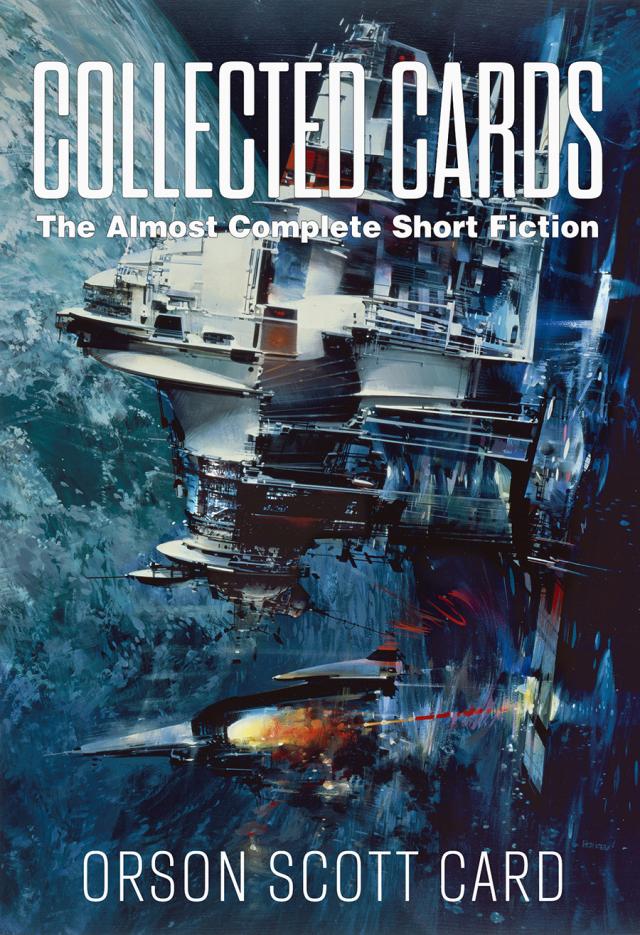
Collected cards the almo.., p.343
Collected Cards: The Almost Complete Short Fiction,
p.343


The months of the voyage passed quickly enough, because they were all so busy. Then . . . rapid deceleration, protected from inertia by technology acquired from the formics. They were coming to the planet Shakespeare; for the colonists, this meant they were coming home.
Admiral Morgan had been in communication with the acting acting governor, Ix Tolo—ridiculous name—because the official acting governor had had the bad manners to take off on a completely meaningless trip right when he was needed for the official public transfer of power. The man probably couldn’t stand being displaced from his office. The vanity of some people.
Morgan’s executive officer, Commodore Vlad das Lagrimas, confirmed that, as far as could be ascertained from orbit, the runway the colonists had constructed for the shuttle met the specifications. Thank heaven they didn’t have to pave these things anymore—it must have been tedious in the days when flying vehicles had to land on wheels.
The only thing that worried Morgan was bringing the Wiggin boy down with him for the first landing. It would be easy enough to tell the original settlers that Morgan was coming ahead of Wiggin to prepare the way. That would give him plenty of chance to make sure they were aware that Wiggin was a teenage boy and hardly likely to be the real governor.
Dorabella agreed with him. But then she pointed out, “Of course, all the older people in this colony are the pilots and soldiers who fought under Ender’s command. They might be disappointed not to see him. But no, it will make it all the more special when he comes down later.”
Morgan thought about it and decided that having Wiggin with him might be more of an asset than not. Let them see the legendary boy. Which was why he called the Wiggin boy to his quarters.
“I don’t know that you need to say anything to the colonists on this first occasion,” said Admiral Morgan. This was the test—would Wiggin be miffed at being held in silence?
“Fine with me,” said Wiggin instantly. “Because I’m not good at speeches.”
“Excellent,” said Morgan. “We’ll have marines there in case these people are planning some sort of resistance—you never know, all their cooperation might be a ruse. Four decades on their own here—they might resent the imposition of authority from forty lightyears away.”
Wiggin looked serious. “I never thought of that. Do you really think they might rebel?”
“No, I don’t,” said Morgan. “But a good commander prepares for everything. You’ll acquire habits like that in time, I’m sure.”
Wiggin sighed. “There’s so much stuff to learn.”
“When we get there, we’ll put the ramp down at once and the marines will secure the immediate perimeter. When the people have assembled around the base of the ramp, then we’ll come out. I’ll introduce you, I’ll say a few words, then you’ll go back inside the shuttle until I can secure appropriate quarters for you in the settlement.”
“Toguro,” said Wiggin.
“Oh, right.”
“Sorry. Battle School slang.”
“Oh, yes. Never went to Battle School myself.” Of course the little brat had to give his little reminder that he had gone to Battle School and Morgan had not. But his use of slang was encouraging. The more childish Wiggin appeared, the easier it would be to marginalize him.
“When can Valentine come down?”
“We won’t start bringing down the new colonists for several days. We have to make sure we do this in an orderly way—we don’t want to swamp the old settlers with too many new ones before there’s housing and food for them all. The same thing with supplies.”
“We’re going down empty-handed?” asked Wiggin, sounding surprised.
“Well, no, of course not,” said Morgan. He hadn’t thought of it that way. It would be a nice gesture to have some key supplies with them. “What do you think, some food? Chocolates?”
“They have better food than we do,” said Ender. “Fresh fruits and vegetables—that’s going to be their gift to us. I bet they’d go boky over the skimmers, though.”
“Skimmers! That’s serious technology.”
“Well, it’s not like they’re any use up here in the ship,” said Ender, laughing. “But some of the xeno equipment, then. Something to show them how much it’s going to help them, now that we’re here. I mean, if you’re worried they’ll resent us, giving them some really useful tech will make us heroes.”
“Of course—that’s what I was planning. I just didn’t think of the skimmers on our first landing.”
“Well, it’d sure help with carrying cargo to wherever it’s going to be warehoused. I know they’d appreciate not having to lug stuff by hand or in carts or whatever they use for transportation.”
“Excellent,” said Morgan. “You’re catching on to this leadership thing already.” The kid really was clever. And Morgan would be the one to reap the good will that bringing the skimmers and other high-tech equipment would create. He would have thought of all this himself if he ever had a chance to stop and think about things. The boy could sit around and think about things, but Morgan couldn’t afford the time. He was constantly on call, and though das Lagrimas handled most things well, Morgan also had to deal with Dorabella.
Not that she was demanding. In fact, she was amazingly supportive. He’d heard from other people that marriage was hellish. The honeymoon lasts a day, they said, and then she starts demanding, insisting, complaining.
All lies. If he had known marriage was like this, he’d have done it long ago. But maybe it was only like this with Dorabella. He was glad he had waited, to marry the one in a million who could make a man truly happy. Because he was besotted. He knew the men joked about it behind his back—he caught their smirks whenever he came back from a rendezvous with Dorabella for an hour or two in the middle of the working day. Let them have their laughs! It was all about envy.
“Sir?” asked Wiggin.
“Oh, yes,” said Morgan. It had happened again—in the middle of a conversation, he had drifted off into thinking about Dorabella. “I have a lot on my mind, and I think we’re through here. Just be in the shuttle at 0800—that’s when we’re closing the doors, everything loaded by the dawn watch. The descent will take several hours, the shuttle pilot tells me, but nobody will be able to sleep—you’ll want to get to bed early tonight so you’re well rested. And it’s better to enter the atmosphere on an empty stomach, if you know what I mean.”
“Yes sir,” said Wiggin.
“Dismissed, then,” said Morgan.
Wiggin saluted and left. Morgan almost laughed out loud. The kid didn’t realize that even on Morgan’s ship, Wiggin’s seniority as a Rear Admiral entitled him to courtesies, including the right to leave when he felt like it instead of being dismissed like a subordinate. But it was good to keep the boy in his place. Just because he had the office of admiral bestowed on him before Morgan actually earned his didn’t mean Morgan had to pretend to show respect to an ignorant teenager.
Wiggin was in his place before Morgan got there, dressed in civilian clothes instead of military uniform—which was all to the good, since it would not be helpful for people to see that they had identical dress uniforms and rank insignias, while Ender had markedly more battle decorations. Morgan merely nodded to Wiggin and went to his own seat, in the front of the shuttle with a communications array at his disposal.
At first the shuttle flight was normal space travel—smooth, perfectly controlled. But as they orbited the planet and then dipped down into their point of entry, the shuttle reoriented itself to have the shield meet and dissipate the heat, which is when the bouncing and yawing and rolling began. As the pilot told him beforehand, “Roll and yaw mean nothing. If we start to pitch, then we’ve got problems.”
Morgan found himself quite nauseated by the time they steadied out into smooth flight at ten thousand meters. But poor Wiggin—the boy practically flew back to the head, where he was no doubt retching his poor head off. Unless the kid had forgotten not to eat and really had something to puke up.
The landing went smoothly, but Wiggin hadn’t returned to his seat—he took the landing in the head. And when the marines reported that the people were gathering, Wiggin was still inside.
Morgan went to the door of the head himself and rapped on it. “Wiggin,” he said, “it’s time.”
“Just a few more minutes, sir,” said Wiggin. His voice sounded weak and shaky. “Really. Looking at the skimmers will keep them busy for a few minutes, and then they’ll meet us with a cheer.”
It hadn’t crossed Morgan’s mind to send the skimmers out ahead of his own entrance, but Wiggin was right. If the people had already seen something wonderful from Earth technology, it would make them all the more enthusiastic when he came out himself. “They can’t watch the skimmers forever, Wiggin,” said Morgan. “When it’s time to go out, I hope you’re ready to join me.”
“I will,” said Wiggin. But then another retching sound gave the lie to that statement.
Of course, retching sounds could be made with or without nausea. Morgan had a momentary suspicion and so he acted on it, opening the door without any warning.
There was Wiggin, kneeling in front of the john, his belly convulsing as his body arched with another retch. He had his jacket and shirt off, tossed on the floor near the door—at least the kid had thought ahead and arranged not to get vomit on his suit. “Anything I can do to help?” asked Morgan.
Wiggin looked at him, his face a mask of barely-controlled nausea. “I can’t keep this up forever,” he said weakly, managing a faint smile. “I’ll be fine in a minute.”
And then he turned his face toward the bowl again. Morgan closed the door and suppressed a smile. So much for any worries that the kid might not cooperate. Wiggin was going to miss his own grand entrance, and it wasn’t even going to be Morgan’s fault.
Sure enough, the midshipman he sent for Wiggin returned with a message, not the boy. “He says he’ll come out as soon as he can.”
Morgan toyed with sending back word that he was not going to have Wiggin’s late arrival distract from his own speech. But no, he could afford to be magnanimous. Besides, it didn’t look as if Wiggin would be ready any time soon.
The air of Shakespeare was pleasant but strange; there was a light breeze, and it carried some kind of pollen on it. Morgan was quite aware that just by breathing, he might be poisoning himself with the blood-sucking worm that almost killed this colony at the start, but they had treatments for it, and they’d get their first dose in plenty of time. So he savored the smell of planetside air for the first time in ages—he had last been on Earth six years before this voyage began.
In the middle distance, the scenery was savannah-like—trees dotting the landscape here and there, lots of bushes. But on either side of the runway, there were crops growing, and he realized that the only way they could accommodate the runway was in the midst of their fields. They had to resent that—it was a good thing he had thought of sending out the skimmers first, to take their minds off the damage their landing had done to the crops.
The people were surprisingly numerous. He vaguely remembered that the hundreds in the original invasion force would now be more than two thousand, since they’d been reproducing like rabbits, even with the relatively few women in the original force.
What mattered most was that they were applauding when he came out. Their applause might be more for the skimmers than for him, but he was content with that, as long as there was no resistance.
His aides had set up a public address system, but Morgan didn’t think they’d need it. The crowd was numerous, but many of them were children, and were so crowded together that from the top of the ramp they were all within easy hailing distance. Still, now that the lectern had been set up, it would look foolish of Morgan not to use it. So he strode to it and gripped it with both hands.
“Men and women of Shakespeare colony, I bring the greetings of the International Fleet and the Ministry of Colonization.”
He had expected applause for that, but . . . nothing.
“I am Rear Admiral Quincy Morgan, the captain of the ship that brought the new colonists, and new equipment and supplies, to your settlement.”
Again, nothing. Oh, they were attentive, and not at all hostile, but they only nodded, and only a few of them. As if they were waiting. Waiting for what?
Waiting for Wiggin. The thought came to him like bile into his throat. They know that Wiggin is supposed to be their governor, and they’re waiting for him.
Well, they’ll find out soon enough just what Wiggin is—and isn’t.
Then Morgan heard the sound of running footfalls from inside the shuttle and coming out onto the ramp. Wiggin couldn’t have timed it better. This really would go more smoothly with him for the crowd to look at.
The crowd’s attention shifted toward Wiggin, and Morgan smiled. “I give you . . .”
But they didn’t hear his answer. They knew who it was. The applause and shouting overpowered Morgan’s voice, even with the amplification, and he did not need to say Wiggin’s name, because the crowd was shouting it.
Morgan turned to give a welcoming gesture to the boy, and was shocked to see that Wiggin was in full dress uniform. His decorations were almost obscenely vast—dwarfing anything on Morgan’s chest. It was so ridiculous—Wiggin had been playing videogames, for all he knew, and here he was wearing decorations for every battle in the war, along with all the other medals he was given after his victory.
And the little bastard had deliberately deceived him. Wearing civilian clothes, and then changing in the bathroom, just so he could upstage him. Was the nausea all faked, too, so that he could make this grand entrance? Well, Morgan would wear a phony smile and then he’d make the kid pay for this later. Maybe he wouldn’t keep Wiggin as a figurehead after all.
But Wiggin didn’t go to the place that Morgan was gesturing him to take at his side, behind the lectern. Instead, Wiggin handed a folded piece of paper to Morgan and then jogged on down the ramp to the ground—where he was immediately surrounded by the crowd, their shouts of “Ender Wiggin!” now giving way to chatter and laughter.
Morgan looked at the paper. On the outside, in pencil, Wiggin had written: “Your supremacy ended when this shuttle touched ground. Your authority ends at the bottom of this ramp.” And he signed it, “Admiral Wiggin”—reminding him that in port, Wiggin was senior to him.
The gall of the boy. Did he think such claims would hold up here, forty years away from any higher authority? And when it was Morgan who commanded a contingent of highly trained marines?
Morgan unfolded the paper. It was a letter. From Polemarch Bakossi Wuri and Minister of Colonization Hyrum Graff.
Ender recognized Ix Tolo immediately, from the late Governor Kolmogorov’s description of him, and ran right up to him. “Ix Tolo,” he shouted as he came. “I’m glad to meet you!”
But even before he reached Tolo and shook his hand, Ender was looking for old men and women. Most of them were surrounded by younger people, but Ender sought them out and tried to recognize the younger faces he had studied and memorized before this voyage even launched.
Fortunately, he guessed right about the first one, and the second one, calling them by rank and name. He made it solemn, that first meeting with the pilots who had actually fought in the war. “I’m proud to meet you at last,” he said. “It’s been a long wait.”
At once the crowd caught on to what he was doing, and backed away, thrusting the old people forward so Ender could find them all. Many of them wept as they shook Ender’s hands; some of the old women insisted on hugging him. They tried to speak to him, to tell him things, but he smiled and held up a hand, signaling, Wait a minute, there are more to greet.
He shook every soldier’s hand, and when he occasionally guessed at the wrong name, they laughingly corrected him.
Behind him, there was still silence from the loudspeakers. Ender had no idea what Morgan would do about the letter, but he had to keep things moving forward here on the ground, so there was never a gap in which Morgan could insert himself.
The moment he had shaken the last old man’s hand, Ender raised that hand up and then turned around, signaling for the people to gather around him. They did—in fact, they already had, so he was now completely surrounded by the crowd. “There are names I didn’t get to call,” he said. “Men and women I didn’t get to meet.” Then, from memory, he spoke the names of all those who had died in the battle. “Too many lost. If only I had known what price was being paid for my mistakes, maybe I could have made fewer of them.”
Oh, they wept at that, even as some of them called out, “What mistakes!”
And then Ender reeled off another list of names—the colonists who had died in those first weeks of the settlement. “By their deaths, by your heroic efforts, this colony was established. Governor Kolmogorov told me about how you lived, what you accomplished. I was still a twelve-year-old boy on Eros when you were fighting the war against the diseases of this land, and you triumphed without any help from me.”
Ender raised his hands to face level and clapped them, loudly and solemnly. “I honor those who died in space, and those who died here.”
They cheered.
“I honor Vitaly Kolmogorov, who led you for thirty-six years of war and peace!” Another cheer. “And Sel Menach, a man so modest he could not bear to face the attention he knew would be paid to him today!” Cheers and laughter. “Sel Menach, who will teach me everything I need to know in order to serve you. Because I’m here, he will now have time to get back to his real work.” A roar of laughter, and a cheer.
And now, from the back of the crowd, from the loudspeakers, came the sound of Morgan’s voice. “Men and women of Shakespeare Colony, please forgive the interruption. This was not how the program for today was supposed to go.”
The people around Ender glanced in puzzlement toward the top of the ramp. Morgan was speaking in a pleasant, perhaps jocular tone. But he was irrelevant to what had just been happening. He was an intruder in this ceremony. Didn’t he see that Ender Wiggin was a victorious commander meeting with his veterans? What did Quincy Morgan have to do with that?