Collected cards the almo.., p.239
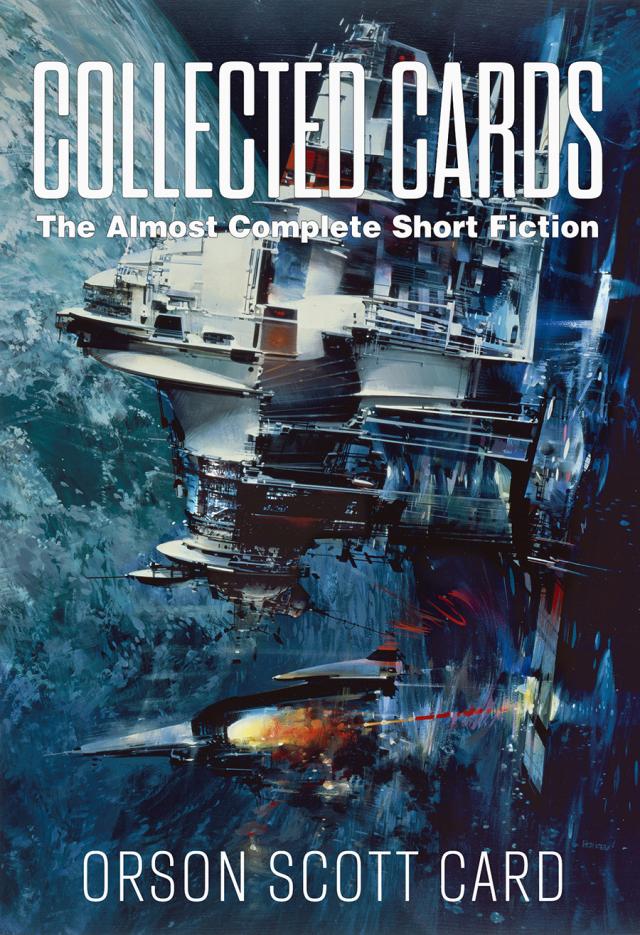
Collected Cards: The Almost Complete Short Fiction,
p.239


She sighed. “Oh, why am I telling you this?”
“Because I saw the newspaper.”
“Because when you saw the newspaper, you were embarrassed but you were not surprised, not shocked when it disappeared. You’ve been seeing things yourself lately, haven’t you?”
So he told her what he’d told no other person, about Selena and Baby Di, about how he kept just missing them. By the end she was nodding.
“Oh, I knew it,” she said. “That’s why you could see the paper. Because the wall between worlds is as thin for you as it is for me.”
“I’m not crazy?” he asked, laughing nervously.
“How should I know?” she said. “But we both saw that paper. And it’s not just us. My kids, too. See, the—what do we call it? haunting? evidences?—it didn’t start till they were grown up and gone. Barry Lear was busy having his stroke and getting downright eager to shed his old body, and I was taking care of him best I could, and all of a sudden I start hearing the radio playing music that my first husband and I used to dance to, big band sounds. And those newspapers, that paperboy, just like it was 1948, the year we were happiest, the summer when I got pregnant, before the baby miscarried and our hearts broke and just before Christmas he found out about the cancer. As if he could feel Barry getting set to leave my life, and Tonio was coming back.”
“And your kids know?”
“You have to understand, Barry provided for us, he never hit anybody or yelled. But he was a completely absent father, even when he was home. The kids were so hungry for a dad, even grown up and moved away they still wanted one, so when they came home for their father’s funeral, all three of them saw the same things I was seeing. And when I told them it was happening before Barry died, that it was Tonio, the man who wasn’t their father but wanted so badly to be, the man who would have been there for them no matter what, if God hadn’t taken him so young—well, they adopted him. They call him their ghost.”
She smiled but tears ran down her cheeks. “That’s what he came home for, Tonio, I mean. For my boys. He couldn’t do it while Barry was here, but as Barry faded, he could come. And now the boys return, they see his coffee cup in the dish drain, they smell his hair oil in the bathroom, they see the newspapers, hear the radio. And they sit there in the living room and they talk. To me, yes, of course, but also to him, telling him about their lives, believing—knowing—that he’s listening to them. That he really cares, he loves them, and the only reason they can’t see him is because he just stepped out, they only just missed him, he’s bound to be in the next room, he can hear every word they say.”
Tim nodded. Yes, that’s how it was. Just how it was.
“But he’s fading now.” She nodded. “They don’t need him so much. The hole in their lives is filled now.” She nodded again. “And in mine. The love of my life. We had unfinished business, you see. Things not done.”
“So why did I see it? The paperboy, the newspaper—I never knew Tonio, I’m not one of your sons.”
“Because you live like I do, on the edge of the other side, seeing in. Because you have unfinished business, too.”
“But I can never finish it now,” he said.
“Can’t you?” she answered. “I married Barry. I had my boys. Then Tonio came back and gave them the last thing they needed. You, now. You could marry, you know. Have more children. Fill that house with life and love again. Your wife and baby, they’ll step back, like Tonio did. But they won’t be gone. Someday maybe you’ll be alone again. Big empty house. And they’ll come back. Don’t you think? Selena—such a lovely name—and your baby Diana. Just in the next room. Around you all the time. Reminding you when you were young. Only by then Diana might not need to be a baby anymore. It won’t be toys she leaves around, it’ll be school-books. Hairbrushes. And the long hairs you find on your pillow won’t be Selena’s color anymore. It’ll be grey. Or white.”
He hadn’t told her about still finding Selena’s hair. She simply knew.
“You can go on with your life without letting go,” said Wanda. “Because you don’t really lose them. They’re just out of reach. I look around Greensboro and I wonder, how many other houses are like mine? Haunted by love, by unfinished love. And sometimes I think, Tonio isn’t haunting us, we’re the ones who are haunting him. Calling him back. And because he loves us, he comes. Until we don’t really need him anymore.”
They talked a little more, and Tim went home, and everything was different, and everything was gloriously the same. It wasn’t madness anymore. They really were just out of reach, he really had just missed them. They were still in the house with him, still in his life.
And, knowing that, believing it now, he could go on. He visited Wanda a couple of times a week. Got to know each of her sons on their visits. Became friends with them. When Wanda passed away, he sat with the family at the funeral.
Tim went back to work, not at the company where he and Selena had met, but in a new place, with new people. Eventually he married, they had children, and just as Wanda had said, Selena and Diana faded, but never completely. There would be a book left open somewhere, one that nobody in the house was reading. There would be a whiff of a strange perfume, the sound of someone humming a tune that hadn’t been current for years.
Right along with his new family, he knew that Diana was growing up, in a house full of siblings who knew about her, loved the stories of her childhood that he told, and who came to him, one by one, as the years passed, to tell him privately that once or twice in their childhood, they had seen her, the older sister who came to them during a nightmare and comforted them, who whispered love to them when friends at school had broken their hearts, whose gentle hand on their shoulder had calmed them and given them courage.
And the smiling mother who wasn’t their mother but there she was in the doorway, just once, just a fleeting glimpse. Selena, looking at the children she had never given birth to but who were still hers, partly hers, because they were his, and he would always be a part of her even though he loved another woman now and shared his life with her.
Sometime, somewhere down the road, his life would draw to a close and he would see them again, face to face, his family, his first family, waiting for him as Tonio had waited for Wanda all those years. He could wait. There was no hurry. They were only moments out of reach.
NOTES ON “MISSED”
I can’t remember now if the local paper asked me for a Halloween story—I think they did, but it might be that I’m conflating this story with a multi-author serial that the same newspaper put together a few years later. It might be that I came up with the idea, called them, and asked if they would consider running a piece of scary fiction and, if so, how long it ought to be.
Whether they initiated it or I did, the result was this story, set in a specific neighborhood. In fact, the house where Tim finds the newspaper is the home of our friends the Jensens. If you can’t tip your hat to friends or family now and then, what’s the fun of being a fiction writer?
I began this story frivolously enough. It was a lark; write a newspaper horror story for Halloween.
But it turned serious almost at once. I had only just started running. After our last child, Erin Louisa, died on the day she was born, I had suddenly come face to face with mortality. People I loved could die. I could die—and at the weight I was carrying at the time, I probably would, sooner rather than later. I got serious about getting my body under control and started exercising. I never became the kind of runner Tim was—but I knew something about what it felt like, to run.
And so I suppose it wasn’t just coincidence that I made this a story about the worst thing in the world—to have a family and lose it. It was what I was going through at the time, in a very small way. And things like that, things from real life, are going to show up even in the “frivolous” fictions of a writer who’s just doing something for the fun of it.
Heal Thyself
There’s a limit to how much you can shield your children from the harsh realities of life. But you can’t blame parents who try Especially when it’s something you have to go out of your way to discuss.
My parents assure me that they would have talked about it someday, but it’s not like the birds and the bees—there’s not a certain age when you have to know. They were letting it slide. I was a curious kid. I had already asked questions that could have led there. They dodged. They waffled. I understand.
But then my childhood friend, Elizio, died of complications from his leukemia vaccination. I had been given mine on the same day, right after him, after jostling in line for twenty minutes with the rest of our class of ten-year-olds. Nobody else got sick. We didn’t know anything was wrong with Elizio, either, not for months. And then the radiation and the chemotherapy, primitive holdovers from an era when medicine was almost indistinguishable from the tortures of the Inquisition. Nothing worked. Elizio died. He was eleven by then. A slow passage into the grave. And I demanded to know why.
They started to talk about God, but I told them I knew about heaven and I wasn’t worried about Elizio’s soul, I wanted to know why there wasn’t some better way to prevent diseases than infecting us with semikilled pseudo-viruses mixed with antigen stimulants. Was this the best the human race could do? Didn’t God give us brains so we could solve these things? Oh, I was full of righteous wrath.
That was when they told me that it was time for me to take a trip to the North American Wild Animal Park. What did that have to do with my question? It will all become clear, they said. But I should see with my own eyes. Thus they turned from telling me nothing to telling me everything. Were they wise? I know this much: I was angry at the universe, a deep anger that was born of fear. My dear friend Elizio had been taken from me because our medicine was so primitive. Therefore anyone could die. My parents. My little sisters. My own children someday. Nothing was secure. And it pissed me off. The way I felt, the way I was acting, I think they felt that nothing but a complete answer, a visual experience, could restore my sense that this was, if not a perfect world, then at least the best one possible.
We left Saltillo that weekend, taking the high-speed train that connected Monterrey to Los Angeles. We got off in El Paso, the southern gateway to the Park. During the half-hour trip, I tried to make sense of the brochures about the Park, all the pictures, the guidebooks. But it was clear to me, even at the age of eleven, that something was being left out. That I was getting the child’s version of what the Park contained. For all that the brochures described was a vast tract of savannahs, filled with wild animals living in their natural habitat, though it was an odd mixture of African, South American, European, and American fauna that they pictured. Of course, to protect the animals against the dangers of straying and the far greater menace of poaching, the Park was fenced about with an impenetrable barrier—not illustrated—of fences, ditches, wires, walls. The thing that made no sense at all, however, was the warning about absolute bio-security. All observations of the Park inside the boundaries were to take place from within completely bio-sealed buses, and anyone who tried to circumvent the bio-seal would be ejected from the Park and prosecuted. They did not say what would happen to anyone who succeeded in getting out into the open air.
Bio-sealed buses suggested a serious biohazard. And yet there was nothing in the brochures to suggest what that biohazard might be. It’s not as if herds of bison could sneak onto the buses if you cracked the seal.
The answer to this mystery was no doubt the answer to my question about why Elizio died, and I impatiently demanded that my parents explain.
They urged me to be patient, and then took me right past the regular buses and on to a nondescript door with the words—in small letters—“Special Tours.”
“What’s so special?” I asked.
They ignored me. The clerk seemed to know without explanation exactly what it was my parents wanted. Then I understood that my parents must have called ahead.
It was a private tour. And not on a bus. We were taken down an elevator into a deep basement, and then put aboard a train on which we rode for more than an hour—longer than the trip from Saltillo to El Paso, though I suspect we were going much slower. Underground, who can tell?
We came up another elevator, and like the underground train, this one had no trappings of tourism. This was a place where people worked; gawking was only a secondary concern.
We were led by a slightly impatient-looking woman to a smallish room with windows on four sides and dozens of sets of binoculars in a couple of boxes. There were also chairs, some stacked, some scattered about almost randomly. As if someone hadn’t bothered to straighten up after a meeting.
“Are they close?” asked Mother.
“We’re here because the water is nearby,” said the woman. “If they aren’t close now, they will be soon.”
“Where’s the water?” asked Father.
The woman pointed vaguely in a direction. It was clear she didn’t want us there. But Mother and Father had the gift of patience. They were here for me, and bore the disdain of the scientist. If that’s what she was.
The woman went away.
My parents picked up binoculars and searched. I also picked out a set and tried to figure out how to focus it.
“It senses your vision automatically,” Father explained. “Just look and it will come into focus.”
“Bacana,” I said. I looked.
There was a lot of dry grassy land, interspersed with drier, sagebrushy land. In one direction there were some trees. That must be where the water was.
“Spotted them yet?” Mother asked.
“To the left of the trees?” asked Father.
“There, too?”
“Where did you see them?”
“In the shade of that rock.”
I searched and finally found what they were looking at.
Men and women. Long-haired. Filthy. Naked.
My strait-laced parents brought me here to see naked people?
Then I looked again, more closely. They weren’t exactly people after all.
“Neanderthals,” I said.
“Homo neanderthalensis, ” said Father.
“They’ve been extinct forever!”
“For about twenty thousand years, most conservative guess,” said Father. “Maybe longer.”
“But there they are,” I said.
“There was a long debate,” said Father. “About how the neanderthals died out.”
“I thought that Homo sapiens wiped them out.”
“It wasn’t so simple. There was plain evidence of communities of sapiens and neanderthalensis living in close proximity for centuries. It wasn’t just a case of kill-the-monsters. So there were several theories. One was that the two species interbred, but neanderthal traits were disprized to such a degree that they faded out. Like round eyes in China.”
“How could they interbreed?” I asked. I was proud of my scientific erudition, as only eleven-year-olds can be. “Look at how different they are from humans.”
“Not so different,” said Mother. “They had rudimentary language. Not the complicated grammars we have now—basically just imperative verbs and labeling nouns. But they could call out to each other across a large expanse and give warning. They could greet each other by name.”
“I was talking about how they look.”
“But I was talking about brain function,” said Mother. “Which is much more to the point, don’t you think?”
“Another theory,” said Father, “was that Homo sapiens evolved from the neanderthals. That one was discredited and then revived several times. It turns out it was the closest one to being right.”
“You know, none of this explains why there are neanderthals out here in the North American Wild Animal Park.”
“You surprise me, son,” said my father. “I thought you would have leapt to at least some conclusion. Instead you seem to be passively awaiting our explanation.”
I hated it when Father patronized me. He knew that, so he did it whenever he wanted to goad me into thinking. It always worked. I hated that, too.
“You brought me here because of the way I reacted to Elizio’s death,” I said. “And because you’re famous scientists yourselves, you got to pull strings and get me a special tour. Not everybody sees this, right?”
“Actually, anybody can, but few want to,” said Father.
“And the biohazard stuff, that suggests some kind of disease agent. What you said about the evolved-from-neanderthals scenario being close to correct suggests—there’s some disease loose in the wild here that causes regular people to turn into cavemen?”
Father smiled wanly at Mother. “Smart boy,” he said.
I looked at Mother. She was crying.
“Just tell me,” I demanded. “No more guessing games.”
Father sighed and put his arm around Mother and began to talk. It didn’t take long to explain.
“The greatest breakthrough in the medical treatment of disease was the germ theory, but it took an astonishingly long time for doctors to realize that almost all human ailments were caused by infectious agents. A few were genetic—hemophilia, cystic fibrosis, sickle-cell anemia—but those all seemed to be recessive genes that conferred a benefit when you had one of them, and only killed you if you had two. All the others—heart disease, dementia, schizophrenia, strokes, nontraumatic cerebral palsy, multiple sclerosis, most cancers, even some crimes—all were actually diseases. What disguised them from researchers for so long was the fact that these diseases were passed along in the womb, across the placenta, mostly by disease agents composed of proteins smaller than DNA. Some were passed along in the ovum. So we had no way to compare a clean, healthy organism with an infected one until we finished mapping the human genetic code and realized that these diseases weren’t there. When we finally tracked them down as loose proteins in the cells, we—”
“We?” I asked.
“I speak of our forebears, of course,” said Father. “Our predecessors.”
“You aren’t in medical research.”