Collected cards the almo.., p.240
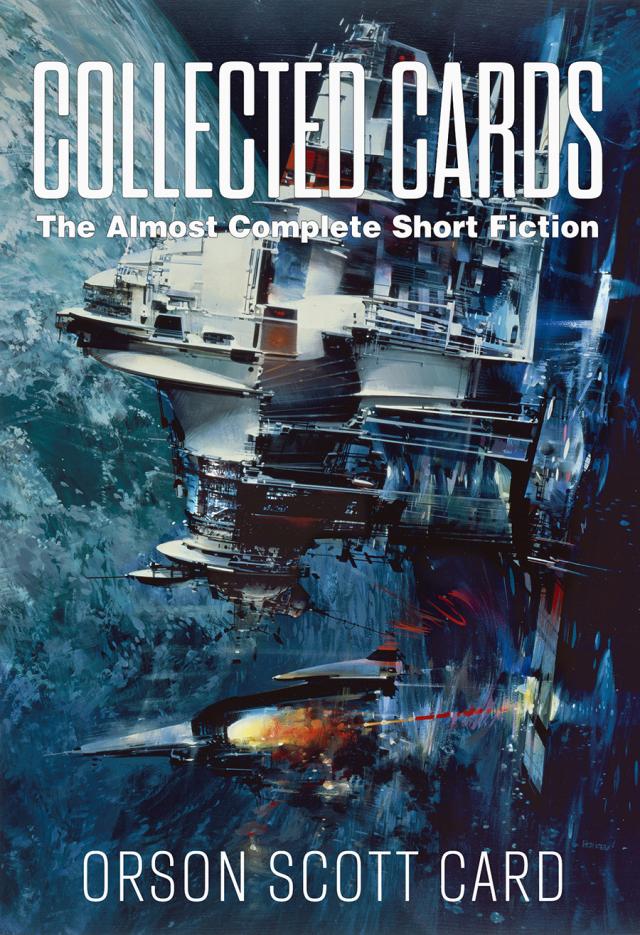
Collected Cards: The Almost Complete Short Fiction,
p.240


“Our colleagues in science,” said Father. “We’ve come a long way to have you quibble about my choice of pronouns. And anthropology is the science of which medicine is merely a subset.”
I had a snappy retort about how nobody ever asks if there’s an anthropologist in the house, but I kept it to myself, mostly because I didn’t want to win points here, I wanted to hear the story.
“How do you inoculate an organism against in-utero infection?” asked Mother rhetorically. “How do you cleanse an ovum that has already been infected?”
“What we developed,” Father began, then interrupted himself. “What was developed.”
“What emerged from the development process,” said Mother helpfully.
“Was,” said Father, “an elegant little counter-infection. Learning from the way these protein bits worked, the researchers came up with a protein complex that hijacked the cell’s DNA just the way these infectious agents did, only instead of slowly—or rapidly—destroying the host cell, our little counter-infection caused the human DNA to check aggressively inside the cell for proteins that didn’t belong there. There are already mechanisms that do bits and parts of that, but this one worked damn near perfectly. Nothing was in that cell that didn’t belong there. It even detected and threw out the wrong-handed proteins that caused spongiform encephalopathies.”
“Now you’re showing off, my love,” said Mother.
“It was perfect,” said Father. “And best of all, self-replicating yet nondestructive. Once you introduced it into a mother, it was in every egg in her body after a matter of days. Any child she bore would have this protection within it.”
“It was perfect,” said Mother. “The early tests showed that it not only prevented diseases, it cured all but the most advanced cases. It was the ultimate panacea.”
“But they hadn’t tested it for very long,” said Father.
“There was enormous pressure,” said Mother. “Not from outside, from inside the research community. When you have a cure for everything, how can you withhold it from the human race for ten years of longitudinal studies, while people die or have their lives wrecked by diseases that could be prevented with a simple inoculation.”
“It had side effects,” I said, guessing the end.
“Technically, no,” said Father. “It did exactly what it was supposed to do. It eradicated diseases with smaller-than-bacteria agents. Period. Nothing else. The only reason that they didn’t immediately spread the counter-infection throughout the world to save as many lives as possible was because of the one foreseeable hitch. Can you think of it? It’s obvious, really.”
I thought. I wish I could say I came up with it quickly, but my parents were nothing if not patient. And I did come up with it after a few false tries, which I can’t remember now. The correct answer: “Aging is a disease. You get this counter-infection, you don’t die.”
“We were concerned about a population explosion,” said Mother. “Even if people completely stopped having children, we weren’t sure that the existing ecosphere could sustain a population in which all the existing children grew up to be adults while none of the adults died off to make room for them. Imagine all the children entering the workforce, while the older generation, newly vigorous and extremely unlikely to die, refused to retire. It was a nightmare. So, by the mercy of God, the counterinfection was restricted to a large longitudinal study centered on Manhattan, a smallish college town in Kansas.”
“There was a quarantine, of sorts,” said Father. “The participants accepted the rules—no physical contact with anyone outside the city during the two years of the study. In exchange, nobody dies of any kind of disease. They jumped at it.”
“The counter-infection got loose!” I said.
“No. Everybody kept to the rules. This was science, not the movies,” said Father. “But in the Manhattan Project, as we inevitably called it, for the first time the test included infants, newborns, children born after the study began, children conceived after the study began. We were so interested in the result with the aging population that it had never crossed our minds that . . . well, it did cure aging. The people who have it would never die of old age. The trouble was, the children were born—”
“As neanderthals,” I said, making the obvious guess.
“And over time,” said Father, “as cells were replaced, the adult bodies also tried to reshape themselves. It was fatal for them. You can’t take an existing body and make it into something else like that. You had a few years of perfect health, and then your bones destroyed themselves in the frantic effort to grow into new shapes. The little ones, the ones who were changed in the womb, only they survived.”
“And that’s who I’m seeing out there,” I said.
“It took fifteen years to find a way to sterilize them all without our counter-infection undoing the sterilization. By then there were so many of them that to keep them all in their natural habitat required a vast reserve. It really wasn’t all that hard to get the citizens of this area to evacuate. Nobody wanted to be anywhere near Manhattan, Kansas. So once again, Homo neanderthalensis has a plot of ground here on Earth. Homo neanderthalensis, the most intelligent toolmaking species ever to evolve naturally.”
“But how could the counter-agent cause us to revert to an earlier stage of evolution?” I asked.
“You weren’t listening,” said Father.
I thought for a moment. “Homo neanderthalensis isn’t an earlier stage,” I said. “There was no more evolution after that.”
“Only a disease,” said Father.
It seemed too incredible to me, as an eleven-year-old who prided himself on understanding the world. “Human intelligence is an infection?”
“Passed from mother to child through the ovum,” said Mother. “By a disease agent that alters the DNA in order to replicate itself. We should have realized it from the fact that in-utero development recapitulates evolution, but there is no stage in which the fetus passes through a habiline form. We didn’t evolve past it. The DNA is hijacked and we are born prematurely, grossly deformed by the disease. Neotonous, erect-standing, language-mad, lacking in sense of smell, too feeble to survive on our own even as adults, in need of clothing and shelter and community to a degree that the neanderthals never were. But . . . smart.”
“So now,” said Father, “do you understand why medical science has to rely on inoculation to fight off cancer, so that a small percentage—far smaller than ever before in human history, but not zero—a small percentage dies? Elizio died because the only alternative we’ve found is for this race of perfectly healthy, immortal, dimwitted beings to inherit the Earth.”
I stood there for a long time in silence, watching the neanderthals, trying to see how their behavior was different from ours. In the years since then I have come to realize that there was no important difference. Being smarter hasn’t made us act any differently from the neanderthals. We make better tools. We have a longer, more thorough collective memory in the form of libraries. We can talk much more fluently about the things we do. But we still do basically the same things. We are neanderthals, at heart.
But I did not understand this at the time. I was, after all, only eleven. I had a much more practical—and heartless—question.
“Why do we keep this park at all?” I asked. “I mean, they’re going to live forever. And all the time they’re alive, they pose a danger of this counter-infection getting loose outside the fence. Why haven’t they all been killed and their bodies nuked or something so that the counteragent is eliminated?”
Mother looked appalled at my ruthlessness, but Father only patted her arm and said, “Of course he thought of that, my love.”
“But so young, to be so—”
“Practical?” prompted Father. “There was a long debate over exactly this issue, and it resurfaced from time to time, though not for decades now. The ones who argued for keeping the Park talked about the necessity of studying our ancestors, and some people talked about the rights of these citizens who, after all, can’t help their medical condition and have committed no crime, but it was all a smokescreen. The real reason we didn’t destroy them all, as you suggested, was because we didn’t have the heart.”
“They were our children,” said Mother, crying again.
“At first,” said Father. “And later, when they weren’t children anymore, we still couldn’t kill them. Because they had become our ancient parents.”
Now, though, I have come to think that while they were both right, the answer is even deeper. We didn’t kill them, and we continue not to kill them, despite the reality of all those dangers, because they are not “they” at all. There, but for the fact that we happen to be the tiniest bit ill, go we.
I had troubling dreams for months afterward. I had mood swings, alternating between aggression and despair. There were times when my parents wished they had just answered my questions about Elizio by taking me to the priest and getting me on the roster of altar boys.
But they were not wrong to take me there, any more than they had been wrong not to tell me up till then. I needed to know before my education was complete. Those who do not know, who continue through adulthood oblivious, in a sense remain children, forever naive. Within the fence of the North American Wild Animal Park is the Garden of Eden, and the people there eat freely of the Tree of Life. Here, outside, in this world of thorns, we dwell in the Valley of the Shadow of Death, madly eating of the fruit of the Tree of Knowledge, as much of it as we can get before we die.
You cannot straddle the boundary. If you bring children into the world on this side of the fence, you must take them to eat the fruit of the tree—not too young, not before they’re able to bear it. But don’t wait too long, either. Let them see, before you die, that death is truly the gift of a merciful God.
Vessel
Most people who read Orson Scott Card’s stories don’t forget them—tales like Ender’s Game, “Dogwalker and the Alvin Maker stories tend to leave an indelible impression. Mr. Card’s last work of fiction to appear here was “Lost Boys” a decade ago, and some people are still talking about that one. Many of you will also recall that he contributed our “Books to Look for” column for several years before passing it on to Charles de Lint. Most of his recent works are novels, including two new ones this year: Enchantment and Ender’s Shadow. We also expect that his latest fantasy, a picture book for adults entitled Magic Mirror, will be released in October.
“Vessel” takes us to North Carolina for an affecting look at family relations. This story was published last year in Spanish and Catalan translations in the magazines BEM and Nexus, respectively. We’re delighted to bring you the first English-language publication of it.
PAULIE HARDLY KNEW HIS cousins before that first family reunion in the mountains of North Carolina, and within about three hours he didn’t want to know them any better. Because his mom was the youngest and she had married late, almost all the cousins were a lot older than Paulie and he didn’t hit it off very well with the two that were his age, Celie and Deckie.
Celie, the girl cousin, only wanted to talk about her beautiful Arabians and how much fun she would have had if her mother had let her bring them up into the mountains, to which Paulie finally said, “It would have been a real hoot to watch you get knocked out of the saddle by a low branch,” whereupon Celie gave him her best rich-girl freeze-out look and walked away. Paulie couldn’t resist whinnying as she went.
This happened within about fifteen minutes of Paulie’s arrival at the mountain cabin that Aunt Rosie had borrowed from a rich guy in the Virginia Democratic Party organization who owed her about a thousand big favors, as she liked to brag. “Let’s just say that his road construction business depended on some words whispered into the right ears.”
When she said that, Paulie was close enough to his parents to hear his father whisper to his mother, “I’ll bet the left ears were lying on cheap motel pillows at the time.” Mother jabbed him and Father grinned. Paulie didn’t like the nastiness in Father’s smile. It was the look that Grappaw always called “Mubbie’s shit-eatin’ smile.” Grappaw was Father’s father, and the only living soul who dared to call Father by that stupid baby nickname. In his mind, though, Paulie liked to think of Father that way. Mubbie Mubbie Mubbie.
Late in the afternoon Uncle Howie and Aunt Sissie showed up, driving a BMW and laughing about how much it would cost to get rid of the scratches from the underbrush that crowded the dirt road to the cabin. They always laughed when they talked about how much things cost; Mubbie said that was because laughing made people think they didn’t care. “But they’re always talking about it, you can bet.” It was true. They hadn’t been five minutes out of the car before they were talking about how expensive their trip to Bermuda had been ha-ha-ha and how much it was costing to put little Deckie into the finest prep school in Atlanta ha-ha-ha and how the boat salesmen insisted on calling thirty-footers “yachts” so they could triple the price but you just have to grit your teeth and pay their thieves’ toll ha-ha-ha like the three billy goats gruff ha-ha-ha.
Then they went on about how their two older children were so busy at Harvard and some Wall Street firm that they just couldn’t tear themselves away but they brought Deckie their little accident ha-ha-ha and they just bet that he and Paulie would be good friends.
Deckie was suntanned to the edge of skin cancer, so Paulie’s first words to him were, “What, are you trying to be black?”
“I play tennis.”
“Under a sunlamp?”
“I tan real dark.” Deckie looked faintly bored, as though he had to answer these stupid questions all the time but he had been raised to be polite.
“Deckie? What’s that short for? Or are you named after the floor on a yacht?” Paulie thought he was joking, like old friends joke with each other, but Deckie seemed to take umbrage.
“Deckie is short for Derek. My friends call me Deck.”
“Are you sure they aren’t calling you duck?” Paulie laughed and then wished he hadn’t. Deckie’s eyes glazed over and he began looking toward the house. Paulie didn’t want him to walk off the way Celie had. Deckie was two years older than Paulie, and it was the important two years. Puberty had put about a foot of height on him and he was lean and athletic and his moves were languid and Paulie wanted more than anything to be just like Deckie instead of being a medium-height medium-strong medium-smart freckled twelve-year-old nothing.
So naturally he tried to cover up his stupid duck joke with an even lamer one. “Have you noticed how everybody in the family has a nickname that ends with ie?” Paulie said. “They might as well hyphenate that into the family name. You’d be Deck Ie-Bride, and Celie would be Ceel Ie-Caswell.”
Deckie smiled faintly. “And you’d be Paul Ie-Asshole.”
Paulie stood there blushing, flustered, until he finally realized that this was not a friendly joke, this was Deckie letting him know that he didn’t exist. So Paulie turned and walked away from Deckie. Did Celie feel like this when she walked away from me? If she did then I’m a rotten shit to make somebody else feel like this. Why can’t I just keep my mouth shut? Other people keep their mouths shut.
Later he saw Deckie and Celie hanging around together, laughing until tears ran down Celie’s face. He knew they were talking about him. Or if they weren’t they might as well be. That was the kind of laughter that never included Paulie, not at school, not at home, not here at this stupid family reunion in this stupid forty-room mansion that some stupid rich person called a “cabin.” Whenever people laughed in real friendship, close to each other, bound by affection or mutual respect or whatever it was, Paulie felt it like a knife in his heart. Not because he was particularly lonely. He liked being alone and other people made him nervous so it wasn’t like he suffered. It hurt him because it was exactly the way people were with Mubbie. Nobody liked him and he still kept joking with them as if they were friends, even Mother, she didn’t like him either, any idiot could see that, they were probably staying together for the sake of “the child,” which was Paulie of course. Or rather Mother was staying for Paulie’s sake, and Mubbie was staying for Mother’s money, which was always useful for tiding him over between sales jobs, which Mubbie always joked his way into losing after having piled up an impressive record of lost sales and mishandled contracts. I’m just like him, Paulie thought. I joke like him, I make enemies like him, people sneer at me behind my back the way they do with him, only I’m not even studly enough to get a rich babe like Mom to bail me through all the screw-ups that lie ahead of me in life.
If I could just learn to keep my mouth shut.
He even tried it for the next couple of hours, being absolutely silent, saying nothing to anybody. But of course the moment he wanted to shut up, that was when all the aunts and uncles and the older cousins had to come up and pretend to care about him. No doubt Mother had noticed that Paulie was by himself and told them to go include Paulie. People did what Mother said, even her older brothers and sisters. She just had a way of making suggestions that people started following before they even had a chance to think about whether they wanted to. So when Paulie tried to get by with nods and smiles, he kept hearing, “Cat got your tongue?” and “You can’t be that shy” and even “You got something you shouldn’t in your mouth, boy?” to which Paulie thought of about five funny answers, one of which wasn’t even obscene, but at least he managed not to say them out loud and completely scandalize everybody and make himself the humiliated goat of the whole reunion, with Mother apologizing to everybody and saying, “I can assure you he wasn’t raised that way,” so that everybody understood that he got his ugly way of talking from Mubbie’s side of the family. Of course, Mother would no doubt end up saying that sometime before the week was over, but maybe Paulie would get through the first day without having to hear it.
Dinner was bad. The dining room table was huge, but not big enough for everybody. Naturally, they had to have Nana, Mother’s grandmother, at the table, even though she was so gaga that she had to be spoonfed some poisonously bland gruel and never seemed to understand anything going on around her. Why didn’t they send her to the second table with the little children of some of the older cousins, nasty little brats with no manners at all and a way of whining that made Paulie want to insert silverware really far down their throats? But no, that was Paulie’s place.